Financial Planning

When the Ram Touches the Wall

Article #473

Picture the young family who’ve saved for years. They pay the builder their deposit, the framing goes up, and then the phone stops being answered. The company’s in liquidation. The director walks away, the guarantee dies with the business, and they’re left with a half-built home and almost no recourse. 

That collapse has a second victim you don’t see – the honest builder down the road who quoted the job properly, priced in his tax, and lost the work to a rival who never intended to pay his way. 

The idea of walking away from your debts is as old as commerce itself. The Romans had a grim phrase, murum aries attigit – the ram has touched the wall. A battering ram was tipped with a heavy bronze or iron ram’s head, and once that head struck the city wall, the defenders could expect no mercy under the customs of war – the siege was over, and quarter was no longer owed. The image was one of a point of no return. Yet modern commerce has inverted that ancient severity. The ram touches the wall, the debts fall due, and the aggressor strolls off to trade next week under a fresh name, the old company left as rubble for the creditors to pick over. 

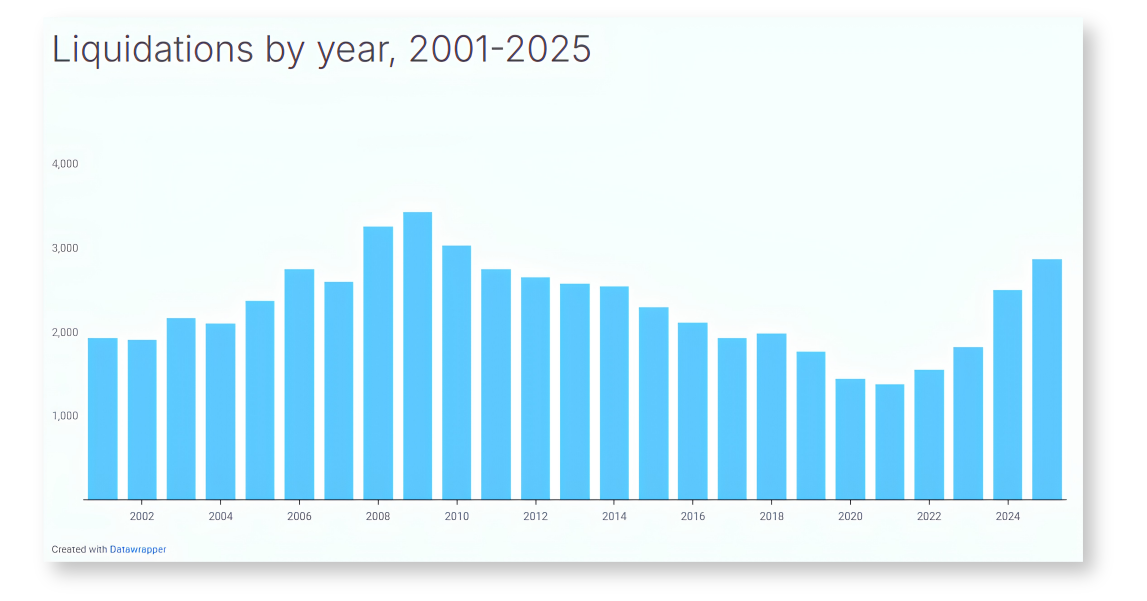
The numbers tell the story. Over 3,000 companies have gone into liquidation in the past year, leaving company failures at levels not seen for more than a decade. Construction still accounts for the largest share, with 764 liquidations; hospitality remains under pressure too, with 422 failures, up 42%. Inland Revenue is now the applicant behind roughly 70% of winding-up applications, as the leniency of the Covid years gives way to a long overdue reckoning. 

Source: Waterstone Insolvency

Here is the moral hazard. During Covid, the Labour government asked Inland Revenue to go easy, and at the time that was fair and humane. Businesses were shuttered by decree, cash flow evaporated overnight, and a temporary forbearance kept many good firms alive. But leniency without an end date breeds zombie firms – businesses trading on, not paying their GST or their PAYE, quietly undercutting the honest operator who cannot possibly compete with someone who simply isn’t paying their way. Audits went uncompleted for years, enforcement was paused, and the tax owed built quietly in the background like water behind a dam. 

And who ultimately foots that bill? You do. Every dollar of GST and PAYE that a ghost firm never pays is a dollar the honest taxpayer must cover, whether through higher taxes tomorrow or services forgone today. GST, remember, is money the firm has already collected from its customers on the Crown’s behalf; PAYE is money already deducted from its workers’ wages. When a ghost firm fails to hand it over, it has not merely gone broke, it has spent money that was never its own. The zombie firm does not just wound its competitor, it quietly picks the pocket of every citizen who does pay their way. 

The distortion runs deeper than a single lost contract. When a firm can undercut the market by the margin of its unpaid tax, it sets a false price for everyone. Honest competitors are forced to choose between matching an impossible number or losing the work. Some cut corners to survive; some cut their own obligations; a few simply give up. In this way the rot spreads outward from one bad actor, and the market slowly learns that paying your way is a competitive disadvantage. That is precisely the lesson a healthy economy cannot afford to teach. 

I noted one in the list of failed firms that had gone to the wall, having proudly offered a lifetime guarantee on its workmanship. It sounds reassuring, and no doubt it won the firm plenty of work. But a lifetime guarantee is only as good as the lifetime of the company. When the business is gone, so is the promise, and the customer is left holding a worthless piece of paper, or a whispered word gone with the wind. 

The remedy is not cynicism, but vigilance. So the burden falls back on you, the customer, to do your due diligence. It is not the headline price that counts; it is the fine print. As a mentor of mine puts it, pay attention to the fine print: it is far more important than the selling price. So ask the questions. Is your builder a Registered Master Builder? Does the firm carry serious credit accreditation and a clean Centrix credit history? Are they carrying forms of debt they cannot service? These are not rude questions, they are prudent ones, and the reputable operator will welcome them. 

Damien Grant, the principal of insolvency firm Waterstone, sees the same pattern from inside the system. “One of the challenges of doing business in New Zealand is that it is too easy for firms not to pay their PAYE or GST, and they can do so for years before the IRD moves to liquidate them,” he says. “Many of these zombie firms continue on well beyond the point at which they should have ceased trading.” 

The result, he argues, is twofold: honest firms are forced to compete against businesses carrying an unfair tax advantage, and when those businesses finally fail, the unpaid bills and wider economic damage are larger than they needed to be. 

And we close here. When you’re handing over your deposit, or your life savings, the cheapest quote can prove the most expensive decision you ever make. This is where a fiduciary matters – someone whose duty is to tell you the unspoken truth, not to sell you comfort. Do the homework before you sign, because when the ram touches your wall, it is already too late. 


Nick Stewart

(Ngāi Tahu, Ngāti Huirapa, Ngāti Māmoe,
Ngāti Waitaha)

Financial Adviser and CEO at Stewart Group

  • Stewart Group is a Hawke's Bay and Wellington based CEFEX & BCorp certified financial planning and advisory firm providing personal fiduciary services, Wealth Management, Risk Insurance & KiwiSaver scheme solutions.

  • The information provided, or any opinions expressed in this article, are of a general nature only and should not be construed or relied on as a recommendation to invest in a financial product or class of financial products. You should seek financial advice specific to your circumstances from a Financial Adviser before making any financial decisions. A disclosure statement can be obtained free of charge by calling 0800 878 961 or visit our website, www.stewartgroup.co.nz


References

  1. RNZ, “Last call: 3000 hospitality businesses gone in a year as business feels the crunch”, 1 September 2026. Centrix reported 3,092 company liquidations in the past 12 months, up 14 percent year-on-year, with construction recording 764 liquidations and hospitality recording 422 liquidations, up 42 percent. 

  2. McDonald Vague / LawNews, “Dealing with the spike in IRD-induced business liquidations”, 26 June 2025. McDonald Vague reported that Inland Revenue accounted for seven out of every ten liquidation applications in the referenced period. 

  3. interest.co.nz, “Liquidations are rising, but the real problem isn’t Inland Revenue enforcement”, 18 April 2026. The article reported 365 winding-up applications in the first quarter of 2026, the highest first quarter in a decade, and noted Inland Revenue’s significant role in March 2026 applications. 

  4. Newsroom, “Inland Revenue audit surge is tapping deep, deep well of unpaid tax”, 4 June 2026. Newsroom reported that Inland Revenue’s boosted compliance activity followed a period of Covid-era leniency and that compliance returns remained strong, suggesting persistent tax gaps. 


The Trains Ran but the Dividends Did Not

Article #472

In August 1845 the index of British railway shares stood at 1,984. By April 1850 it was 673. [1]

What makes the Railway Mania worth remembering is not that it was a swindle, largely it was not. The technology was real, and what the money built is still there.

Parliament authorised thousands of miles of new line and the network more than tripled by 1850. At the peak, railway construction ran close to seven percent of national income, roughly half of all capital formation in the country. About a third of the authorised lines were never built. The rest ran for a century and a half. [2]

The story was right. The shareholders were still ruined. Clergymen, widows, country solicitors, Charlotte Bronte. People not greedy so much as correct about the future and wrong about the price. Something similar has just finished happening in China.

What China was promised, and what it delivered

Ten years ago, the story almost wrote itself. China would overtake the United States, and its currency would take a seat among the world’s reserve currencies. On 1 October 2016, the renminbi was fast tracked into the IMF’s Special Drawing Rights basket. [3]

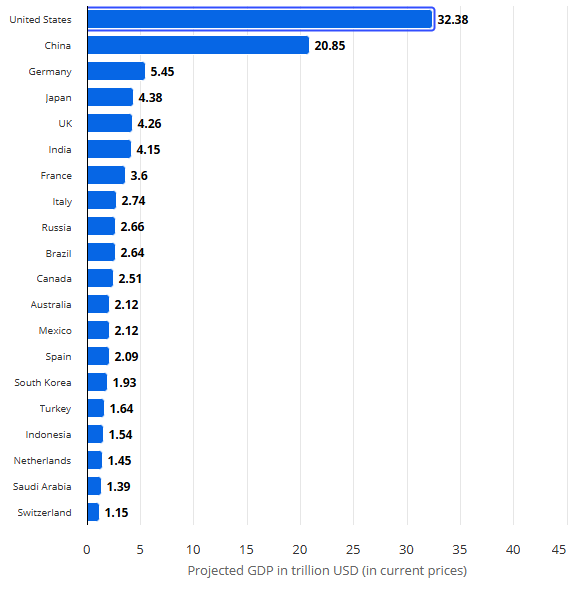
The growth half largely came true. China’s economy grew from roughly USD 11 trillion in 2015 to USD 19.63 trillion in 2025, and is expected to cross USD 20 trillion this year. [4] Seventy percent in a decade, off an already enormous base.

The other half did not. It did not overtake the United States, which reached USD 30.77 trillion in 2025, and the IMF has quietly cut its own 2030 projection for China from USD 27.5 trillion to USD 23.1 trillion. [4] [12] Still, anyone who bought the growth story in 2015 was not badly wrong about growth. The mistake was assuming that national growth would translate cleanly into shareholder return.

Source: Statista | Largest economies worldwide 2026

What the shareholders got

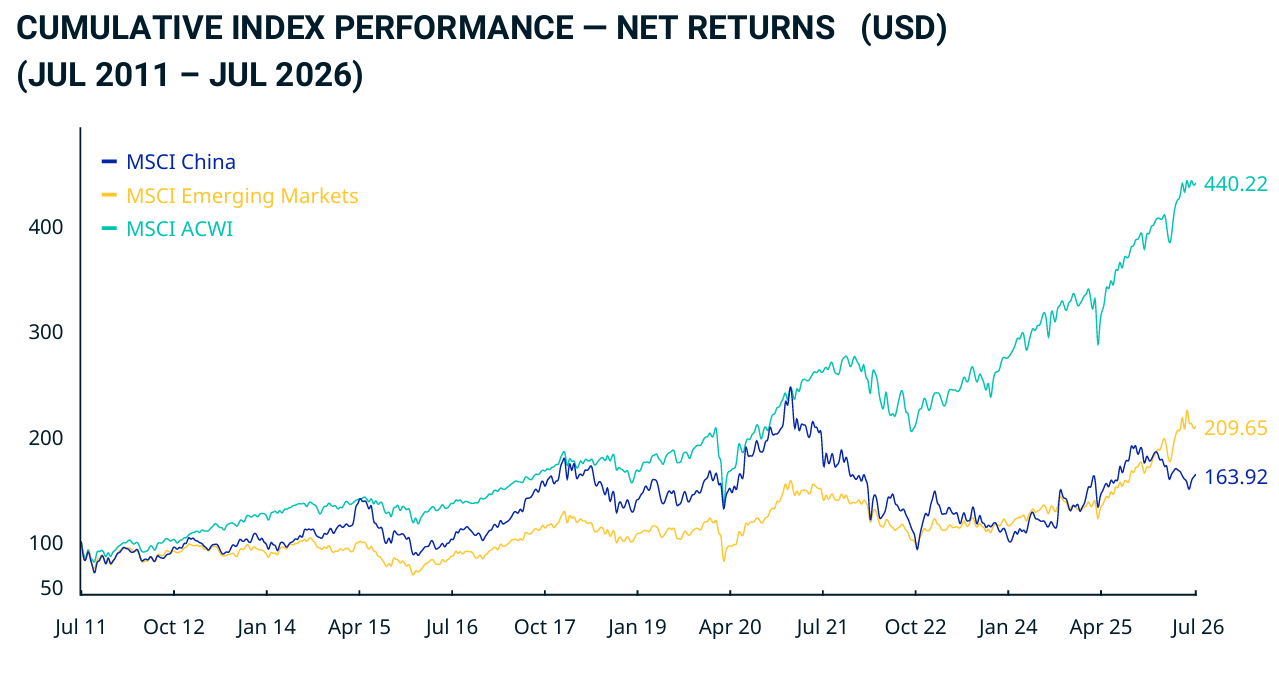
For the period to 31 July 2026, the MSCI China Index returned minus 2.13% a year over five years and 4.88% a year over ten. These are net returns, after the withholding tax a foreign investor actually pays. Compounded, the five-year result is a cumulative loss of about 10.2%. [5]

Over the same periods, the MSCI All Country World Index returned 10.85% and 12.32% a year, while emerging markets returned 8.03% and 9.19%. [5] Put simply, a dollar in the world index grew to about USD 1.67. A dollar in China became about USD 0.90.

China did not merely lag the Americans, which is the comparison everyone reaches for. It lagged the emerging world it was supposed to be leading.

Nor is the ten-year figure as flattering as it looks. It was rescued by two strong years at the end.

Explore the full MSCI China Index Factsheet HERE

The middle of the period is where the damage was done. The index fell 21.72% in 2021, 21.93% in 2022 and 11.20% in 2023. [5] Together, those three losing years compounded to a cumulative loss of nearly 46%. A dollar invested at the start of 2021 was worth about USD 0.54 by the end of 2023.

The recoveries of 2024 and 2025, at 19.42% and 31.17%, look handsome in isolation. They are the arithmetic of climbing out of a hole. A 46% fall needs an 85% gain simply to get back to even.

Note what the ride cost. Over those five years, the index carried an annualised standard deviation of 27.89%, against 15.07% for the world index, and a Sharpe ratio of minus 0.08 against 0.53. [5] In plain English, China delivered nearly double the volatility and still a negative return. Investors were not paid for the risk. They paid for it.

An investor who bought at the loudest point fared worse still. The Shanghai Composite peaked at 5,166 on 12 June 2015 and, eleven years on, has not been back. [9]

The currency that never arrived

The reserve-currency promise is the cleaner failure, because it was measurable from the start. In the first quarter of 2026, the renminbi accounted for 1.99% of global foreign exchange reserves, down from 2.18% at the end of 2024 after dipping to 1.92% in the third quarter of 2025. The US dollar sat at 57.13%, and the euro at 20.03%. [6]

The IMF attributes most of the latest uptick to exchange-rate valuation rather than to reserve managers buying, and COFER revises prior quarters as reporting is corrected. [6] The useful reading is the broad trend, not the second decimal place: flat to down across a decade of ambition. Reserve managers proved unwilling to hold a currency they could not move freely.

New Zealand's exposure was in the order book

For New Zealand, the direct investment loss was probably not the main story. Very few New Zealanders held Chinese shares directly. Our exposure arrived through customers rather than the share register, which is harder to rebalance because nobody runs an annual review on their order book.

Wine is the clean example. Shipments to China rose 47% in the year to mid 2025, to $56 million, against total wine exports of $2.10 billion. [7] Volumes are climbing again this year, but prices are falling, with a bulk wine price war running through Marlborough as a record harvest looks for a home. [8]

The saviour story turned out to be champagne without the fizz. The litres arrived. The dollars did not.

The point runs past wine. A grower or packhouse built around one fast-growing market holds a concentrated position as real as any portfolio holding, and far less liquid. Plantings take years to come into production, and cool stores, packing lines and market accreditation are not reallocated over a weekend.

Worse, that exposure correlates with everything else on the balance sheet. Land value, the borrowing secured against it, the labour bill and forward sales all move in the same direction. When the market that was going to take everything decides to pay less, the hit lands everywhere at once.

The order book is the least diversified asset most owners have, and the only one they rarely review as an investment risk. If the business is already a concentrated bet on one market, the owner’s portfolio has no business becoming a second concentrated bet on the same story.

The grain of truth

The other side deserves its best case. Chinese shares are cheap: 14.09 times trailing earnings against 23.24 for the world index, 10.97 times forward earnings against 17.13, and a dividend yield of 2.26% against 1.59%. [5] Shanghai also posted its strongest year since 2020 and touched decade highs in March 2026. [9]

The trouble is that cheapness has been available the whole way down. China traded at a discount for most of the decade, and for much of it the discount widened. That did not stop 2021, or 2022, or 2023. A low multiple is not a floor. It is the market pricing risk, and sometimes it prices that risk correctly.

Nor should the recent strength be mistaken for a full recovery. The rest of the world ran hard over the same stretch, so China has closed no gap, and the five-year number is still negative after it. Selling today solely because of the last five years would repeat the 2015 error in reverse. The direction changes. The mistake does not.

Evidence favours patience. Let the froth settle before committing, like a freshly poured beer you do not drink while it is all head.

The fiduciary question

The plain question is who was telling you the story, and what they were holding while they told it. Growth narratives sell funds, conference tickets and column inches. That is not a conspiracy; it is how incentives work. But none of those people were in your portfolio when the five-year number came in negative.

A fiduciary has the less enjoyable job of saying that a good story and a good investment are not the same thing, and that the gap between them is where most money is lost.

A frog in a well

Sun Tzu put it plainly. A victorious army wins first and then goes to battle, while a defeated army goes to battle first and then looks for the victory. [10] The asset allocation is settled before the market does anything.

Calling economic growth a return does not make it a return.

The trains ran. The dividends did not. Both things were true at once in 1850, and both have been true again.

So before the next irresistible story arrives, seek advice and wise counsel. Remember what Zhuangzi wrote some twenty-three centuries ago: a frog in a well cannot be talked with about the sea, for he is confined to the limits of his hole. [11]

The frog was not wrong about his well. The well was real. It simply was not the ocean.


Nick Stewart

(Ngāi Tahu, Ngāti Huirapa, Ngāti Māmoe,
Ngāti Waitaha)

Financial Adviser and CEO at Stewart Group

  • Stewart Group is a Hawke's Bay and Wellington based CEFEX & BCorp certified financial planning and advisory firm providing personal fiduciary services, Wealth Management, Risk Insurance & KiwiSaver scheme solutions.

  • The information provided, or any opinions expressed in this article, are of a general nature only and should not be construed or relied on as a recommendation to invest in a financial product or class of financial products. You should seek financial advice specific to your circumstances from a Financial Adviser before making any financial decisions. A disclosure statement can be obtained free of charge by calling 0800 878 961 or visit our website, www.stewartgroup.co.nz


References

1. Campbell, G. and Turner, J.D. (2012). Dispelling the Myth of the Naive Investor during the British Railway Mania, 1845-1846. Business History Review, 86(1). Railway share price index at 1,984 in August 1845, falling to 673 by April 1850.

2. Arnold, A.J. and McCartney, S. (2022). Managerial Failure in early Victorian Britain: Network and capital expansion during the Railway Mania. Business History. Network reached 6,621 miles by 1850, tripled since 1844; railway capital formation near 7% of GDP in 1847; about a third of authorised lines never built.

3. International Monetary Fund. Currency Composition of Official Foreign Exchange Reserves (COFER), dataset notes. The renminbi has been separately identified in COFER from 2016Q4, following its inclusion in the Special Drawing Rights basket on 1 October 2016.

4. International Monetary Fund, World Economic Outlook, as compiled by Statista and Worldometer. China nominal GDP of USD 19.63 trillion (2025) and an estimated USD 20.85 trillion (2026); United States USD 30.77 trillion (2025).

5. MSCI (2026). MSCI China Index (USD) Index Factsheet, data as at 31 July 2026. Net returns in USD: MSCI China five year minus 2.13% and ten year 4.88% annualised; MSCI ACWI 10.85% and 12.32%; MSCI Emerging Markets 8.03% and 9.19%. Annual net returns 2021 minus 21.72%, 2022 minus 21.93%, 2023 minus 11.20%, 2024 19.42%, 2025 31.17%. Fundamentals: MSCI China P/E 14.09, forward P/E 10.97, dividend yield 2.26%; MSCI ACWI P/E 23.24, forward P/E 17.13, dividend yield 1.59%. Five year annualised standard deviation 27.89% against 15.07% for MSCI ACWI; five year Sharpe ratio minus 0.08 against 0.53.

6. International Monetary Fund (1 July 2026). IMF Data Brief: Currency Composition of Official Foreign Exchange Reserves, World Aggregates, First Quarter 2026. Renminbi 1.99% (from 1.95% in 2025Q4), US dollar 57.13%, euro 20.03%. Earlier briefs give the renminbi at 2.18% in 2024Q4 and 1.92% in 2025Q3. COFER revises prior quarters as reporting is corrected.

7. New Zealand Winegrowers (2025). Annual Report 2025. Exports to China up 47% to $56 million; total wine exports $2.10 billion.

8. Vino Joy News (July 2026). China's white wine boom has triggered a Marlborough price war.

9. Shanghai Stock Exchange data via CEIC and Trading Economics; Global Times (January 2026) reporting the Shanghai Composite's 18.41% gain in 2025 and its return to decade highs.

10. Sun Tzu, The Art of War, Chapter 4, Tactical Dispositions. Rendered by Thomas Cleary as: a victorious army first wins and then seeks battle; a defeated army first battles and then seeks victory.

11. Zhuangzi, Outer Chapters, The Floods of Autumn (Qiushui), 4th century BCE. James Legge translation: a frog in a well cannot be talked with about the sea, he is confined to the limits of his hole.

12. ChinaPower Project, Center for Strategic and International Studies (2026). Unpacking China's GDP. IMF projection for China in 2030 revised from USD 27.5 trillion (April 2023) to USD 23.1 trillion (April 2025).


We've Seen This SpaceX Movie Before

Article #469

Last month I warned readers: when the noise gets loud, ignore it; seek advice and wise counsel instead. 

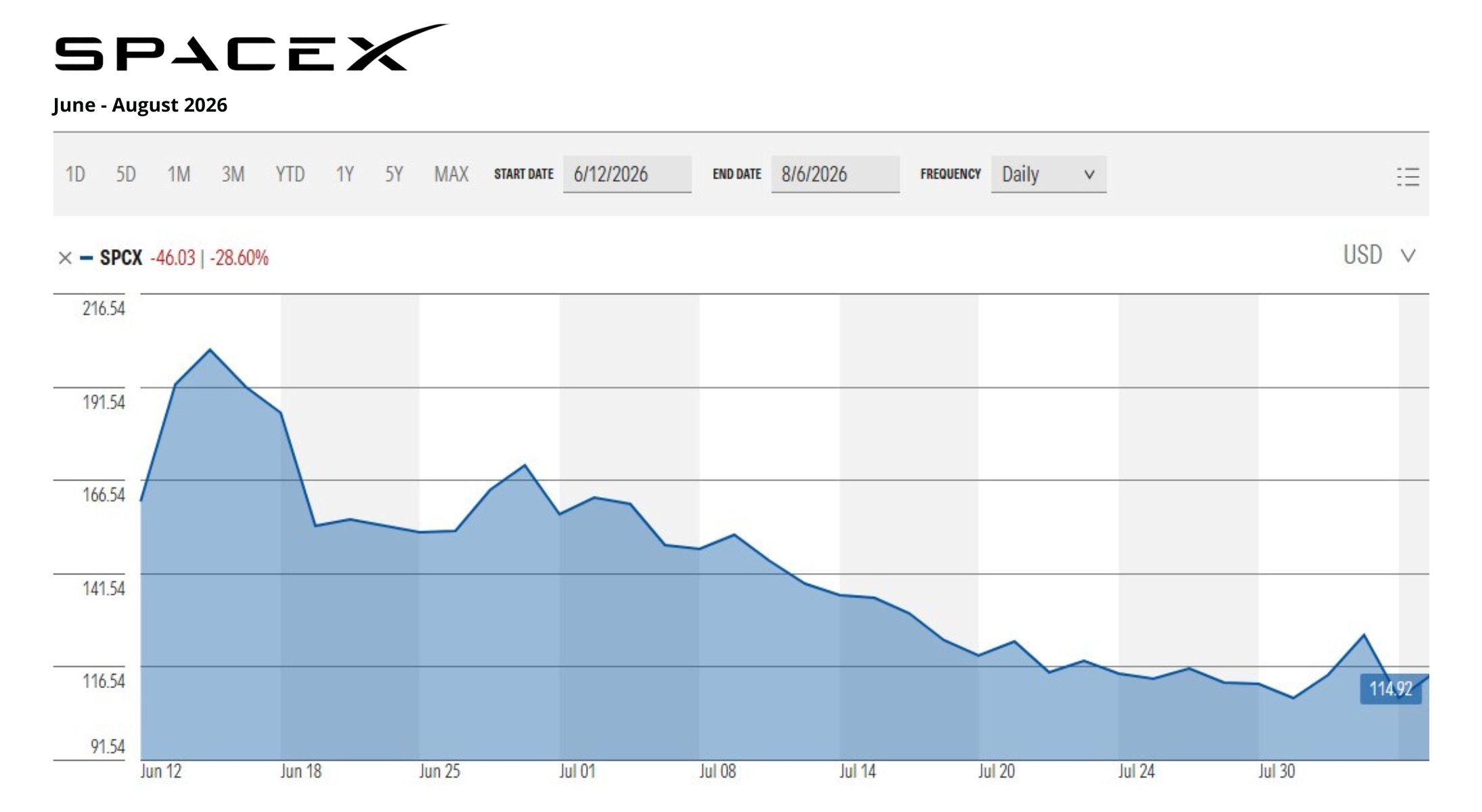
The noise around SpaceX's IPO has been deafening. It priced at USD 135, ripped above USD 225 within days, and briefly made Elon Musk the world's first trillionaire on paper [1]. Then reality hit. 

I said the evidence favours patience. Let the froth settle before committing, like a freshly poured beer; you don't drink it while it's all head. 

Here's how it settled. SpaceX has crashed straight back to Earth through its own listing price. More than USD 1 trillion, around NZD 1.7 trillion, has been wiped from its value. From a June peak of USD 225 it closed at USD 114.92 on 6th August, below even its USD 135 listing price. Musk's paper fortune has fallen by more than USD 500 billion [1] [2] [3]. The company posted a consolidated net loss of USD 4.9 billion last year, swollen by its xAI acquisition, yet trades at more than 100 times sales [2].  

The analysts can’t even agree with one another. Bullish desks pinned targets north of USD 250; HSBC has just opened coverage at USD 115, roughly where it trades; Morningstar reckons fair value sits lower still [2] [3]. When the experts disagree by that margin, you’re not looking at analysis. You’re looking at a story, and stories are priced by mood. 

Around 23,000 Kiwis bought in to SpaceX through Sharesies, mostly in the after-market, well after the smart money had taken its seat [1]. By then, the offer-price allocation had happened offshore and the wild ride from USD 135 to USD 225 (and back) was well underway. Those who felt they were getting in early were, in truth, the exit liquidity for those who actually had. 

To those investors, I would gently say: none of this is new. 

USD 114.92 - SpaceX Closing Share Price on 6th August 2026

Buying for Blue Skies 

Our own market taught this very lesson just over a decade ago. You don’t need a crystal ball; only a memory.  

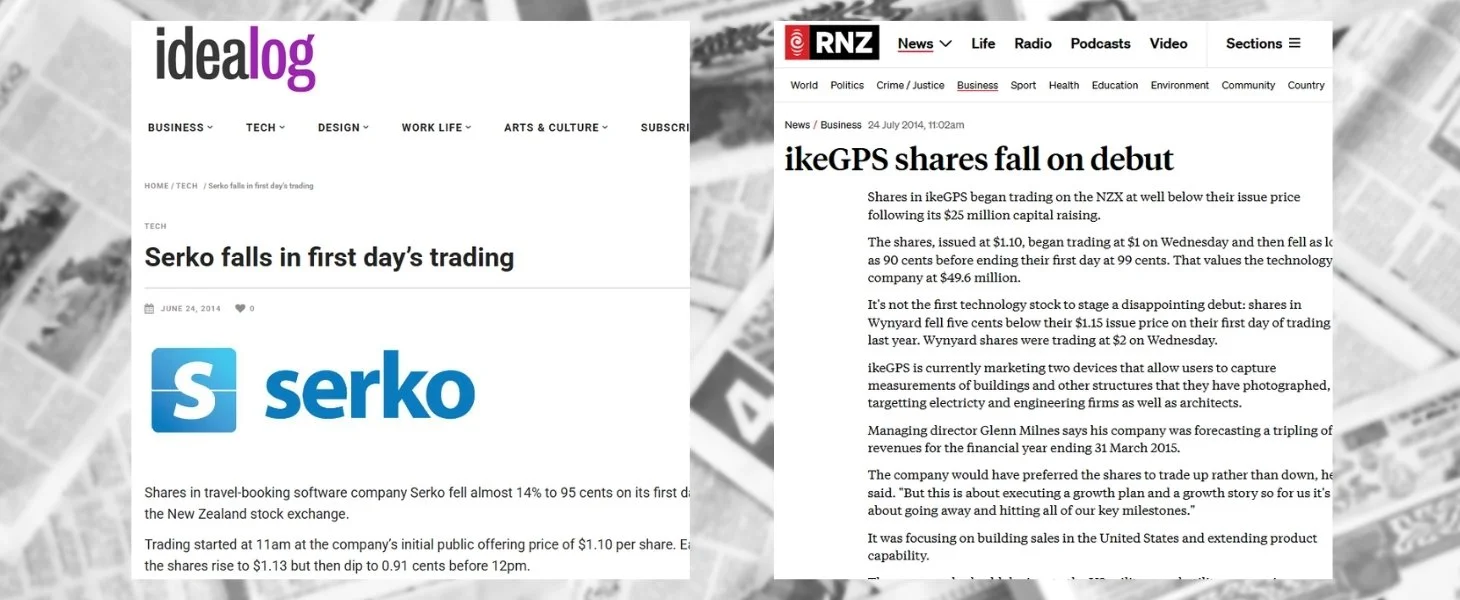
In 2014, listings came thick and fast. Travel-software firm Serko and measurement-device maker ikeGPS both floated at $1.10. Both quickly traded below their issue price, with ikeGPS down more than 18 percent on debut [4]. As one fund manager astutely put it: the market had been paying for blue sky three months earlier, and simply wasn't paying anymore [4]. The hype had outrun the businesses. Serko, to its credit, later found real success. Yet even now it trades below the heights the froth once implied, proving that even a ‘good’ company bought at a hyped price can still disappoint for years.  

It brings to mind something an old horse trainer once told me: “When they start, they've got the money and I've got the experience; when they leave, I've got their money and they've had the experience.” 

News articles on Serko and ikeGPS in 2014

The Quiet Opposite 

In the same 2014 rush, an old Hawke's Bay apple and logistics business called Scales came to market at $1.60, the very bottom of its indicative range, and had such a subdued debut it too slipped below its offer price in the first few days [5] [6]. No blue sky, no celebrity founders; just apples, coolstores, cargo, with about two-thirds of the business rooted right here in the Bay. Tellingly, the private equity seller kept a 20 percent cornerstone stake rather than bolting for the exit; skin left in the game, not cashed out at the top [6].  

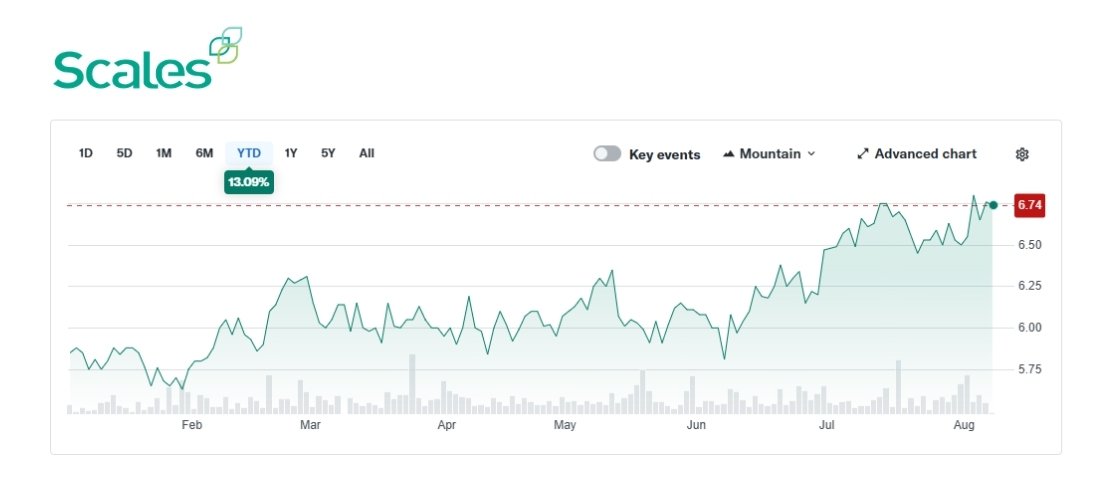
IPOs floated by private equity usually attract scepticism, and the inevitable doubters lined up. They were wrong. Net profit came in some 87 percent above the float forecast, and shares today sit near record highs around $6, several times the issue price [7] The overlooked apple grower quietly outran the blue-sky darlings that had stolen the headlines on listing day. 

What separates the winners from the wreckage is simple: what you are buying, and who is selling and why. When insiders cash out at the peak, you are not the early investor. You are the exit. 

Scales YTD Share Price (December 2025 - August 2026)

The Devil in the Details 

There's a sting in the tail many day-one chasers never see coming. It’s buried in fine print, which as I always say, matters more than the selling price.  

New Zealand has no general capital gains tax, so most assume share profits are tax-free. Alas, not always. A “stag” buys a float purely to flip on the pop. Buy shares mainly to sell them, and Inland Revenue treats the gain as income, taxed at your rate, up to 39 percent. Buy to hold, and the same shares may not be taxed at all. Intention is everything [8]. Many who chased SpaceX bought the after-market and are now underwater. They’re carrying the flipper's tax intention without the flipper's profit, and are unable to offset the loss. 

There's a further wrinkle for anyone with a decent offshore holding. Once your overseas shares pass a cost threshold, proposed to double from NZD 50,000 to NZD 100,000 from the 2026–27 tax year, the foreign investment fund rules can tax a deemed slice of the value each year, whether or not you sold anything [9]. A newer method taxing only realised gains exists, but it is narrow and does not apply to ordinary listed shares like a US-listed SpaceX [9]. These settings are still working through Parliament and turn entirely on your circumstances. None of this is tax advice, but it is exactly the sort of thing you ought to check before you act. 

Choosing Patience over Hype 

Betting on a day-one pop with no real idea what you own is not investing; it is a coin toss with a tax bill. The alternative is not timidity, and the lesson is not anti-technology. High-growth tech can reward the patient, diversified investor handsomely. It is anti-hype. 

A disciplined, evidence-led approach can still be flexible and tactical, positioning around genuine opportunity when the evidence supports it, without chasing froth or mistaking a hyped listing for a considered decision. Scales was the quiet reward for buying a business; the blue-sky floats of Serko and ikeGPS were an expensive lesson in buying a story. SpaceX is that same lesson in a shiny new package. 

There is even a footnote of hope for the burned. Facebook fell more than 50 percent below its 2012 float price within four months, then clawed it all back within about fifteen as earnings caught up. A badly priced float can find a floor and recover in time… but that’s cold comfort to whoever paid top dollar on day one, and certainly no substitute for buying well in the first place [3] 

When the noise gets loud, the best investors don't chase the rocket. They read the audited accounts, understand who is selling and why, and let time and compounding do the work.  

In short: they seek advice and wise counsel. It may behoove others to consider doing the same.


Nick Stewart

(Ngāi Tahu, Ngāti Huirapa, Ngāti Māmoe,
Ngāti Waitaha)

Financial Adviser and CEO at Stewart Group

  • Stewart Group is a Hawke's Bay and Wellington based CEFEX & BCorp certified financial planning and advisory firm providing personal fiduciary services, Wealth Management, Risk Insurance & KiwiSaver scheme solutions.

  • The information provided, or any opinions expressed in this article, are of a general nature only and should not be construed or relied on as a recommendation to invest in a financial product or class of financial products. You should seek financial advice specific to your circumstances from a Financial Adviser before making any financial decisions. A disclosure statement can be obtained free of charge by calling 0800 878 961 or visit our website, www.stewartgroup.co.nz


REFERENCES

1. NZ Herald / Newstalk ZB, "Share crash wipes $1.7 trillion from the value of Elon Musk’s SpaceX, crimps thousands of Kiwi investors" (July 2026) 

2. Yahoo Finance, "SpaceX Stock Just Violently Crashed Below Its Opening-Day Price" (July 2026) 

3. BeInCrypto, "SpaceX Stock Crash Wipes $500 Billion From Musk’s Fortune" (July 2026) 

4. NZ Herald, "ikeGPS plunge may show tech IPO party over" (July 2014) 

5. Scoop / BusinessDesk, "Scales shares edge lower on NZX debut" (25 July 2014) 

6. NZ Herald, "Scales shares set at bottom of range for IPO" (July 2014) 

7. NZ Herald / Direct Capital, "Scales’ Golden Apples"; Stockopedia SCL share data (2026) 

8. Inland Revenue, "Share investments": ird.govt.nz 

9. Inland Revenue Tax Policy, "Foreign investment fund changes" information sheet (May 2026); Budget 2026 FIF threshold proposal 


Wholesale Investor Rules: Calling a Cat a Fish

Article #468

Abraham Lincoln liked to ask how many legs a dog has if you count the tail as one. Four, he said: calling the tail a leg doesn’t make it a leg. New Zealand’s wholesale investor rules have spent a decade calling tails legs. Last week a Christchurch courtroom finally counted.

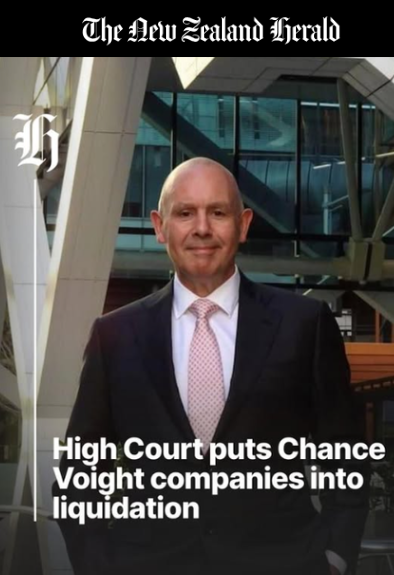
On Friday 24 July the High Court placed six companies in Bernard Whimp’s Chance Voight group into liquidation. Associate Judge Dale Lester found a pattern of obfuscation, incompetence and evasion, an entirely unsustainable model, and a scheme that could only pay existing investors by finding new ones. Founded in 2021, the group had raised more than $54 million from perhaps 230 people to pour into property-based wholesale debt promising returns of 10 to 13 per cent a year. By September 2025 it sat on a negative net asset position of $11.8 million. The evidence, the judge said, was overwhelming.

One detail is almost too good. Whimp asked the court to delay the hearing until he could unlock money from his late father’s estate, which, he said, would in turn fund a $110 million land development. The judge was unmoved, calling the request a microcosm of how the whole group had been run. Quite. You cannot conjure a solvent business from a deceased estate any more than you can pull a rabbit from an empty hat, though plenty have tried. Meanwhile a related Whimp entity had drawn some $9.2 million in “management fees”, around 24 per cent of all money invested, even as the group booked a $5.5 million trading loss in a single half-year. Fees, in other words, for failure.

Here is what should trouble every reader. Chance Voight’s investors were, in the main, aged 65 and over, and the first liquidators’ report found many had only a limited grasp of the risks. Yet each had been certified a “wholesale” investor: sophisticated enough, in law, to need no protection at all.

You can call a cat a fish, but you can’t teach it to swim.

The mechanism is simple. The Financial Markets Conduct Act lets companies raise money without disclosure, licensing or supervision, provided the investors are wholesale. Under the “eligible investor” rule, anyone can claim that badge so long as a financial adviser, chartered accountant or lawyer signs to agree. Tick the box, and every retail protection evaporates. And this was no discreet, professional affair: the court noted Chance Voight was marketed in regional and local newspapers, on Facebook and at in-person promotional events, the mass channels of the retail world, not the closed room of the true professional.

A long process for a too-low bar 

The regulator has been uneasy for years. When the FMA took a test case to force issuers to verify the investors sent their way, it lost: Justice Fitzgerald found the permissive regime was a feature of the law, not a bug. But she put her finger on the fault. The problem, she observed, was not so much the content of the certificates as that certificates with patently defective grounds, or none at all, were being confirmed regardless. It is the confirmation process that is falling down; and if it cannot protect investors, the balance struck in the legislation may need resetting, a matter, she said, for Parliament and not the court.

That was the judiciary handing the problem to the politicians. This month, at last, they picked it up. Commerce Minister Cameron Brewer has released an MBIE consultation, part two of the plan to lift our capital markets, that concedes what advisers have muttered for years: our settings are an international outlier, “unique” and “relatively permissive,” with “some evidence” that inexperienced investors are getting into wholesale offers. Its options read like a reply to Fitzgerald: a more objective eligibility test, a cap on how much an eligible investor can put at risk, a requirement that applicants take independent financial advice, restrictions on wholesale advertising, and, squarely, real onus on the professional confirmer, with an infringement offence for inadequate certifications.

Click above to read more on Wholesale Investors from the Financial Markets Authority

What still needs attention 

Those are the right levers, and they should be pulled. None of this is an argument for tearing the regime down. Genuine sophisticated investors exist, and raising capital from them without the full disclosure burden is a legitimate and valuable part of a working market. MBIE rightly notes that certificates lasting only two years already make life needlessly costly for real professionals. The point is narrower. The bar has been set too low, left to rot, and waved through by people with every incentive not to look too closely. Consider that none of the thresholds, $5 million in net assets, a million-dollar investment history, a $750,000 minimum subscription, has been adjusted for inflation since the Act took effect in 2013. Thirteen years of asset-price growth, house prices above all, has done the widening for Parliament: the same numbers now capture people they were never meant to reach. The bar did not get more generous; the country simply ran up more nominal dollars against a line that never moved. Last year the FMA referred 22 accountants and eight lawyers to their professional bodies over the misuse of these very certificates.

Two gaps deserve more than the paper gives them.

The first is the advice layer. A retail adviser must put the client’s interests first and prove a recommendation is suitable: goals, cash flow and appetite for risk, all understood and documented, the file running to fifty pages. A wholesale-only adviser owes a bare statutory duty to give priority to the client’s interests, but needs no FMA licence, follows no Code of Professional Conduct, and never has to establish that the advice was suitable. The relationship can be purely transactional: take the $5 million, place it in a syndicate, move on. If you think professional advice is expensive, try the amateur variety.

The second is the Crown’s own hand. Of the roughly 70 managed funds on Invest NZ’s “acceptable” list for Active Investor Plus migrants, against nearly $1.5 billion of committed capital, all but a handful are wholesale, and few are household names. Invest NZ’s own disclaimer states that inclusion is not an endorsement or recommendation by it or the Government. We invite wealthy newcomers to make this country home, steer them onto a state-curated list, then wash our hands of what follows. All care, no responsibility. A wealthy migrant, a surgeon, a farmer, someone who simply inherited well, may know nothing of geared, illiquid property debt, yet is stamped “wholesale” on a net-asset figure alone. Funds on a Crown list should answer to retail-grade disclosure, not hide behind the wholesale tag.

Underneath it all sits a regulator half in the dark. The IMF warned back in 2017 that there was insufficient data to assess the risks in our wholesale sector; nine years on, the FMA has admitted it still has very little sense of the size, structure or practices of that market. You cannot police what you have never measured.

Two centuries ago the little port of Kōrorareka, on the same Bay of Islands coast that cradled New Zealand’s first capital, was infamous as the Hell Hole of the Pacific, a settlement beyond the reach of any law. We renamed it Russell, gentrified it, and told ourselves the lawlessness was history. But a regime that lets an operator gather tens of millions from retirees on a one-page certificate nobody properly checks, through advisers who owe them little and a regulator the courts say owes them nothing, has not left the frontier behind. One judge has wound the companies up. Another has told Parliament what to fix. Submissions close on 25 August. Make sure the reform closes the loophole, rather than merely repaints the saloon.*

* Stewart Group does not provide advice to investors under the wholesale investor rules. We took that decision years ago, in the view that all investors deserve full disclosure and a fiduciary relationship. 


Further Reading: For those interested in the wholesale investor discussion, this guide provides a practical overview of the key differences between retail and wholesale investors, including eligibility criteria, investor protections and regulatory requirements.


Nick Stewart

(Ngāi Tahu, Ngāti Huirapa, Ngāti Māmoe,
Ngāti Waitaha)

Financial Adviser and CEO at Stewart Group

  • Stewart Group is a Hawke's Bay and Wellington based CEFEX & BCorp certified financial planning and advisory firm providing personal fiduciary services, Wealth Management, Risk Insurance & KiwiSaver scheme solutions.

  • The information provided, or any opinions expressed in this article, are of a general nature only and should not be construed or relied on as a recommendation to invest in a financial product or class of financial products. You should seek financial advice specific to your circumstances from a Financial Adviser before making any financial decisions. A disclosure statement can be obtained free of charge by calling 0800 878 961 or visit our website, www.stewartgroup.co.nz


REFERENCES

1. “Court slams Whimp entities into liquidation; Kerr bankrupted in the UK.” David Chaplin, Investment News NZ, 26 July 2026.

2. “‘Unsustainable’ Chance Voight companies put into liquidation.” NBR, 24 July 2026 — judgment of Associate Judge Dale Lester; Teneo’s John Fisk, Lara Bennett and Malcolm Hollis appointed liquidators; comments of FMA enforcement head Margot Gatland.

3. David Chaplin, “Wholesale investment: there’s a hole in the market.” BusinessDesk, 21 July 2026.

4. “Government looking at wholesale investor loophole.” Good Returns, 17 July 2026; “Government seeks feedback on loophole exposing unsavvy investors to risky deals.” NZ Herald, July 2026.

5. Ministry of Business, Innovation and Employment, capital markets reform discussion paper (part two), July 2026. Submissions close 25 August 2026.

6. First interim liquidators’ report on the Chance Voight group (PwC), 2026 — investor age profile and limited risk understanding; “management fees” of $9.2m, some 24% of funds invested; $5.5m half-year trading loss; negative net assets of $11.8m at 30 September 2025.

7. Financial Markets Authority, [2025] NZHC 2723 — judgment of Fitzgerald J (18 September 2025) on the confirmation process and the balance struck in the legislation.

8. Financial Markets Authority — referral of 22 accountants and eight lawyers to their professional bodies over misuse of eligible investor certificates.

9. International Monetary Fund, Financial Sector Assessment Programme, New Zealand, 2017; FMA review of custody arrangements, 2026.

10. Invest New Zealand / Immigration New Zealand, Active Investor Plus visa: list of acceptable managed investment schemes and non-endorsement disclaimer.

11. Financial Markets Conduct Act 2013, Part 3 and Schedule 1.

12. “Kōrorareka — the Hell Hole of the Pacific.” Te Ara / NZ History, Ministry for Culture and Heritage.


The Walls That Fall: What Hadrian Teaches Us about a Financial Plan

Article #465

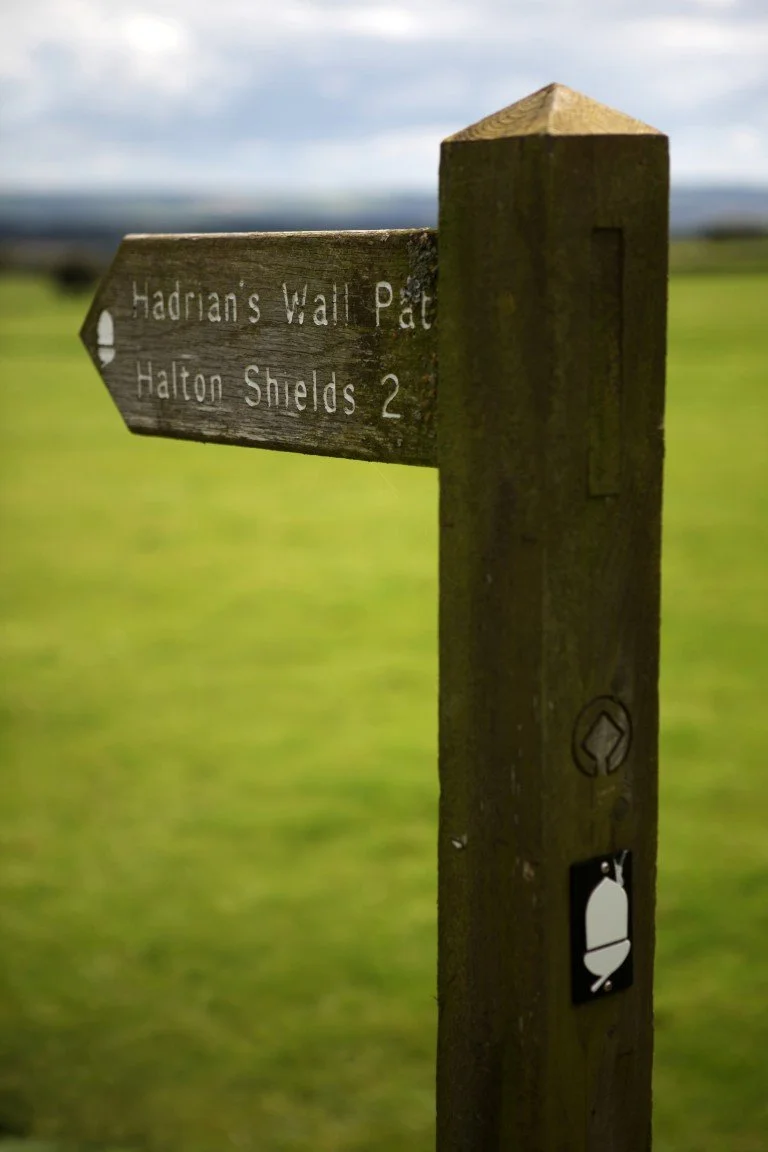
Hadrian's Wall has fascinated me since I was a kid. As you read this, I will have just finished cycling part of it with my family and a good friend who’s also a client.

It’s the kind of trip where you spend your evenings in a pub working out the next day's ride, and your days quietly humbled by what people built two thousand years ago. I've been reading up on the wall for months, as one does before such a trip. And - hazard of the job - the more I read, more I noticed a story that financial advisers, and the people who rely on them, should pay attention to.

The Wall, as it stood

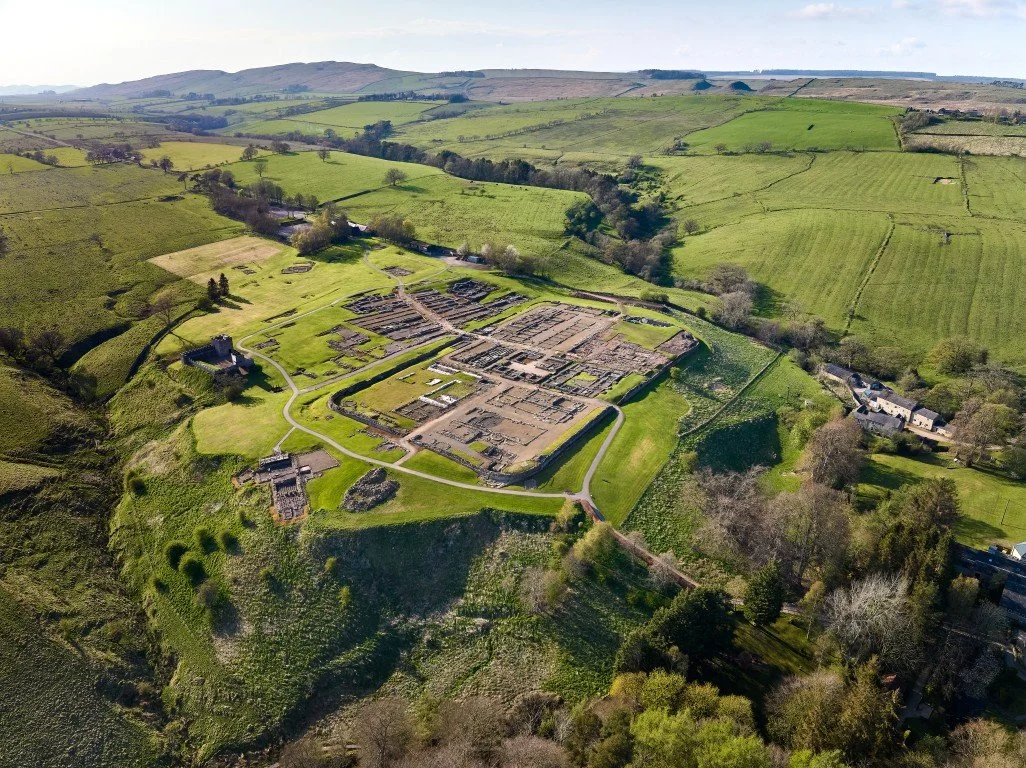
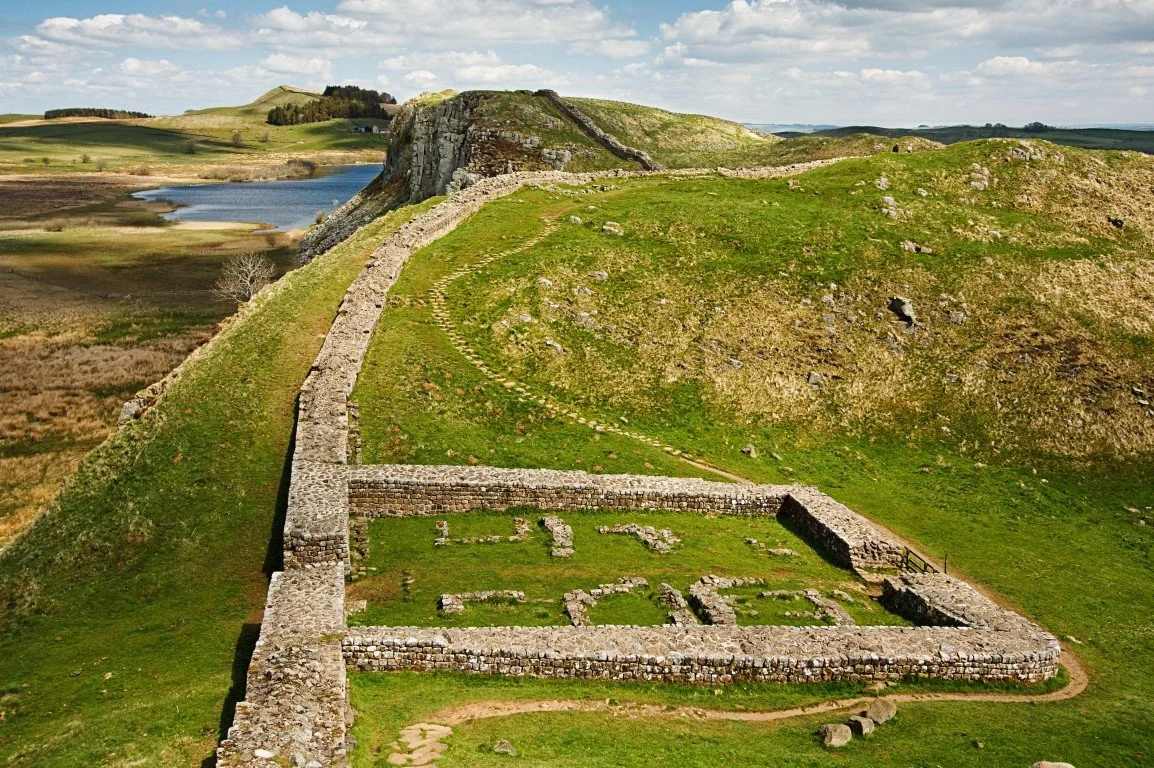
Hadrian's Wall was begun in AD 122 under the emperor of the same name. It ran 73 miles coast to coast, from Wallsend on the River Tyne in the east to Bowness-on-Solway in the west. Around 15 feet high, originally 10 feet thick (later narrowed to 8 in places to speed construction), fronted by a wide ditch, with a fortlet known as a milecastle every Roman mile, and two observation turrets in between each one. It took the legions roughly six years to build, and it was manned in some form for nearly three centuries.

To put the scale of it in New Zealand terms: Picture a stone wall from Tauranga to Raglan. Every mile of it manned, every milecastle stocked, every turret garrisoned, around the clock. Then think about how hard it has proved in modern times to commit to a second Auckland Harbour crossing. Decades of debate, billions in costings, and we still haven't put a spade in the ground for what is essentially a few kilometres of road and tunnel.

The Romans put up that wall in six years and manned it for nearly three centuries. The quantum of capital, the legionary labour, the supply lines, the stone, the timber, the ongoing garrison: it boggles the mind. It was the state of the art. The frontier, literally and figuratively, of what was possible.

But, that’s not the part I found most instructive. This is.

The upgrade that didn't hold

When Hadrian died in AD 138, his successor Antoninus Pius made a different call.

He decided the wall wasn't enough, or wasn't far enough north, and he pushed the frontier deeper into what is now central Scotland. He ordered a new wall built between the Firth of Forth and the Clyde, on the orders of his governor Quintus Lollius Urbicus. The Antonine Wall, as we now call it, was 39 miles of turf on a stone base. It had 16 forts and a road called the Military Way running behind it. It was the next-generation solution. The bold reposition. The upgrade.

It was also abandoned within about a generation.

The legions pulled back to Hadrian's Wall. The Antonine Wall, the most ambitious frontier project of its day, became a curiosity in the Scottish landscape.

Two of the most expensive military engineering projects of the ancient world. Both built by the best engineers of their age. Both, in their way, overtaken by circumstance. We use neither Antionine nor Hadrian’s Wall in this modern age. We don’t need to.

The parallel

Reading about this, I couldn’t help but think of when I sit down with people who tell me their financial plan is bulletproof.

The plan is usually built around a single conviction. A favoured stock that has done well for the last decade. A fund the adviser recommended at a long lunch in 2019. A single asset class, often residential property, sometimes a concentrated equity portfolio. The numbers add up on a spreadsheet. The projections look tidy. The client signs off and feels secure.

It’s state of the art... for its day.

The trouble is that any day eventually ends. Markets shift, and they shift in ways that are obvious only in hindsight. Sectors that looked unassailable five years ago are nursing real wounds now.

The growing effectiveness of AI is reshaping how per-seat software businesses get valued, because if one person and an agent can do the work of nine, the per-seat model starts looking thin. GLP-1 drugs are reshaping assumptions about big pharma earnings. The post-Covid environment has changed everything from vaccination rates to office occupancy to commodity flows. Plenty of concentrated bets that looked clever in 2021 are no longer looking quite so clever in 2026.

The wall that was bold and bulletproof becomes a museum piece, and very often the people standing inside it are the last to notice.

What the Romans got right and what they got wrong

The Romans weren't stupid. They were the best engineers of their age, and Hadrian's Wall is, in its own right, an extraordinary achievement. It didn't fail because the design was poor. It became irrelevant because the world around it changed: the politics of Rome, threats to the Empire, economics. The circumstances that called for the Wall no longer existed.

Walls, by their nature, do not change.

Plans, by their nature, should.

This is the thing I keep coming back to: A good financial plan isn't a wall. It's a garrison. It must be broadly spread, regularly reviewed, regularly rotated, grounded in the evidence rather than in one manager's conviction about the next big thing. The factors that drove returns in the last cycle are not the factors that will drive them in the next. Tax settings, the regulatory landscape your family, your goals – the world changes with time. A plan that doesn't change with them isn't a plan; it's a monument, and a fairly expensive one at that.

For savvy investors, the discipline isn't picking the right wall once. It's seeking wise counsel often enough that you notice when the frontier has shifted, and you can adjust before you find yourself defending ground that no longer matters.

This is also why we are an evidence-based firm. We don't try to pick the next winning stock or guess which active manager will sit in the top quartile in five years' time, because the academic record on that is settled and it isn't kind. Most active managers don't beat their benchmark over long periods. The few who do can't reliably be picked in advance. The path that has actually compounded for clients over the decades is something far less glamorous: broad diversification, disciplined exposure to the factors that drive long-term returns, low costs, and the patience to stay the course. We use Dimensional funds for that reason. The foundation is fifty years of academic research, not someone's conviction about the next big thing.

In practice, the work is unglamorous. It's an annual review with hard questions of last year's plan. It's rebalancing when a position has run further than the strategy intended. It's saying no to the new shiny thing because it doesn't fit the wider picture. It's sitting down again when life changes, because the plan needs to change with it. None of it makes a great story at a barbecue. All of it compounds quietly, and it is the whole point.

Fifty years in

So I've been out there this week, marking my 50th; watching the moors roll past and thinking about the Roman soldiers who walked that wall for 300 years and the ones who walked away from the Antonine Wall after thirty. And thinking, with gratitude, about the clients we've walked alongside over the years. The conversations that have moved plans forward, the times we've changed direction together, and the times we've held firm.

The world keeps moving. The job is to move with it, thoughtfully, with discipline, and with help.

Here's to the next fifty.


Nick Stewart

(Ngāi Tahu, Ngāti Huirapa, Ngāti Māmoe,
Ngāti Waitaha)

Financial Adviser and CEO at Stewart Group

  • Stewart Group is a Hawke's Bay and Wellington based CEFEX & BCorp certified financial planning and advisory firm providing personal fiduciary services, Wealth Management, Risk Insurance & KiwiSaver scheme solutions.

  • The information provided, or any opinions expressed in this article, are of a general nature only and should not be construed or relied on as a recommendation to invest in a financial product or class of financial products. You should seek financial advice specific to your circumstances from a Financial Adviser before making any financial decisions. A disclosure statement can be obtained free of charge by calling 0800 878 961 or visit our website, www.stewartgroup.co.nz

  • We do not hold or advise on any private credit or private equity investments.


REFERENCES

  1. English Heritage, "History of Hadrian's Wall", english-heritage.org.uk

  2. Britannica, "Hadrian's Wall" and "Antonine Wall" entries, britannica.com

  3. Historic Environment Scotland, "Antonine Wall", historicenvironment.scot

  4. North East Museums (Segedunum Roman Fort), "The building and development of Hadrian's Wall", northeastmuseums.org.uk

  5. World History Encyclopedia, "Hadrian's Wall" and "Antonine Wall", worldhistory.org

  6. UNESCO World Heritage listings, Frontiers of the Roman Empire (Hadrian's Wall designated 1987; Antonine Wall designated 2008)

  7. Bede, Ecclesiastical History of the English People (8th century), early historical description of Hadrian's Wall as "eight feet in breadth, and twelve in height"


Scotland the Brave - The Darien Scheme That Worked

Feature Article


A Canny View reader asked an excellent question after last month's column: what was the alternative? What would have happened if the Darien project had been successful?

Whilst I don't hold myself out to be a historian, I do find alternative history enjoyable reading, with its endless what-ifs.

Last month's piece (If you missed it, read heretook up Scotland's catastrophic 1698 bet on a trading colony in Panama, the one that bankrupted the nation and led, within a decade, to its loss of sovereignty to England. The lesson, plainly, was about concentration risk: bet a fifth of your wealth on one thing, and you had better be ready for the day it doesn't work.

But what if it had worked? Indulge me a moment.

It is 1698. William Paterson's vision holds. Disease is mastered through better drainage and stricter quarantine. The Spanish, having sized up Caledonia's defences, choose negotiation over assault. The English, sensing they cannot beat the Scots to the Isthmus, partner instead of obstruct.

Within a decade, Caledonia is the trading hub of the Americas. Goods from Canton and Manila are landed on the Atlantic side, hauled across a few miles of jungle, and reloaded onto ships bound for Edinburgh and Amsterdam. The Company of Scotland pays a 40% dividend in 1710. It pays one again in 1715.

Scotland enters the 18th century rich. There is no bankruptcy. No loss of sovereignty. Edinburgh, not London, becomes northern Europe's financial centre. Adam Smith, born in 1723, writes The Wealth of Nations in a country that does not need to borrow England's economic theory; it has its own.

The story doesn't stop there. The Acts of Union, in our real history, were the price Scotland paid for the Darien bankruptcy. Take the bankruptcy away, and the union never happens. So when Queen Anne dies in 1714 and the English Parliament invites George of Hanover to take the throne, the Scottish Parliament is free to make its own choice, and reaffirms the Stuart line. James Francis Edward becomes James VIII of Scotland. His son Charles Edward never has to invade in 1745, because his father is already sitting in Edinburgh.

Which means no Battle of Culloden in 1746. No Disarming Act. No proscription of Highland dress, no systematic dismantling of clan structures. Which means no Highland Clearances. Which means the great Scottish diaspora of the 19th century, the one that founded Dunedin in 1848 and put Scottish names on half the farms in Hawke's Bay, never happens, or happens at a fraction of the scale.

A successful Darien does not just save Scotland's sovereignty. It rewrites the demographic map of New Zealand.

And by the late 19th century, when the world's powers turn their attention to cutting a canal through the Isthmus, the Scots have been there for two hundred years. They have the local knowledge, the capital, and the political will. The canal opens, somewhere between 1890 and 1905, under Scottish ownership. One of the world's great chokepoints, the gate between the Atlantic and the Pacific, is not American. It is Scottish.

Speaking for myself, I highly doubt either my maternal or paternal ancestors would have made the journey from Perthshire, Scotland.

Paterson gets a statue on Princes Street. And every Scot who didn't subscribe is haunted, for the rest of their life, by what they missed.

This is the harder lesson.

The bet that pays off gets remembered as vision. The same bet that fails gets remembered as folly. The two bets were identical.

Imagine two funds in 2020. Both concentrate. Both bet on a small basket of high-conviction names. Five years later, one is celebrated as a genius and the other is torn apart in print. The portfolios looked identical at the start. The strategies were the same. What differed was which way the dice landed.

This is survivorship bias, and it is the great mischief-maker of finance. We study Buffett, not the thousand value managers who concentrated and lost. We celebrate the founder who bet the company and won, not the ten who bet and quietly disappeared. The lesson taught is that conviction beats prudence. The lesson untaught is that survival beats both.

When concentration works, you don't learn the right thing. You learn that the rules don't apply to you, and you bet bigger next time. The next Darien is always larger than the last.

What does this mean for a Canny investor at the kitchen table?

It means diversification is not, as the fund manager class sometimes implies, a strategy for the meek. It is the structure that lets you stay in the game on the day the dice land wrong. And sooner or later, they will.

The business owner whose company is 80% of their wealth is not bold; they are exposed. The retiree leveraged into a single Hawke's Bay property is not bold; they are exposed. The investor who has refused to trim a winner that now dominates the portfolio is not bold; they have simply been right so far. That is all.

The Scots who didn't subscribe in 1698 missed a fortune in the world I just imagined. In the world we actually got, they kept theirs.

Across enough rolls of the dice, the second outcome is the one that matters. The first is the one you read about.

We always enjoy the dialogue with our Canny View followers, so please keep up the great feedback, and we'll do our best to accommodate.

Nick Stewart

(Ngāi Tahu, Ngāti Huirapa, Ngāti Māmoe,
Ngāti Waitaha)

Financial Adviser and CEO at Stewart Group

  • Stewart Group is a Hawke's Bay and Wellington based CEFEX & BCorp certified financial planning and advisory firm providing personal fiduciary services, Wealth Management, Risk Insurance & KiwiSaver scheme solutions.

  • The information provided, or any opinions expressed in this article, are of a general nature only and should not be construed or relied on as a recommendation to invest in a financial product or class of financial products. You should seek financial advice specific to your circumstances from a Financial Adviser before making any financial decisions. A disclosure statement can be obtained free of charge by calling 0800 878 961 or visit our website, www.stewartgroup.co.nz


Turning Fifty: The Inflection Point

Article #464

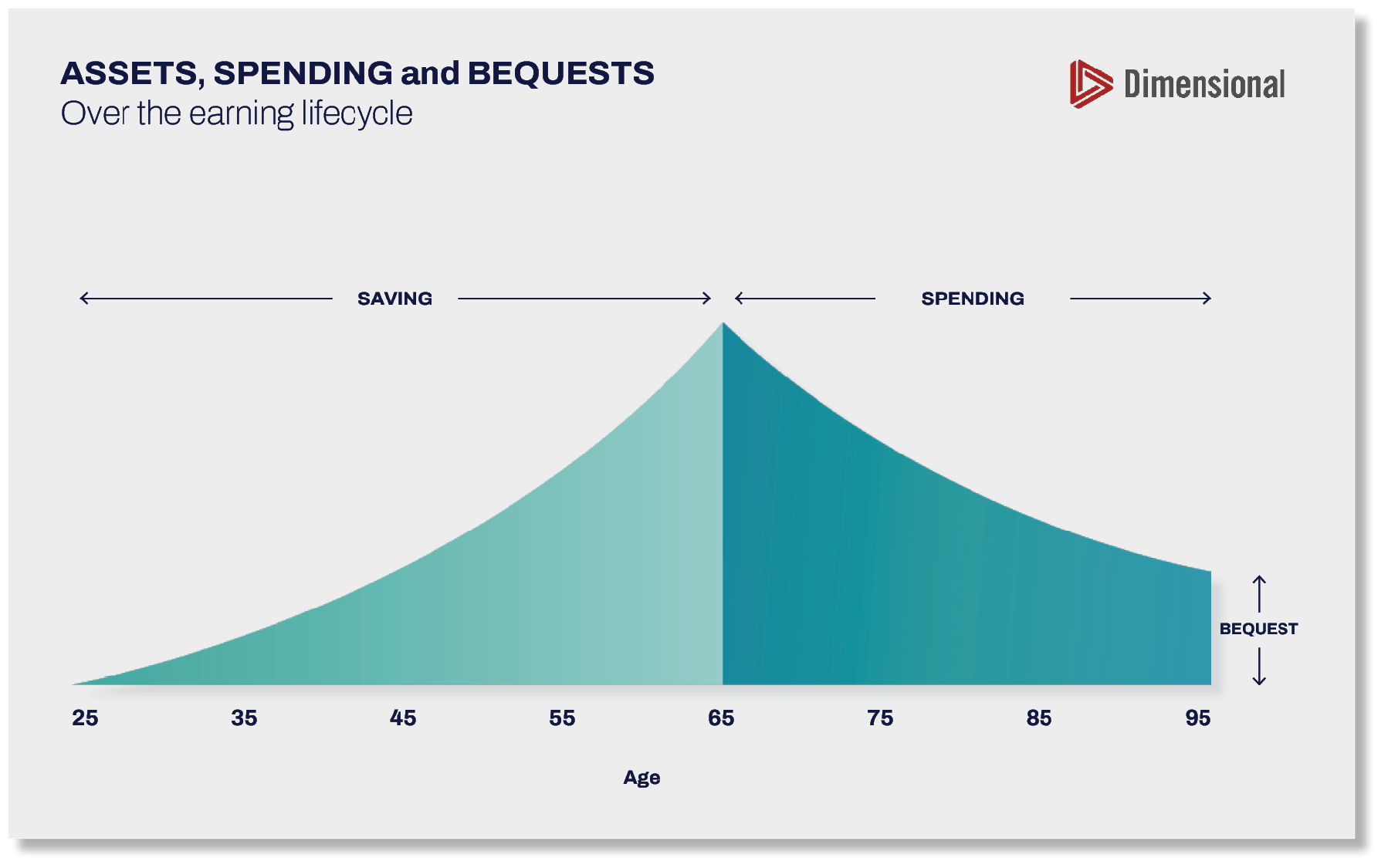
I turned 50 on the second of July. That includes nearly 30 in the workforce, 26 years as a financial adviser, 20 as a husband and 18 as a father. Do the maths and I'm roughly two-thirds through my optimal earning window, if we call 65 the end of the innings. It’s made me stop and do the thing I always ask of clients: take an honest look at where I am now, and where the next 15 years are heading.

Most of us never think about the shape of our earning life, but it follows a pattern. The 20s are for learning a trade, finding your feet in a profession, perhaps marrying, often still paying off the student loan. The 30s bring children, a mortgage and the long grind of deepening a career. By the 40s the income finally lifts and a little pressure comes off. Then the 50s and 60s arrive, and many people start thinking about the golden years to come. Here’s the rub: a fit and healthy 65-year-old has not just finished their best earning years; for many, the earning stream has stopped altogether. The way we’re living these days, those earnings now need to carry us all the way through to our 90s. That’s three decades of withdrawals from a jar you stopped filling, so you need to put a lot of cookies in that jar to sustain yourself for 30 years.

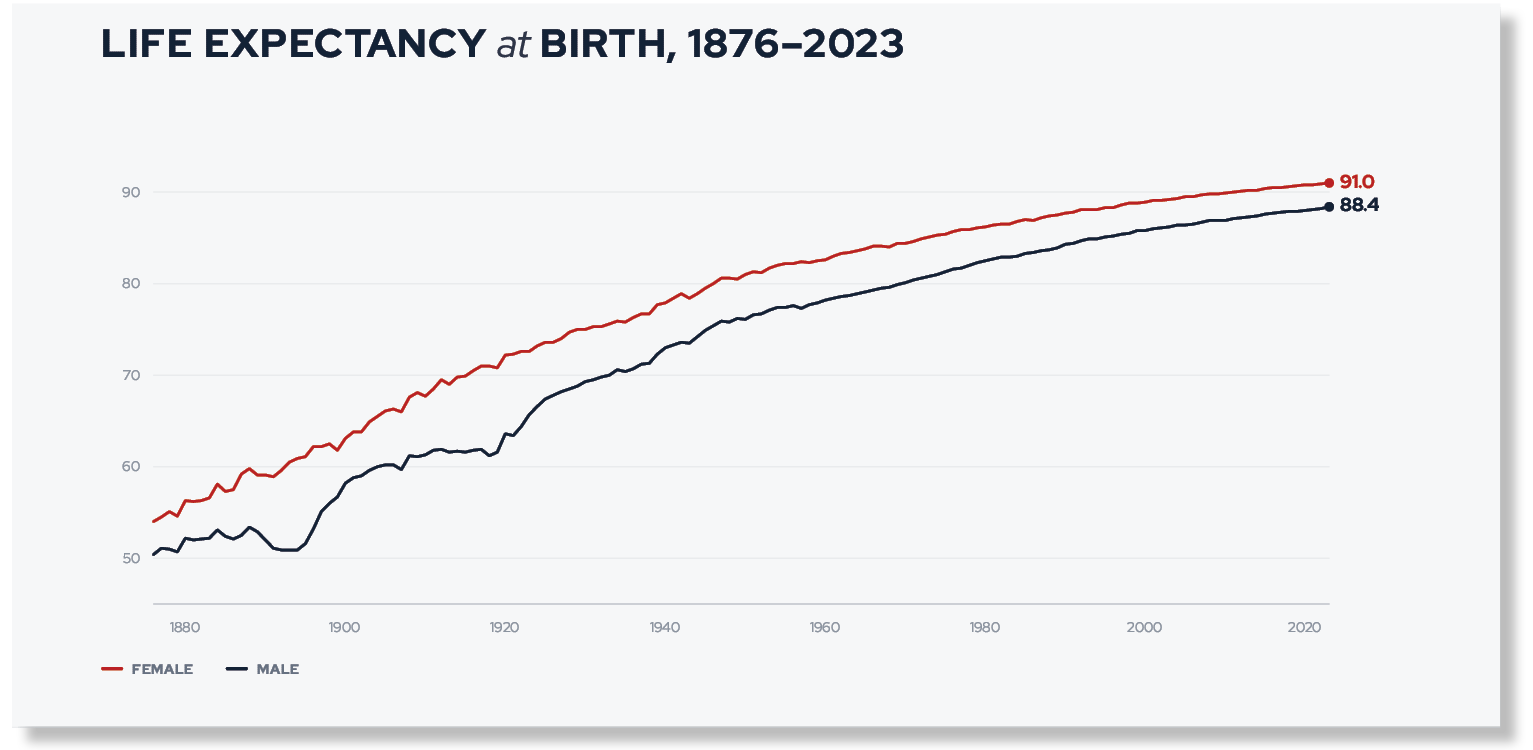
For most of human existence, 50 was the end of the road. In 1900, life expectancy for men in New Zealand sat in the late fifties [1]. A man of 50 in those days really was winding down, because he was nearly done. The Victorians built their whole idea of a life stage around it - you worked until your body gave out, and the gap between the two was mercifully short. Today, a healthy 50-year-old can reasonably expect another 35 years or more, and an increasing number of us will see ninety [1]. We’ve held on to the old instinct that 50 is the beginning of the end, while living an entirely different reality. The body tells us we have arrived. The maths tells us we are barely halfway.

Source data: New Zealand cohort life tables: March 2025 update | Stats NZ

This is where I see good people stumble, though rarely through recklessness. The kids are nearly gone, the mortgage is finally in retreat, and “finally” becomes the word of the moment. Finally, we can do a few things for ourselves! The bucket list, the holidays, the trips deferred for 20 years while school fees and braces and first cars ate every spare dollar. It feels earned, and it feels good, because it is and it does. Behavioural research calls this ‘present bias’; a hard-wired habit of overweighting the reward we can have today against the one we must wait for [2]. But that freed-up cash flow is being enjoyed at the precise moment it should be doing its hardest work. The next 15 years from 50 are prime accumulation time, not the victory lap people imagine them to be.

Most balance sheets tend to be the same at 50: top-heavy with lifestyle assets. The house, the cars, the bach with its rates, maintenance and insurance quietly eroding spare cash or savings each year. It has been the Kiwi dream for as long as I can remember, and there is nothing wrong with wanting that dream. But while the numbers look perfectly reasonable on the surface, the cash flow underneath is poor. The assets that produce real income and liquidity - the ones that will still pay you when your salary stops - are too small to move the needle in this scenario. You’re carrying a great deal of weight that does not work for you, and worse – it's costing you to hold it.

This is where knowing values is crucial. At 50, you need to be clear on what matters and what you must build over the next fifteen years – because every goal is built on cash flow, and cash flow comes from the assets you have accumulated. Get the values right and the rest follows in a straight line. Leave them vague and you’ll inevitably keep spending on what feels good now, instead of what carries you through your 70s, 80s and 90s. The order in which your returns arrive in the early retirement years can make or break a 30-year drawdown, and a poor first few years while you are drawing down does damage that a good average return never quite repairs [3].

It can feel uncomfortable to take such a frank look at your present and future, but it’s fairly straightforward. Do your lifestyle assets fit what you are trying to build? Are you protecting your peak earning stream as the engine that funds everything else? Is your cash flow working backwards, servicing debt on things that do not compound, or forwards, building assets that do?

The gap between what New Zealanders expect to retire on and what they have set aside remains stubbornly wide. It widens fastest for those who assume there is still plenty of time [4]. At 50, most people can still materially change their later years by engaging and making a few incremental course adjustments. These changes don’t have to be dramatic, but they do need to be early. A small correction to a flight path early in the journey lands you in a completely different place.

Often, the best co-pilot on such a journey is a professional financial advisor. And if you think professional advice is expensive, try using an amateur – see what it costs you. Unfortunately, the most expensive amateur you can ever hire is usually yourself; timing the market with optimism and a spreadsheet doesn’t tend to get the same results as methodical, proven strategies and a steady pair of hands at the wheel. Time in the market is the one advantage you cannot buy back later at any price [5].

This is the fiduciary truth of it, and it is the part I care about most after 26 years. Seeking wise counsel at 50 is not an admission of weakness. It’s the best way to understand your own position; we’re all the worst judges of our own blind spots, but an unbiased third party can see the whole scene with clarity.

A good adviser is not there to take the holidays away. They are there to make sure the holidays at 70 are still possible.

50 is the inflection point where you can still move the dial in a way you simply cannot at 65. The runway is shorter than it was, but you’ve got a good bit of tarmac left before earnings come to a stop. The question is not whether the time for preparation has passed (it hasn’t), but whether you will use what remains of it. A burden shared is a burden halved.


Nick Stewart

(Ngāi Tahu, Ngāti Huirapa, Ngāti Māmoe,
Ngāti Waitaha)

Financial Adviser and CEO at Stewart Group

  • Stewart Group is a Hawke's Bay and Wellington based CEFEX & BCorp certified financial planning and advisory firm providing personal fiduciary services, Wealth Management, Risk Insurance & KiwiSaver scheme solutions.

  • The information provided, or any opinions expressed in this article, are of a general nature only and should not be construed or relied on as a recommendation to invest in a financial product or class of financial products. You should seek financial advice specific to your circumstances from a Financial Adviser before making any financial decisions. A disclosure statement can be obtained free of charge by calling 0800 878 961 or visit our website, www.stewartgroup.co.nz

  • We do not hold or advise on any private credit or private equity investments.


REFERENCES

  1. Stats NZ. (n.d.). Life expectancy. https://www.stats.govt.nz/information-releases/new-zealand-cohort-life-tables-march-2025-update/

  2. ScienceInsights. (n.d.). What is present bias? How it shapes your decisions. https://scienceinsights.org/what-is-present-bias-how-it-shapes-your-decisions/

  3. Sequence of returns risk: Why the order of returns matters in retirement. The Long Math. https://www.thelongmath.com/articles/investing-and-financial-literacy/sequence-of-returns-risk/

  4. Te Ara Ahunga Ora. (2022). Annual report 2022. https://assets.retirement.govt.nz/public/Uploads/Annual-Report/TAAO-RC-Annual-Report-2022.pdf

  5. Dai, W., & Dong, A. (2023, October 31). We found 30 timing strategies that “worked”—and 690 that didn't. Dimensional Fund Advisors. https://www.dimensional.com/sg-en/insights/we-found-30-timing-strategies-that-worked-and-690-that-didnt


The Red Baron's Dicta: Timeless Lessons in Discipline and Risk

Article #453

April 21st marks the anniversary of Manfred von Richthofen's death: the legendary Red Baron who claimed 80 aerial victories before falling at just 25 years old.

Since childhood, I've been captivated by his story. Here was an aerial combat pioneer and crack shot hunter since his youth, who transformed the chaos of dogfighting into a disciplined science. What makes his story relevant for investors isn't his success, but how he achieved it through disciplined adherence to proven principles – and ultimately, how he lost everything by abandoning them in a single moment of exuberance.

From Hunter to Ace

Von Richthofen's foundation as a hunter shaped everything that followed. Before he ever climbed into a cockpit, he'd spent years stalking game on his family's Silesian estate, learning patience, precision, and the critical importance of positioning. A hunter doesn't charge blindly at prey; he studies wind direction, uses terrain for cover, and waits for the perfect shot. Honed since boyhood, these instincts would prove invaluable in the skies above the Western Front.

He brought this hunter’s mentality with him when he transferred to the Imperial German Air Service in 1915. He learnt his craft from Oswald Boelcke, the era's preeminent fighter tactician, whose maxims established fundamental rules for air combat. But von Richthofen didn't simply follow his mentor's teachings; he refined them through his own experience into his own dicta – an effective combat manual that became the foundation for his legendary Flying Circus.

The Dicta: A Hunter's Discipline Applied to Combat

The Baron's rules were precise and probabilistic, each designed to stack advantages systematically.

  • Secure advantages before attacking: altitude, sun position, numerical superiority. Like a hunter choosing his ground, never engage until the odds favour you.

  • Attack from behind where opponents can't see you, just as a hunter approaches game from downwind.

  • Fire only at close range when your target is properly in your sights – ammunition is limited, and wild shots achieve nothing.

  • Always carry through an attack once started. Half-measures waste the advantage you've worked to secure.

  • Keep your eye on your opponent; never let them trick you into looking away. A hunter who loses focus on his quarry finds himself suddenly the hunted.

  • When threatened, don't evade—turn and face the attack. Running reveals your vulnerability; confronting the threat keeps you in control.

  • Over enemy lines, always remember your line of retreat. Know where safety lies, just as a hunter always knows the path back to camp.

He drilled his pilots in these tactics as they flew, pairing them as leader and wingman, spaced 60 metres abreast to allow room for manoeuvre without collision. They flew in tight formation, massing their power for coordinated strikes. This ensured every engagement began with probability tilted in their favour.

The Flying Circus became legendary for systematic execution. Von Richthofen applied that hunter's patience to aerial warfare, refusing to engage unless conditions favoured him. His bright red Fokker Dr.I triplane was essentially psychological warfare, announcing his presence and unnerving opponents before the first shot was fired.

Manfred von Richthofen (centred) with his mentor Hauptmann Oswald Boelcke (left) and Reserve Lieutenant Max Immelmann (right)

From Nick Stewart’s personal collection

Stacking Structural Advantages in Investing

Just as von Richthofen never attacked without multiple advantages working simultaneously, successful investing requires layering structural advantages that compound over time:

Numerical superiority: Broad diversification reduces unsystematic risk. Rather than betting everything on a single stock or sector, spread exposure across asset classes, geographies, and market capitalisations. You're not dependent on any single position succeeding, giving you better odds overall.

Securing altitude advantage: Tilts towards factors like value and small-cap, which decades of academic research show provide systematic return premiums over time. This means you begin each engagement from a position of structural strength backed by empirical evidence.

Additionally, low costs prevent silent erosion of returns. Every percentage point in fees is altitude surrendered before the engagement begins. Index and enhanced index funds that minimise expenses ensure more of your capital remains invested and compounding rather than being siphoned off.

Remembering your retreat: Liquidity enables repositioning when needed. Like von Richthofen’s strategy, portfolios need the ability to adapt without being trapped in unfavourable positions. Illiquid investments might offer higher returns, but they remove flexibility precisely when you might need it most.

Always see things through: Tax efficiency keeps more capital compounding. In New Zealand's relatively benign capital gains environment, this means strategic timing of realisations, thoughtful use of portfolio investment entities, and attention to income versus capital return characteristics.

Like securing altitude and sun position before attacking, proper asset allocation and positioning come first. Like firing only at close range with targets in your sights, investment decisions require clear conviction based on evidence, not speculation. Like the Flying Circus's coordinated attacks, diversification across asset classes works more effectively than concentrated bets.

Oil painting by Max Ordinall, from Nick’s personal collection

Constant Awareness: The Discipline of Waiting and Watching

Von Richthofen's rule about keeping your eye on your opponent and never being tricked into looking away speaks directly to behavioural finance. The greatest threat to individual investment success isn't market volatility. It's our own behavioural biases, causing us to look away at critical moments.

In investing, maintaining awareness means monitoring what you can control whilst ignoring what you can’t - AKA the noise designed to distract:

  • Portfolio drift from target allocations matters. Daily market movements don't.

  • Rebalancing opportunities when asset classes diverge significantly from targets matter. Quarterly earnings reports for individual companies within diversified index funds don't.

  • Changes in personal circumstances requiring plan adjustments matter. Predictions about where markets are headed next month don't.

Discipline is harder in practice than in abstract. The retail investment industry generates an overwhelming torrent of information, most of it designed to make you feel you're missing something critical if you're not constantly trading. But as von Richthofen ignored enemy aircraft that didn't present advantageous engagement opportunities, investors must ignore much of market commentary and focus solely on what affects their systematic advantages.

Systematic Execution: Rebalancing as Tactical Discipline

Disciplined rebalancing is your “always carry through an attack once started” parallel. When equity markets surge beyond target allocations, trim them back to target. When they fall and fear is highest, rebalance back into them. Half-measures, like trimming only slightly or delaying rebalancing in case of a better opportunity later, waste the systematic advantage you’ve built.

This is extraordinarily difficult psychologically. Trimming equities after they've surged feels like selling winners. Adding to equities after they've fallen feels like catching a falling knife. But this mechanical adherence removes emotion from decision-making and ensures you're systematically buying low and selling high without attempting to time markets.

Von Richthofen's pilots didn't abort attacks halfway through if conditions looked momentarily unfavourable. They committed fully, trusting their systematic advantages would prevail. The same discipline applies to rebalancing: execute completely. Trust the process.

When Threatened, Face the Attack

When markets plunge, and portfolios decline, every instinct screams to sell, to "preserve what's left”, or to flee to cash.

This is precisely when systematic discipline matters most. Loss aversion—the behavioural bias where losses feel roughly twice as painful as equivalent gains—drives panic selling at market bottoms. Recency bias makes recent volatility feel like the new permanent reality. These biases trick investors into looking away from their long-term objectives and focusing on short-term pain.

Facing the attack means maintaining perspective. Your goals—retirement security, educational funding, legacy objectives—haven't changed because markets had a volatile quarter or year. Your systematic advantages—diversification, factor tilts, low costs—still function. The evidence supporting long-term equity returns hasn't evaporated.

Avoiding Fatal Deviation

The Baron's final flight on April 21, 1918, illustrates what happens when principles are abandoned. Engaging Canadian pilot Wilfrid May in a prolonged dogfight, von Richthofen broke multiple cardinal rules. The wind that day blew from an unusual direction—not the prevailing westerlies favouring German pilots. The extended engagement pushed him progressively deeper over Allied lines near the ridgeline at Corby.

He forgot his line of retreat. Flying low in pursuit of a relatively inexperienced opponent, he'd surrendered altitude advantage for the thrill of another victory. No wingman accompanied him. No formation support protected him. Every systematic advantage that had kept him alive through 80 victories had evaporated in the heat of pursuit.

A single, well-timed shot from Australian ground troops ended the legend—despite the aerial victory subsequently claimed by Canadian RAF pilot Roy Brown. One bullet. One moment of losing sight of position, probability, and principles.

Investors make remarkably similar mistakes constantly. Prolonged bull markets create overconfidence, and carefully constructed asset allocations drift unchecked because "equities always go up" or "bricks and mortar never lose value." A colleague's cryptocurrency windfall makes disciplined portfolios feel inadequate, tempting abandonment of evidence-based strategies for speculation. Market corrections trigger panic selling despite decades until retirement, abandoning the systematic discipline that would mean buying at depressed prices.

These are precisely the moments when abandoning proven principles feels most justified—and when probability turns decisively against us. We're pursuing that one more gain, chasing performance, abandoning our line of retreat.

Von Richthofen's legacy is defined by the systematic, probabilistic approach that made him exceptional – and his demise shows the value in sticking with what works.

His manual endures because it improves probability in combat. Markets require a similarly disciplined approach: following proven principles not just when conditions are favourable, but especially when every instinct says otherwise. 

Nick Stewart

(Ngāi Tahu, Ngāti Huirapa, Ngāti Māmoe,
Ngāti Waitaha)

Financial Adviser and CEO at Stewart Group

  • Stewart Group is a Hawke's Bay and Wellington based CEFEX & BCorp certified financial planning and advisory firm providing personal fiduciary services, Wealth Management, Risk Insurance & KiwiSaver scheme solutions.

  • The information provided, or any opinions expressed in this article, are of a general nature only and should not be construed or relied on as a recommendation to invest in a financial product or class of financial products. You should seek financial advice specific to your circumstances from a Financial Adviser before making any financial decisions. A disclosure statement can be obtained free of charge by calling 0800 878 961 or visit our website, www.stewartgroup.co.nz


REFERENCES

  1. Franks, N. & Bennett, A. (1995). The Red Baron's Last Flight. Grub Street Publishing.

  2. Kilduff, P. (2007). Red Baron: The Life and Death of an Ace. David & Charles.

  3. Fama, E.F. & French, K.R. (1992). "The Cross-Section of Expected Stock Returns." Journal of Finance, 47(2), 427-465.

  4. Kahneman, D. & Tversky, A. (1979). "Prospect Theory: An Analysis of Decision under Risk." Econometrica, 47(2), 263-291.

Canny View: Into the Bush — and Back, Rewarded 

Article #451

The crack of a rifle echoes through the ranges. Deer season is open, and thousands of New Zealand hunters are pulling on their boots, loading up their packs, and heading into the hills with purpose. The roar is in full swing, and the pursuit of a good stag and a well-stocked freezer is very much alive. 

As I watch the preparations unfold each year, I can't help but see unmistakable parallels between heading into the bush and heading into the markets. Both reward the well-prepared investor. Both punish the cavalier. In both cases, coming home well and coming home rewarded start long before you take your first step. 

Know the terrain before you go in 

No serious hunter heads into unfamiliar bush without doing their homework first. They study the topography, understand the animal patterns, check the weather forecast, and know their exit routes. They talk to people who have hunted that country before. They don't assume that experience from one range translates perfectly to another. 

The investment landscape demands the same meticulous care. Before committing capital, the prepared investor takes time to understand the environment they're entering: market conditions, their own risk tolerance, time horizon, and the nature of the assets they're holding. Again, a fund or asset class that performed brilliantly in one market cycle may behave very differently in the next. 

Winging it in either arena tends to end badly, and usually at a financial cost to the unwary. 

Make your intentions known 

Every responsible hunter tells someone where they're going, when they expect to be back, and the route they plan to take. More than mere courtesy, this is protocol that keeps people safe when conditions change unexpectedly. Search and rescue teams will tell you that the single most useful thing a hunter can do before heading out is leave a detailed intentions form with someone they trust. 

In financial planning, this translates to working with a trusted fiduciary adviser who holds the full picture of your goals, your situation, and your plan. They're the person who knows where you're headed, what you're working towards, and can raise the alarm or offer a steadying, experienced hand if the conditions shift unexpectedly. A financial plan that lives only in your head is about as useful as intentions you forgot to leave behind before heading into the ranges. 

Safety first: Treat every firearm as loaded 

The golden rule of firearm safety is to treat every weapon as if it's loaded, every time, without exception. No shortcuts, no assumptions, no matter how familiar the environment or how experienced you are. The moment you stop following the rules is the moment accidents happen. 

In investing, the equivalent is always respecting risk, even when conditions look calm, and the market appears benign. It's easy to become cavalier about risk after a long bull run. Portfolios go up, confidence grows, and caution starts to feel unnecessary. But the investors who come unstuck are rarely those who panicked in a downturn; more often, they're the ones who stopped taking risk seriously when times were good and had over-exposed themselves before the conditions changed. Complacency is the safety left on when you're absolutely sure you don't need it, and this oversight will catch up with you eventually. 

Don't pull the trigger prematurely 

A seasoned hunter knows that a poor shot, taken in haste, without a clear line of sight, or before the animal is properly settled, can wound rather than harvest, and cost you the opportunity altogether. Patience is not a waste of time, nor mere passivity. It is the active, disciplined decision to wait until conditions are right. 

The same applies to investment decisions made in the heat of the moment. Selling out of a portfolio when markets fall sharply can feel decisive, and even prudent, at the time. But it often locks in paper losses and leaves you sitting on the sidelines in cash when the recovery comes. And recoveries, historically, tend to come faster and more forcefully than most people expect. 

The discipline to hold your position, wait for the right conditions, and resist the urge to act simply because the uncertainty is uncomfortable is what separates a skilled, long-term investor from a reactive one. 

Go prepared and stay prepared 

The experienced hunter carries more than a rifle. They bring a first aid kit, emergency shelter, a personal locator beacon, and enough food and water to last longer than expected. They aim for the best outcome, while being genuinely prepared for the worst.

A well-constructed investment portfolio works the same way.  

Diversification is your emergency kit. It won't prevent all downturns or shield you from every storm, but it ensures no single bad outcome takes you out entirely. Spreading your exposure across asset classes, geographies, and sectors means that when one area of the market is under pressure, others may be holding firm or even gaining ground. Regular reviews with your adviser are the equivalent of checking your gear before each outing; it's essential maintenance that most people wish they'd undertaken sooner when something eventually goes wrong. 

The reward is in the preparation 

Seasoned hunters come home with something to show for their efforts more often than not, and it's not luck. It's methodical preparation, sound judgment, deep respect for the environment, and the discipline to follow the rules—even when no one is watching and it would be easy to cut corners. 

The same is true of investing. The clients who tend to come home well-rewarded are rarely those who chased the latest hot opportunity or abandoned their carefully built plan at the first sign of difficulty. They're the ones who went in prepared, stayed their course through the inevitable rough patches, kept reviewing and adjusting with their adviser, and trusted a disciplined, evidence-based process over the long run. 

The bush doesn't care how confident you are. Neither do the markets. But go in right, with a clear plan, the right gear, a trusted guide, and the discipline to follow through when it counts, and both have something well worth taking home. 

And if the stag proves elusive this Easter, there's always the egg hunt: a somewhat safer pursuit, with arguably better odds of coming home rewarded. 


Nick Stewart

(Ngāi Tahu, Ngāti Huirapa, Ngāti Māmoe,
Ngāti Waitaha)

Financial Adviser and CEO at Stewart Group

  • Stewart Group is a Hawke's Bay and Wellington based CEFEX & BCorp certified financial planning and advisory firm providing personal fiduciary services, Wealth Management, Risk Insurance & KiwiSaver scheme solutions.

  • The information provided, or any opinions expressed in this article, are of a general nature only and should not be construed or relied on as a recommendation to invest in a financial product or class of financial products. You should seek financial advice specific to your circumstances from a Financial Adviser before making any financial decisions. A disclosure statement can be obtained free of charge by calling 0800 878 961 or visit our website, www.stewartgroup.co.nz

Fonterra Sale: A Once-in-a-Generation Opportunity for Financial Balance

Article # 446

Fonterra's shareholder approval of the $3.2 billion capital return from the Mainland Group sale has now been rubber-stamped. Farmers are set to receive an average of $392,000 per operation—some larger operations receiving over $2-3 million.¹

The deal, which saw 88% support back in October when the $4.2 billion sale to French dairy giant Lactalis was approved, represents a watershed moment for New Zealand dairy farmers. Last week's special meeting confirmed the capital return arrangements through a scheme of arrangement, with settlement expected any time between now and the end of March.²

JHVEPhoto - stock.adobe.com

Around 60% of shareholding farms will receive at least $200,000, while some of the co-op's largest shareholders will receive over $2-3 million. Southland's Fortuna Group, with more than 4.4 million shares, will receive close to $9 million, while state-owned farmer Pāmu could receive $10 million.²

This reflects the sector's strategic maturity and forward-thinking approach to wealth creation beyond a single generation. It's a recognition that the most resilient farming families build diversified financial structures that can support their operations and families through all market cycles.

The balance of the sale proceeds is being retained by Fonterra to reinvest in its ingredients and foodservice businesses, with some cash used to retire debt or applied as working capital. Fonterra forecast its balance sheet metrics to stay in line with targets, being debt to EBITDA of less than 3x and gearing of 30-40%.²

Understanding Real Returns: The Smart Farmer's Perspective

Savvy farmers know headline numbers don't tell the whole story.

While the recent $10.16 per kilogram of milk solids farmgate price represents a nominal record,³ astute operators understand the critical importance of inflation-adjusted returns when assessing true profitability.

The previous high-water mark came in the 2013/14 season at $8.40 per kilogram.⁴ At first glance, this suggests farmers are now receiving approximately 21% more per kilogram than they did eleven years ago. However, this comparison becomes meaningless when examined through the lens of actual input cost inflation that has fundamentally transformed farm economics.

The rising cost of production

Between 2019 and 2024, the average total cost for milk production across major exporting regions increased by around 14%, with over 70% of that increase occurring since 2021.⁵ While on-farm inflation peaked at 10.2% in the year to March 2022,⁶ costs remained elevated through 2023 before moderating slightly in 2024. However, the cumulative impact since 2013 is huge.

The structural cost uplift is evident across every input category. From 2018-19 to 2024-25:

  • Interest costs for an average dairy farm rose 86.5%, from $187,182 to $246,416 annually.⁷

  • Insurance costs increased approximately 33% over five years, with insurance premiums now succeeding fertiliser and interest rates as a major cost pressure in 2024.⁸

DairyNZ estimates dairy operating expenses reached $8.16 per kilogram of milk solids in 2022/23, up sharply from $7.23 in 2021/22.⁹ The national break-even farmgate milk price for the 2024/25 season is $7.76 per kilogram of milk solids.¹⁰

Fertiliser costs saw some products skyrocket from $799 per tonne to $1,800 per tonne during the peak inflation period.¹¹ While prices moderated in 2024 (declining 4.2% in the sheep and beef sector),¹² the cumulative impact of years of price escalation remains embedded in farm cost structures. Additionally, feed costs for dairy farms rose 28.2% between 2020-21 and 2022-23.¹³

Added pressure from interest rates

While the Official Cash Rate has fallen to 2.25%, medium and longer-term fixed mortgage rates have been rising since December 2025. Wholesale interest rates have increased more than half a percentage point since November, with banks lifting 2-5 year fixed rates accordingly.

ASB's 2-year rate now sits at 4.95% and 3-year at 5.19%, while Westpac's 4-year rate has risen to 5.19% and 5-year to 5.29%.¹⁴ Markets are pricing in potential OCR hikes from mid-2026 as inflation sits at 3.1%, above the Reserve Bank's 1-3% target band.¹⁴

This dynamic creates renewed debt servicing pressure for farmers despite the falling OCR. The disconnect between short-term policy rates and longer-term borrowing costs reflects market expectations about future inflation and the eventual return to higher rates.

Smart farmers recognise this reality: $10 per kilogram milk price (while excellent in nominal terms) represents the outcome of working harder, investing more capital, and operating more efficiently within a structurally higher cost environment. When you strip away the nominal gains and examine purchasing power, farmers aren't substantially better off than they were at the previous peak. They've simply adapted to significantly higher operating costs.

The best operators understand that sustainable wealth creation requires thinking strategically beyond the farm gate. Relying solely on commodity price increases that barely keep pace with input cost inflation is not a wealth-building strategy, it's survival.

Extreme Volatility Demands Resilience

Recent price swings have been dramatic, rapid, and unpredictable – proving why wealth structures beyond farm gate are essential for multi-generational farming families.

The season opened in August 2025 with Fonterra forecasting a midpoint of $10 per kilogram with a wide range of $8-$11 per kilogram.¹⁵ For several months, this appeared achievable as prices held firm.

December’s dairy downturn

After nine consecutive Global Dairy Trade auction declines, Fonterra cut its farmgate milk price forecast for the second time in the season in December. It dropped from the season-opening midpoint of $10 per kilogram down to $9 per kilogram with a narrowed range of $8.50-$9.50.¹⁶ Whole Milk Powder prices had fallen 5.7%, having declined nearly 28% from their May peak.¹⁶

Market commentary was uniformly bearish, with analysts warning of sustained supply-side pressure and global milk flows outstripping demand. The outlook was grim. Farmers adjusted budgets, planned for lower cashflows, and braced for a difficult season.

Then, in a remarkable reversal, the market staged a recovery.

An unexpected upswing

Four consecutive positive Global Dairy Trade auctions saw prices surge back to September levels.¹⁷ Whole Milk Powder, which accounts for half the auction by volume and has the greatest influence on farmgate milk price, rose 2.5% to US$3,706 per metric tonne in late February. Skim milk powder increased 3% to US$2,973 per metric tonne, while butter surged 10.7% to US$6,347 per metric tonne.¹⁷

Last Friday (February 20, 2026) Fonterra responded to this market recovery by lifting its forecast again, just ten weeks after the December cuts. The co-op raised the midpoint from $9.00 to $9.50 per kilogram with a new range of $9.20-$9.80.¹⁸ CEO Miles Hurrell cited "recent improvements in global commodity prices combined with Fonterra's well contracted sales book."¹⁸

Additionally, Fonterra announced a special dividend of 14-18 cents per share from the entire fiscal 2026 underlying earnings generated by Mainland Group, payable following the completion of the sale to Lactalis.¹⁸

Volatility as a hard-learned lesson

This whipsaw journey (from $10, to $9, to $9.50) over the course of just four months illustrates the fundamental challenge facing farming families who depend entirely on commodity prices for wealth creation.

These aren't gradual, predictable shifts that allow for careful planning. They're rapid, material changes driven by global supply and demand dynamics that individual farmers cannot influence or accurately predict. In August, the outlook appeared strong. By December, it appeared dire. By February, it had recovered.

What will it look like in May? July? No one knows.

This volatility creates genuine financial planning challenges for families trying to build intergenerational wealth. How do you plan for retirement, fund the next generation's education, or structure succession when your primary income source can swing 10-20% in a matter of weeks?

Critically, even as Fonterra lifted its forecast, CEO Hurrell acknowledged that "global milk production remains above seasonal norms, meaning the risk of further volatility in pricing remains."¹⁸ In other words, yesterday's good news could reverse again next month. The unpredictability is structural, not temporary.

History guarantees there’ll be another downturn. You need to establish whether your family's financial security depends entirely on timing those cycles correctly, or whether you've built diversified wealth structures that can weather volatility while continuing to generate real returns.

Learning from the Best for Diversification

The most successful farming enterprises share one common characteristic: off-farm assets that aren't correlated to dairy commodity cycles.

The farm is the engine of wealth generation, but it shouldn't be the sole repository of wealth. Diversification creates financial resilience, provides genuine optionality, and reduces dependence on factors beyond the farm gate.

Strategic diversification into property, shares, managed funds, or other investments can provide income streams that aren't dependent on global dairy prices, exchange rates, or seasonal conditions. These assets have the potential to generate real returns above inflation. They can create genuine wealth growth, rather than simply keeping pace with rising costs.

Diversification also provides crucial liquidity that farm assets cannot deliver. When opportunities arise—whether that's acquiring neighbouring land, investing in new technology, or supporting the next generation's education—liquid investments can be accessed without forcing farm asset sales at potentially disadvantageous times. When emergencies occur, diversified wealth provides options and reduces stress.

This builds a comprehensive financial strategy that supports both farm and family for generations. The farm remains the core productive asset and the foundation of family identity and purpose – within a broader wealth structure providing stability, optionality, and genuine financial security through all market conditions.

Many farmers intend to reinvest this capital return into their farming operations.² This makes sense for operations with clear productivity improvements available. However, the most strategic approach balances on-farm reinvestment with genuine diversification beyond the farm gate.

There’s a question every farming family should ask: if we reinvest everything back into the farm, are we building wealth – or simply maintaining our exposure to a single asset class subject to extreme volatility and structural cost inflation?

Ensuring Quality Advice

As farmers contemplate deploying this imminent capital, the relationship with their financial adviser becomes paramount. This may be the largest single capital deployment decision many farming families ever make. Getting it right requires an adviser who is genuinely and legally committed to putting your interests first.

Will your adviser provide a written statement affirming that the advice relationship is of a fiduciary nature, where your interests unequivocally surpass those of the adviser?

Under New Zealand's financial advice regime, advisers are legally required to put their clients' interests first when giving advice and to prioritise their clients' interests over any conflicts.¹⁹ However, requiring your adviser to put this commitment in writing—in clear, unambiguous language—separates those who truly embrace fiduciary responsibility from those who simply meet minimum compliance standards.

Request a letter explicitly stating that all recommendations will prioritise your long-term financial wellbeing over commission structures, conflicts of interest, product preferences, or any other adviser considerations. This letter should confirm:

  • That the adviser will put your interests unequivocally ahead of their own

  • That they will disclose all conflicts of interest proactively

  • They will recommend only investments and strategies that serve your long-term objectives

  • Their compensation will be structured in alignment with your success

  • They will provide ongoing accountability for the advice given

If an adviser hesitates or refuses to provide this written commitment, that tells you everything you need to know about where their priorities truly lie. The best advisers welcome this clarity because it aligns with how they already operate.

It’s not about distrust—it's about establishing crystal-clear accountability in what may be the most significant financial planning exercise of your farming career.

Payment is Imminent – What About a Plan?

The timeline has crystallised. With settlement expected between now and the end of March,² farmers have mere weeks before capital arrives. The Overseas Investment Office approval cited the $3.2 billion direct injection of capital to New Zealand farmers as a strong economic benefit, alongside Lactalis' $100 million capital expenditure commitment and ongoing supply arrangements.² Finance Minister Nicola Willis confirmed the transaction met the "benefit to New Zealand test."²

For farmers who haven't yet engaged in comprehensive financial planning, the time to act is now—not after the money arrives. Once capital is in the bank account, the psychological pressure to "do something" with it can lead to reactive decisions, not strategic ones.

Execute on robust financial planning that diversifies wealth beyond agricultural assets into uncorrelated investments, creates multiple income streams independent of commodity cycles and inflation erosion, structures tax-efficient wealth transfer to the next generation, provides financial resilience and liquidity against future market downturns, and builds genuine intergenerational wealth that can support family objectives for decades.

Work with advisers now to develop comprehensive plans, have thorough family discussions about objectives and succession, and ensure structures are ready for when the capital arrives. The planning should happen now; the deployment happens when the money is in your account.

The Bottom Line

The dairy sector has proven its resilience, discipline, and strategic thinking through multiple crisis periods. But dependence on commodity prices alone creates unnecessary risk for farming families seeking to build multi-generational wealth.

Now, thanks to the Fonterra sale, farmers can take the next strategic step—building financial structures that weather all cycles and generate real wealth across generations. Beyond the next season, or even the next decade, this is about creating financial security that supports your family's farming legacy for the next century.

The question becomes whether you'll deploy the capital strategically, with proper advice, appropriate diversification, with explicit attention to generating real returns above inflation.

With capital arriving imminently and markets demonstrating their unpredictability daily, the time for planning is now. The most successful farmers will approach this thoughtfully, strategically… and with professional, fiduciary guidance that puts their interests unequivocally first.

Nick Stewart

(Ngāi Tahu, Ngāti Huirapa, Ngāti Māmoe,
Ngāti Waitaha)

Financial Adviser and CEO at Stewart Group

  • Stewart Group is a Hawke's Bay and Wellington based CEFEX & BCorp certified financial planning and advisory firm providing personal fiduciary services, Wealth Management, Risk Insurance & KiwiSaver scheme solutions.

  • The information provided, or any opinions expressed in this article, are of a general nature only and should not be construed or relied on as a recommendation to invest in a financial product or class of financial products. You should seek financial advice specific to your circumstances from a Financial Adviser before making any financial decisions. A disclosure statement can be obtained free of charge by calling 0800 878 961 or visit our website, www.stewartgroup.co.nz

  • Article no. 446


References

  1. BusinessDesk (19 February 2026). "Fonterra farmers set to rubber stamp $3.2b Mainland Group capital return". ASB estimated average return at $392,000, with 60% receiving at least $200,000.

  2. BusinessDesk (19 February 2026). Settlement expected between now and end of March 2026.

  3. NZ Herald (26 September 2025). Final farmgate milk payout reached $10.16 per kilogram of milk solids.

  4. NZ Herald (18 March 2025). In 2013/14 season, Fonterra paid $8.40/kg.

  5. Rabobank (18 February 2025). Between 2019 and 2024, average total cost increased 14%, with over 70% since 2021.

  6. NZ Herald (22 August 2022). On-farm inflation 10.2% for year to March 2022.

  7. Farmers Weekly (4 June 2024). Interest costs rose 86.5% from $187,182 (2018-19) to $246,416 (2024-25).

  8. USDA (2025). In 2024, insurance premiums succeeded fertiliser and interest rates as major cost pressure.

  9. Infometrics (August 2023). Operating expenses at $8.16 per kgMS in 2022/23.

  10. DairyNZ (2024). Break-even at $7.76 kg/MS for 2024/25.

  11. NZ Herald (22 August 2022). One fertiliser increased to $1,800/tonne from $799/tonne.

  12. Beef + Lamb NZ (June 2024). Fertiliser declined 4.2% in 2023-24.

  13. DairyNZ. Feed costs rose 28.2% between 2020-21 and 2022-23.

  14. RNZ (9 February 2026) and Opes Partners (25 February 2026). ASB: 2-year at 4.95%, 3-year at 5.19%; Westpac: 4-year at 5.19%, 5-year at 5.29%. Wholesale rates up over half a percentage point. Note: BNZ reversed recent rate hikes on 27 February 2026, cutting 3-year to 4.99%, 4-year to 5.19%, 5-year to 5.29%.

  15. Fonterra (August 2025). Season opened at $10/kg midpoint with range $8-$11/kg.

  16. Farmers Weekly (18 December 2025). Fonterra cut forecast to $9/kg midpoint, range $8.50-$9.50, following nine consecutive GDT declines.

  17. BusinessDesk (19 February 2026). WMP rose 2.5% to US$3,706/MT, SMP 3%, butter 10.7% following four consecutive positive auctions.

  18. Reuters/Fonterra (20 February 2026). "NZ's Fonterra lifts annual milk price forecast, teases special dividend". New midpoint $9.50/kg, range $9.20-$9.80. Special dividend 14-18 cents per share from Mainland Group FY26 earnings. CEO noted volatility risk remains.

  19. FMA New Zealand. Advisers must put client's interests first.

The DIY Investment Trap: Why New Zealanders Need to Play the Net Game

Article # 444

The democratisation of investing has transformed the financial landscape. Where once only institutional investors had access to sophisticated investment vehicles, today's retail investors can build diversified portfolios with a few clicks on their smartphones. Exchange-traded funds (ETFs) have been at the forefront of this revolution: in the United States, they now represent half of all listed funds[1], a remarkable shift that reflects their popularity and accessibility. 

The investment supermarket has expanded exponentially, offering strategies across listed and unlisted assets, domestic and international markets, and countless sectors and themes. From tech giants like Apple and Nvidia to broad market indices, bond funds to commodity trackers, the barriers to entry have never been lower.  

A generation ago, building a globally diversified portfolio required significant wealth and professional intermediaries. Today, it requires a brokerage account and an internet connection. 

But more choice doesn't automatically mean better outcomes. In New Zealand, there's a growing cohort of DIY investors who are playing the gross game when they should be playing the net game. They're watching their portfolio balances grow, celebrating double-digit returns, and comparing performance with friends… all whilst ignoring the substantial tax implications that will ultimately determine their real wealth accumulation. 

The Bracket Creep Reality 

New Zealand's tax landscape has shifted dramatically, yet many investors haven't adjusted their thinking accordingly. A significant number of Kiwis now find themselves in the 33% tax bracket (income between $70,000 and $180,000) or even the 39% bracket for those earning over $180,000, often without realising it until after 31 March when their tax returns are typically filed.[2] 

This isn't always due to massive salary increases or career progression. Bracket creep, driven by wage inflation without corresponding tax threshold adjustments, is quietly pushing more New Zealanders into higher tax brackets each year[3]. As wages rise to keep pace with the cost of living, the tax system captures an increasingly large slice of that income. What once seemed like a tax bracket reserved for high earners has become surprisingly accessible to middle-income professionals. 

But there's another factor many overlook when calculating their tax position: total earnings extend far beyond salary. Consider the full picture of your financial life. That cash sitting in the bank, even at relatively low interest rates, generates taxable income[4]. It might not seem like much on an individual transaction basis, but across multiple accounts and a full tax year, it adds up. 

Trust distributions, company dividends, rental income from investment properties, and profits from share trading; these all contribute to your taxable income.  

Many investors are genuinely surprised when they discover their effective tax rate is higher than anticipated, simply because they've been thinking about salary in isolation rather than total taxable income.  

The Hidden Consequence 

When you buy shares in Nvidia, Apple, or any other direct shareholding, or when you invest in ETFs tracking international markets, you're creating taxable events. Under New Zealand's tax rules, particularly the Foreign Investment Fund (FIF) regime, these investments generate tax obligations that must be included in your annual return[5]. 

The FIF rules are complex and often misunderstood. Many investors assume they only pay tax when they sell. In reality, they may be liable for tax on deemed income each year, regardless of whether they've sold anything. Yet a startling number of investors either don't realise this or don't adequately account for it in their investment strategy. 

They're focused on gross returns (the headline numbers showing how much their portfolio has grown) without applying a tax overlay to understand their true, net position. They celebrate when their tech stock portfolio rises 25%, but forget to calculate what that means after tax obligations are met. 

How We Got Here 

For roughly 25 years, New Zealand maintained a relatively flat tax structure with a top rate of 33%[6]. The tax environment was stable and predictable. Investors could make reasonably informed decisions knowing that their tax position would remain relatively constant. 

But the introduction of the 39% top tax rate in 2021[7], combined with the absence of inflation indexing for tax brackets, has fundamentally changed the game. Each year, more New Zealanders cross into higher tax brackets not because they're genuinely wealthier in real terms, but simply because thresholds haven't kept pace with inflation. 

The compounding effect is significant. A professional who was comfortably in the 30% bracket (or lower) a decade ago might now find themselves in the 33% or even 39% bracket, despite their real purchasing power having barely changed. The tax burden has increased substantially, yet investment strategies have often remained unchanged. 

Gross Returns vs Net Reality 

An investment delivering a 10% gross return might sound attractive, but if you're in the 39% tax bracket and a significant portion of that return is taxable under the FIF rules, your net return tells a very different story. Suddenly that 10% might be closer to 6% or 7% after tax. It’s still positive, but materially different from the headline figure. 

This distinction becomes even more critical when comparing investment options. A lower-gross-return investment with tax advantages might deliver superior after-tax returns compared to a higher-gross-return investment that's tax-inefficient for your circumstances. 

You don't want to win the battle only to lose the war. Chasing gross returns without understanding the net outcome is a pyrrhic victory – it looks impressive on portfolio statements but delivers disappointing real-world results when tax time arrives. 

The Silo Trap 

Even when investors recognise the need for professional advice, they can fall into another trap: the silo regime. Perhaps influenced by barbecue conversation about diversifying across advisers – “don't put all your eggs in one basket, mate” – some investors split their portfolio. They might allocate $750,000 here with one adviser, another substantial chunk there with a second, and perhaps a third portion elsewhere for good measure. 

The logic seems sound on the surface. After all, diversification is a fundamental investment principle, so why not diversify your advisers too? It provides a sense of security, multiple perspectives, and perhaps even keeps each adviser "honest" through implicit competition. 

You’re essentially asking each adviser to play with one hand tied behind their back. 

No single adviser in this fragmented arrangement understands your complete tax position. They can't see the full picture of your income sources, your various investment vehicles, or how different components of your portfolio interact from a tax perspective. They're optimising for their slice of your wealth without any visibility into the whole. 

One might be selecting investments that generate substantial taxable income, unaware that another adviser is doing the same thing, pushing you into a higher tax bracket than necessary. Or they might be duplicating strategies, eliminating the diversification benefits you sought by splitting your portfolio in the first place. 

Each adviser might be doing an excellent job with their portion, yet your overall outcome remains suboptimal because no one is orchestrating the tax efficiency of the complete picture[9].  

It's the financial equivalent of having multiple chefs each cooking one course of a meal without coordinating the menu. You might end up with three excellent dishes that don't work together at all. 

Why You Need a Financial Adviser 

Professional guidance matters. And not just any adviser, but one who can see your complete financial picture and implement a coordinated, tax-efficient strategy across all your assets. 

Investment success isn't measured by individual account performance. It's measured by your actual, after-tax wealth accumulation. An adviser with a holistic view can structure investments in ways that are tax-efficient for your specific circumstances, recognising that different investment vehicles have different tax treatments and that your personal tax situation is unique. 

They can help you understand whether PIE funds, direct shares, or other investment structures make the most sense for your position. They can coordinate the timing of income recognition, manage your exposure to FIF rules, and ensure your overall portfolio is working towards your net wealth goals rather than simply chasing gross returns. 

When seeking advice, look for a fee-only, unconflicted fiduciary adviser[10]. This ensures their recommendations are driven by your best interests, not commission structures or product sales targets. A fiduciary is legally obligated to put your interests first—a distinction that matters profoundly when navigating the complex intersection of investment strategy and tax planning. 

Fee-only advisers are compensated for their advice and service, not for selling particular products. This alignment of interests is crucial when you need objective guidance on tax-efficient structuring rather than a sales pitch for the highest-commission product. 

The Path Forward 

The DIY investment revolution isn't going away, nor should it. Access to investment opportunities is fundamentally democratising and positive. But as the New Zealand tax environment becomes increasingly complex, investors need to evolve their approach. 

Understanding your total tax position, applying a tax overlay to investment decisions, and focusing relentlessly on net returns rather than gross figures—these aren't optional luxuries. They're necessities for anyone serious about building wealth in today's environment. 

The supermarket aisle may be longer than ever, offering more choice than any previous generation of investors could have imagined. But choosing wisely requires understanding the true price you're paying; not just the label on the shelf, but the price after tax.  

The game has changed. Make sure you're playing it properly. 

Nick Stewart

(Ngāi Tahu, Ngāti Huirapa, Ngāti Māmoe, Ngāti Waitaha)

Financial Adviser and CEO at Stewart Group

  • Stewart Group is a Hawke's Bay and Wellington based CEFEX & BCorp certified financial planning and advisory firm providing personal fiduciary services, Wealth Management, Risk Insurance & KiwiSaver scheme solutions.

  • The information provided, or any opinions expressed in this article, are of a general nature only and should not be construed or relied on as a recommendation to invest in a financial product or class of financial products. You should seek financial advice specific to your circumstances from a Financial Adviser before making any financial decisions. A disclosure statement can be obtained free of charge by calling 0800 878 961 or visit our website, www.stewartgroup.co.nz

  • Article no. 444


References

[1] Investment Company Institute, 2024 data on US ETF market share  

[2] Inland Revenue Department, "Individual income tax rates" (current as of 2024-25 tax year)  

[3] New Zealand Treasury, "Fiscal drag and bracket creep analysis," 2024  

[4] Inland Revenue Department, "Resident withholding tax on interest"  

[5] Inland Revenue Department, "Foreign investment fund rules and portfolio investment entities"  

[6] New Zealand Tax History, "Top personal tax rates 1988-2021"  

[7] Taxation (Annual Rates for 2020–21, Feasibility Expenditure, and Remedial Matters) Act 2021  

[8] Financial Advice New Zealand, "The importance of holistic financial planning," professional standards guidance  

[9] Chartered Accountants Australia and New Zealand, "Tax-effective wealth management strategies," 2024

[10] Financial Markets Authority, "Financial adviser disclosure requirements and fiduciary standards," Financial Markets Conduct Act 2013 

28 Investment Principles That Actually Work When Markets Don't Cooperate

Article # 442

I've watched families navigate decades of volatility: crashes, recoveries, euphoria, panic. The ones who preserve wealth across generations don't have secret information or perfect timing. They follow simple rules, consistently.

February has 28 days. To ring it in, here are 28 guiding principles that have stood the test of time regardless of market activity.

1.       The market rewards patience, not prediction.

Most noise isn't information. The constant stream of commentary, analysis, and breaking news creates the illusion that staying informed means staying ahead. It doesn't. The market moves on fundamentals that reveal themselves slowly, not on headlines that change hourly.

2.       Focus on what you can control: Costs, discipline, diversification, behaviour.

You cannot control returns. You cannot control when recessions arrive or when bull markets end. But you can control how much you pay in fees, how consistently you invest, how broadly you spread your risk, and how you respond when fear or greed takes hold.

3.       You don't need to beat the market. You just need to capture it.

The obsession with outperformance drives investors towards complexity, higher costs, and ultimately, disappointment. Capturing market returns through low-cost, diversified portfolios has built more wealth over time than the pursuit of alpha ever has.

4.       The simplest portfolio is often the smartest.

Complexity rarely adds value. It adds cost, confusion, and opportunity for error. A straightforward allocation across global equities and bonds, rebalanced systematically, has outperformed the vast majority of elaborate strategies.

5.       Volatility is the price of admission.

Don't demand returns without accepting the ride. Equities deliver premium returns over time, because of fluctuations in the short term. If you cannot stomach the volatility, you don't deserve the returns.

6.       Time in the market matters more than timing the market. Always.

Missing just the 10 best days over a 20-year period can cut your returns nearly in half. Funnily enough, the best days often follow the worst ones – so it’s hard to capture them after getting cold feet on the downswing. Staying invested through the chaos is what separates wealth-builders from market-timers.

7.       Diversification is a dark horse.

Its power is revealed over decades, not days. When one asset class stumbles, another steadies the ship. The benefit isn't dramatic in any one year, but over a lifetime of investing, it's the difference between weathering storms and being swept away by them.

8.       Your plan should be built on evidence, not emotion.

Especially when emotions run high. When markets crash, fear whispers that this time is different and worse than any before. When markets soar, greed tells you that you're missing out. Evidence and decades of market history tell a different story – a much more trustworthy one.

9.       Chasing performance is a tax on impatience.

Last year's winners become this year's laggards with predictable regularity. By the time a fund or strategy appears on a "best performer" list, the opportunity has usually passed. Avoid getting swept up in the furore.

10.  The market has already priced in what everyone knows.

You don't need to outguess it. If information is public, it's already reflected in prices. Your edge as an investor isn't superior information, it's superior behaviour.

11.  A disciplined strategy beats a brilliant prediction. Every time.

Predictions fail. Discipline endures. The investor who follows a consistent plan through all market conditions will outperform the ‘strategist’ who tries to predict turning points.

12.  Your behaviour matters more than your products.

Panic is more expensive than fees: selling in a downturn locks in losses, while buying at market peaks locks in mediocre returns. Managing your behaviour by staying calm, and staying invested, matters far more than optimising your expense ratio by a few measley basis points.

13.  You don't need the perfect moment.

The moment you start is perfect enough. Markets climb over time. Waiting for a correction before investing often means waiting forever. Start now. Adjust as you go.

14.  Rebalancing is the quiet hero of long-term returns.

It forces buy-low, sell-high. When equities surge, rebalancing trims them back. When they crash, rebalancing buys more. It's counter-intuitive, uncomfortable… and extraordinarily effective over time.

15.  The best portfolios feel boring.

Boredom is not a bug, it's a feature. If your portfolio keeps you up at night with excitement, you’re probably taking on unnecessary risk. Wealth is built slowly, quietly, and without drama.

16.  Markets recover more often than they collapse.

History is your friend. Every bear market in history has eventually given way to a new bull market. Crashes feel permanent in the moment. They never are – as the adage goes, “this too shall pass.”

17.  Ignore headlines.

They're written to sell attention, not build wealth. Financial media thrives on urgency and alarm. Your portfolio should thrive on patience and perspective.

18.  Compounding works best when you don't interrupt it.

Let time do the heavy lifting. Albert Einstein allegedly called compound interest the eighth wonder of the world. But, it only works if you leave it alone – every time you exit the market, you reset the clock.

19.  Costs compound too.

Costs compound just like returns. Pay for advice that adds value, not for products that don't. The difference between value and waste always reveals itself in the fullness of time.

20.  Bad days don't destroy portfolios. Bad decisions do.

Markets fall. That's normal, and things will swing back the other way. Selling during the fall, abandoning your plan, or fleeing to cash – those are the decisions that inflict permanent damage.

21.  Not every risk deserves a reward.

Factor premiums do. Stocks are riskier than bonds, so they should deliver higher returns. Small-cap and value stocks have historically outperformed over long periods. These are risks worth taking. Concentrated bets on individual stocks or sectors? Not so much.

22.  Your portfolio should be built around you, not around the news cycle.

Your goals, your time horizon, and your risk tolerance should dictate your allocation. Not the latest economic forecast or geopolitical crisis.

23.  You don't need to predict the future.

…But you do need a strategy that survives it. Robust portfolios aren't built on forecasts. They're built on diversification, discipline, and the recognition that uncertainty is permanent.

24.  Stay invested, stay diversified, stay disciplined.

The rest is commentary. If you do these three things consistently, you will be fine. Better than fine, in fact. You'll be wealthier than the vast majority of investors who spend their lives chasing the next opportunity.

25.  Wealth isn't created in moments of excitement.

It's created in years of consistency. The investors who succeed aren't the ones who make brilliant trades or perfectly time the market. They're the ones who show up, year after year, regardless of conditions. Consistency compounds.

26.  Your worst investing day feels catastrophic. Your best investing decade feels inevitable.

Perspective matters. In the moment, a 20% drawdown feels like the end. Twenty years later, it's a footnote. Keep the long view. Stay the course.

27.  Successful investors are more patient than ‘smart’.

Intelligence helps, but temperament wins out every time. The ability to sit still, to do nothing when everyone else is panicking or euphoric, is worth more than any financial qualification.

28.  Markets don't care about your timeline. Build a plan that doesn't care about the markets.

You might need money in five years for a house deposit or in thirty years for retirement. The market will do what it does regardless. Structure your portfolio around your needs, not market predictions, and you'll sleep better through every cycle.

Remember: Markets will always be chaotic. Your response doesn't have to be.

Follow the rules (and seek professional advice)

These principles work. But they work best when you have someone in your corner who isn't conflicted by commissions, product sales, or institutional agendas.

Seek independent, impartial advice that puts you first and foremost. You are the sun, not the moon: your financial plan should orbit around you, your goals, your circumstances. Not around what someone else needs to sell.

Nick Stewart

(Ngāi Tahu, Ngāti Huirapa, Ngāti Māmoe, Ngāti Waitaha)

Financial Adviser and CEO at Stewart Group

  • Stewart Group is a Hawke's Bay and Wellington based CEFEX & BCorp certified financial planning and advisory firm providing personal fiduciary services, Wealth Management, Risk Insurance & KiwiSaver scheme solutions.

  • The information provided, or any opinions expressed in this article, are of a general nature only and should not be construed or relied on as a recommendation to invest in a financial product or class of financial products. You should seek financial advice specific to your circumstances from a Financial Adviser before making any financial decisions. A disclosure statement can be obtained free of charge by calling 0800 878 961 or visit our website, www.stewartgroup.co.nz

  • Article no. 442


The People's Poet and The People's Purse: From Burns to KiwiSaver

Article # 441

"A man's a man for a' that." - Robert Burns, 1795 [1]

Nigh on Burns Day feels like an appropriate moment to reflect on Scotland's most beloved poet. Robert Burns was no mere wordsmith; he was a revolutionary who believed wisdom and dignity belonged to everyone, not just the privileged few. Writing in Scots dialect rather than formal English, he made poetry accessible to common people in the 1700s; a radical and transformative act in its time.

Burns lived during the Age of Enlightenment, when intellectual discourse was largely confined to universities and aristocratic salons. Yet here was a ploughman-poet who insisted profound insights could come from anywhere: the farm, the tavern, ordinary folk going about their daily lives. His poetry gave voice to universal human experiences in language the people could understand.

An 18th-century Scottish poet has more to do with modern finance than you might think. Burns' commitment to democratising culture mirrors a shift that's been happening in the investment world, culminating in what might be New Zealand's most egalitarian financial innovation: KiwiSaver.

Burns' Revolutionary Accessibility

When Burns penned verses celebrating ploughmen, mice, and haggis, he was doing something deeply subversive. He was adamant that insight into the human condition – love, loss, joy, struggle – wasn't the exclusive domain of the educated elite. His genius lay in understanding that emotional intelligence and wisdom about human nature mattered more than formal education or social standing.

Consider "Auld Lang Syne," sung around the world each New Year; a meditation on friendship and memory, accessible to anyone. Or "To a Mouse," where disturbing a field mouse's nest becomes a profound reflection on planning and uncertainty. These weren't lofty academic exercises but observations from lived experience.

Burns recognised that a farmer could possess a deeper understanding than a nobleman. He celebrated the common person through genuine respect for their capacity for wisdom and feeling. This wasn't sentimentality; it was a fundamental belief in human equality that was genuinely radical for his era.

The Long Road to Investment Democratisation

For most of human history, investing was an aristocratic pursuit. You needed significant capital, insider connections, and often formal education to participate. Even in more recent history, the average person's financial planning extended to perhaps a savings account and hoping their employer's pension would suffice.

The journey toward broader access has been gradual:

  • Stock exchanges initially served merchants and wealthy traders.

  • The 20th century brought mutual funds and pension schemes, but these remained largely employer-controlled or required significant individual initiative and financial literacy.

  • The democratisation of investment accelerated with regulatory changes, technology, index funds, and online platforms.

Yet each advance still required knowledge and a confidence many New Zealanders lacked. We had democratised access… but barriers to participation remained.

KiwiSaver: The People's Purse

Enter KiwiSaver in 2007 – New Zealand's fiscal equivalent to Burns’ poetry [2]. Rather than another standard investment vehicle, it was a fundamentally egalitarian structure that would have made the Scottish bard proud.

KiwiSaver's genius lies in its true accessibility. It actively enrols people. Employers and employees both contribute. The government provides incentives. Millions of New Zealanders who might never have considered themselves "investors" were suddenly building wealth through capital markets.

The design was deliberately inclusive, as automatic enrolment meant participation became the default. Contribution rates started modestly, making it achievable for low-income workers whilst still meaningful. Importantly, the employer contribution requirement meant workers weren't building wealth alone – it was a structural recognition that wealth-building works best as a collective endeavour.

KiwiSaver has become the backbone of New Zealand's capital markets, channelling billions into productive investment [3]. As of 2024, over 3 million New Zealanders are members, with total funds exceeding $100 billion. This isn't just personal nest eggs; it's the foundation of New Zealand's investment infrastructure, funding businesses, infrastructure, and innovation.

Every working Kiwi (the cleaner, the teacher, the retail worker, the tradesperson) can build capital alongside CEOs and professionals. A person earning minimum wage with KiwiSaver has access to the same professional fund management and diversification as a high earner. The difference is scale, not opportunity.

This is investment democratisation at its finest. Not because it's simple, but because it's genuinely even-handed. Both employer and employee contribute and benefit.

Why the Human Element Still Matters

Burns understood that success in life wasn't just about opportunity; it was about how we think, feel, and respond to circumstances. Modern research tells us the same: emotional intelligence drives financial outcomes more than traditionally valued metrics like education or age [4][5].

KiwiSaver provides the vehicle. Successful wealth building still requires the human qualities Burns celebrated:

  • Patience over panic

  • Contentment over materialism

  • Long-term perspective over short-term thinking

Burns understood human nature deeply: our capacity for both wisdom and folly, our tendency toward both courage and fear.

Consider the emotional journey of investing, where markets are in a state of flux, and news cycles fan the anxious flames. The temptation to react emotionally and flee markets during downturns, or chase returns during booms, undermines long-term success.

The most successful KiwiSaver investors aren't necessarily the wealthiest or most educated. They're the ones who maintain emotional discipline. They understand that a market correction isn't a catastrophe but an opportunity. They resist the urge to constantly check balances and tinker with allocations. They stay the course through volatility, because they know what Burns knew: that the best outcomes often require patience, faith, and the wisdom to see beyond immediate circumstances.

Understanding your own emotional responses is the foundation of sound decision-making.

The Need for Wise Counsel

Burns also knew the value of good companions and sound advice. "Auld Lang Syne" isn't just about nostalgia; it's about trusted relationships that endure through time.

Having access to KiwiSaver is transformative, but maximising its benefit requires guidance. Understanding contribution rates, choosing appropriate funds, adjusting as circumstances change, planning for retirement – these decisions benefit enormously from experienced counsel.

Consider the choices KiwiSaver members face:

  1. Which fund suits your risk tolerance and timeline?

  2. Should you contribute more than the minimum?

  3. How does KiwiSaver fit with buying a home or other financial goals?

  4. When should you adjust your strategy as you age?

These aren't trivial questions, and answers vary greatly depending on individual circumstances.

Just as Burns made poetry accessible by expressing profound truths clearly, good financial advice makes wealth-building accessible by clarifying complexity without oversimplifying it.

A man's a man for a' that – every person deserves both the tools and the counsel to build lasting wealth.

Nick Stewart

(Ngāi Tahu, Ngāti Huirapa, Ngāti Māmoe, Ngāti Waitaha)

Financial Adviser and CEO at Stewart Group

  • Stewart Group is a Hawke's Bay and Wellington based CEFEX & BCorp certified financial planning and advisory firm providing personal fiduciary services, Wealth Management, Risk Insurance & KiwiSaver scheme solutions.

  • The information provided, or any opinions expressed in this article, are of a general nature only and should not be construed or relied on as a recommendation to invest in a financial product or class of financial products. You should seek financial advice specific to your circumstances from a Financial Adviser before making any financial decisions. A disclosure statement can be obtained free of charge by calling 0800 878 961 or visit our website, www.stewartgroup.co.nz

  • Article no. 441


References

[1] Burns, R. (1795). A Man's A Man For A' That. In Poems Chiefly in the Scottish Dialect.

[2] Inland Revenue. (2007). KiwiSaver Act 2006: Implementation and Overview. Wellington: New Zealand Government.

[3] Financial Markets Authority. (2024). KiwiSaver Annual Report 2024. Wellington: New Zealand Government.

[4] Brown, K. W., & Ryan, R. M. (2003). The benefits of being present: Mindfulness and its role in psychological well-being. Journal of Personality and Social Psychology, 84(4), 822-848.

[5] Klontz, B., Britt, S. L., Mentzer, J., & Klontz, T. (2011). Money beliefs and financial behaviors: Development of the Klontz Money Script Inventory. Journal of Financial Therapy, 2(1), 1-22.

Taking Advice from Algorithms: Why the Messy Line Matters

Article # 440

You know what real life looks like? Messy. But you wouldn't know it from most financial plans – not algorithmic ones, anyway.

Most advice out there comes as a straight line. A tidy formula. Clean inputs, clean outputs. Do X, get Y! Save this percentage, retire at that age. Follow these steps, achieve this outcome.

But real life is messier. It's a chaotic tangle of loops and knots and unexpected detours.

And here's the thing about that mess—it's not a bug. It's not a sign you're doing it wrong. It's not evidence that you're bad with money or that you lack discipline. The mess is the point. The mess is what makes us human.

The Seduction of the Straight Line

There's something deeply appealing about algorithmic advice. It’s so clean. Plug in your numbers, and out comes a plan: no ambiguity, no second-guessing. Just follow the formula.

When you're overwhelmed by financial decisions, a straight line feels like relief. Someone—or something—finally has the answer. “Just tell me what to do, and I'll do it!”

Everything’s mapped out. It’s paint by numbers, just like when you were a kid.

But here's what the algorithm doesn't know: it doesn't know that your mother just got diagnosed with cancer and you're trying to figure out if you can afford to take unpaid leave. It doesn't know that your child is struggling in school and needs a tutor you hadn't budgeted for. It doesn't know that you just got an unexpected bonus and you're torn between paying down debt, investing, or finally taking that trip you've been postponing for five years.

The algorithm doesn't know that you're human, and life changes.

Why Math Isn't Enough

Don’t be mistaken - the maths matters. Of course it does! Compound interest is real. Time value of money is real. The difference between a 6% return and an 8% return over thirty years is very real.

But when we reduce money to maths alone, we forget what it feels like to make decisions when you're scared. Or uncertain. Or grieving. Or excited. Or exhausted. Or newly in love. Or watching your industry collapse. Or getting a second chance you never expected.

Financial decisions aren't made in a vacuum. They're made in the tangled middle of actual lives.

That's why human financial advice still matters. Not because humans are better at maths than machines—we're definitely not. But because good advisors know that the maths is just the beginning. The real work is helping people navigate the gap between what the spreadsheet says they should do and what feels possible in their actual circumstances.

Algorithms Optimise, Humans Navigate

Here's what I've learned after years of working with people and their money: algorithms optimise for efficiency. Humans navigate complexity.

An algorithm can tell you the mathematically optimal move. But it can't tell you whether that move is worth the fight it'll cause with your spouse. It can't weigh the emotional cost of saying no to your child’s sports travel team against the financial benefit of staying on track. It can't factor in the value of sleeping soundly at night, even if that means choosing a less "optimal" investment.

There's a reason Japanese retirement homes started removing robots and bringing back human caregivers.1 The robots were more efficient. They didn't get tired. They didn't call in sick. They could lift residents without risking back injuries. But the residents wanted the human touch. They wanted someone who could sense when they needed comfort, not just assistance. Someone who could respond to mood, not just medication schedules.

The same principle applies to money. The algorithm gives you the straight line. The human advisor helps you draw your actual path through the tangled mess.

And sometimes the best financial decision isn't the one that maximizes your net worth. Sometimes it's the one that lets you live with yourself. Sometimes it's the one that honours your values, even when it costs you. Sometimes it's the one that acknowledges you're not just a rational economic agent making optimal choices—you're a person trying to build a life that matters.


You Don't Know Where You Sit on the Curve

Late last year, I wrote about how no one actually knows where they sit on the curve of life's probabilities.2 The algorithm assumes average. But you're not living an average life—you're living your specific life, with your specific luck (good and bad) in any given year. My claims year proved that perfectly.

Some years, you sail through with nothing but routine expenses. The algorithm would call that "optimal."

Other years, everything hits at once. Three family emergencies, a job loss, a health scare, and a busted gearbox. The algorithm would call that "suboptimal" or "poor planning."

Yet, both years are just… life. You didn't do anything wrong in the hard year. You didn't do anything especially right in the easy year. You just lived as normal, where probability meets reality and the straight line becomes a scribble.

The Question Worth Asking

So here's what I want you to ask someone you care about today: What did your budget not account for this past year?

Budgets are great. I believe in them. But they're not magic. Real life always sneaks something in. The car repair. The friend's wedding at the other end of the country. The opportunity you couldn't pass up. The emergency that wasn't really an emergency but felt like one at the time.

Those deviations from the plan? They're not failures. They're data. They're information about what your life actually requires, not what the algorithm thinks it should require.

The straight line is beautiful. But the tangled mess is real. And real is where we have to learn to make good decisions.

Why We Still Seek Human Advice

Here's the deeper truth about why people still seek human financial advice in an age of robo-advisors and AI-powered planning tools: life is dynamic, and our responses need to be too.

A good financial plan isn't static. It breathes. It adapts. It changes when your circumstances change, when your values shift, when unexpected opportunities arise or unwanted challenges appear.

The algorithm updates when you feed it new numbers. The human advisor updates when they see the worry in your eyes, hear the excitement in your voice, sense the hesitation you can't quite articulate. They adjust not just to what has changed, but to how you've changed.

Because here's what the tangled mess really represents: not chaos, but adaptation. Not failure, but responsiveness. Not a deviation from the plan, but evidence that you're paying attention to your actual life and adjusting accordingly.

The straight line assumes the future will be like the past. The tangled line knows better. It knows that life zigs when you expect it to zag. It knows that the best plan is one that can bend without breaking, that can accommodate both disaster and delight, that can hold space for the full complexity of being human.

That's not a bug in the system. That's the whole point of having a life worth planning for.

Nick Stewart

(Ngāi Tahu, Ngāti Huirapa, Ngāti Māmoe, Ngāti Waitaha)

Financial Adviser and CEO at Stewart Group

  • Stewart Group is a Hawke's Bay and Wellington based CEFEX & BCorp certified financial planning and advisory firm providing personal fiduciary services, Wealth Management, Risk Insurance & KiwiSaver scheme solutions.

  • The information provided, or any opinions expressed in this article, are of a general nature only and should not be construed or relied on as a recommendation to invest in a financial product or class of financial products. You should seek financial advice specific to your circumstances from a Financial Adviser before making any financial decisions. A disclosure statement can be obtained free of charge by calling 0800 878 961 or visit our website, www.stewartgroup.co.nz

  • Article no. 440


References

  1. James Wright's research on Japanese eldercare facilities found that care workers often rejected robots like the "Hug" lifting device, preferring to care with their own hands and finding it more respectful to residents. See: Wright, James. Robots Won't Save Japan: An Ethnography of Eldercare Automation (Cornell University Press, 2023); and MIT Technology Review's coverage of robot implementation challenges in Japanese care homes (January 2023).

  2. "Why Self-Insurance Rarely Works," Stewart Group, December 5, 2024


Should I Invest in What I Love? Product Affection vs Investment Logic

Personal product preferences are often the worst possible guide to investment decisions.

I remember when my family first got a GoPro. Revolutionary technology, stunning footage – everyone wanted one. Naturally, I thought: "This company is going places. Maybe I should buy shares." It's a seductive logic: if I love the product, surely others will too. A decade later, I'm thankful I didn't act on that impulse.

This instinct to invest in what we know and love feels intuitive. We use the products, we understand them, we see their value. But this emotional connection – what behavioural economists call "familiarity bias" – is precisely what makes it dangerous.

Back in 2014, GoPro went public and quickly hit a market capitalization of $10 billion with virtually no competition. Today? The stock trades around $1.87 per share – down 98% from its peak, with over $9.7 billion in market value lost.

What went wrong?

Smartphones killed the action camera star. Modern phones became waterproof, gained multiple lenses, and developed image stabilisation that rivals dedicated cameras. GoPro thought they were competing against other action cameras when they were actually competing against the most successful consumer device in history.

But here's the deeper lesson: loving a product tells you nothing about the company's competitive position or long-term viability. A great product is necessary but far from sufficient for investment success. In GoPro's case, every smartphone manufacturer became their competitor, each with deeper pockets and products consumers were already buying.

The Pattern Repeats Closer to Home

This isn't just an overseas story. Take My Food Bag – during COVID lockdowns, it seemed genius. The company went public in March 2021 at $1.85 per share, raising $342 million. Customers loved the service and bought shares. Many retail investors had enjoyed watching co-founder Nadia Lim cook on TV for years – hardly grounds for a wise investment decision. The result? Shares now trade around 25 cents – an 86% decline. As one fund manager noted, "It was a classic private equity exit, which has seen a lot of retail investors lose out."[1]

The timing seemed perfect. Lockdowns had created new habits. People were cooking at home more. The convenience model made sense. But investors failed to ask: what happens when lockdowns end? Is this a permanent behaviour shift or a temporary adaptation? How defensible is the business model? These are the uncomfortable questions that emotional attachment prevents us from asking.

As one fund manager noted, "It was a classic private equity exit, which has seen a lot of retail investors lose out."

Then there's Ryman Healthcare, beloved by many Kiwi families for good reason. My own family experienced the amazing care and kindness shown towards my late father during his time in the dementia care unit at Ryman in Havelock North. The quality of their villages is genuinely impressive. Yet despite these strengths, the stock hit $10.87 in December 2019 and now trades around $2.87 – down 74%. The investment thesis crumbled under construction delays and regulatory challenges, demonstrating that exceptional service doesn't automatically translate into strong investment returns.

This one hits close to home because the service was excellent. But gratitude and investment logic operate in different domains. A company can deliver outstanding customer experiences while simultaneously facing operational headwinds that undermine shareholder returns.

These three examples share a common thread: product or service quality created an emotional connection that clouded rational investment analysis.

The Evidence Against Emotional Investing

Behavioural finance research identifies "familiarity bias" as a major driver of poor investment decisions, where investors favour what they know rather than what performs best.[2] This bias is particularly pronounced amongst long-term investors who believe they're securing against volatility when they're actually concentrating risk.

The evidence against stock picking is overwhelming:

An Arizona State University study by Professor Hendrik Bessembinder examining over 28,000 stocks from 1926 to 2024 found that just 4% of firms created all net wealth in the U.S. stock market. The remaining 96% collectively matched Treasury bills over their lifetimes, and the majority of individual stocks actually reduced shareholder wealth compared to holding cash.[3]

Think about that. If you picked a stock at random, you'd have better than even odds of underperforming cash. The market's impressive returns come from a tiny fraction of companies – and identifying them in advance is nearly impossible.

Professional fund managers fare no better. S&P Dow Jones Indices' SPIVA Scorecard shows that after 10 years, approximately 85% of large-cap funds underperform the S&P 500, and after 15 years, around 90% trail the index.[4] Even Warren Buffett admits: "In 58 years of Berkshire management, most of my capital-allocation decisions have been no better than so-so."[5]

These aren't amateur investors. These are professionals with research teams, Bloomberg terminals, insider access, and decades of experience. If they can't beat a simple index fund, what makes individual investors think they can, especially when driven by product affection rather than analysis?

The Smart Money Questions

Instead of asking "Do I love this product?", evidence-based investors ask: How big is the addressable market? What prevents competitors from copying this? How strong are the financials? Is the company innovating fast enough? What could make this product obsolete?

These questions are deliberately uncomfortable because they force you to look beyond your emotional attachment. They require research, analysis, and a willingness to acknowledge uncertainty. Most importantly, they shift the focus from "I like this" to "can this company maintain a durable competitive advantage?"

The answers usually point to the same solution: diversification. Diversified index funds consistently outperform stock picking over the long term, providing market-matching returns while reducing the risk of catastrophic losses from individual stock failures.[6]

Diversification isn't glamorous. There's no story to tell at dinner parties about your clever stock pick. But it's precisely this lack of excitement that makes it effective. By owning the entire market, you guarantee you'll own the 4% of companies that generate all the wealth creation, without needing to predict which ones they'll be.

As a fee-only adviser working with evidence-based strategies, the real value isn't in chasing hot stocks or validating product obsessions. It's in building a robust financial plan grounded in decades of research, then maintaining discipline through market noise and emotional temptation.

This discipline is harder than it sounds. When GoPro was soaring, when My Food Bag was listing during lockdowns, when you're genuinely grateful for care received – the emotional pull to invest is powerful. It feels like you have special insight. You don't. You have an emotional connection clouding your judgment.

The most valuable thing a good adviser provides isn't stock tips or market predictions. It's the voice of reason when your emotions are screaming at you to invest in what you love. It's the person who asks the uncomfortable questions: "Have you analyzed the competitive landscape? What's your exit strategy? How does this fit your overall plan?" These questions aren't exciting, but they're essential.

Seek wise counsel, commit to a plan that aligns with your goals, and redirect that energy from stock-picking to living your life. Enjoy the products you love. Be grateful for excellent service. Just don't confuse these feelings with investment insight.

Your future self will thank you for choosing evidence over emotion.

Nick Stewart

(Ngāi Tahu, Ngāti Huirapa, Ngāti Māmoe, Ngāti Waitaha)

Financial Adviser and CEO at Stewart Group

  • Stewart Group is a Hawke's Bay and Wellington based CEFEX & BCorp certified financial planning and advisory firm providing personal fiduciary services, Wealth Management, Risk Insurance & KiwiSaver scheme solutions.

  • The information provided, or any opinions expressed in this article, are of a general nature only and should not be construed or relied on as a recommendation to invest in a financial product or class of financial products. You should seek financial advice specific to your circumstances from a Financial Adviser before making any financial decisions. A disclosure statement can be obtained free of charge by calling 0800 878 961 or visit our website, www.stewartgroup.co.nz

  • Article no. 437


References

  1. My Food Bag Group Limited. (2024-2025). Financial Results and Market Updates. NZX Announcements. Retrieved from https://investors.myfoodbag.co.nz/

    • Devon Funds Management. (2025). "My Food Bag Investment Analysis." RNZ Business Interview, May 22, 2025.

  2. Huberman, G. (2001). Familiarity breeds investment. Review of Financial Studies, 14(3), 659–680. https://doi.org/10.1093/rfs/14.3.659

    • Chew, S.H., Li, K.K., & Sagi, J. (2023). Home bias explained by familiarity, not ambiguity. Social Science Research Network. https://papers.ssrn.com/sol3/papers.cfm?abstract_id=3870716

    • De Vries, A., Erasmus, P.D., & Gerber, C. (2017). The familiar versus the unfamiliar: Familiarity bias amongst individual investors. Investment Analysts Journal, 46(1), 24-39.

  3. Bessembinder, H. (2024). Shareholder wealth enhancement, 1926 to 2022 (Updated through 2024). Arizona State University, W.P. Carey School of Business. Retrieved from https://wpcarey.asu.edu/department-finance/faculty-research/do-stocks-outperform-treasury-bills

    • Bessembinder, H. (2018). Do stocks outperform Treasury bills? Journal of Financial Economics, 129(3), 440-457.

  4. S&P Dow Jones Indices. (2024). SPIVA U.S. Scorecard Year-End 2024. Retrieved from https://www.spglobal.com/spdji/en/documents/spiva/spiva-us-year-end-2024.pdf

  5. Berkshire Hathaway Inc. (2022). Letter to Shareholders. Annual Report 2022.

  6. Malkiel, B.G. (2019). A random walk down Wall Street: The time-tested strategy for successful investing (12th ed.). W.W. Norton & Company.

    • Bogle, J.C. (2017). The little book of common sense investing: The only way to guarantee your fair share of stock market returns (10th anniversary ed.). John Wiley & Sons.

    • Fama, E.F., & French, K.R. (2010). Luck versus skill in the cross-section of mutual fund returns. The Journal of Finance, 65(5), 1915-1947.


Don't Let Your Adviser's Retirement Disrupt Yours

If you're planning your retirement with a financial adviser who's anywhere near retirement age themselves, you might be setting yourself up for a nasty surprise.

Recent industry data indicates only 10-20% of financial advisers have a documented succession plan, despite many advisers being in their mid-50s and planning to retire within the next decade. Meanwhile, 83% of people with advisers worry about what happens when their adviser retires, and more than half fear they won't receive any warning at all.

That's not just a statistic. It's a wake-up call for Kiwi investors.

You'll Likely Outlive Your Adviser's Career

If you retire at 65, you're likely to live another 25-30 years. According to Stats NZ, life expectancy for a 65-year-old New Zealander is currently 20.6 years for men and 23.2 years for women – and those figures continue to improve over time. Many Kiwis will live well into their 90s, with centenarians becoming increasingly common.

Now consider this: if your 60-year-old adviser plans to work until they're 70, that gives you just 5-10 years of their guidance during a retirement that could span three decades. You'll almost certainly outlive their working life, and quite possibly outlive them entirely.

The mismatch is stark. You need financial guidance for 25-30+ years, but your peer-age adviser might only be around for a third of that journey. Without a proper succession plan, you're facing two decades of uncertainty at precisely the time you need stability most.

The Hidden Risk in Your Financial Plan

Think about the irony for a moment. You hire a financial adviser to help you plan for decades of retirement, ensuring you'll never run out of money or face unexpected disruptions… Yet the person guiding you through this process often hasn't done the same planning for their own practice.

When an adviser retires without a proper succession plan, clients typically get assigned to someone new. Often, it’s someone they've never met.

The investment philosophy might change. The service style could be completely different. It's a bit like when your GP retires without warning and you're left scrambling to find someone new who understands your goals and history.

If you're pre-retirement (around 55 or 60) and working with an adviser who's 65 with no succession plan, you're practically guaranteeing yourself a disruptive transition right as you enter retirement. Even if that adviser works until 70 or 75, you'll still need another 15-20 years of advice after they're gone.

Why Advisers Avoid This Conversation

The reluctance to plan succession isn't malicious; it's deeply human. Creating a proper succession plan requires advisers to share their revenue with younger team members, invest significant time in training and mentoring, and confront their own career endings.

Many simply prefer to coast into semi-retirement rather than undertake this difficult work.

But their comfort shouldn't come at your expense, especially when you're planning for a retirement that could easily span three decades.

What a Proper Succession Looks Like

A well-executed succession plan doesn't happen overnight. The best transitions span multiple years, giving you time to build relationships with next-generation advisers while your current adviser gradually steps back.

You should see:

  • Early introductions to the advisers who will eventually manage your portfolio

  • Gradual transitions where new advisers take on increasing responsibility over 3-7 years

  • Consistent philosophy ensuring your investment approach doesn't change with personnel

  • Clear communication about the timeline and process

  • Demonstrated commitment such as ownership stakes for next-generation advisers

  • Age diversity on the advisory team to ensure continuity


Again, think of it like shopping for a family doctor. You don't want someone in their late 60s or 70s; you want someone who can look after you for multiple decades into the future. The same logic applies to your financial adviser, perhaps even more so given the 25-30 year timeframe you're planning for.

An adviser in their 30s or 40s can realistically serve you throughout your entire retirement. An adviser in their 60s simply cannot, no matter how skilled or dedicated they are.

This doesn’t mean you can’t get advice from an adviser in this age bracket – simply that you need to ask questions about the future.

7 Questions to Ask About Adviser Succession

Don't wait for your adviser to bring it up. Take control by asking:

  1. Do you have a documented succession plan?

  2. Who will work with my family when you retire?

  3. Have I already met this person, or are they yet to be hired?

  4. What's the age range of your advisory team?

  5. How will you ensure my investment approach, services, and fees remain consistent?

  6. What's the timeline for this transition?

  7. Given I might need advice for another 25-30 years, how does your firm plan to serve me throughout my entire retirement?


If your adviser seems uncomfortable or unprepared to answer these questions, that tells you everything you need to know.

Building Succession Into Your Planning

Smart financial planning means thinking holistically about risk. You diversify your investments through KiwiSaver and other portfolios, maintain emergency funds, and plan for healthcare costs. Adviser succession should be part of that same risk management framework.

If you're in your 40s, you might have more flexibility, but you should still favour advisers with clear succession plans. If you're approaching retirement, this becomes non-negotiable. You need an advisory team that can serve you for the next 30 years, not just the next five.

Look for firms that have already made the hard choices – those that have hired and trained next-generation advisers, documented processes and consistent philosophies, and made those younger advisers actual owners in the business. This isn't just good planning; it's a commitment to their clients' long-term wellbeing.

The Bottom Line

Your financial security is too important to leave to chance. The adviser helping you plan for decades of retirement should have spent at least as much time planning for their own succession.

The actuarial reality is clear: at 65, you're looking at potentially 25-30 years of retirement. Your peer-age adviser simply won't be working that long. The question isn't whether succession will happen – it's whether it will happen with planning and care, or chaos and disruption.

Ask the hard questions now. If the answers don't satisfy you, it might be time to find an adviser who's as committed to your future as you are.

Nick Stewart
(Ngāi Tahu, Ngāti Huirapa, Ngāti Māmoe, Ngāti Waitaha)

Financial Adviser and CEO at Stewart Group

  • Stewart Group is a Hawke's Bay and Wellington based CEFEX & BCorp certified financial planning and advisory firm providing personal fiduciary services, Wealth Management, Risk Insurance & KiwiSaver scheme solutions.

  • The information provided, or any opinions expressed in this article, are of a general nature only and should not be construed or relied on as a recommendation to invest in a financial product or class of financial products. You should seek financial advice specific to your circumstances from a Financial Adviser before making any financial decisions. A disclosure statement can be obtained free of charge by calling 0800 878 961 or visit our website, www.stewartgroup.co.nz

  • Article no. 434


Acknowledgements

Special thanks to Keith Matthews of Tulett Matthews and Associates for exploring this critical topic on the Empowered Investor Podcast and highlighting the importance of adviser succession planning for investors approaching retirement.

References

  1. Investment Planning Council (IPC) survey of 1,500+ Canadians with financial advisers, cited in Tulett Matthews & Associates, "Empowered Investor Podcast Episode 120: Don't Let Your Adviser's Retirement Disrupt Yours" (October 2024)

  2. Stats NZ, "National and subnational period life tables: 2017–2019" - Life expectancy data for 65-year-olds in New Zealand

  3. Industry research on adviser succession planning cited in Tulett Matthews & Associates podcast, showing 10-20% of advisers have documented succession plans, with average adviser age of 54 years

When Ideology Replaces Analysis: The Sparrow Lesson for Investors

It's fairly well known that Mao Zedong's Great Leap Forward (1958–1962) ended in one of history's deadliest famines: tens of millions died, villages emptied by hunger, fields stripped bare. What's less well known is how a war on sparrows helped set the catastrophe in motion.  [1]

‘Ed Brown’ by Michael Parekowhai, 2000 - A favourite of Nick’s that hangs on the wall at home.

In 1958, Mao launched the Four Pests Campaign, targeting rats, flies, mosquitoes… and sparrows. The tiny birds, he decreed, were "enemies of the people" for daring to eat the people's grain.  [2]

And so, an entire civilisation mobilised against the feathered menace. Schoolchildren banged pots and pans in the streets, peasants drummed on washbasins, and factory sirens screamed for hours to keep the birds in flight until they fell dead from exhaustion. Nests were torn down, eggs smashed, and chicks stomped into the earth.

The results were biblical. In Beijing alone, more than a million sparrows were killed in a matter of weeks. Rural communes competed to see who could pile the highest mountain of avian corpses, a kind of grotesque festival of progress.

But victory, when it came, was short-lived. The sparrows, it turned out, had been eating more insects than grain. Within a year, the skies were empty, and the earth was crawling. Locusts rose like living clouds, devouring fields from horizon to horizon. Peasants watched in horror as the crops disappeared into the mandibles of an unstoppable plague of their own making.

Rather than admit his mistake, Mao doubled down on absurdities. He replaced the sparrows with imported Soviet "science" – the theories of Trofim Lysenko, an agronomist who believed that crops could be re-educated through hard labour. Genetics was bourgeois nonsense, Lysenko said; what mattered was enthusiasm. If you ploughed deeper, planted closer, and shouted revolutionary slogans loudly enough, the harvest would multiply.

So, fields were churned to depths that eviscerated the biome, seedlings were planted shoulder to shoulder until none could breathe, and bureaucrats inflated yields to impossible heights. Mountains of fake grain were reported; much of the real grain was exported to show socialist success.

By 1960, China was starving. Whole provinces were dying in silence. Still, the propaganda blared: "The people's communes are good!"

A survivor later put it simply: "We killed the birds, and then the insects ate everything else."

New Zealand's Sacred Cow

We have our own version of Lysenko's ideology. You've heard it at every barbecue, every family gathering, every pub conversation about money:

  • "You can't go wrong with bricks and mortar."

  • "Buy land – God's not making any more of it."

  • "Rent money is dead money."

  • "Safe as houses."

  • "Property always goes up."

For two decades, these mantras proved prophetic. House prices in Auckland rose 500% between 2000 and 2021. Kiwi households saw their home become their retirement plan, their children's inheritance, their ticket to prosperity. Property investment became a religion, complete with its own prophets (real estate agents), its own evangelists (property coaches), and its own scripture (Rich Dad Poor Dad).

The scriptures were simple: leverage to the hilt, buy multiple rentals, negative gear against your income, and watch the capital gains roll in. Interest rates were at historic lows (and surely they'd stay there forever). The government needed house prices to keep rising; from pensioners to banks, the entire economy seemed to float on residential property values.

Alas - ideology, no matter how many believers it has, eventually meets mathematical reality.

When the Locusts Arrived

When the Reserve Bank lifted the Official Cash Rate from 0.25% to 5.5% between 2021 and 2023, the proverbial locusts began to swarm and feast.  [3]

Investors who'd stretched to buy rental properties on interest-only loans at 2.5% suddenly faced repayments double what they'd planned for. Those who'd bought at the peak in 2021, with the assumption that prices would continue relentlessly marching upward, now watched their equity disappear into the maw of change.

The median house price in New Zealand has fallen 18% from its 2021 peak according to CoreLogic, with steeper declines in some regions. In Wellington, prices dropped over 20%.  [5], [4]

Investors who bought at the top, banking on endless capital gains to compensate for negative cash flow, are now holding properties worth less than their mortgages. Negative equity isn't just an American problem from the 2008 crisis anymore; it's arrived in Epsom and Island Bay, in Christchurch and Hamilton. [5]

Mortgage stress has become a daily reality for thousands of New Zealand families. What was affordable at 2.5% is crushing at 7%. Property gambles that made sense when you could lock in cheap debt for years, now bleed money every month.

The Property Value Fundamentals We Ignored

Like Mao's bureaucrats ignoring the ecology of pest control, New Zealand ignored the fundamentals that underpin property values:

1.     Debt serviceability

We convinced ourselves record-low interest rates were the new normal; a pleasantly permanent feature of the economic landscape.

They weren't. They were weather, not climate.

Anyone who'd stress-tested their mortgage at 7% rates had a good idea what this would look like, but most didn't bother. After all, the Reserve Bank had signalled rates would stay low until 2024, hadn't they? (They had. They were wrong.)

2.     Yield vs. cost

Rental properties returning 3% gross yield while mortgages cost 7% represents what economist Hyman Minsky termed "Ponzi finance"—where income flows cover neither principal nor interest charges, requiring continuous new debt or capital appreciation to survive [6]. When prices stopped rising, the mathematics became unavoidable. You can't lose money every month and call it investing just because you hope the asset will appreciate.

3.      Supply and demand

Yes, God's not making more land. But man is making more zoning laws, more construction, and more high-density housing. Auckland's recent upzoning has added the potential for tens of thousands of new dwellings. National's push for urban intensification is changing the supply equation.

Supply does respond to price eventually. The assumption that demand would endlessly outstrip supply was ideology, not analysis.

4.     Demographic and economic shifts

Net migration swings wildly:

  • We saw massive outflows to Australia when its economy boomed.

  • Birth rates are falling.

  • Working from home changed where people want to live, making provincial cities more attractive.


How to Avoid Being the Sparrow Killer

No investment is exempt from fundamental analysis – not even the quarter-acre Kiwi dream. Here’s what you need to do:

Test your assumptions first

Before buying property (or any investment), ask the hard questions: Can I afford this if interest rates hit 8%? What if the property stays vacant for three months? What if it needs a $30,000 roof replacement? What if prices don't rise for a decade—can I still hold on? If your investment only works under best-case scenarios, you're not investing—you're gambling with borrowed money.

Recognise ideology masquerading as wisdom

When someone says "you can't go wrong with property”: ask them about Japan, where house prices fell for fifteen consecutive years after 1991 with Tokyo property losing 60% of its value. Or Ireland, where property crashed 50% in 2008-2012. Or Detroit, where homes now sell for less than second-hand cars. [6]

The phrase "you can't go wrong" is the most dangerous in investing. You absolutely can go wrong with property, shares, bonds, or any other asset – when you pay too much, borrow too heavily, or ignore the fundamentals.

Understand that all assets are priced relative to alternatives

When term deposits paid 0.5%, property's 3% gross yield looked attractive by comparison. At 5.5% risk-free rates from the bank, suddenly that leveraged rental property earning 3% gross (maybe 1% after rates, insurance, maintenance, and management) looks substantially less clever. Capital always flows to its best risk-adjusted return. When safe returns become attractive again, risky assets must reprice.

Seek Wise Counsel

Honest, professional financial advice isn’t just valuable in these situations; it’s essential.

Not the mate at the barbecue repeating what worked in 2015. Not the property spruiker selling $5,000 weekend seminars on wealth creation. Not the Instagram influencer with a Lamborghini, a course to sell, and a P.O. box in the Cayman Islands.

Find an adviser who'll tell you hard truths instead of comfortable lies. Someone who'll stress-test your assumptions, challenge your thinking, and ask the questions you don’t want to acknowledge:

  • What if you're wrong?

  • What if rates stay high for five years?

  • What if prices don't recover for a decade?

  • What does your portfolio look like if this happens?

 The best financial advice often sounds boring. That’s because it is boring: it involves diversification across asset classes, appropriate leverage you can service in bad times, understanding what you own and why, and planning for scenarios you hope won't happen.

It's not a catchy slogan you can repeat at a dinner party. It's certainly not exciting enough to build a social media following around.

Instead, it's mathematics, discipline, humility, and the wisdom to know that "everyone's doing it" has never – not once in the history of markets – been a sound investment strategy. Quite the opposite; when everyone's doing it, that’s usually a good moment to step back and ask why.

Mao surrounded himself with yes-men who told him what he wanted to hear. The sparrows paid the price. Then the insects thrived. Then the people paid the price. The echo chamber produced catastrophe because ideology replaced observation, and enthusiasm replaced analysis.

The Bottom Line for Kiwi Investors

Don't let your financial future be decided by mantras. Don't let social ‘proof’ substitute for due diligence. And crucially, don't assume what has worked for the past twenty years will work for the next twenty.

Instead, seek counsel that respects the complexity of markets, acknowledges uncertainty honestly, understands risk as well as reward, and helps you build wealth on foundations stronger than popular sentiment or revolutionary enthusiasm.

The fundamentals always win. Always. The only question is whether you'll be positioned to weather the fallout, or whether you’ll be left exposed in the fields.

The locusts are always waiting.

Nick Stewart
(Ngāi Tahu, Ngāti Huirapa, Ngāti Māmoe, Ngāti Waitaha)

Financial Adviser and CEO at Stewart Group

  • Stewart Group is a Hawke's Bay and Wellington based CEFEX & BCorp certified financial planning and advisory firm providing personal fiduciary services, Wealth Management, Risk Insurance & KiwiSaver scheme solutions.

  • The information provided, or any opinions expressed in this article, are of a general nature only and should not be construed or relied on as a recommendation to invest in a financial product or class of financial products. You should seek financial advice specific to your circumstances from a Financial Adviser before making any financial decisions. A disclosure statement can be obtained free of charge by calling 0800 878 961 or visit our website, www.stewartgroup.co.nz

  • Article no. 432


References

[1] F. Dikötter, *Mao's Great Famine: The History of China's Most Devastating Catastrophe, 1958–-1962*.. London: Bloomsbury Publishing, 2010.

[2] J. Shapiro, *Mao's War Against Nature: Politics and the Environment in Revolutionary China*.. Cambridge: Cambridge University Press, 2001.

[3] Reserve Bank of New Zealand, “Official Cash Rate decisions and historical data,”, 2024. [Online]. Available: https://www.rbnz.govt.nz

[4] Real Estate Institute of New Zealand (REINZ), “Historical house price data and market statistics,”, 2024. [Online]. Available: https://www.reinz.co.nz

[5] CoreLogic New Zealand, “House price indices and market analysis reports,”, 2024. [Online]. Available: https://www.corelogic.co.nz

[6] H. P. Minsky, “The Financial Instability Hypothesis,”, The Jerome Levy Economics Institute Working Paper No. 74, 1992.


NZ's Economic Costume: Why Kiwis Feel Poor Despite Being "Rich"

Tonight is Halloween - a celebration of masks, illusions, and things that appear frightening but aren't real. How fitting, then, to discuss New Zealand's latest economic costume: the world's fifth-wealthiest country per capita, according to Allianz's latest Global Wealth Report.[1]

Each Kiwi is apparently worth $617,000 on average. Pop the champagne, right? Not quite.

The mask of prosperity doesn't quite match the face underneath. Most New Zealanders are too busy checking their bank balances and wincing at grocery receipts to celebrate this dubious honour.

At a recent conference abroad, colleagues from other nations questioned why New Zealanders exhibit such a "small dog complex" about our economy and stock market when we rank so highly in global wealth tables. "You must be a very wealthy nation," they observed, puzzled by our apparent lack of confidence. Their bewilderment was understandable—on paper, we look remarkably prosperous.

But the disconnect between this glowing statistic and daily financial reality reveals something troubling about how we measure prosperity - and exposes an uncomfortable truth about New Zealand's economic decline. Our "complex" isn't insecurity. It's realism.

A Nation of Landlords

Napoleon famously dismissed Britain as "a nation of shopkeepers"; a merchant class focused on trade rather than grand imperial pursuits.

If the French Emperor were observing New Zealand today, he might call us "a nation of residential landlords." We've become obsessed with buying and selling houses to one another. We treat property as our primary investment vehicle and wealth-creation strategy.

That impressive $617,000 wealth figure is overwhelmingly driven by this fixation: property values.[2] Housing represents approximately 50-58% of New Zealand household wealth.[3] Yet curiously, when the Herald reports that stripping out real estate sees us drop only to eighth place in net financial assets, something doesn't add up. If more than half our wealth is property, removing it should see us plummet far further down the rankings.

This data inconsistency itself reveals the problem: international wealth comparisons struggle to accurately capture economies where asset bubbles distort the picture. Regardless of the exact ranking, the core truth remains – housing wealth is fundamentally different from productive wealth.

If you own a $1.2 million house in Auckland, congratulations on being wealthy on paper. But alas, you can't pay for petrol with housing equity. That "wealth" is locked away, inaccessible unless you sell and move somewhere cheaper (which increasingly means moving south or to Australia[4]). Meanwhile, you're servicing a massive mortgage at interest rates that peaked above 7%.

For those who don't own property, the inflated housing market represents the opposite of wealth. It's a barrier that pushes homeownership further out of reach with each passing year.

We've become experts at shuffling residential properties between ourselves while creating little new productive value. The resulting "wealth" is a mirage. It makes the statistics look good while leaving people feeling financially squeezed.

The GDP Reality Check

Here's where the wealth ranking crumbles entirely. New Zealand's GDP per capita tells a completely different story. In the 1950s, New Zealand ranked third globally in GDP per capita. Today? We've plummeted to 37th.[5]

GDP per capita – which measures actual economic output and productivity – sits more than 20% below the OECD average. The Productivity Commission noted we should be 20% above that average given our policy settings, but we're achieving the exact opposite. As one economist bluntly put it: "We may be punching above our weight, but that's only because we are in the wrong weight division."[6]

In 2024's economic performance rankings, New Zealand placed 33rd out of 37 OECD countries.[7] We beat only Finland, Latvia, Turkey, and Estonia. Per capita output has been declining since December 2022.[5]

These are not the statistics of a wealthy, thriving nation.

When you lay bare these numbers, Kiwis' so-called "small nation complex" makes perfect sense. We're not suffering from false modesty; we're experiencing economic reality the wealth rankings fail to capture.

The Debt Burden

The wealth figures also conveniently ignore what we owe. New Zealand and Australia have seen their debt ratios surge by 15.2 percentage points to reach 113% of GDP.[1] High asset values paired with equally high debt levels mean many households are drowning in mortgage payments, leaving little for savings or discretionary spending.

The Reserve Bank was among the world's most aggressive in raising interest rates, and the economy has faltered accordingly.[5] Per capita output has contracted while unemployment climbs. Firms are downsizing. This is the lived experience behind the statistics—and it bears no resemblance to the fifth-wealthiest nation on earth.

Sixty Years of Relative Decline

The long view is sobering. New Zealand has been growing significantly slower than other OECD countries for six decades.[6] We've dropped from elite economic status to below-average performer. Our isolation, small market size, and weak productivity growth have compounded into structural disadvantages that successive governments have failed to overcome.

The wealth ranking actually highlights our problem. We've substituted asset appreciation for genuine economic growth. Rather than building productive capacity, improving wages, or fostering innovation, we've watched house prices soar and called it prosperity.

Napoleon's shopkeepers at least sold goods to customers beyond their own shores. Our landlords primarily rent to each other.

The Need for Fiduciary Advice

For individuals navigating this challenging economic landscape, the disconnect between headline wealth and financial reality makes professional guidance more critical than ever. Understanding the difference between illiquid property wealth and accessible financial assets, managing debt strategically in a high-interest environment, and building genuine financial resilience requires expertise beyond newspaper headlines.

Working with a qualified financial adviser who operates under fiduciary duty – i.e. is legally obligated to act in your best interests – can help cut through the noise. Whether you're trying to balance mortgage stress with retirement savings, questioning if your "wealth" is working effectively, or simply wondering why the statistics don't match your bank account, professional advice tailored to your specific circumstances is invaluable.

The gap between perception and reality has never been wider. Kiwis understand what the statistics obscure: you can't eat your house equity, and paper wealth means nothing when your purchasing power is eroding. What my international colleagues mistook for a national inferiority complex is actually clear-eyed recognition of our economic challenges. In uncertain times, sage financial counsel from a trusted fiduciary adviser isn't a luxury. It's essential for turning illusion into genuine security.

Nick Stewart
(Ngāi Tahu, Ngāti Huirapa, Ngāti Māmoe, Ngāti Waitaha)

Financial Adviser and CEO at Stewart Group

  • Stewart Group is a Hawke's Bay and Wellington based CEFEX & BCorp certified financial planning and advisory firm providing personal fiduciary services, Wealth Management, Risk Insurance & KiwiSaver scheme solutions.

  • The information provided, or any opinions expressed in this article, are of a general nature only and should not be construed or relied on as a recommendation to invest in a financial product or class of financial products. You should seek financial advice specific to your circumstances from a Financial Adviser before making any financial decisions. A disclosure statement can be obtained free of charge by calling 0800 878 961 or visit our website, www.stewartgroup.co.nz

  • Article no. 431


References

[1] Allianz Global Wealth Report 2025. Available at: https://www.allianz.com/en/economic_research/publications/specials_fmo/global-wealth-report.html

[2] New Zealand Herald (October 2024). "New Zealand ranks among world's top five wealthiest countries per capita in rich list report." Available at: https://www.nzherald.co.nz/business/new-zealand-ranks-among-worlds-top-five-wealthiest-countries-per-capita-in-rich-list-report/MX2QDDZWXFBBNF3NT5734XTW3E/

[3] New Zealand Treasury (2023). "Estimating the Distribution of Wealth in New Zealand." Working Paper 23/01. Available at: https://www.treasury.govt.nz/sites/default/files/2023-04/twp23-01.pdf

[4] Statistics New Zealand (July 2025). "Net migration loss to Australia in 2024." New Zealand recorded a net migration loss of 30,000 people to Australia in 2024, the largest calendar-year loss since 2012. The South Island's population grew at 1.4% annually (faster than the North Island's 1.3%), with Canterbury's Selwyn District and Queenstown-Lakes experiencing the fastest growth rates. Available at: https://www.stats.govt.nz/news/net-migration-loss-to-australia-in-2024/

[5] RNZ News (December 18, 2024). "NZ ranks low in global economic comparison for 2024." Available at: https://www.rnz.co.nz/news/business/537075/nz-ranks-low-in-global-economic-comparison-for-2024

[6] New Zealand Productivity Commission. "Economic Performance and Productivity Analysis." Referenced in Economy of New Zealand, Wikipedia. Available at: https://en.wikipedia.org/wiki/Economy_of_New_Zealand

[7] The Economist (December 2024). "OECD Economic Performance Rankings 2024."

The Price of Wisdom: What Financial Advice Is Really Worth

Russell Investments has done something rather brave: it has attempted to reduce the value of financial advice to a single number. That number, for 2025, is 4.52%.

The precision is almost comical. Not 4.5%, not "around 4 or 5%", but 4.52% – calculated to two decimal places, as if this were physics rather than the messy business of helping people not wreck their retirements. But even if the decimal places are a bit of theatre, the exercise forces an uncomfortable question into the open: what exactly are financial advisers selling, and is it worth the fee?

Investment Lessons from 1987 and 2021

New Zealanders have long memories when it comes to financial disasters. However, we seem doomed to repeat them in different asset classes.

The 1987 sharemarket crash created a generation-long aversion to equities that arguably cost Kiwi investors more than the crash itself. Those who fled shares and never returned missed decades of recovery and growth. Fast forward to the 2020s, and the only real change was the flavour of asset class in question. Property replaced shares as the "safe" investment – the thing that "always goes up." Except… it didn't.

The residential property market's dramatic decline from its 2021 peak caught out a generation of leveraged investors who'd been assured that bricks and mortar were different. Investors who'd borrowed heavily to accumulate multiple properties found themselves drowning as interest rates climbed and property values plummeted.

Russell's data shows that investors who stayed invested in the New Zealand sharemarket over the past decade outperformed those who missed just the 10 best trading days by 3.57% annually. Miss the 40 best days, and you're 60% worse off.

The expensive lesson: panic is usually more costly than the crisis that triggered it. As is the herd mentality that drives people into overvalued assets for fear of missing out.

What You're Actually Paying for with Professional Advice

The Russell report is admirably blunt about what advisers actually do.

Strip away the corporate language about "behavioural coaching" and the message is clear: advisers are worth paying primarily because they stop you from doing something catastrophic – whether that's panic-selling during downturns or panic-buying during manias.

That 4.52% breaks down like this:

  • 3.57% comes from preventing fear-based or greed-based decisions

  • 0.2% from helping choose appropriate risk levels

  • 0.75% from customising wealth plans.

The rest – the "emotional and technical expertise" of seasoned advisers – is declared "priceless."

What you're paying for isn't genius stock-picking or property market timing. You're paying someone to tell you uncomfortable truths – like that property yields in 2021 didn't justify the prices, that borrowing heavily into an overheated market was dangerous, and that diversification matters even when one asset class seems invincible.

What Russell Misses Entirely

But here's what Russell's tidy arithmetic utterly fails to capture: the value of comprehensive financial planning that extends well beyond investment returns.

1.Tax efficiency

This alone can dwarf that 4.52% in any given year. The difference between holding investments in the wrong structure versus the right one – PIE funds versus direct holdings, trusts versus personal ownership, the timing of realisations – can mean tens of thousands of dollars in a single tax year for even moderately wealthy families.

2. Asset protection

What's the percentage value of having your wealth properly structured so that a lawsuit, business failure, or relationship breakdown doesn't wipe out everything you've built? If disaster occurs, the value is effectively infinite.

3. Succession planning

This is even harder to reduce to basis points. What's it worth to ensure your estate passes efficiently to your children rather than being carved up by lawyers and the IRD? What's it worth to avoid family disputes over inheritances or ensure your business survives your death?

4. Risk management

Risk management extends beyond investment volatility. Adequate insurance coverage, appropriate policy structures, regular reviews as circumstances change – the value becomes apparent only in catastrophe but is no less real.

Support for The Goals That Matter

Perhaps most importantly, Russell's framework completely ignores what might be the highest value proposition: helping clients achieve what they really want from their wealth.

Financial plans aren't spreadsheet exercises. They're roadmaps to specific life goals – retiring early, funding children's education without debt, buying that bach, leaving a meaningful legacy, or achieving financial independence that allows career changes.

Consider these two real examples:

Example 1: Diversifying Portfolios for Property Accumulators

A professional couple in their early fifties came to us convinced they'd need to work until 65. They'd accumulated three rental properties during the boom years – two still carrying significant mortgages. They were stressed and beginning to resent the properties that were supposed to secure their future.

After comprehensive analysis, we restructured their affairs entirely. We helped them sell two properties, eliminated all personal debt, and repositioned their investments into a properly diversified portfolio with appropriate tax efficiency. The result? They retired at 58 with more financial security and significantly less stress. The value wasn't in the 4.52% – it was in getting seven extra years of freedom.

Example 2: Strategic Phased Retirement with Increased Tax Efficiency

A business owner approaching a potential sale came to us six months before signing a term sheet. Through careful structuring involving family trusts, timing of the sale, and strategic use of tax vehicles, we reduced his tax liability by over $300,000 – money that remained with his family rather than going to the IRD. More importantly, we helped him structure the proceeds to support a phased retirement that included funding his children's business ventures and establishing a charitable legacy.

These kinds of results don't show up in Russell's investment-centric quantification. But they're often what clients value most.

The Fiduciary Difference in Financial Advice

This is where the fee-only, fiduciary model becomes essential. When your adviser is paid solely by you – not by product commissions, not by mortgage brokers' referral fees, not by insurance kickbacks – all of these dimensions of advice become trustworthy.

Consider the property boom of the late 2010s and early 2020s. How many advisers benefited indirectly from encouraging clients toward leveraged property investment? A fee-only fiduciary has no such conflicts. Their only incentive is your long-term financial health.

A fiduciary investment adviser operating under frameworks like CEFEX certification isn't only preventing you from panic-selling equities; they're providing the disciplined portfolio construction and advice that can prevent over-concentration of one asset class in the first place.

The leveraged property investors of 2021 needed someone to tell them they were being greedy and foolish. Most didn't have that person. Or worse, they had advisers whose business models depended on encouraging behaviours that would later prove ruinous.

Investors need someone – a real person, with your best interest at heart – in their corner. An algorithm can rebalance a portfolio, but it can't talk someone out of borrowing a million dollars to buy their third rental property when yields don't justify prices. It certainly can't design a comprehensive wealth structure that addresses tax, protection, succession, and life goals simultaneously while adapting to changing circumstances over decades.

What Advice is Really Worth

The real value of fee-only fiduciary advice encompasses dimensions Russell doesn't even attempt to measure.

Behavioural coaching has genuine value. But reducing comprehensive financial advice to a single percentage derived from mainly investment considerations is like judging a surgeon's worth solely by their suturing speed rather than successful procedures.

The real value isn't in any spreadsheet. It's in the confidence of knowing someone is watching your back without any hidden agenda, the relief of having comprehensive planning that addresses tax, protection, and succession alongside investments, and the profound satisfaction of achieving what you set out to do with strategic wealth management.

It’s Time for a Different Conversation

If you're tired of product pitches masquerading as advice, or if you've outgrown the traditional model of financial guidance, perhaps it's time to try a different conversation – and we’re always happy to talk.

As a fee-only, CEFEX-certified fiduciary adviser, Stewart Group is legally and ethically bound to put your interests first – always. We don't receive investment commissions, referral fees, or any form of conflicted remuneration. Our only incentive is your success across all dimensions of your financial life.

Whether you're navigating a business sale, restructuring an investment portfolio that's grown unwieldy, planning for retirement that's closer than you'd like to admit, or simply wondering if there's a better way to structure your wealth – comprehensive fiduciary advice might serve you well.

The first conversation costs nothing but time. Why not contact us today, to arrange a confidential discussion about your financial circumstances and goals.

Nick Stewart
(Ngāi Tahu, Ngāti Huirapa, Ngāti Māmoe, Ngāti Waitaha)

Financial Adviser and CEO at Stewart Group

  • Stewart Group is a Hawke's Bay and Wellington based CEFEX & BCorp certified financial planning and advisory firm providing personal fiduciary services, Wealth Management, Risk Insurance & KiwiSaver scheme solutions.

  • The information provided, or any opinions expressed in this article, are of a general nature only and should not be construed or relied on as a recommendation to invest in a financial product or class of financial products. You should seek financial advice specific to your circumstances from a Financial Adviser before making any financial decisions. A disclosure statement can be obtained free of charge by calling 0800 878 961 or visit our website, www.stewartgroup.co.nz

  • Article no. 430


References

  • Russell Investments (2025). The Value of an Adviser: New Zealand Edition. Russell Investments.

  • Brokers Ireland (2025). The Value of Advice: A Whitepaper. Brokers Ireland.

  • Chaplin, D. (2025, October 14). "The value of financial advice (to two decimal points)". BusinessDesk.