
Article #473
Picture the young family who’ve saved for years. They pay the builder their deposit, the framing goes up, and then the phone stops being answered. The company’s in liquidation. The director walks away, the guarantee dies with the business, and they’re left with a half-built home and almost no recourse.

That collapse has a second victim you don’t see – the honest builder down the road who quoted the job properly, priced in his tax, and lost the work to a rival who never intended to pay his way.
The idea of walking away from your debts is as old as commerce itself. The Romans had a grim phrase, murum aries attigit – the ram has touched the wall. A battering ram was tipped with a heavy bronze or iron ram’s head, and once that head struck the city wall, the defenders could expect no mercy under the customs of war – the siege was over, and quarter was no longer owed. The image was one of a point of no return. Yet modern commerce has inverted that ancient severity. The ram touches the wall, the debts fall due, and the aggressor strolls off to trade next week under a fresh name, the old company left as rubble for the creditors to pick over.
The numbers tell the story. Over 3,000 companies have gone into liquidation in the past year, leaving company failures at levels not seen for more than a decade. Construction still accounts for the largest share, with 764 liquidations; hospitality remains under pressure too, with 422 failures, up 42%. Inland Revenue is now the applicant behind roughly 70% of winding-up applications, as the leniency of the Covid years gives way to a long overdue reckoning.
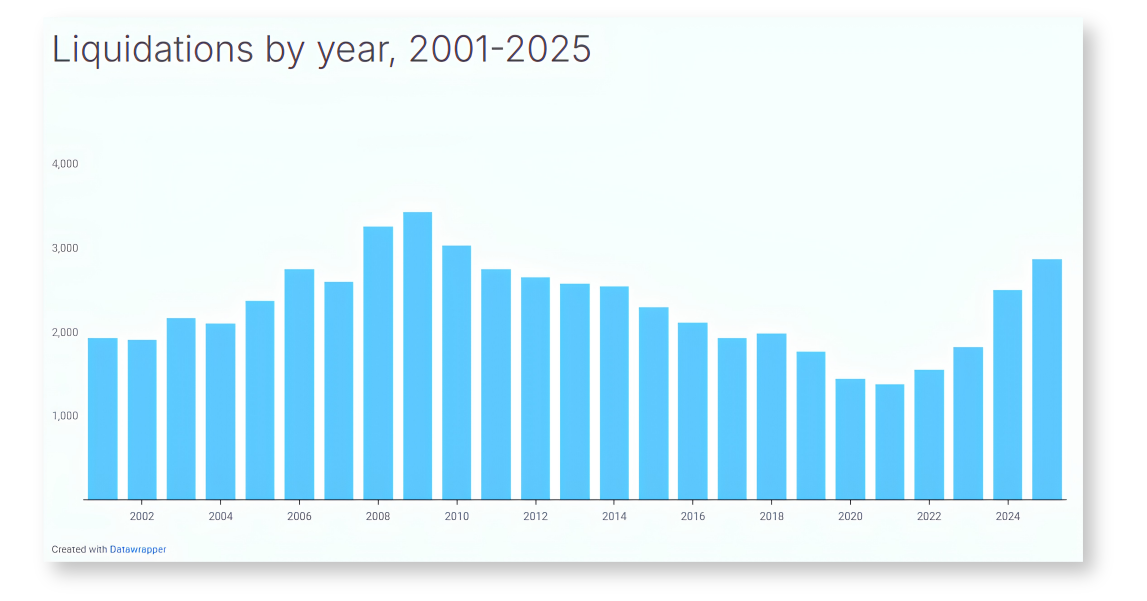
Source: Waterstone Insolvency
Here is the moral hazard. During Covid, the Labour government asked Inland Revenue to go easy, and at the time that was fair and humane. Businesses were shuttered by decree, cash flow evaporated overnight, and a temporary forbearance kept many good firms alive. But leniency without an end date breeds zombie firms – businesses trading on, not paying their GST or their PAYE, quietly undercutting the honest operator who cannot possibly compete with someone who simply isn’t paying their way. Audits went uncompleted for years, enforcement was paused, and the tax owed built quietly in the background like water behind a dam.
And who ultimately foots that bill? You do. Every dollar of GST and PAYE that a ghost firm never pays is a dollar the honest taxpayer must cover, whether through higher taxes tomorrow or services forgone today. GST, remember, is money the firm has already collected from its customers on the Crown’s behalf; PAYE is money already deducted from its workers’ wages. When a ghost firm fails to hand it over, it has not merely gone broke, it has spent money that was never its own. The zombie firm does not just wound its competitor, it quietly picks the pocket of every citizen who does pay their way.
The distortion runs deeper than a single lost contract. When a firm can undercut the market by the margin of its unpaid tax, it sets a false price for everyone. Honest competitors are forced to choose between matching an impossible number or losing the work. Some cut corners to survive; some cut their own obligations; a few simply give up. In this way the rot spreads outward from one bad actor, and the market slowly learns that paying your way is a competitive disadvantage. That is precisely the lesson a healthy economy cannot afford to teach.
I noted one in the list of failed firms that had gone to the wall, having proudly offered a lifetime guarantee on its workmanship. It sounds reassuring, and no doubt it won the firm plenty of work. But a lifetime guarantee is only as good as the lifetime of the company. When the business is gone, so is the promise, and the customer is left holding a worthless piece of paper, or a whispered word gone with the wind.
The remedy is not cynicism, but vigilance. So the burden falls back on you, the customer, to do your due diligence. It is not the headline price that counts; it is the fine print. As a mentor of mine puts it, pay attention to the fine print: it is far more important than the selling price. So ask the questions. Is your builder a Registered Master Builder? Does the firm carry serious credit accreditation and a clean Centrix credit history? Are they carrying forms of debt they cannot service? These are not rude questions, they are prudent ones, and the reputable operator will welcome them.
Damien Grant, the principal of insolvency firm Waterstone, sees the same pattern from inside the system. “One of the challenges of doing business in New Zealand is that it is too easy for firms not to pay their PAYE or GST, and they can do so for years before the IRD moves to liquidate them,” he says. “Many of these zombie firms continue on well beyond the point at which they should have ceased trading.”
The result, he argues, is twofold: honest firms are forced to compete against businesses carrying an unfair tax advantage, and when those businesses finally fail, the unpaid bills and wider economic damage are larger than they needed to be.
And we close here. When you’re handing over your deposit, or your life savings, the cheapest quote can prove the most expensive decision you ever make. This is where a fiduciary matters – someone whose duty is to tell you the unspoken truth, not to sell you comfort. Do the homework before you sign, because when the ram touches your wall, it is already too late.

Nick Stewart
(Ngāi Tahu, Ngāti Huirapa, Ngāti Māmoe,
Ngāti Waitaha)
Financial Adviser and CEO at Stewart Group
Stewart Group is a Hawke's Bay and Wellington based CEFEX & BCorp certified financial planning and advisory firm providing personal fiduciary services, Wealth Management, Risk Insurance & KiwiSaver scheme solutions.
The information provided, or any opinions expressed in this article, are of a general nature only and should not be construed or relied on as a recommendation to invest in a financial product or class of financial products. You should seek financial advice specific to your circumstances from a Financial Adviser before making any financial decisions. A disclosure statement can be obtained free of charge by calling 0800 878 961 or visit our website, www.stewartgroup.co.nz
References
RNZ, “Last call: 3000 hospitality businesses gone in a year as business feels the crunch”, 1 September 2026. Centrix reported 3,092 company liquidations in the past 12 months, up 14 percent year-on-year, with construction recording 764 liquidations and hospitality recording 422 liquidations, up 42 percent.
McDonald Vague / LawNews, “Dealing with the spike in IRD-induced business liquidations”, 26 June 2025. McDonald Vague reported that Inland Revenue accounted for seven out of every ten liquidation applications in the referenced period.
interest.co.nz, “Liquidations are rising, but the real problem isn’t Inland Revenue enforcement”, 18 April 2026. The article reported 365 winding-up applications in the first quarter of 2026, the highest first quarter in a decade, and noted Inland Revenue’s significant role in March 2026 applications.
Newsroom, “Inland Revenue audit surge is tapping deep, deep well of unpaid tax”, 4 June 2026. Newsroom reported that Inland Revenue’s boosted compliance activity followed a period of Covid-era leniency and that compliance returns remained strong, suggesting persistent tax gaps.