
Article #472
In August 1845 the index of British railway shares stood at 1,984. By April 1850 it was 673. [1]
What makes the Railway Mania worth remembering is not that it was a swindle, largely it was not. The technology was real, and what the money built is still there.
Parliament authorised thousands of miles of new line and the network more than tripled by 1850. At the peak, railway construction ran close to seven percent of national income, roughly half of all capital formation in the country. About a third of the authorised lines were never built. The rest ran for a century and a half. [2]
The story was right. The shareholders were still ruined. Clergymen, widows, country solicitors, Charlotte Bronte. People not greedy so much as correct about the future and wrong about the price. Something similar has just finished happening in China.

What China was promised, and what it delivered
Ten years ago, the story almost wrote itself. China would overtake the United States, and its currency would take a seat among the world’s reserve currencies. On 1 October 2016, the renminbi was fast tracked into the IMF’s Special Drawing Rights basket. [3]
The growth half largely came true. China’s economy grew from roughly USD 11 trillion in 2015 to USD 19.63 trillion in 2025, and is expected to cross USD 20 trillion this year. [4] Seventy percent in a decade, off an already enormous base.
The other half did not. It did not overtake the United States, which reached USD 30.77 trillion in 2025, and the IMF has quietly cut its own 2030 projection for China from USD 27.5 trillion to USD 23.1 trillion. [4] [12] Still, anyone who bought the growth story in 2015 was not badly wrong about growth. The mistake was assuming that national growth would translate cleanly into shareholder return.
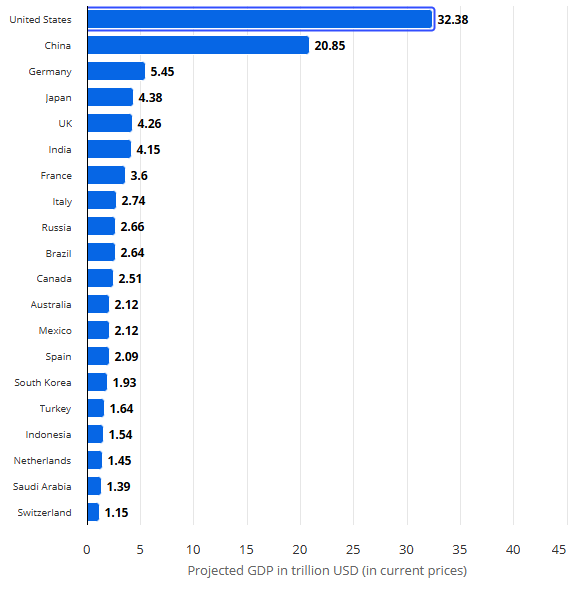
Source: Statista | Largest economies worldwide 2026
What the shareholders got
For the period to 31 July 2026, the MSCI China Index returned minus 2.13% a year over five years and 4.88% a year over ten. These are net returns, after the withholding tax a foreign investor actually pays. Compounded, the five-year result is a cumulative loss of about 10.2%. [5]
Over the same periods, the MSCI All Country World Index returned 10.85% and 12.32% a year, while emerging markets returned 8.03% and 9.19%. [5] Put simply, a dollar in the world index grew to about USD 1.67. A dollar in China became about USD 0.90.
China did not merely lag the Americans, which is the comparison everyone reaches for. It lagged the emerging world it was supposed to be leading.
Nor is the ten-year figure as flattering as it looks. It was rescued by two strong years at the end.
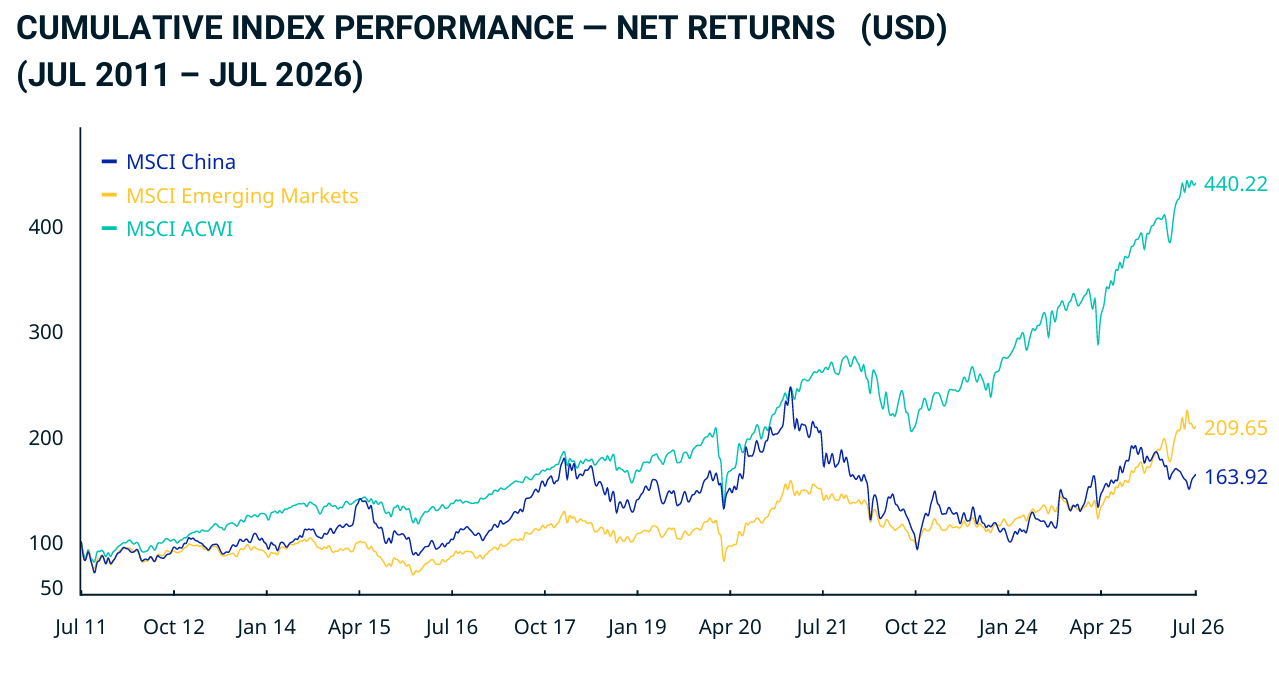
Explore the full MSCI China Index Factsheet HERE
The middle of the period is where the damage was done. The index fell 21.72% in 2021, 21.93% in 2022 and 11.20% in 2023. [5] Together, those three losing years compounded to a cumulative loss of nearly 46%. A dollar invested at the start of 2021 was worth about USD 0.54 by the end of 2023.
The recoveries of 2024 and 2025, at 19.42% and 31.17%, look handsome in isolation. They are the arithmetic of climbing out of a hole. A 46% fall needs an 85% gain simply to get back to even.
Note what the ride cost. Over those five years, the index carried an annualised standard deviation of 27.89%, against 15.07% for the world index, and a Sharpe ratio of minus 0.08 against 0.53. [5] In plain English, China delivered nearly double the volatility and still a negative return. Investors were not paid for the risk. They paid for it.
An investor who bought at the loudest point fared worse still. The Shanghai Composite peaked at 5,166 on 12 June 2015 and, eleven years on, has not been back. [9]
The currency that never arrived
The reserve-currency promise is the cleaner failure, because it was measurable from the start. In the first quarter of 2026, the renminbi accounted for 1.99% of global foreign exchange reserves, down from 2.18% at the end of 2024 after dipping to 1.92% in the third quarter of 2025. The US dollar sat at 57.13%, and the euro at 20.03%. [6]
The IMF attributes most of the latest uptick to exchange-rate valuation rather than to reserve managers buying, and COFER revises prior quarters as reporting is corrected. [6] The useful reading is the broad trend, not the second decimal place: flat to down across a decade of ambition. Reserve managers proved unwilling to hold a currency they could not move freely.

New Zealand's exposure was in the order book
For New Zealand, the direct investment loss was probably not the main story. Very few New Zealanders held Chinese shares directly. Our exposure arrived through customers rather than the share register, which is harder to rebalance because nobody runs an annual review on their order book.
Wine is the clean example. Shipments to China rose 47% in the year to mid 2025, to $56 million, against total wine exports of $2.10 billion. [7] Volumes are climbing again this year, but prices are falling, with a bulk wine price war running through Marlborough as a record harvest looks for a home. [8]
The saviour story turned out to be champagne without the fizz. The litres arrived. The dollars did not.
The point runs past wine. A grower or packhouse built around one fast-growing market holds a concentrated position as real as any portfolio holding, and far less liquid. Plantings take years to come into production, and cool stores, packing lines and market accreditation are not reallocated over a weekend.
Worse, that exposure correlates with everything else on the balance sheet. Land value, the borrowing secured against it, the labour bill and forward sales all move in the same direction. When the market that was going to take everything decides to pay less, the hit lands everywhere at once.
The order book is the least diversified asset most owners have, and the only one they rarely review as an investment risk. If the business is already a concentrated bet on one market, the owner’s portfolio has no business becoming a second concentrated bet on the same story.
The grain of truth
The other side deserves its best case. Chinese shares are cheap: 14.09 times trailing earnings against 23.24 for the world index, 10.97 times forward earnings against 17.13, and a dividend yield of 2.26% against 1.59%. [5] Shanghai also posted its strongest year since 2020 and touched decade highs in March 2026. [9]
The trouble is that cheapness has been available the whole way down. China traded at a discount for most of the decade, and for much of it the discount widened. That did not stop 2021, or 2022, or 2023. A low multiple is not a floor. It is the market pricing risk, and sometimes it prices that risk correctly.
Nor should the recent strength be mistaken for a full recovery. The rest of the world ran hard over the same stretch, so China has closed no gap, and the five-year number is still negative after it. Selling today solely because of the last five years would repeat the 2015 error in reverse. The direction changes. The mistake does not.
Evidence favours patience. Let the froth settle before committing, like a freshly poured beer you do not drink while it is all head.
The fiduciary question
The plain question is who was telling you the story, and what they were holding while they told it. Growth narratives sell funds, conference tickets and column inches. That is not a conspiracy; it is how incentives work. But none of those people were in your portfolio when the five-year number came in negative.
A fiduciary has the less enjoyable job of saying that a good story and a good investment are not the same thing, and that the gap between them is where most money is lost.
A frog in a well
Sun Tzu put it plainly. A victorious army wins first and then goes to battle, while a defeated army goes to battle first and then looks for the victory. [10] The asset allocation is settled before the market does anything.
Calling economic growth a return does not make it a return.
The trains ran. The dividends did not. Both things were true at once in 1850, and both have been true again.
So before the next irresistible story arrives, seek advice and wise counsel. Remember what Zhuangzi wrote some twenty-three centuries ago: a frog in a well cannot be talked with about the sea, for he is confined to the limits of his hole. [11]
The frog was not wrong about his well. The well was real. It simply was not the ocean.

Nick Stewart
(Ngāi Tahu, Ngāti Huirapa, Ngāti Māmoe,
Ngāti Waitaha)
Financial Adviser and CEO at Stewart Group
Stewart Group is a Hawke's Bay and Wellington based CEFEX & BCorp certified financial planning and advisory firm providing personal fiduciary services, Wealth Management, Risk Insurance & KiwiSaver scheme solutions.
The information provided, or any opinions expressed in this article, are of a general nature only and should not be construed or relied on as a recommendation to invest in a financial product or class of financial products. You should seek financial advice specific to your circumstances from a Financial Adviser before making any financial decisions. A disclosure statement can be obtained free of charge by calling 0800 878 961 or visit our website, www.stewartgroup.co.nz
References
1. Campbell, G. and Turner, J.D. (2012). Dispelling the Myth of the Naive Investor during the British Railway Mania, 1845-1846. Business History Review, 86(1). Railway share price index at 1,984 in August 1845, falling to 673 by April 1850.
2. Arnold, A.J. and McCartney, S. (2022). Managerial Failure in early Victorian Britain: Network and capital expansion during the Railway Mania. Business History. Network reached 6,621 miles by 1850, tripled since 1844; railway capital formation near 7% of GDP in 1847; about a third of authorised lines never built.
3. International Monetary Fund. Currency Composition of Official Foreign Exchange Reserves (COFER), dataset notes. The renminbi has been separately identified in COFER from 2016Q4, following its inclusion in the Special Drawing Rights basket on 1 October 2016.
4. International Monetary Fund, World Economic Outlook, as compiled by Statista and Worldometer. China nominal GDP of USD 19.63 trillion (2025) and an estimated USD 20.85 trillion (2026); United States USD 30.77 trillion (2025).
5. MSCI (2026). MSCI China Index (USD) Index Factsheet, data as at 31 July 2026. Net returns in USD: MSCI China five year minus 2.13% and ten year 4.88% annualised; MSCI ACWI 10.85% and 12.32%; MSCI Emerging Markets 8.03% and 9.19%. Annual net returns 2021 minus 21.72%, 2022 minus 21.93%, 2023 minus 11.20%, 2024 19.42%, 2025 31.17%. Fundamentals: MSCI China P/E 14.09, forward P/E 10.97, dividend yield 2.26%; MSCI ACWI P/E 23.24, forward P/E 17.13, dividend yield 1.59%. Five year annualised standard deviation 27.89% against 15.07% for MSCI ACWI; five year Sharpe ratio minus 0.08 against 0.53.
6. International Monetary Fund (1 July 2026). IMF Data Brief: Currency Composition of Official Foreign Exchange Reserves, World Aggregates, First Quarter 2026. Renminbi 1.99% (from 1.95% in 2025Q4), US dollar 57.13%, euro 20.03%. Earlier briefs give the renminbi at 2.18% in 2024Q4 and 1.92% in 2025Q3. COFER revises prior quarters as reporting is corrected.
7. New Zealand Winegrowers (2025). Annual Report 2025. Exports to China up 47% to $56 million; total wine exports $2.10 billion.
8. Vino Joy News (July 2026). China's white wine boom has triggered a Marlborough price war.
9. Shanghai Stock Exchange data via CEIC and Trading Economics; Global Times (January 2026) reporting the Shanghai Composite's 18.41% gain in 2025 and its return to decade highs.
10. Sun Tzu, The Art of War, Chapter 4, Tactical Dispositions. Rendered by Thomas Cleary as: a victorious army first wins and then seeks battle; a defeated army first battles and then seeks victory.
11. Zhuangzi, Outer Chapters, The Floods of Autumn (Qiushui), 4th century BCE. James Legge translation: a frog in a well cannot be talked with about the sea, he is confined to the limits of his hole.
12. ChinaPower Project, Center for Strategic and International Studies (2026). Unpacking China's GDP. IMF projection for China in 2030 revised from USD 27.5 trillion (April 2023) to USD 23.1 trillion (April 2025).