Article #471
Your parents lied to you.
Not about Santa Claus, or carrots improving your eyesight, or the dog going to live on a farm. About something far more expensive, and something you probably did with a pen in your hand and a banker smiling across a desk.
“Buy the best house you can afford,” they said, somewhere between the roast lamb and the pavlova. “Property always goes up.” They smiled knowingly, the way parents do when they think they have just handed you the map to the treasure.
They handed you a map, alright. To a different kind of buried thing entirely.

There is a peculiarly New Zealand religion around property, and we are its most devoted congregation. We flip through TradeMe listings the way other cultures read scripture, and attend open homes on Saturdays like it is church. We have been raised to believe that the house is the thing. The bigger the better. Stretch for it. The bank will say yes.
And the bank will say yes. That is precisely the problem. Banks are not your parents and they are not your friends. They exist to extract a return from the spread between what they pay for money and what they charge you for it, and are content to lend you every last dollar you can theoretically service. The bank's interest is not your interest. Literally.
Property Always Goes Up
Except when it does not. Cotality data released this month shows that in the second quarter of 2026, 13.1% of New Zealand homes resold at a loss, the highest since 2012, at a median $60,000 below purchase price and $159 million across the quarter. Investors fared worst at 13.5%, against 12.2% for owner-occupiers.[1] In fairness, 86.9% still resold at a gross profit, so this is a slide rather than a rout, and it has come without the mortgagee sales of the global financial crisis.
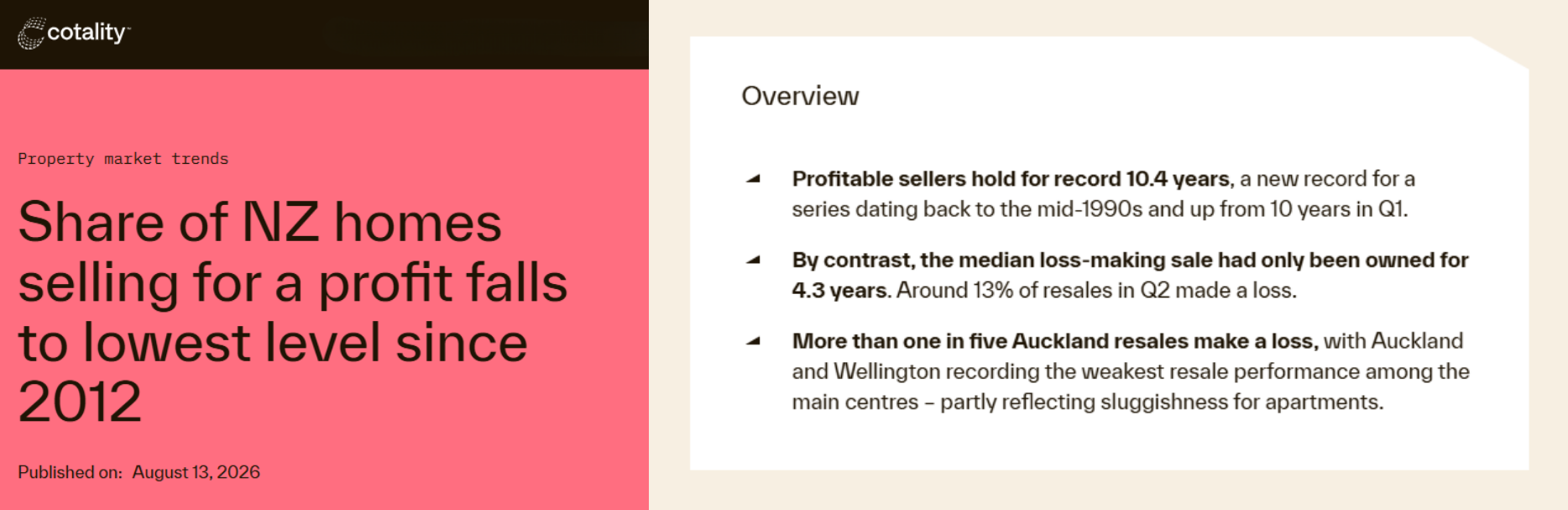
Source: Cotality | Explore Insights and Report HERE
But the number that matters most for this argument is the hold period. Profitable resales had been owned for a median of 10.4 years, a record high. Loss-making resales, 4.3 years.[1]
That is the whole case in two figures. Time rescues a property purchase, and borrowing to the absolute ceiling is what takes time away from you, because when the rate cycle turns or the premium arrives or the job changes, you sell when you must rather than when you choose. The buffer is not a luxury. The buffer is the hold period.
The counter-case deserves an honest hearing. Property has, over long periods, rewarded those who bought as much as they could as early as they could, while inflation eroded their debt. That is true, and it is also survivorship talking. The three conditions that made maximum leverage work, being falling interest rates, cheap and available insurance, and council rates rising near inflation, have now reversed at once.
The Rate Rollercoaster
Between November 2021 and May 2023 the Reserve Bank lifted the OCR from a record low 0.25% to 5.50%, and by January 2024 the average one-year fixed rate had climbed to 7.5% from 2.58%.[2] Households borrowed to the maximum of their serviceability were suddenly underwater. Rates came down through 2025 as the Bank cut nine times to 2.25%.[3] On 8 July 2026 it raised the OCR for the first time in three years.[4] The cycle is shorter than anyone expected.
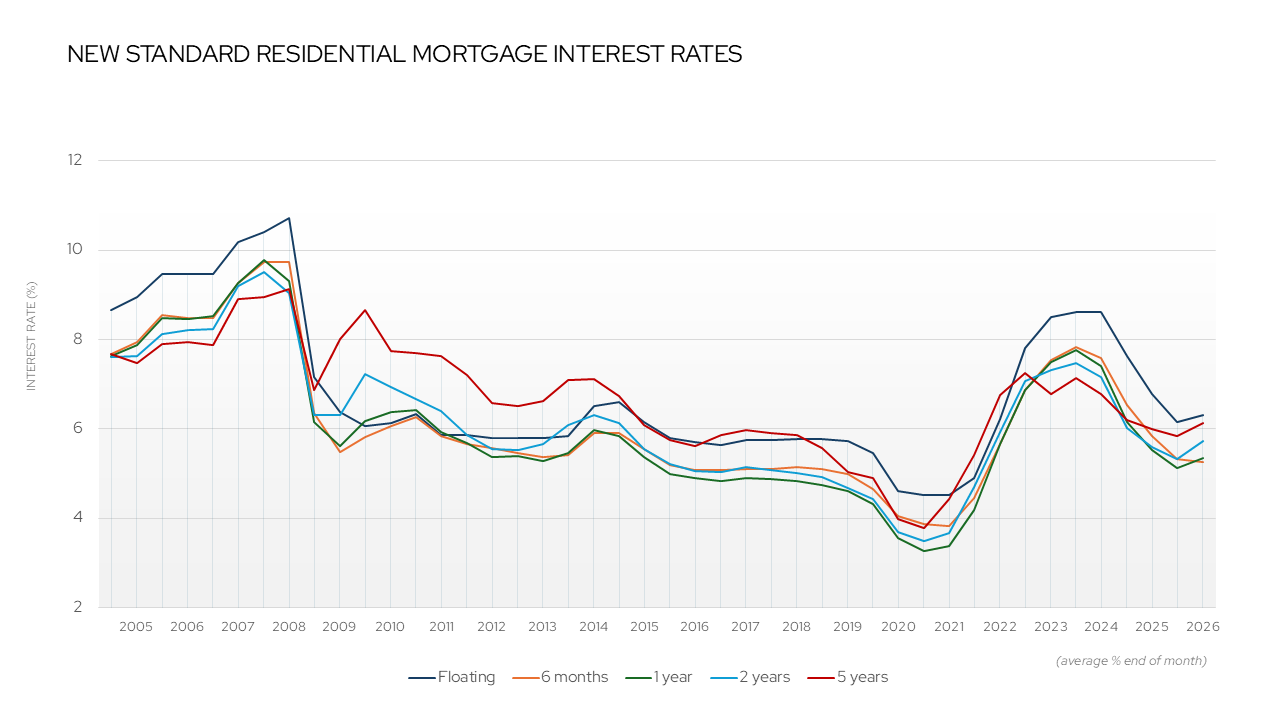
Source: www.rbnz.govt.nz/statistics - New residential mortgage standard interest rates
Then Comes the Insurance Bill
House insurance averaged $2,815 in the final quarter of 2025, a 37% jump in three years, and Consumer NZ puts the rise at three times general inflation since 2011.[5,6,7]
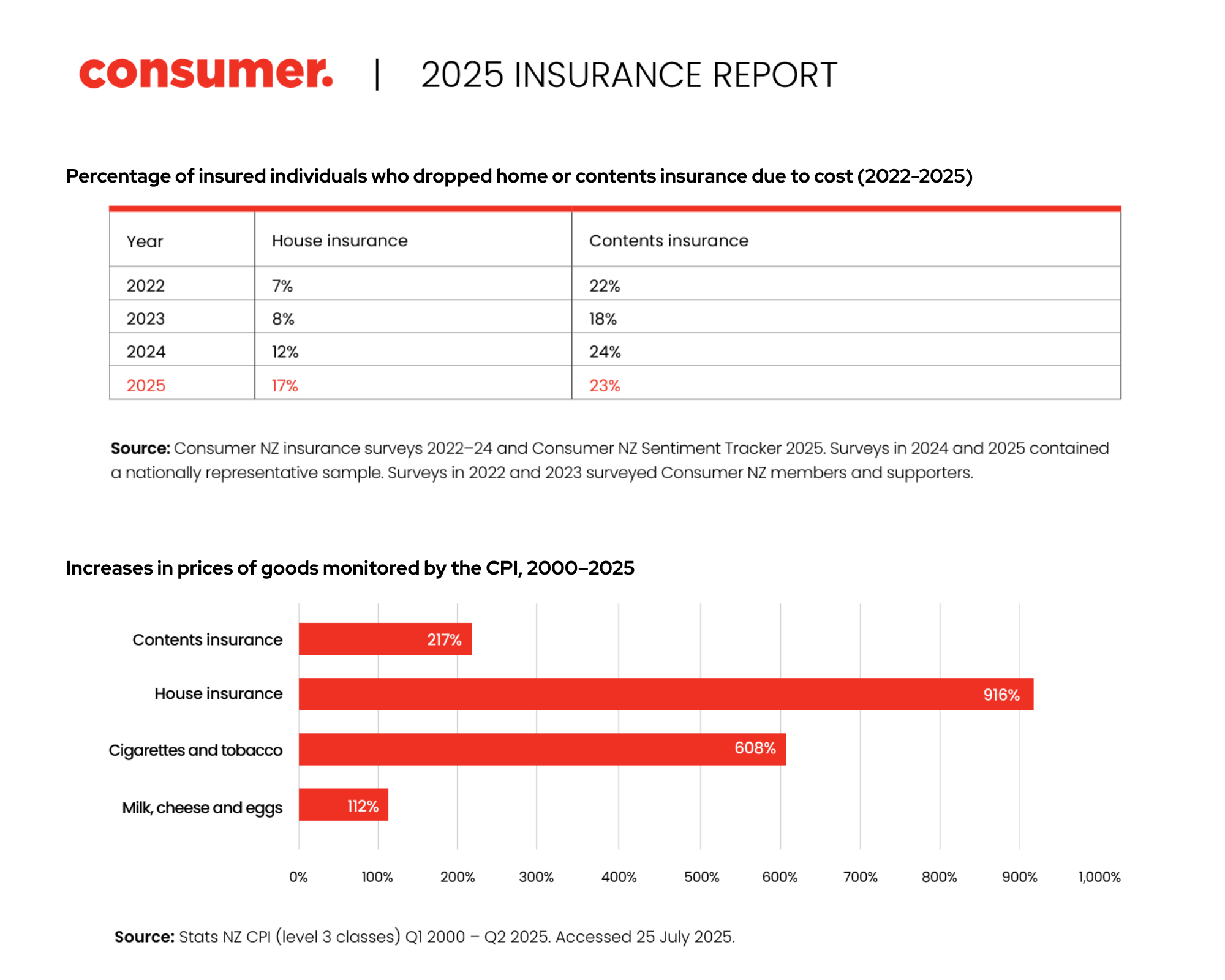
Explore the full Consumer Insurance Report HERE
But price is no longer the whole story. Availability is, and that is a different order of problem. A premium is a negotiation. A refusal is a wall. You cannot get a mortgage without insurance, so a house that cannot be insured cannot really be sold. The valuation does not fall because the building changed. It falls because the finance did.
In January 2026 AA Insurance told the Buller District Mayor it would stop issuing new home, business and landlord policies across the postcode covering Westport, Carters Beach and Cape Foulwind.[8] Existing customers could renew. New buyers could not get cover at all. Within weeks it paused new policies in Woodend, citing seismic exposure rather than flood, then declined new business across Blenheim, Renwick and Seddon.[9] Legal commentators call this the beginning of a new kind of insurance retreat.[10] AA Insurance was simply the one that announced it. Others declined quietly.
Closer to Home
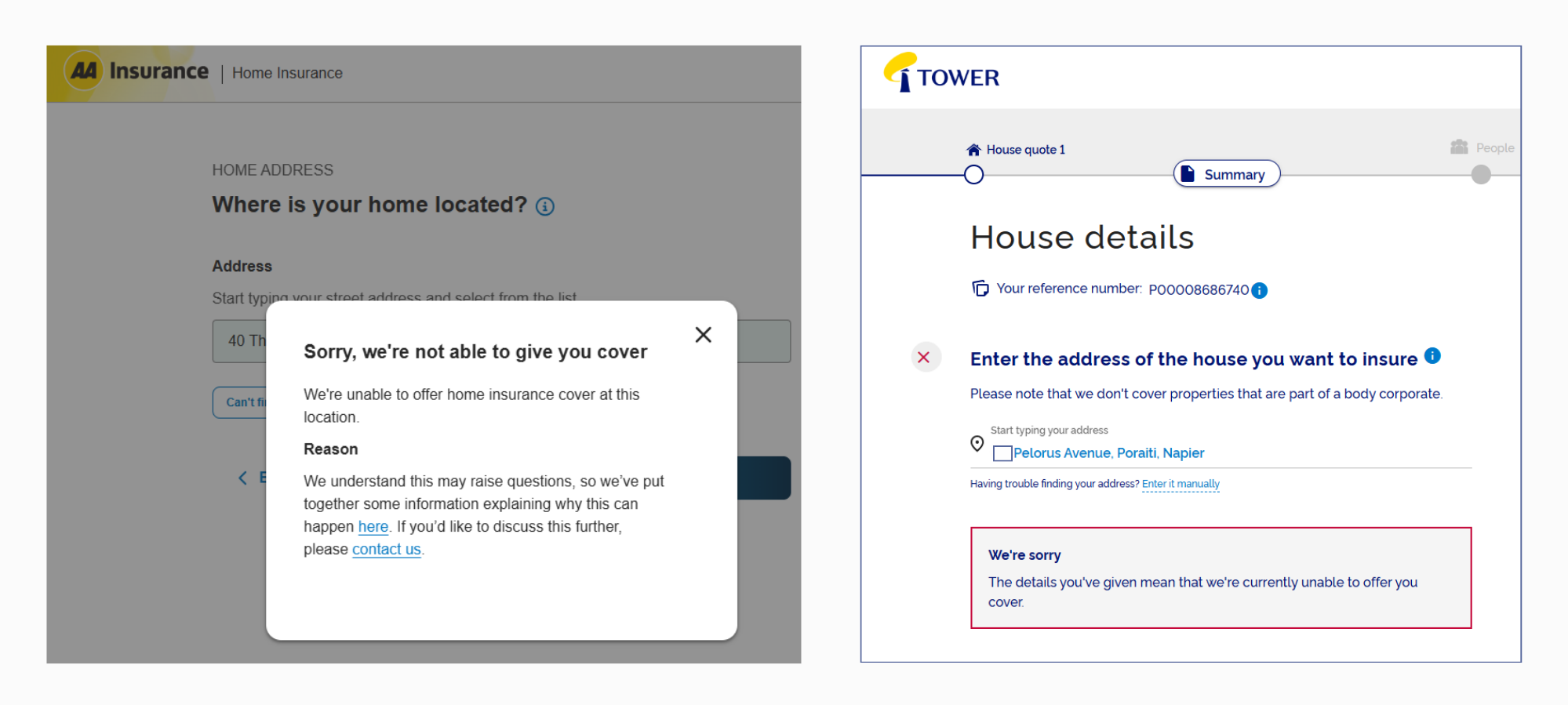
In April 2026 it emerged that Tower Insurance was refusing to cover some homes in Parklands Residential Estate, a modern council-owned development near Park Island in Napier. Buyers entering estate addresses into Tower's website were told cover could not be offered, the insurer citing a high risk of flooding from sea surge.[11]
These are new homes, with ground levels the council says were set above significant storm surge scenarios. And yet a major insurer would not touch them. Napier City Council is meanwhile spending $37.4 million on stormwater to protect Te Awa and Maraenui.[12] Public money, directed at a problem an insurer had already priced into its underwriting.
Cyclone Gabrielle caused $2.17 billion in insurance losses across this region, and the review that followed found new housing in areas of known flood risk suggested past lessons had not been learned.[13,14] Nobody mentioned any of this at the open home. Before you sign, enter the address into an insurer's website, read the LIM, and look at the flood hazard maps. That is the due diligence our open-home culture trains us to skip in favour of admiring the benchtops.
And Then There Are Rates
Not mortgage rates. Council rates, which are moving the same way. Stats NZ has local authority rates and payments up 8.8% in the year to March 2026, against headline inflation of 3.1%, and rates were the single largest contributor to that inflation figure.[15] Where water charges are shifting to a separate delivery entity under Local Water Done Well, the number on the rates notice is no longer the number leaving your account.
One More Thing: The Election
Every party to the left of centre now favours taxing property in some form. The differences are of instrument and degree, not direction.
Labour is campaigning on a 28% capital gains tax covering residential investment and commercial property, applying only to gains made after 1 July 2027, with the family home, farms, shares and KiwiSaver exempt. It would replace the bright-line test.[16,18]
The Greens go further, proposing a 2.5% annual super-rich tax on net assets above $10 million per individual, and a Capital Acquisitions Tax charging 33% on inheritances and gifts received above a lifetime threshold of $1 million, with family homes and family farms carved out and the tax paid by the recipient rather than the estate.[17] Opportunity, formerly TOP, proposes a land value tax of 1.75% urban and 0.5% rural.[19]
Te Pāti Māori has not published its 2026 tax policy, so its numbers for this election are not known. The direction is. The party campaigned in 2023 on a wealth tax rising to 8% on net wealth above $10 million, a 2% annual levy on property appreciation and taxes on undeveloped and vacant land, and KPMG counts it among those pressing for structural reform this time round.[16,20] Treat the 2023 figures as history rather than policy until the manifesto lands.
National, ACT and NZ First are not the mirror image of this. Neither proposes new property taxes, and their emphasis is on lower-tax settings and targeted reforms to boost investment.[16] That is closer to holding the current line than reversing it, and the current line is already favourable, with the bright-line test back to two years since July 2024 and full interest deductibility restored from April 2025. Their position is continuity, not a counter-offer.
KPMG notes that a capital gains tax is now the common denominator across the likely alternative government, although Chris Hipkins has ruled out Labour backing a wealth or inheritance tax.[16] None of it is law, and coalition negotiation will decide what any of it looks like. Voters decide on 7 November. But on one side of the House the direction of travel points squarely at property, and on the other it does not move at all.
What the Buffer Actually Buys
Take two buyers on the same street and the same income. One borrows $900,000 against a $1.05 million house. The other borrows $700,000 against an $850,000 house ten minutes further out. At 5.5% over thirty years, the gap in repayments is roughly $1,100 a month.
Nothing separates them while conditions hold. The difference appears when something moves. A one percentage point rise on $900,000 costs about $9,000 a year, against $7,000 on $700,000. A 37% jump in the premium lands on a household that has $1,100 a month of room, or on one that has none. A redundancy is a difficult year for one and a forced sale for the other.
That $200,000 was never really about the house. It was about buying the ability to wait, and the resale data says waiting is the whole game.
The Boring Alternative
Buy less than you can borrow. Keep a buffer. Sleep at night.
The house ten minutes further from the school zone that costs $200,000 less is not a failure. It is a margin of safety, and more to the point it is time. It is the difference between selling at 4.3 years because you have to and holding for 10.4 years because you can. It is the room to fix the roof without going back to the bank, and to stop doing anxious arithmetic at 2am. If you think professional advice is expensive, try using an amateur.
Property can be a wonderful long-term asset. But the best house you can afford is not the best house for you. It is just the biggest risk you were allowed to take.
The bank will tell you what you can borrow, not what you should. For that, seek impartial advice and wise counsel.

Nick Stewart
(Ngāi Tahu, Ngāti Huirapa, Ngāti Māmoe,
Ngāti Waitaha)
Financial Adviser and CEO at Stewart Group
Stewart Group is a Hawke's Bay and Wellington based CEFEX & BCorp certified financial planning and advisory firm providing personal fiduciary services, Wealth Management, Risk Insurance & KiwiSaver scheme solutions.
The information provided, or any opinions expressed in this article, are of a general nature only and should not be construed or relied on as a recommendation to invest in a financial product or class of financial products. You should seek financial advice specific to your circumstances from a Financial Adviser before making any financial decisions. A disclosure statement can be obtained free of charge by calling 0800 878 961 or visit our website, www.stewartgroup.co.nz
References
1. Cotality - Share of NZ Homes Selling for a Profit Falls to Lowest Level Since 2012. cotality.com/nz, 17 August 2026. https://www.cotality.com/nz/insights/articles/share-of-nz-homes-selling-for-a-profit-falls-to-lowest-level-since-2012
2. Mortgage Express NZ - Is Now the Right Time to Lock in Your Home Loan Rate? mortgage-express.co.nz
3. Canstar NZ - In Which Direction Are Mortgage Interest Rates Headed? canstar.co.nz, June 2026
4. Reserve Bank of New Zealand - Official Cash Rate raised 25 basis points to 2.50%, 8 July 2026. rbnz.govt.nz
5. Quashed - Why Is My House Insurance So Expensive? 2026 NZ Premium Hike Guide. quashed.co.nz
6. Reserve Bank of New Zealand - Insurance Availability and Risk-Based Pricing, Financial Stability Report, May 2024. rbnz.govt.nz
7. Consumer NZ - What's Going On With Home Insurance? consumer.org.nz, February 2026
8. RNZ - Insurer Temporarily Halts New Policies in Westport Due to Flood Risk. rnz.co.nz, 28 January 2026
9. NZ Herald - Major Insurer Declines New Home Insurance Policies for Blenheim. nzherald.co.nz, 3 February 2026
10. Minter Ellison - Insurers Dial Back Flood Risk Exposure: Where Will This Lead? minterellison.co.nz, May 2026
11. 1News - Insurer Flags Sea Surge Risk for Some Napier Estate Properties. 1news.co.nz, April 2026
12. Napier City Council - $37.4M Stormwater Investment Unlocks 400 Homes and Flood Protection for Napier. napier.govt.nz, December 2025
13. Insurance Business NZ - Hawke's Bay Homeowners Face Insurance Woes, Rising Security Risks. insurancebusinessmag.com, November 2024
14. Insurance Business NZ - Hawke's Bay Flood Review Highlights Need for Improved Risk Management. insurancebusinessmag.com, July 2024
15. Stats NZ - Annual Inflation at 3.1 Percent in March 2026: Local Authority Rates and Payments Up 8.8 Percent. stats.govt.nz, April 2026
16. KPMG New Zealand - Summary of 2026 Election Tax Policies. kpmg.com/nz, August 2026
17. 1News - Greens Propose Wealth, Inheritance Taxes to Fund Income Tax Changes. 1news.co.nz, 21 June 2026
18. Buddle Findlay - Labour's Capital Gains Tax: Time to Think Ahead. buddlefindlay.com, 2026
19. The Post - Opportunity Party Reveals Policies on Land Tax, Universal Basic Income and KiwiSaver Reform. thepost.co.nz, May 2026
20. RNZ - Te Pāti Māori Proposes Suite of Changes in New Tax Policies. rnz.co.nz, 27 July 2023. No 2026 tax policy published as at 20 August 2026