
Article #470
Everything costs more, yet by every measurable standard, we are producing less. Welcome to Baumol's cost disease, with a Wellington twist.
Picture a string quartet performing Mozart in 1790. Four musicians, half an hour, a finished piece of music. Now picture the same quartet performing the same piece in 2026. Four musicians, half an hour, the same music.
The output is identical. The cost is not.
This is Baumol's cost disease - economist William Baumol's 1966 observation that some sectors cannot get more productive no matter how clever you are [1]. You cannot ask the violinists to play twice as fast. Yet they must still be paid enough not to quit and retrain as software engineers. And engineers' wages keep rising because their productivity does. So performing the piece costs more every decade, while the performance itself never changes.
Baumol's insight was never an argument against paying the violinist. It was a warning about where the money comes from. Rising wages in less productive sectors are affordable only because a productive sector somewhere is generating the surplus to fund them. Pull out the productive sector and the whole arrangement stops being generosity and starts being arithmetic.
Which brings us to the Wellington twist. We have the disease. We do not have the cure.

The number that is not moving
On 1 April, the adult minimum wage rose again, to $23.95 an hour, up 45 cents, a 'moderate' two percent lift the government was quick to call balanced [2]. On the same day, main benefits rose 3.11 percent, indexed to the CPI. New Zealand Superannuation lifted 2.9 percent, indexed to wages. The default KiwiSaver contribution ticked up to 3.5 percent. The living wage moved to $29.90 an hour. The government indexed its obligations, sent out the press releases, and moved on.
Businesses do not get to index theirs. They just get the obligation, and the bill that comes with it.
Here is the part nobody in Wellington wants to say out loud. Stats NZ's own figures show multifactor productivity fell 0.9 percent in the year to March 2025 [3]. Labour productivity nudged up 0.8 percent, but only because firms shed workers faster than output dropped [3]. We did not get more productive. We got smaller, slightly less inefficiently.
Our labour productivity gap with the top half of the OECD has widened from 34 percent in 1996 to roughly 40 percent today [4]. We sit alongside Mexico, Greece and Portugal [5]. Construction is the starkest case of all: the sector is producing at roughly the same rate it managed in 1985 [6]. Four decades of technology, and the shed goes up at the same speed.
Baumol's violinist was paid out of a surplus the rest of the economy threw off. Ours is paid out of an economy that has stopped producing one. Every April the floor climbs. The output that is meant to fund it goes sideways at best. The gap does not close. It compounds.
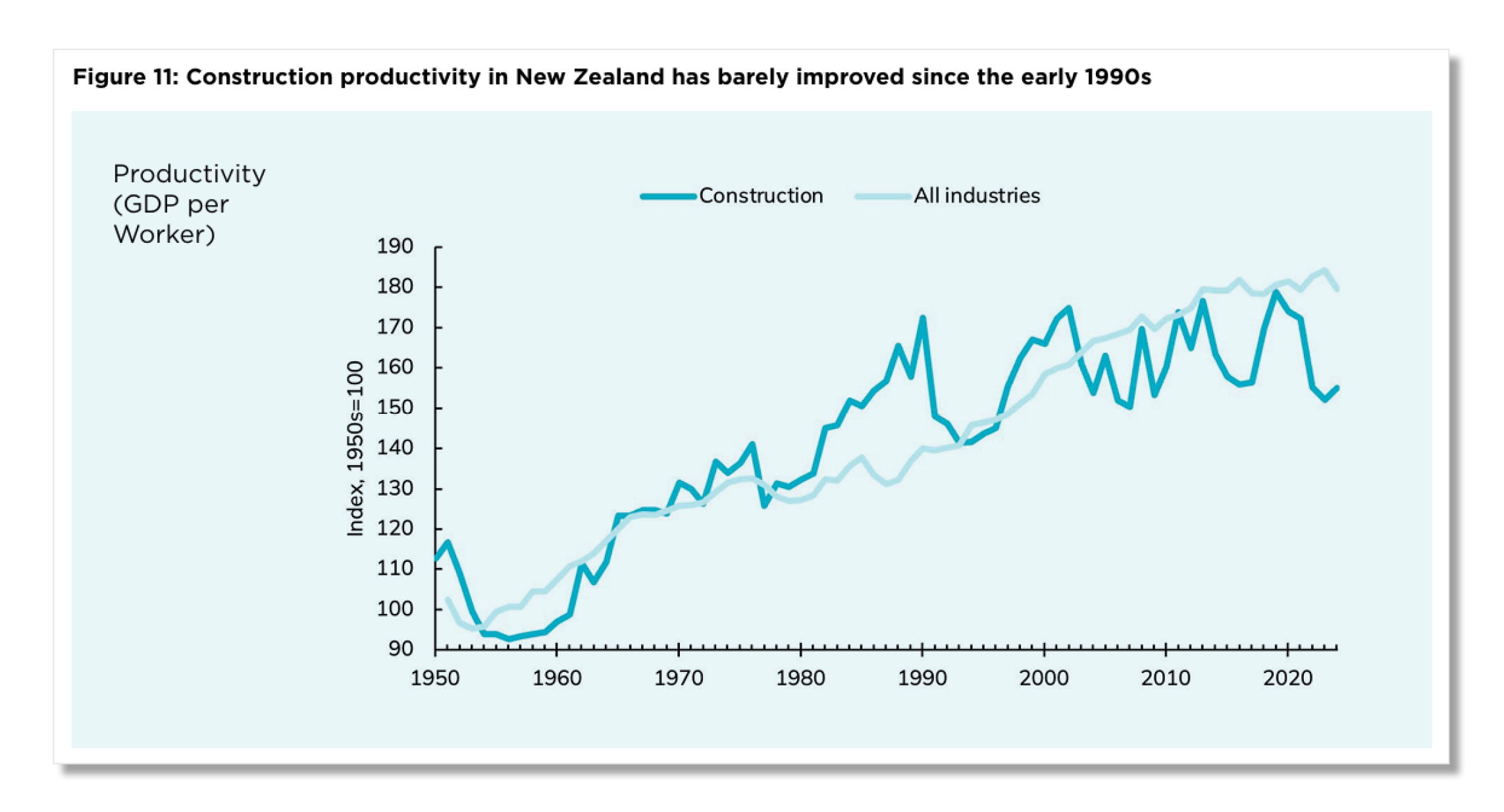
Source: NZCBIA Report No 2024-01
California told us how this ends
In April 2024, California lifted the minimum wage for large fast-food chains from USD 16 to USD 20 an hour: a 25 percent jump and one of the biggest single-sector hikes in American history [7]. The most rigorous peer-reviewed study to date found the sector shed around 18,000 jobs in the first year, roughly a 3.2 percent fall relative to the rest of the country [7].
But the more telling story is what came next. Two years on, researchers tracking the same restaurants found the damage had changed shape. Workers kept their jobs but lost hours, lost overtime, and increasingly lost out to a kiosk [8]. One franchise group saw shift work fall by more than 20 percent. Another chain cut labour hours across its outlets by nearly 12 percent [8].
The wage floor did not lift those workers so much as quietly saw off the bottom rung of the ladder they were standing on.
This is not an argument that people should be paid less. It is an observation about what happens when the price of labour is set by decree rather than by what that labour can produce, and about who gets hurt when the two drift apart. It is never the people who set the number.
What Baumol never saw coming
For sixty years, cost disease was incurable precisely because you could not automate the quartet. The violinist was safe. So was the waiter, the till operator, the aged-care worker. Their inefficiency was their job security.
AI is the first technology that credibly threatens that assumption, and it arrives at the exact moment the wage floor is climbing [9]. The jobs most exposed to a rising minimum (entry-level, routine, repeatable) are precisely the jobs AI is coming for first [9]. In California, the same franchises facing the higher wage bill were the ones rolling out ordering kiosks, app ordering and AI drive-throughs fastest.8 Raise the cost of the role and hand the employer a cheaper substitute in the same quarter, and you do not need an economics degree to see which way that goes.
The 17-year-old looking for a first job is now competing not just with a higher wage bill, but with a piece of software that never calls in sick, never takes a smoko break, and never asks for a raise.
Slicing versus baking
Which brings us to November.
Here is what the election will be about, and what it should be about, and they are not the same thing.
Every party will campaign on how to slice the pie. Who pays more tax and who pays less. Who gets the transfer, the credit, the exemption. Where the floor should sit and how fast it should rise. It is a rich, noisy, deeply satisfying argument, and it will absorb the entire campaign.
Almost nobody will campaign on baking a bigger pie.
Yet the pie is the whole argument. A minimum wage is affordable when output is rising, because there is more to go round and the violinist gets paid out of the surplus. When output is flat, the same policy is not generosity. It is a redistribution of a pie that is not growing, and someone at the margin - usually the least skilled, the youngest, the last hired - pays for it without ever being told they are paying [10].
We even had a Productivity Commission. Set up in 2010 at ACT's insistence to ask precisely this question, it drifted - by the end it was inquiring into immigration settings and just transitions, and ACT itself abolished it in 2024, and nobody much mourned [11 The one body built to ask how we bake a bigger pie had spent its final years arguing about slices. That is the country in miniature.
So here is the question worth putting to whoever knocks on your door between now and 7 November: not what will you lift, but what will you grow? What, specifically, will be more productive in three years than it is today, and how will you know?
If the reply is a slogan, you have your answer.
What this means for you
If you own a business: stress-test your margins against a wage line that rises every April whether or not your revenue does. Automation is no longer an efficiency play. It is defensive.
If you invest: sectors leaning hardest on minimum-wage labour - hospitality, retail, aged care - carry a structural cost risk that never shows up in a glossy prospectus. Price it in.
If you are a parent: the entry-level job your kids would once have used to get a foot in the door is the one most at risk. Have a Plan B for how they build experience when the first rung keeps getting sawn off.
The government can index its obligations every April and move on. Businesses cannot.
They will tell you a rising tide lifts all boats. They never mention the ones still tied to the wharf. And every April, the tide comes in a little higher. The trouble is, the businesses are anchored, and the school-leavers cannot swim yet.

Nick Stewart
(Ngāi Tahu, Ngāti Huirapa, Ngāti Māmoe,
Ngāti Waitaha)
Financial Adviser and CEO at Stewart Group
Stewart Group is a Hawke's Bay and Wellington based CEFEX & BCorp certified financial planning and advisory firm providing personal fiduciary services, Wealth Management, Risk Insurance & KiwiSaver scheme solutions.
The information provided, or any opinions expressed in this article, are of a general nature only and should not be construed or relied on as a recommendation to invest in a financial product or class of financial products. You should seek financial advice specific to your circumstances from a Financial Adviser before making any financial decisions. A disclosure statement can be obtained free of charge by calling 0800 878 961 or visit our website, www.stewartgroup.co.nz
References
Baumol, W. J., and Bowen, W. G., Performing Arts: The Economic Dilemma: A Study of Problems Common to Theater, Opera, Music, and Dance, Twentieth Century Fund, 1966.
Beehive.govt.nz, Minimum Wage Increase Balances Business and Worker Needs, 12 December 2025; Employment New Zealand, Minimum Wage Is Increasing on 1 April 2026, 9 March 2026.
Stats NZ, Productivity Statistics: 1978–2025, 23 April 2026.
BERL, Relooking at Our Productivity Gap, 2024.
MBIE and MFAT, New Zealand's Productivity in a Changing World: Long-Term Insights Briefing, 17 December 2025.
Newsroom, Construction Sector Productivity Stuck in '80s, 9 August 2024; Beehive.govt.nz, Construction Sector Productivity the Same as 1985, 9 August 2024.
Clemens, J., Edwards, O., and Meer, J., “Did California's Fast Food Minimum Wage Reduce Employment?”, NBER Working Paper No. 34033, July 2025.
Owen, S., Ripley-Rodriguez, E., Jenkins, M., Walsh, S., and Tang, K., Let Them Eat Big Macs, Crunch Wraps, and Whoppers: A Working Paper Describing the Statewide Impact of California's $20 Fast Food Minimum Wage, University of California, Santa Cruz Institute for Social Transformation, November 2025.
IDC / Deel, AI at Work: The Role of AI in the Global Workforce, November 2025.
Stats NZ, Unemployment Rate at 5.3 Percent in the September 2025 Quarter, 5 November 2025.
New Zealand Government, New Zealand Productivity Commission Act Repeal Act 2024, New Zealand Legislation, 2024.
