Election 2026

Death and Taxes

Article #458

This Thursday, Nicola Willis will deliver Budget 2026. The headlines will be familiar: tight control of spending, focus on health, education, defence and law and order, a return to surplus.[1] To her credit, the Finance Minister has shown discipline.

On Tuesday, in her pre-Budget speech to Business North Harbour, she announced 8,700 public service job cuts over the next three years, $2.4 billion in savings, the merger of agencies, and AI as “a basic expectation” across government systems.[2] The public service had grown from roughly 48,000 in 2017 to over 63,000 by the end of 2024, a 33 percent expansion in six years against largely flat productivity growth. Trimming it back toward 1 percent of population is overdue.

The harder question is timing. The coalition has been in office for two and a half years. The electoral mandate was fresh in late 2023. Decisions of this magnitude, with this kind of political cost, are easier early in a term and almost impossible to deliver in election year without the optics looking opportunistic. The reforms should have been made then.

That delay matters because the bond market is a fickle lover when a country is carrying heavy debt and producing little productivity growth. Fitch has placed New Zealand’s AA+ rating on negative outlook, citing rising challenges in reducing debt after years of delayed fiscal consolidation; debt to GDP is projected to reach 56 percent by 2027.[3] The 10-year government bond yield is sitting near 4.7 percent. Every basis point on that yield translates into real money in interest costs. Markets are watching, and they are no longer giving New Zealand the benefit of the doubt.

This is the fiscal context in which the campaign begins.

Budget Day on the 28th is not really the main event. It is the starting gun for the election campaign that ends on 7 November. And the backdrop against which that campaign will be fought is grim.

The NZX 50 touched fresh lows this week. The Gross Index, which includes reinvested dividends, has delivered a total return of around 3 percent over the past five years.[4] That is less than 1 percent per year in nominal terms. Strip out dividends, and the price-only index is in negative territory. Once you factor in cumulative inflation of around 20 percent, New Zealand investors have gone backwards by close to 17 percent in real purchasing power. No other major Western bourse can claim that distinction. The S&P 500 has roughly doubled. The ASX 200 is up around a third. The FTSE, long the laggard of major markets, has still delivered around 30 percent. Even the Nikkei, dormant for two decades, has delivered roughly 70 percent.

This matters because when the stock market is not creating wealth, politicians look for ways to redistribute existing wealth. That is the genuine political logic of the moment, and it is amplified by the mechanics of MMP. Labour cannot govern alone. To form a government, it will need the Greens and almost certainly Te Pāti Māori. Whatever Labour campaigns on, the coalition partners will demand more.

Labour has confirmed it will campaign on a capital gains tax targeted at residential and commercial property, with revenue ringfenced for free GP visits.[5] The Greens have gone further, proposing a 2.5 percent annual wealth tax on net assets above $2 million, and a 33 percent inheritance tax on lifetime gifts and estates above a $1 million threshold.[6] Te Pāti Māori has signalled wealth taxes as a coalition bottom line.[7] Fitch has reportedly been briefed on tax measures beyond what Labour has publicly disclosed.[8]

The Greens’ inheritance tax proposal is the one to pay closest attention to. It is, in everything but name, the return of estate duty. And it is worth remembering, on the eve of a Budget that opens an election year, why New Zealand abandoned that tax in 1992.

Estate duty was sold as a tool of equity. In practice, it became a destroyer of family legacies. By the early 1970s, rates had climbed as high as 40 percent, with thresholds catching far more than just the wealthy.[9] For families whose wealth was tied up in illiquid assets, the death of a patriarch or matriarch triggered financial catastrophe.

The Hawke’s Bay orcharding sector provides stark examples. Local orchardists who had spent decades developing pipfruit operations found their estates assessed at development values rather than agricultural income values. Families faced duty bills exceeding several years of profit. The choice was bleak: sell blocks to developers, or take on crippling loans.[10] Many spent thirty years or more servicing that debt, an entire generation lost to a single tax assessment. A block of land that had taken a grandfather forty years to develop into productive orchard could be lost to an unexpected death and an Inland Revenue assessment within eighteen months.

The Waikato dairy sector tells the same story. Multi-generational farms were forced to sell down herds and land to meet duty bills. The remaining operations often lacked the scale needed to remain viable, and some families saw their children leave farming altogether.[11] It was not incompetence that ended these legacies. It was a tax code that demanded immediate liquidity from operations that simply do not generate it.

Rural service businesses, the stock and station agents, transport firms, processing contractors, faced the same pressure. Many took on outside investors to meet duty bills, and those investors eventually engineered buyouts. The consolidation of New Zealand’s agricultural service sector during the 1980s owed much to estate duty’s destabilising effect.[12]

Defenders argued at the time, and will argue again, that proper planning could avoid these outcomes. Two things are worth saying about that. First, the planning itself was a deadweight cost. Families spent thousands on lawyers and accountants navigating frequently changing rules rather than reinvesting in their enterprises.[13] Second, deaths do not arrive on schedule.

What does prudence look like in practice? It looks like reviewing trust structures that may have been set up two decades ago under different rules. It looks like understanding which assets sit where, who owns what, and what the liquidity profile of an estate actually is on any given day. It looks like considering whether life insurance has a role to play in funding potential tax liabilities. It looks like beginning the conversations between generations that families instinctively defer.

The lesson from estate duty is not that all tax is bad. It is that taxes on illiquid family assets transfer productive wealth from those who built it to whoever has the ready cash to buy at distress prices. That is not redistribution. It is destruction. And it is being proposed at a moment when fewer families have the financial cushion to weather it, against a stock market that has produced no real wealth for half a decade.

Thursday’s Budget will not settle this debate. It opens it. Families with farm, orchard, or business assets ought to be reviewing their structures now, seeking wise counsel from advisers who understand both the tax architecture and the fiduciary weight of decisions made under pressure. None of this argues for selling out of New Zealand equities at the lows: capitulation at the bottom is the parallel mistake, the same wealth destruction by another route. The answer is diversification and counsel, not retreat. The families who recovered from estate duty were almost always those who took advice early. The ones who lost everything were those who waited until the tax was already in force.

History rhymes. It does not, thankfully, repeat. But only if we are paying attention.


Nick Stewart

(Ngāi Tahu, Ngāti Huirapa, Ngāti Māmoe,
Ngāti Waitaha)

Financial Adviser and CEO at Stewart Group

  • Stewart Group is a Hawke's Bay and Wellington based CEFEX & BCorp certified financial planning and advisory firm providing personal fiduciary services, Wealth Management, Risk Insurance & KiwiSaver scheme solutions.

  • The information provided, or any opinions expressed in this article, are of a general nature only and should not be construed or relied on as a recommendation to invest in a financial product or class of financial products. You should seek financial advice specific to your circumstances from a Financial Adviser before making any financial decisions. A disclosure statement can be obtained free of charge by calling 0800 878 961 or visit our website, www.stewartgroup.co.nz


REFERENCES

[1] The Treasury, Budget 2026, 28 May 2026, treasury.govt.nz/publications/budgets/budget-2026

[2] NZ Herald, Nicola Willis’ public service cuts to save $2.4b, 8700 jobs to go, 19 May 2026; 1News, Thousands of public service jobs to go, major Govt shake-up announced, 19 May 2026

[3] Fitch Ratings, New Zealand AA+ outlook revised to negative, March 2026; Trading Economics, New Zealand 10-Year Government Bond Yield

[4] S&P/NZX 50 Gross Index, 5-year return data to 20 May 2026, NZX and Yahoo Finance

[5] NZ Herald, Labour’s capital gains tax: Chris Hipkins celebrates ‘progressive’ policy, 28 October 2025

[6] Become Wealth, Wealth Tax NZ: What It Means and Who Would Pay, April 2026; Green Party Alternative Budget 2025

[7] RNZ, Te Pāti Māori proposes suite of changes in new tax policies

[8] Scoop News, Fitch Report Exposes Labour’s Secret Tax Agenda, 29 April 2026

[9] Inland Revenue Department, Annual Report 1975 (Wellington: Government Printer, 1976), 23-25

[10] P.J. Skellerup, “Estate Duty and the New Zealand Horticultural Sector,” NZ Journal of Agricultural Economics 3, no. 2 (1979): 45-52

[11] Ministry of Agriculture and Fisheries, Agricultural Statistics 1980 (Wellington: Government Printer, 1981), 67-89

[12] R.M. Sandrey and S.R. Reynolds, “Structural Change in New Zealand Agriculture 1972-1987,” Review of Marketing and Agricultural Economics 58, no. 1 (1990): 15-28

[13] NZ Law Society, Submission on Estate and Gift Duties Amendment Bill (Wellington: NZLS, 1983), 8-12

Two Years of Drift: New Zealand's Squandered Mandate for Change

Article # 445

In late 2023, New Zealanders voted decisively for change. After six years of Labour government under Jacinda Ardern and Chris Hipkins, the country was exhausted. The NZX had become one of the worst‑performing stock markets in the developed world [1]. Trust in core institutions, from the police to the healthcare system, had cratered [2]. Real economic growth was negative [3]. The cost of living was crushing ordinary families, while housing remained stubbornly unaffordable.

The coalition government swept to power on a mandate to reverse this decline. But two years later, that mandate has been squandered through timidity and a fatal misreading of the moment.

It's tempting to view this government's approach through the lens of John Key and Bill English's post‑GFC strategy. Between 2008 and 2017, that duo carefully managed spending cuts while allowing growth to flourish organically [4]. They made incremental reforms, maintained fiscal discipline, and let the private sector drive recovery. It worked brilliantly. Unemployment fell, growth returned, and National won three consecutive elections.

But 2026 is not 2010, and the global playing field has fundamentally changed. Interest rates have surged after over a decade of easy money [5]. New Zealand's underlying productivity crisis can no longer be ignored [6].

This government has tried to apply the Key‑English playbook to a radically different situation. Ministers speak reassuringly of “green shoots”, yet the economy contracted 0.9% in Q2 2025, then grew just 1.1% in Q3, a volatile pattern that speaks to underlying fragility rather than sustained recovery [7]. Real GDP per capita continues falling [8].

The retail sector tells the story most viscerally. Boxing Day sales slumped 12.4%, consumers spent just $51.2 million on non‑food retail, down from $58.5 million the previous year [9]. As Simplicity chief economist Shamubeel Eaqub observed, “For a lot of businesses this should be their saving grace” [10].

January 2026 brought only marginal relief: core retail spending lifted a mere 0.6% compared to the same month last year, with weather events depressing regional performance and retailers “just treading water as the economy moves sideways, rather than forwards,” according to Retail NZ CEO Carolyn Young [11]. In the meantime, retail business liquidations surged 34% year‑on‑year [12].

Consider ACT leader David Seymour's State of the Nation speech on Sunday, where he diagnosed the core problem with brutal clarity. “People work their guts out only to find that they're further behind,” he said, noting young New Zealanders simply “can't make the numbers add up” when looking at student loans, wages, taxes, and housing costs. He called emigration a “flashing light on the dashboard” and observed that previous generations worked hard “because hard work was a rewarding strategy. That deal feels broken.” He admitted the government is “on track to post a small surplus by 2030, but after that, our ageing population will put us back in the red for more decades of deficit spending.” Yet his proposed solution, reducing the number of ministers to 20 and departments to 30, only epitomises the incrementalism that has defined this government. When your coalition partner polling at 7.6% is calling for bolder action than you are, you've misread the moment [13].

With the election now confirmed for 7 November 2026, Prime Minister Christopher Luxon’s party has a narrow lead in recent polls, but the fundamentals are troubling. The latest Roy Morgan poll has National at 34.5% compared to Labour's 30.5%, with the coalition government on 52% versus the opposition's 44% [14]. Yet 51.5% of voters say New Zealand is “heading in the wrong direction” [15].

The Argentina Mirror

In 1913, Argentina's per capita income exceeded Germany, France, Sweden, Italy, and Spain [16]. Like New Zealand, it was a resource‑rich agricultural powerhouse built on classical liberal foundations. Both countries ranked among the world's wealthiest in the first half of the 20th century [17].

Argentina's fall was dramatic. Decades of Peronist corporatism culminated in the crisis that brought Javier Milei to power. By December 2023, Argentina faced 211% annual inflation, 42% poverty, a 15% quasi‑fiscal deficit, and an economy in free fall [18].

Milei cut the budget by 30% and balanced it by his second month in the job [18]. He implemented 1,246 deregulations through August 2025 [18]. He abolished 10 ministries and fired more than 53,000 public employees [18]. Annual inflation fell from 211% to around 32% by January 2026 [18–21]. GDP grew 6.3% and investment surged 32% in the second quarter of 2025 [18]. More than 11 million people have been pulled out of poverty [18].

The results are transformative. After Milei eliminated rent controls, rental housing supply tripled and real prices fell 30% [18]. When he deregulated agricultural markets, vaccine costs for livestock producers dropped by two‑thirds [18]. Home appliance prices fell 35% after eliminating import‑licensing schemes [18].

There are real victories here. They’re 28‑year‑old Franco signing a 30‑year mortgage,  “unthinkable only a couple of years ago” [18]. They’re freelancer Cecilia finally able to focus on work instead of navigating convoluted tax laws [18]. They’re farmer Pedro Gassiebayle reinvesting in his business and thinking about efficiency for the first time [18].

To be sure, Argentina's transformation faces headwinds. Monthly inflation ticked up to 2.9% in January 2026 in the fifth consecutive monthly increase, and questions have emerged about the government's statistical methodology [19–21]. The path remains narrow and fraught. But even with a few snags, the direction is unmistakable: from complete collapse toward functioning markets.

New Zealand's Drift

Compare that to New Zealand. Two years after a change in government, there's been no meaningful regulatory reform despite endless consultation. Government spending has barely been constrained [22]. Infrastructure delivery remains slow and over‑budget [23]. Housing consents have fallen [24]. The promised Fast‑track Approvals Bill has been watered down. RMA reform has been incremental when transformation was needed.

Most damningly, the fundamental drivers of our decline remain unaddressed. We still can't build houses efficiently. We still can't deliver infrastructure on time or budget. Our planning system still makes simple projects take years to consent. Meanwhile, retailers close their doors while politicians tout those elusive green shoots.

The Key‑English approach worked because the GFC was primarily a demand shock. New Zealand's current malaise is structural.

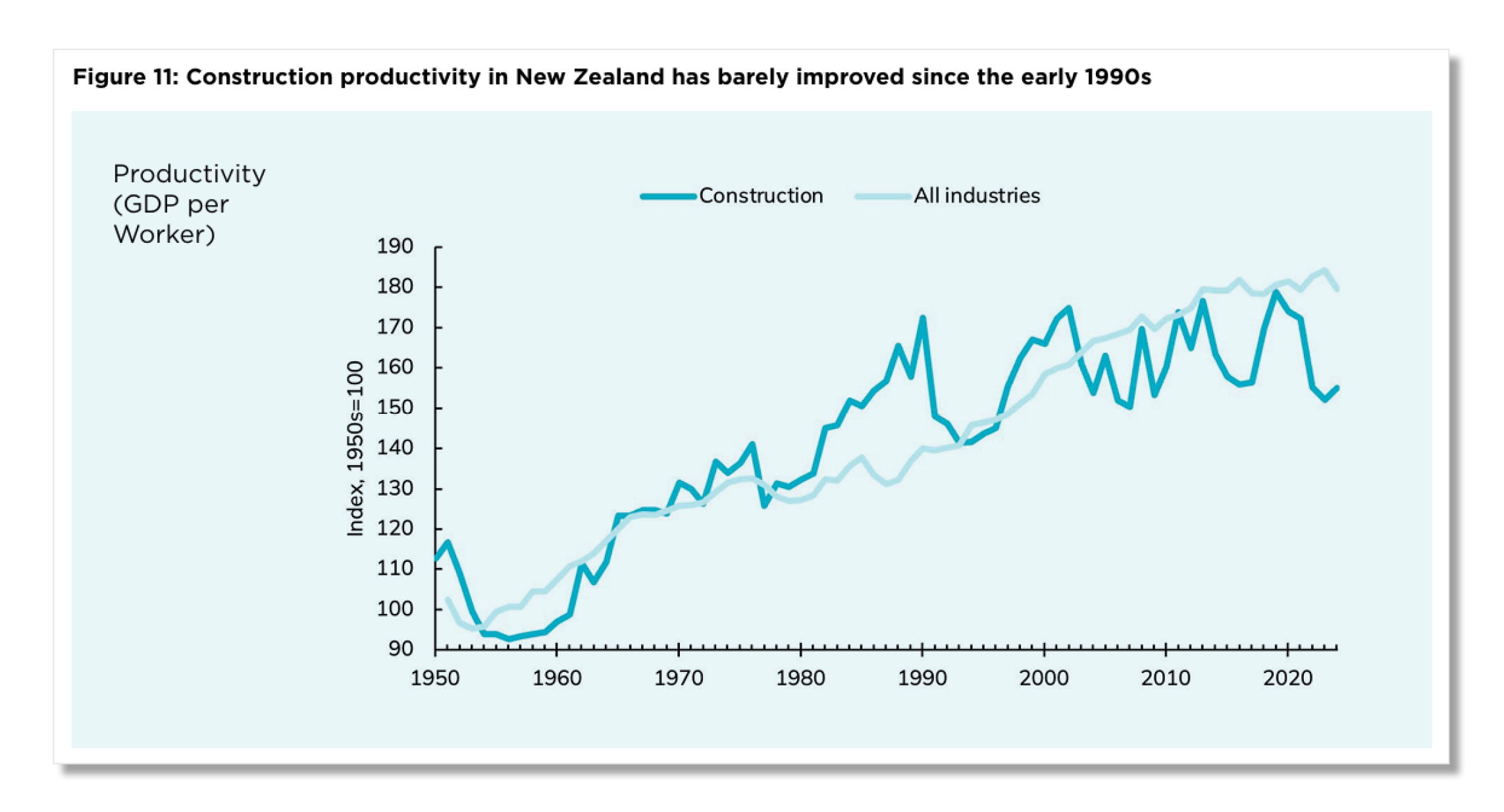
We have a productivity crisis decades in the making [25]. We have infrastructure crumbling from underinvestment [26]. We have planning and regulatory systems that strangle growth.

As Austrian economist Ludwig von Mises told Argentines in 1959: “Economic recovery does not come from a miracle; it comes from the adoption of sound economic policies” [18].

The Electoral Reckoning

With nine months until the election, this government faces an uncomfortable reckoning. Voters were promised change and received continuity. They were told to trust the process while their living standards declined. Now they're being asked to believe in green shoots while retail spending barely budges and liquidations surge.

The opposition will hammer a simple message: You had your chance and you wasted it. And they'll be right. This government has fundamentally misread the moment. It applied a playbook designed for managing cyclical downturns to a structural crisis requiring transformation.

What makes Argentina's transformation particularly instructive is that Milei turned the mainstreaming of libertarian thought into political victory [18]. He became the first political leader in 80 years to propose that the whole corporatist state had to be torn down and replaced with limited government [18]. New Zealand faces no such ideological battle. We already have strong institutions, low corruption, an independent central bank, and largely functional markets. We don't need revolution; we need our government to use the mandate voters gave them.

The tragedy is that we could reform from strength if our leaders found the courage. Instead, we're drifting toward the point where only painful corrections remain viable. Postponing necessary reforms doesn't achieve stability. It ensures that, when reform finally comes, it's painful and disruptive.

Two years ago, voters gave this government a mandate for change. Nine months from an election, with retail sales barely growing and businesses liquidating at record rates, they're learning that careful management of decline is still decline. As Milei declared to Argentines: “Either we persist on the path of decadence, or we dare to travel the path of freedom” [18].

New Zealand faces the same choice. Two years ago, voters chose change but received decadence, polite, incremental, delivered with press releases about green shoots while retailers close their doors.

Argentina's history suggests we're running out of time to change course. The voters will render their verdict on November 7.

Nick Stewart

(Ngāi Tahu, Ngāti Huirapa, Ngāti Māmoe, Ngāti Waitaha)

Financial Adviser and CEO at Stewart Group

  • Stewart Group is a Hawke's Bay and Wellington based CEFEX & BCorp certified financial planning and advisory firm providing personal fiduciary services, Wealth Management, Risk Insurance & KiwiSaver scheme solutions.

  • The information provided, or any opinions expressed in this article, are of a general nature only and should not be construed or relied on as a recommendation to invest in a financial product or class of financial products. You should seek financial advice specific to your circumstances from a Financial Adviser before making any financial decisions. A disclosure statement can be obtained free of charge by calling 0800 878 961 or visit our website, www.stewartgroup.co.nz

  • Article no. 445


References

1. NZX. Market performance data, 2020–2023.

2. Statistics New Zealand. New Zealand General Social Survey: Trust in public institutions, 2018–2023.

3. Statistics New Zealand. Gross Domestic Product (GDP) data, 2022–2025.

4. New Zealand Treasury. Fiscal consolidation analysis, 2008–2017.

5. Reserve Bank of New Zealand. Official Cash Rate (OCR) data, 2021–2023.

6. OECD. Productivity statistics for New Zealand.

7. Statistics New Zealand. Quarterly GDP data, Q2–Q3 2025.

8. Statistics New Zealand. Real GDP per capita data, 2024–2025.

9. Worldline NZ. Retail spending data and Boxing Day sales figures, December 2025.

10. RNZ. “Tough December for retailers, as Boxing Day sales slump 12.4 percent.” 13 January 2026.

11. Inside Retail NZ / Ragtrader. Retail sector reports, January 2026.

12. Centrix. Retail business liquidations data, reported February 2026.

13. RNZ / Reid Research. Polling data on ACT Party support, January 2026.

14. Roy Morgan. New Zealand voting intention poll, January 2026.

15. Roy Morgan. Government confidence rating, January 2026.

16. Maddison Project Database. Historical GDP per capita comparisons, 1913.

17. Maddison Project Database. Long‑term international income comparisons, early 20th century.

18. Vásquez, Ian, and Marcos Falcone. “Liberty Versus Power in Milei’s Argentina.” Cato Institute – Free Society, Fall 2025.

19. ABC News. Argentina inflation reporting, February 2026.

20. Fortune. Argentina inflation and economic reform coverage, February 2026.

21. Washington Times. Argentina inflation and fiscal policy reporting, February 2026.

22. New Zealand Treasury. Budget documents, 2024–2026.

23. Infrastructure Commission Te Waihanga. Project delivery and cost‑overrun reports.

24. Statistics New Zealand. Building consents data, 2024–2025.

25. New Zealand Productivity Commission. Long‑term productivity analysis.

26. Infrastructure Commission Te Waihanga. Infrastructure deficit assessments.