Article #476
A friend and colleague in Chile was knocked off his bike by a delivery motorcycle, rupturing a hamstring. Four months off the bike. I wanted to post him honey from our hives, but quarantine rules will not let honey near a border, so he got possum and merino socks instead. Back came an intriguing coin.

One coin, two sides. Seven economists, the “Chicago Boys”, are featured, with one face honouring them as the architects of Chilean economic development. On the reverse sits Chile’s coat of arms and its national motto: Por la razón o la fuerza. By reason or by force. The coin tells the story of a country that tried both.
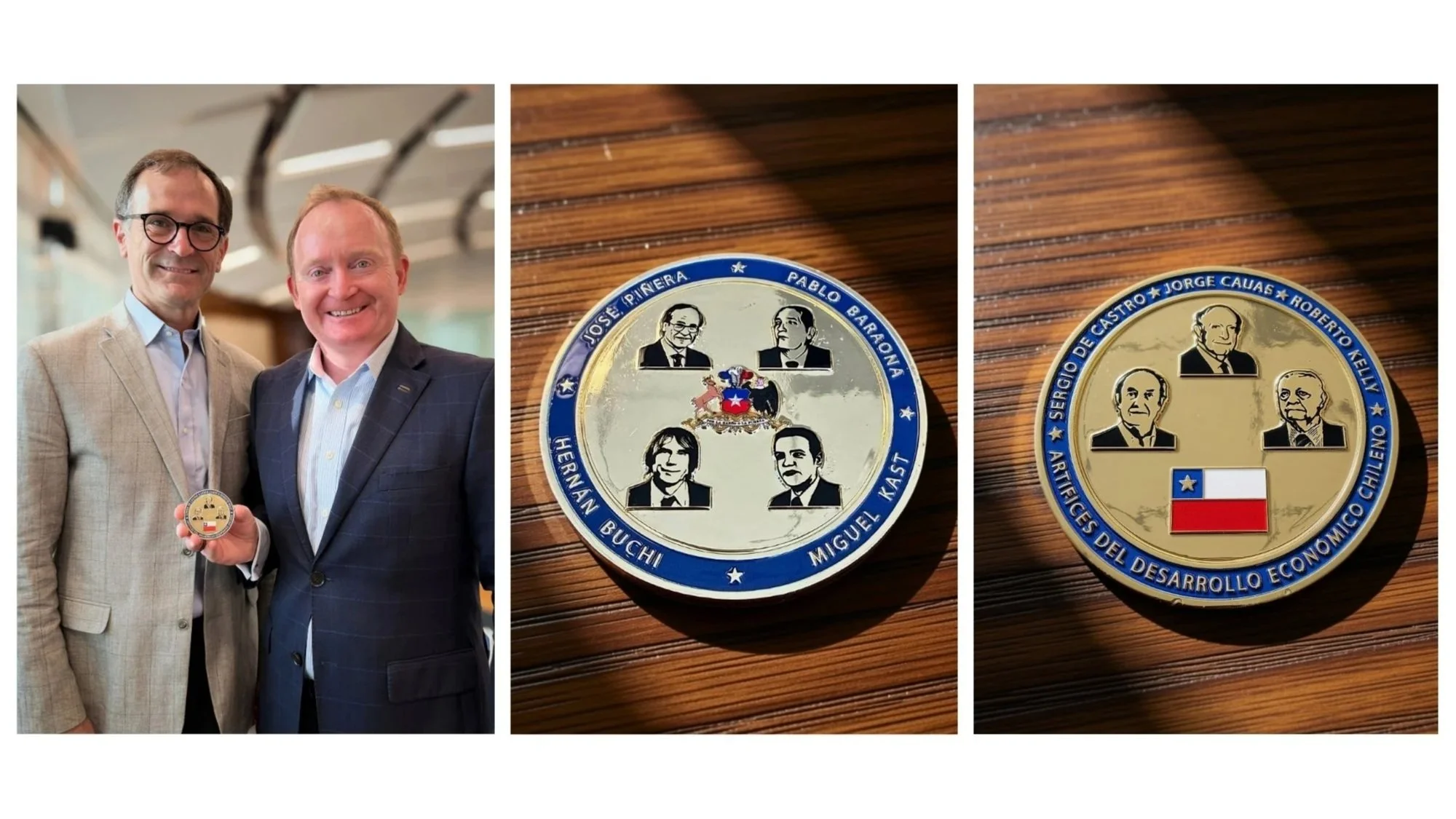
Nick with Rodrigo and the Chilean coin he kindly gifted him
From 1971 the Allende government nationalised copper, with Congress voting for it. It took the banks, and by late that year the state controlled seventeen of them holding around 90% of the country’s credit. Factories were requisitioned into public ownership. Wages rose and prices were held down. [1]
Then the shelves emptied. A black market grew. By January 1973 the government was rationing dozens of essentials, bread among them, and neighbourhood supply and price committees decided who got what. By December 1973, consumer prices were 508% higher than a year earlier. [2]
Now look at our ballot.
The Greens would force Foodstuffs and Woolworths to sell 120 stores and two distribution centres into public ownership as KiwiMart, at a cost of $2.8 billion. New Zealand First would buy the BNZ back from NAB and merge it with Kiwibank, at $7.5 billion upwards, with compulsory acquisition held in reserve. Labour would not take ownership but would set the price by banning excessive pricing on essentials. National, which normally resists this sort of thing, would split Pak’nSave from New World and Four Square if the Commerce Commission agreed that the separation would leave shoppers better off. [3]
Four parties, four instruments, one instinct. Peters calls it “taking back our country” rather than nationalisation, recalling the warning attributed to Emerson: “The louder he talked of his honour, the faster we counted our spoons.”
The grievance is real. The 2022 market study found the duopoly controlled about 90% of main grocery shopping, with excess profits the Commission then put at more than a million dollars a day. Four Australian-owned banks hold about 84% of lending. Nobody doing the weekly shop needs convincing that something is wrong. [4]
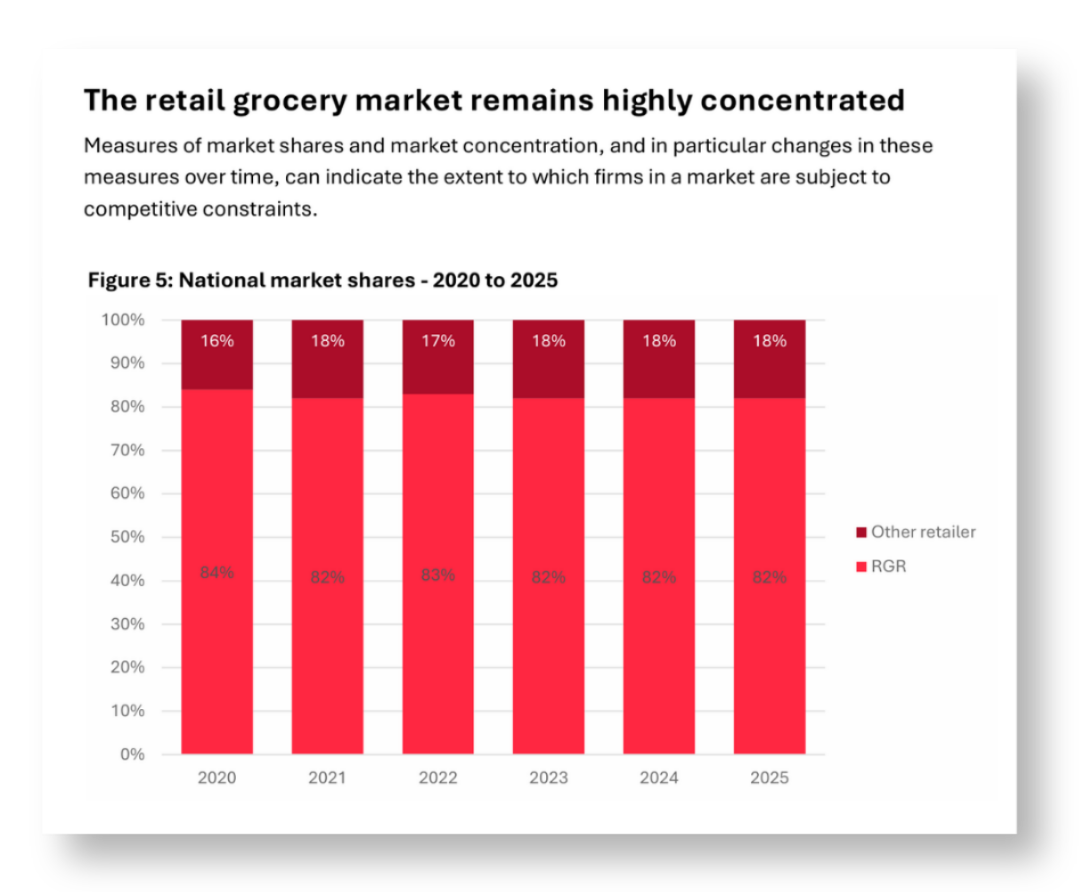
Source: Annual Grocery Report 2025/2026 - Commission analysis of sales revenue provided by industry participants and Statistics New Zealand data. RGR = Regulated Grocery Retailer
National’s proposal is the only one that changes market structure rather than ownership. It leaves every store in private hands and defers to the Commerce Commission. Willis is right that incremental reform has not delivered. ACT is against it. Foodstuffs points out that more than 500 owner-operated stores sit inside the two co-operatives. [5]
But all four reach for the till when the harder question is why nobody can build a shop.
Here is what that question looks like on the ground, twenty minutes from our Hastings office. In 2012, Foodstuffs North Island bought a site across the road from Pak’nSave Tamatea in Napier. It sold the site in 2015 with a covenant barring its use as a supermarket, one of a set running for up to 99 years. Woolworths had two stores in central Napier and none in the south of the city. The High Court found the covenant had been lodged to stop Woolworths, or anyone else, from developing a supermarket there. Justice Radich called the conduct deliberate and serious and, in August 2024, fined Foodstuffs $3.25 million, the largest penalty yet under section 28 of the Commerce Act. [6]
That is a Napier site that could have carried a third banner but did not. No act of nationalisation would have put one there. A rule did the damage, and a rule undid it. Grocery land covenants were banned in 2022 and are now unenforceable, but the Commission pursued the case anyway. [8]
Milton Friedman drew a distinction worth keeping in mind here. Being pro-free enterprise is not the same as being pro-business. Business corporations in general, he wrote, are not defenders of free enterprise but one of the chief sources of danger to it. Almost every owner wants open competition for everybody else and a little protection for himself. [7]
A covenant on a title is a moat dug by a company. A consent that takes years is a moat dug by a council. Both keep the third banner out, and the shopper pays for both. Defending property rights is not the same as defending the incumbent.
Yet four years on, there is still no third full-line chain in this country. Costco entered as a warehouse club, with its second site set to go up in Drury’s fast-tracked town centre. The Government now has a bill before the House creating a consenting express lane for new supermarkets. That is the admission. The binding constraint is not who holds the title. It is how long it takes to get a shop out of the ground. [8]
What changed Chile was not who held the shares but the conditions for competition: stable money, open entry, enforceable contracts and taxes that businesses could live with. From 1987 to 2015, the proportion of Chileans living below the national poverty line fell sharply, while income per person rose substantially. [9]
Scotsman Adam Smith made the same case centuries earlier: little else was needed to carry a state from the lowest barbarism to the highest degree of opulence but peace, easy taxes and a tolerable administration of justice. [10]
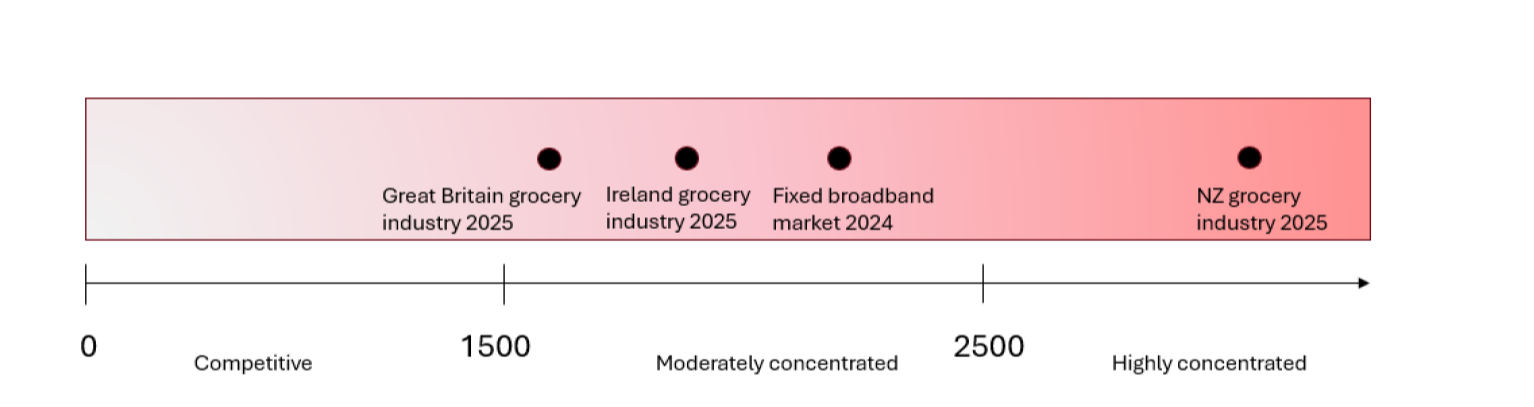
Source: Commerce Commission New Zealand
Herfindahl-Hirschman Index (HHI) takes the market shares of each firm in a market.
New Zealand’s grocery industry HHI for 2025 was 3,585 which indicates limited competitive pressure. Concentration in Auckland also remains high, with the HHI increasing to 2,635 in 2025, from 2,561 in 2024.
Smith’s other observation was our propensity to truck, barter and exchange. Nobody directed the socks or the coin, no price was named, and both of us came out ahead. The only authority involved was the biosecurity rule that stopped the honey, exactly the sort of plain, predictable rule Smith meant.
The honest part is what the coin leaves off. Chile’s reforms were imposed by a dictatorship, which stripped them of legitimacy. Growth continued after democracy returned in 1990: force set the policy, but reason made it stick. [9]
There is a cost in all of this that appears in none of the parties’ costings, and it lands on people who did not vote for any of it.
Every valuation rests on what a business will earn and the rate at which those earnings are discounted. Political risk goes into that rate. Lift it and the value falls, with no change in the till.
Neither Foodstuffs nor Woolworths New Zealand is listed here, and BNZ belongs to NAB, so no New Zealand portfolio moved directly on those announcements. The precedent is what moves. If a government can force an owner to sell a profitable business at a price set by the Crown, or legislate its structure apart, every regulated business in this country carries a little more risk than it did a month ago. Contact, Meridian, Genesis and Mercury are on that list, and New Zealand First has named them for a split of its own. So are the ports, airports and lines companies.
KiwiSaver held $138.8 billion at March 2026. Those companies sit inside it. The people who own them are not speculators. They are teachers, shearers and people in their sixties who have been contributing since 2007. [11]
Property rights are not an ideological flourish. They underpin every valuation of the shares held in your portfolio and KiwiSaver.
Fix the rules and competition follows. Buy the shops and the government owns the queue.
The Chileans put both options on their coat of arms and have tried each one: by reason or by force.
The vote will decide which of those we reach for. How you respond is still your choice and worth good counsel.

Nick Stewart
(Ngāi Tahu, Ngāti Huirapa, Ngāti Māmoe,
Ngāti Waitaha)
Financial Adviser and CEO at Stewart Group
Stewart Group is a Hawke's Bay and Wellington based CEFEX & BCorp certified financial planning and advisory firm providing personal fiduciary services, Wealth Management, Risk Insurance & KiwiSaver scheme solutions.
The information provided, or any opinions expressed in this article, are of a general nature only and should not be construed or relied on as a recommendation to invest in a financial product or class of financial products. You should seek financial advice specific to your circumstances from a Financial Adviser before making any financial decisions. A disclosure statement can be obtained free of charge by calling 0800 878 961 or visit our website, www.stewartgroup.co.nz
References
1. Espinosa, R. (2021). Salvador Allende’s development policy: lessons after 50 years. Economic Affairs; De Vylder, S. (1974). Allende’s Chile. Cambridge University Press.
2. Edwards, S. (2023). The Debauchery of Currency and Inflation: Chile, 1970–1973. NBER Working Paper 31890; Datosmacro.com. (1973). IPC de Chile 1973, reporting December 1973 CPI inflation of 508.0% year-on-year.
3. RNZ and 1News, 16 September 2026, National to pursue Pak’nSave and New World break up; NZ Herald, 3 September 2026, Greens promise to nationalise 120 supermarkets; RNZ and interest.co.nz, 17 May 2026, NZ First proposal to buy back BNZ and merge with Kiwibank; NBR, 16 September 2026, Labour price gouging policy.
4. Commerce Commission (2022). Market study into the retail grocery sector: Final Report, 8 March 2022; Reserve Bank of New Zealand banking sector statistics, 2026.
5. RNZ and 1News, 16 September 2026, National to pursue Pak’nSave and New World break up. The independent analysis cited by Nicola Willis modelled grocery prices 3.5% lower after one year and 5% lower after six, with $12.6 billion of consumer benefit over twenty years. Foodstuffs and ACT responses reported the same day.
6. Commerce Commission v Foodstuffs North Island Ltd, High Court, Wellington, August 2024; Commerce Commission media release, 8 August 2024; Simpson Grierson, Competition and Consumer Law Update, August 2024.
7. Friedman, M. (1999). The Business Community’s Suicidal Impulse. Cato Policy Report, Vol. XXI No. 2, for the quoted sentence; the wider argument runs through Friedman, M. and Friedman, R. (1980). Free to Choose. Harcourt Brace Jovanovich.
8. Commerce (Grocery Sector Covenants) Amendment Act 2022; Commerce Commission v Foodstuffs North Island, $3.25 million penalty, 2024; RNZ and Beehive, 12 November 2025, second Costco store at Drury and the supermarket consenting express lane bill.
9. World Bank. Poverty headcount ratio at national poverty lines (% of population) – Chile, 1987–2015; World Bank. GDP per capita (constant 2015 US$) – Chile, 1987–2015; Edwards, S. (2023). The Chile Project: The Story of the Chicago Boys and the Downfall of Neoliberalism. Princeton University Press.
10. Stewart, D. (1793). Account of the Life and Writings of Adam Smith LL.D., quoting a paper by Smith of 1755; Smith, A. (1776). An Inquiry into the Nature and Causes of the Wealth of Nations, Book I, Chapter 2.
11. Plan For Life research, KiwiSaver funds under management at March 2026.