
Article #468
Abraham Lincoln liked to ask how many legs a dog has if you count the tail as one. Four, he said: calling the tail a leg doesn’t make it a leg. New Zealand’s wholesale investor rules have spent a decade calling tails legs. Last week a Christchurch courtroom finally counted.
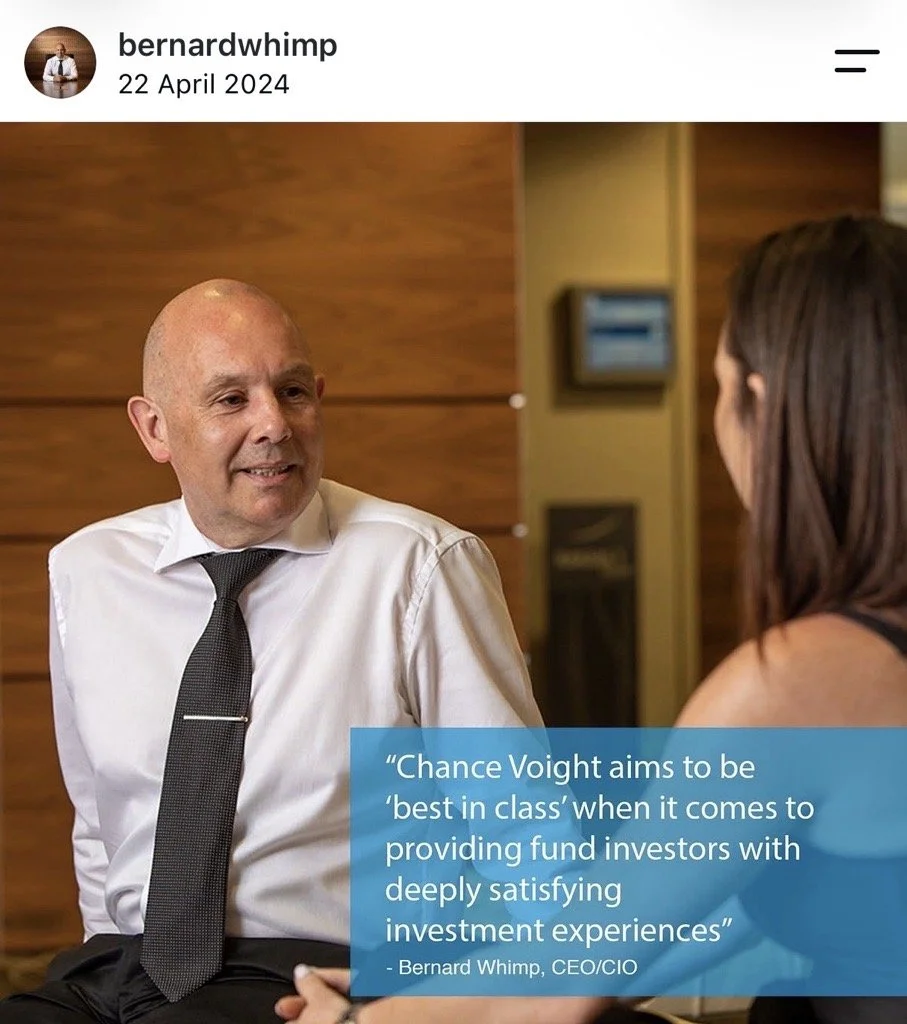
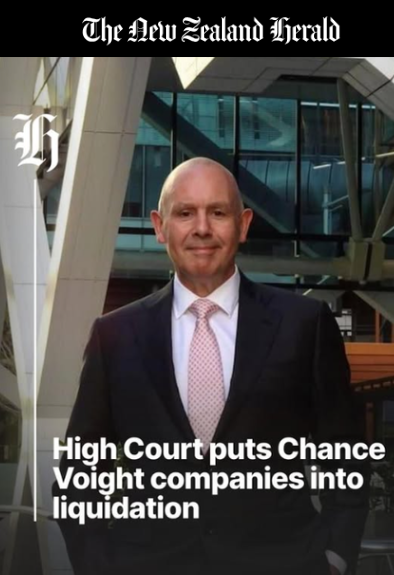
On Friday 24 July the High Court placed six companies in Bernard Whimp’s Chance Voight group into liquidation. Associate Judge Dale Lester found a pattern of obfuscation, incompetence and evasion, an entirely unsustainable model, and a scheme that could only pay existing investors by finding new ones. Founded in 2021, the group had raised more than $54 million from perhaps 230 people to pour into property-based wholesale debt promising returns of 10 to 13 per cent a year. By September 2025 it sat on a negative net asset position of $11.8 million. The evidence, the judge said, was overwhelming.
One detail is almost too good. Whimp asked the court to delay the hearing until he could unlock money from his late father’s estate, which, he said, would in turn fund a $110 million land development. The judge was unmoved, calling the request a microcosm of how the whole group had been run. Quite. You cannot conjure a solvent business from a deceased estate any more than you can pull a rabbit from an empty hat, though plenty have tried. Meanwhile a related Whimp entity had drawn some $9.2 million in “management fees”, around 24 per cent of all money invested, even as the group booked a $5.5 million trading loss in a single half-year. Fees, in other words, for failure.
Here is what should trouble every reader. Chance Voight’s investors were, in the main, aged 65 and over, and the first liquidators’ report found many had only a limited grasp of the risks. Yet each had been certified a “wholesale” investor: sophisticated enough, in law, to need no protection at all.
You can call a cat a fish, but you can’t teach it to swim.

The mechanism is simple. The Financial Markets Conduct Act lets companies raise money without disclosure, licensing or supervision, provided the investors are wholesale. Under the “eligible investor” rule, anyone can claim that badge so long as a financial adviser, chartered accountant or lawyer signs to agree. Tick the box, and every retail protection evaporates. And this was no discreet, professional affair: the court noted Chance Voight was marketed in regional and local newspapers, on Facebook and at in-person promotional events, the mass channels of the retail world, not the closed room of the true professional.


A long process for a too-low bar
The regulator has been uneasy for years. When the FMA took a test case to force issuers to verify the investors sent their way, it lost: Justice Fitzgerald found the permissive regime was a feature of the law, not a bug. But she put her finger on the fault. The problem, she observed, was not so much the content of the certificates as that certificates with patently defective grounds, or none at all, were being confirmed regardless. It is the confirmation process that is falling down; and if it cannot protect investors, the balance struck in the legislation may need resetting, a matter, she said, for Parliament and not the court.
That was the judiciary handing the problem to the politicians. This month, at last, they picked it up. Commerce Minister Cameron Brewer has released an MBIE consultation, part two of the plan to lift our capital markets, that concedes what advisers have muttered for years: our settings are an international outlier, “unique” and “relatively permissive,” with “some evidence” that inexperienced investors are getting into wholesale offers. Its options read like a reply to Fitzgerald: a more objective eligibility test, a cap on how much an eligible investor can put at risk, a requirement that applicants take independent financial advice, restrictions on wholesale advertising, and, squarely, real onus on the professional confirmer, with an infringement offence for inadequate certifications.

Click above to read more on Wholesale Investors from the Financial Markets Authority
What still needs attention
Those are the right levers, and they should be pulled. None of this is an argument for tearing the regime down. Genuine sophisticated investors exist, and raising capital from them without the full disclosure burden is a legitimate and valuable part of a working market. MBIE rightly notes that certificates lasting only two years already make life needlessly costly for real professionals. The point is narrower. The bar has been set too low, left to rot, and waved through by people with every incentive not to look too closely. Consider that none of the thresholds, $5 million in net assets, a million-dollar investment history, a $750,000 minimum subscription, has been adjusted for inflation since the Act took effect in 2013. Thirteen years of asset-price growth, house prices above all, has done the widening for Parliament: the same numbers now capture people they were never meant to reach. The bar did not get more generous; the country simply ran up more nominal dollars against a line that never moved. Last year the FMA referred 22 accountants and eight lawyers to their professional bodies over the misuse of these very certificates.
Two gaps deserve more than the paper gives them.
The first is the advice layer. A retail adviser must put the client’s interests first and prove a recommendation is suitable: goals, cash flow and appetite for risk, all understood and documented, the file running to fifty pages. A wholesale-only adviser owes a bare statutory duty to give priority to the client’s interests, but needs no FMA licence, follows no Code of Professional Conduct, and never has to establish that the advice was suitable. The relationship can be purely transactional: take the $5 million, place it in a syndicate, move on. If you think professional advice is expensive, try the amateur variety.
The second is the Crown’s own hand. Of the roughly 70 managed funds on Invest NZ’s “acceptable” list for Active Investor Plus migrants, against nearly $1.5 billion of committed capital, all but a handful are wholesale, and few are household names. Invest NZ’s own disclaimer states that inclusion is not an endorsement or recommendation by it or the Government. We invite wealthy newcomers to make this country home, steer them onto a state-curated list, then wash our hands of what follows. All care, no responsibility. A wealthy migrant, a surgeon, a farmer, someone who simply inherited well, may know nothing of geared, illiquid property debt, yet is stamped “wholesale” on a net-asset figure alone. Funds on a Crown list should answer to retail-grade disclosure, not hide behind the wholesale tag.
Underneath it all sits a regulator half in the dark. The IMF warned back in 2017 that there was insufficient data to assess the risks in our wholesale sector; nine years on, the FMA has admitted it still has very little sense of the size, structure or practices of that market. You cannot police what you have never measured.
Two centuries ago the little port of Kōrorareka, on the same Bay of Islands coast that cradled New Zealand’s first capital, was infamous as the Hell Hole of the Pacific, a settlement beyond the reach of any law. We renamed it Russell, gentrified it, and told ourselves the lawlessness was history. But a regime that lets an operator gather tens of millions from retirees on a one-page certificate nobody properly checks, through advisers who owe them little and a regulator the courts say owes them nothing, has not left the frontier behind. One judge has wound the companies up. Another has told Parliament what to fix. Submissions close on 25 August. Make sure the reform closes the loophole, rather than merely repaints the saloon.*
* Stewart Group does not provide advice to investors under the wholesale investor rules. We took that decision years ago, in the view that all investors deserve full disclosure and a fiduciary relationship.
Further Reading: For those interested in the wholesale investor discussion, this guide provides a practical overview of the key differences between retail and wholesale investors, including eligibility criteria, investor protections and regulatory requirements.

Nick Stewart
(Ngāi Tahu, Ngāti Huirapa, Ngāti Māmoe,
Ngāti Waitaha)
Financial Adviser and CEO at Stewart Group
Stewart Group is a Hawke's Bay and Wellington based CEFEX & BCorp certified financial planning and advisory firm providing personal fiduciary services, Wealth Management, Risk Insurance & KiwiSaver scheme solutions.
The information provided, or any opinions expressed in this article, are of a general nature only and should not be construed or relied on as a recommendation to invest in a financial product or class of financial products. You should seek financial advice specific to your circumstances from a Financial Adviser before making any financial decisions. A disclosure statement can be obtained free of charge by calling 0800 878 961 or visit our website, www.stewartgroup.co.nz
REFERENCES
1. “Court slams Whimp entities into liquidation; Kerr bankrupted in the UK.” David Chaplin, Investment News NZ, 26 July 2026.
2. “‘Unsustainable’ Chance Voight companies put into liquidation.” NBR, 24 July 2026 — judgment of Associate Judge Dale Lester; Teneo’s John Fisk, Lara Bennett and Malcolm Hollis appointed liquidators; comments of FMA enforcement head Margot Gatland.
3. David Chaplin, “Wholesale investment: there’s a hole in the market.” BusinessDesk, 21 July 2026.
4. “Government looking at wholesale investor loophole.” Good Returns, 17 July 2026; “Government seeks feedback on loophole exposing unsavvy investors to risky deals.” NZ Herald, July 2026.
5. Ministry of Business, Innovation and Employment, capital markets reform discussion paper (part two), July 2026. Submissions close 25 August 2026.
6. First interim liquidators’ report on the Chance Voight group (PwC), 2026 — investor age profile and limited risk understanding; “management fees” of $9.2m, some 24% of funds invested; $5.5m half-year trading loss; negative net assets of $11.8m at 30 September 2025.
7. Financial Markets Authority, [2025] NZHC 2723 — judgment of Fitzgerald J (18 September 2025) on the confirmation process and the balance struck in the legislation.
8. Financial Markets Authority — referral of 22 accountants and eight lawyers to their professional bodies over misuse of eligible investor certificates.
9. International Monetary Fund, Financial Sector Assessment Programme, New Zealand, 2017; FMA review of custody arrangements, 2026.
10. Invest New Zealand / Immigration New Zealand, Active Investor Plus visa: list of acceptable managed investment schemes and non-endorsement disclaimer.
11. Financial Markets Conduct Act 2013, Part 3 and Schedule 1.
12. “Kōrorareka — the Hell Hole of the Pacific.” Te Ara / NZ History, Ministry for Culture and Heritage.