Article #479
Squeezing the lemon
During the December 1918 election campaign, Sir Eric Geddes promised to squeeze Germany until you could hear the pips squeak [1]. Germany never paid anything like the bill. Squeezing is easy to promise. The juice is another matter.
More than half a century later Denis Healey borrowed the image. In Lincoln in February 1974, as Labour's shadow chancellor, he promised to squeeze property speculators until the pips squeaked. The press turned that into squeezing the rich, and the line has stood for the rich in general ever since [2].

Labour had committed itself to a wealth tax. Healey spent five years as Chancellor trying to design one. Looking back in 1989, he admitted he could not draft one that would raise enough revenue to be worth the administrative cost and the political hassle [3].
In the meantime Britain ran out of money. On 28 September 1976 Healey was at Heathrow, bound for the IMF annual meetings, when sterling slid. He turned back to the Treasury and announced that Britain would seek a record $3.9 billion loan. The Letter of Intent, signed on 15 December, committed the government to deep cuts in public spending [4][5].
The squeezer had become the squeezed. Within three years of promising to squeeze the speculators, the Chancellor was negotiating terms with Britain's creditors. It is worth remembering as New Zealand heads to the polls on 7 November.
What is on the table
The Green Party proposes a 2.5% annual tax on net assets above $10 million, covering property, shares and bonds, with the family home exempt. Alongside it sits a 33% capital acquisitions tax on inheritances and gifts worth more than $1 million, paid by the person receiving, with family homes and family farms exempt [6].
The revenue would fund a $10,000 tax-free threshold and a 45% top rate above $160,000, which the Greens say would cut tax for 96% of New Zealanders [6].
They are not alone. Te Pāti Māori want a targeted wealth tax on the wealthiest 3%, at 1.5% on net assets above $2 million, 2% above $5 million and 2.5% above $10 million [7]. Opportunity proposes an annual land tax of 1.75% on urban land and 0.5% on rural land [8]. Same instinct, different coat. Across the left, the reach is for a levy on what you hold rather than what you receive.
And here is the irony. Opportunity is the kingmaker in the latest 1News Verian poll, on 8%, so its plan is not idle talk [9]. Yet Gareth Morgan, who founded the party now called Opportunity, argued on 10 October that “Wealth taxes kill entrepreneurship” and called the tax plans of Labour, the Greens and now Opportunity regressive for New Zealand [10]. The man who once campaigned to rid the country of cats now seems keen to see off his own creation.
Who could deliver it
Before anyone panics, a reality check. National, ACT and NZ First oppose wealth, inheritance and comprehensive capital gains taxes [11]. Labour has ruled out a wealth or inheritance tax. Its own centrepiece is a 28% tax on gains from the sale of investment and commercial property, excluding the family home, applying only to gains made after 1 July 2027 [12].
Under MMP, the Green package could only arrive as the price of a coalition, and then only in whatever form the negotiation produces. Election night tells you the direction. The coalition talks tell you the substance.
A valuation is not cash
There is a hard truth under all of this. A wealth tax is levied on a valuation. It is paid in cash.
Take an owner with $20 million of net assets, most of it a business built over two generations. Under the Green rules the first $10 million is free. The second $10 million attracts 2.5%. That is $250,000 a year, every year, due whether the business had a record year or a bad one. The business does not pay it. The owner does, from income already taxed, from borrowing, or from selling a slice of the thing that employs people.
A lower threshold bites harder. Take a family company worth $14 million, with the family home left out. The Greens tax the $4 million above their line, which is $100,000 a year. On Te Pāti Māori's published tiers, treating each band as a marginal rate, the same company faces about $245,000 a year. Their published summary leaves open whether the family home counts towards the $2 million base.
Then someone has to value it. Listed shares are easy. So, mostly, are an orchard or a commercial building in Hastings, because a valuer can work from recent sales. A private trading company is not. Nor is a minority shareholding in a family business or a partnership interest. Every annual valuation is an argument with Inland Revenue waiting to happen.
As the old line goes, you may call a cat a fish, but it can’t swim. You may call a valuation wealth, but it can’t pay the bill.
The Greens’ own costings assume 28.5% of the super-rich tax is never collected, lost to avoidance and minimisation, on advice from the Parliamentary Library informed by Treasury [13]. When the people designing a tax concede that more than a quarter leaks away before it starts, the rest of the brochure is a wish.
The proposed inheritance tax has the same flaw in a different coat. Because the person receiving pays, a son or daughter who inherits a $3 million share of a family business could face a bill in the hundreds of thousands of dollars. The asset does not come with that cash attached.
The scoreboard
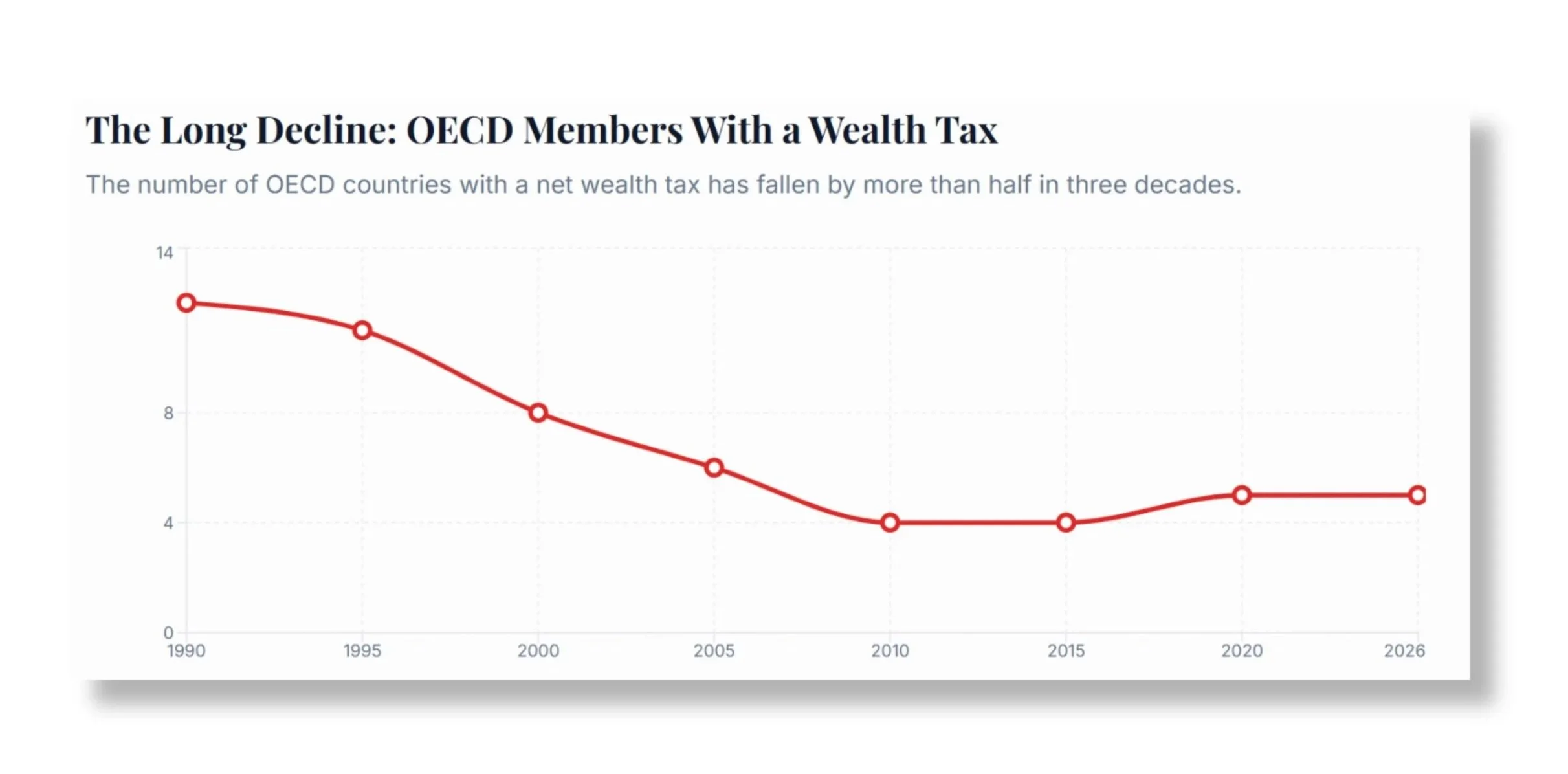
The OECD found 12 member countries had a net wealth tax in 1990 and only four by 2017. Repeals were usually justified on efficiency and administrative grounds, and the taxes often failed to meet their redistributive goals [14].
Norway is the case study everyone reaches for. In 2022 a rise took its top combined rate to 1.1%. That year more than 30 billionaires and multimillionaires left, according to Dagens Næringsliv [15]. Capital has legs. Its owners have passports.
The Netherlands has just learned the same lesson the quick way. In February the lower house passed a law taxing the annual rise in value of shares, bonds and crypto at 36%, whether or not anything was sold. A petition gathered more than 61,000 signatures and coalition senators preferred a tax on sale. The cabinet has now proposed taxing shares and bonds only when they are sold, from 1 January 2028 [16]. Tax the cash, not the valuation.
Source: Regen-Fin
The grain of truth
The counter-case deserves a fair hearing.
New Zealand has no general capital gains tax and no inheritance tax [11]. A salary earner pays tax on every dollar from the first. A long-term property or share investor can see large gains taxed lightly or not at all. That is a genuine gap, and these parties are at least trying to fill it with a number rather than a slogan. The OECD itself accepts that where capital is lightly taxed, or inheritances are not taxed, a net wealth tax may play a substitution role [14].
The administration case is not all one way either. Research in Fiscal Studies puts the central cost of running a well-designed UK wealth tax at about 0.1% of taxable wealth for taxpayers and 0.05% for the tax authority [3]. That counts the cost of collecting the tax, not the cost to the owner of finding the cash.
But a wealth tax is the hardest tool for that job. A capital gains tax is levied when cash changes hands. Even Labour's narrower version bites only on sale. A wealth tax is levied when it does not. It taxes the paper, year after year, and leaves the owner to find the money.
Whose interest is being served
For families, the practical question is not who you vote for. It is whether your structure works under more than one government.
Who holds what. How it would be valued, and by whom. Where the cash would come from in a lean year. Whether the succession plan still works if a 33% tax falls on the next generation. Whether a trust settled decades ago still serves the people it was meant to.
Do not restructure in a panic for a policy that may never pass. But do know your position, your structures and your succession plan before election night hands the file to a coalition room. Those are planning questions, and they are better answered calmly before a policy lands than in a rush after it.
Healey learned the lesson over five years. The pips squeaked, but it was the Treasury that ran out of juice. Grow the pie first, then argue about the slice.
Position for your goals, not for a caucus vote. When the noise gets loud, seek advice and wise counsel.

Nick Stewart
(Ngāi Tahu, Ngāti Huirapa, Ngāti Māmoe,
Ngāti Waitaha)
Financial Adviser and CEO at Stewart Group
Stewart Group is a Hawke's Bay and Wellington based CEFEX & BCorp certified financial planning and advisory firm providing personal fiduciary services, Wealth Management, Risk Insurance & KiwiSaver scheme solutions.
The information provided, or any opinions expressed in this article, are of a general nature only and should not be construed or relied on as a recommendation to invest in a financial product or class of financial products. You should seek financial advice specific to your circumstances from a Financial Adviser before making any financial decisions. A disclosure statement can be obtained free of charge by calling 0800 878 961 or visit our website, www.stewartgroup.co.nz
References
1. Langworth, R. (2014). Squeeze Germany until the pips squeak. Churchill Project, richardlangworth.com. On Sir Eric Geddes, First Lord of the Admiralty, and the 1918 election. The Cambridge speech of December 1918 is recorded at phrases.org.uk.
2. Healey, D. Speech at Lincoln, 18 February 1974, reported in The Times, 19 February 1974 (as quoted in Wikiquote: Denis Healey). Often misreported as “tax the rich until the pips squeak”. See also LabourList (October 2015), 10 of the best Denis Healey quotes.
3. Burgherr, D. (2021). The costs of administering a wealth tax. Fiscal Studies, 42(3-4), 677-697 (quoting Denis Healey, 1989). https://doi.org/10.1111/1475-5890.12276
4. Pickford, S. (9 December 2016). Britain’s big bailout, December 15, 1976. The World Today, Chatham House.
5. OMFIF (28 September 2016). When Britain went bust. https://www.omfif.org/2016/09/when-britain-went-bust/
6. 1News (21 June 2026). Greens propose wealth, inheritance taxes to fund income tax changes. https://www.1news.co.nz/2026/06/21/greens-propose-wealth-and-inheritance-taxes-to-fund-income-tax-changes/
7. 1News (26 August 2026). Te Pāti Māori launches new tax policy, says most would pay less. https://www.1news.co.nz/2026/08/26/te-pati-maori-launches-new-tax-policy-says-most-would-pay-less/ and Deloitte New Zealand (September 2026). Election tax policies, part three.
8. Opportunity Party (May 2026). Tax Reset policy. https://cdn.opportunity.org.nz/documents/policy/Opportunity%20Policy%20-%20Tax%20Reset.pdf, and 1News (30 June 2026). Explainer: What are the Opportunity Party’s policies? https://www.1news.co.nz/2026/06/30/explainer-what-are-the-opportunity-partys-policies/
9. 1News (13 October 2026). Poll: Hipkins and Luxon now neck and neck, Opportunity on track for 10 MPs. https://www.1news.co.nz/2026/10/13/poll-hipkins-and-luxon-now-neck-and-neck-opportunity-on-track-for-10-mps/
10. Morgan, G. (10 October 2026). Opportunity’s tax plan joins Labour, Greens as regressive for NZ. Newsroom. https://newsroom.co.nz/2026/10/10/gareth-morgan-opportunitys-tax-plan-joins-labour-greens-as-regressive-for-nz/
11. KPMG New Zealand (August 2026). Election 2026 party tax policies tracker (updated to 6 August 2026), and Grant Thornton New Zealand (2026). Tax policy at the crossroads: growth, simplicity and redistribution in Election 2026.
12. Deloitte New Zealand (August 2026). Election tax policies, part two (Tax Alert), and interest.co.nz (June 2026). Labour finance spokesperson Barbara Edmonds says the only tax policy Labour will campaign on is its capital gains tax.
13. interest.co.nz (2026). Natalia Albert says finally the Green Party has mostly got its tax policy right (28.5% of the super-rich tax assumed uncollected, on Parliamentary Library advice informed by Treasury). https://www.interest.co.nz/public-policy/139129/natalia-albert-says-finally-green-party-has-mostly-got-its-tax-policy-right
14. OECD (2018). The Role and Design of Net Wealth Taxes in the OECD. OECD Tax Policy Studies No. 26. OECD Publishing, Paris.
15. IFC Review (April 2023). Europe’s super-rich abandoning Norway at record rate as wealth tax rises slightly (citing Dagens Næringsliv).
16. IMI Daily (16 September 2026). Netherlands retreats from 36% unrealized gains tax, will propose sale-based model instead; and DutchNews.nl (30 September 2026). The box 3 tax changes: what they are and what they mean for you.