
Article #456
This month marks 319 years since Scotland ceased to exist as an independent state. The cause was less a constitutional question than a financial one – and the lesson still applies to every household balance sheet today.
Three hundred and nineteen years ago this month, on the first of May, 1707 [1], Scotland ceased to exist as an independent state. Its parliament voted itself out of existence, and the Kingdom of Great Britain came into being. The Acts of Union are usually taught as constitutional history, but they are as much a story of financial planning gone catastrophically wrong.
Scotland did not so much choose union as fall into it, broke and humiliated, after staking nearly everything it had on what its promoters had insisted was a sure thing: the Darien scheme.
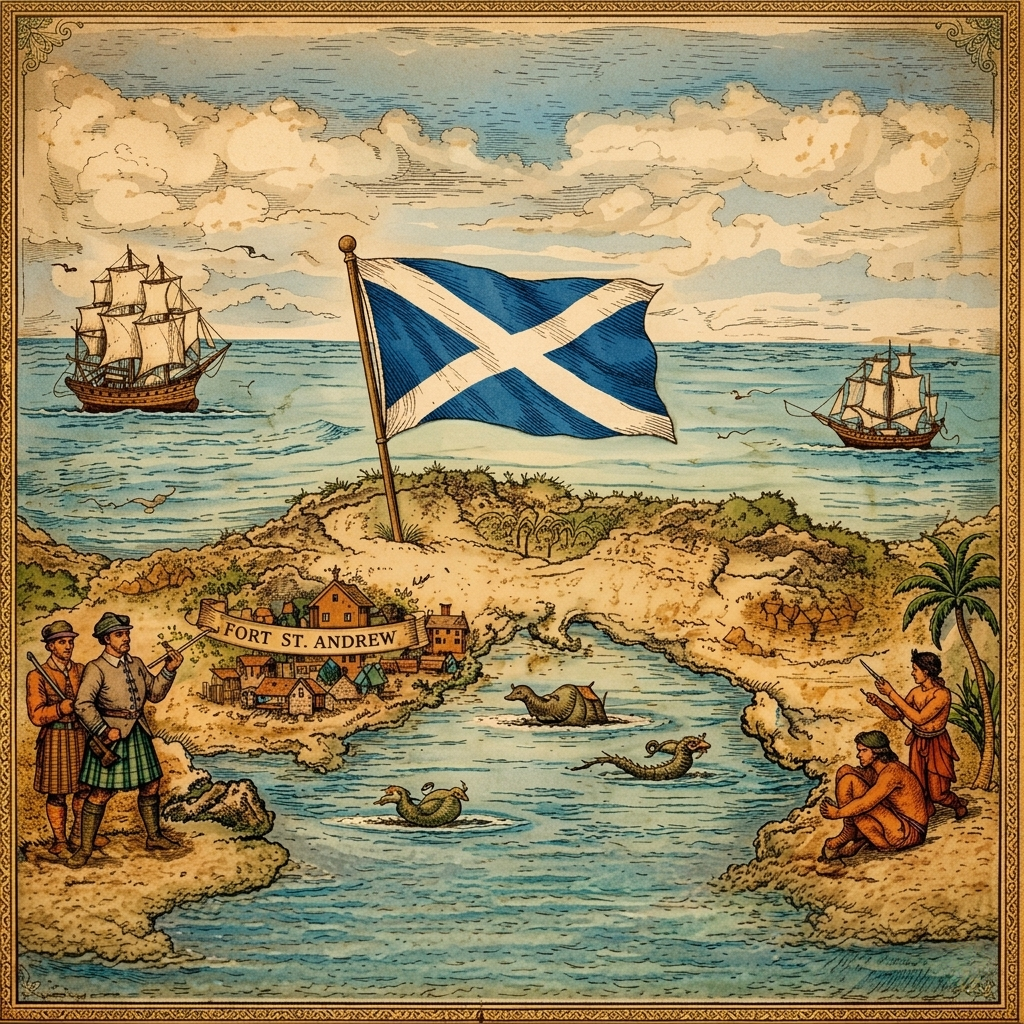
In 1695, Scottish financier William Paterson – the same man who had founded the Bank of England but a year earlier [2] – proposed Scotland should establish a colony at Darien, on the Isthmus of Panama. The vision was breathtaking. Scottish ships would dominate the route between the Atlantic and the Pacific, freed from the English Navigation Acts that shut them out of imperial trade. Cargo would be portaged across the isthmus. Scotland would become the Venice of the New World, a global trading power overnight. It was to be the Suez Canal of its age, two centuries before anyone had the engineering to dig one.
The Company of Scotland was incorporated to fund the venture. The original plan was to raise capital across England and the Netherlands as well as Scotland, but the East India Company and the English crown moved swiftly to choke foreign subscriptions. What might have been an international syndicate became, by political accident, an exclusively Scottish one. The Scots took up the slack with extraordinary enthusiasm. Aristocrats, merchants, burghs, ministers of the kirk, widows of modest means – to subscribe to Darien became an act of national pride. It was a vote of confidence in Scotland’s economic independence.
By the time the books closed, the company had raised roughly £400,000.[3] A simple inflation calculator translates this to around NZ$140 to $185 million in today’s money. But that figure is misleading: NZ$140 million today would not buy a single street of houses in central Edinburgh, or for that matter Havelock North. In 1698, £400,000 could capitalise an entire colonial empire. The honest comparison is to the size of the economy that produced it. Measured as a share of national output, the equivalent today would be at least NZ$28 billion (around £12 billion sterling), and likely considerably more.[10] £400,000 was somewhere between a fifth and a quarter of all the coin and credit in circulation in Scotland.[4] Imagine a country where one in every four pounds had been committed to a single offshore venture before the first ship had even sailed.
The first expedition of around 1,200 colonists left Leith in July 1698 and reached Darien in November.[5] What they found bore little resemblance to the prospectus.
A harsh lesson in ‘Expectations vs Reality’
The land was a malarial swamp. It was claimed by Spain, with whom England did not wish to pick a fight. The soil could not feed the settlers, the climate killed them faster than supplies could reach them, and King William (William II of Scotland and III of England) had quietly instructed the English colonies in the Americas to render no assistance whatsoever.
By the time a second expedition arrived to reinforce the colony, the first had already largely died or fled. In April 1700, the survivors of the second expedition surrendered to a Spanish blockade and abandoned New Caledonia, as they had hopefully named it. Of the roughly 2,500 colonists who had set out, about 2,000 were dead.[6] The £400,000 was gone.
What followed was the slow grind of insolvency at a national scale. The Scottish gentry was ruined. Trade collapsed. The Bank of Scotland (founded the same year as the Company of Scotland but wise enough to decline any role in the scheme)[8] survived – the country around it did not.
England then offered a treaty of union with a payment built into it; some £398k to sweeten the deal. This was on the same order of national-output magnitude as the Darien capital itself and conveniently covered the losses of those investors almost to the pound.[7]
Organised resistance evaporated. Robert Burns would later write that Scotland’s parliament had been “bought and sold for English gold.”[9] Whatever the moral verdict, the financial mechanism was clear enough. Scotland traded its sovereignty for a bailout. That is the line from a Panamanian swamp to the Acts of Union.
Don’t bet the farm (or the country) on a ‘sure thing’
A sure thing that absorbs a fifth of your capital is not a plan. It is a wager, and a dangerous one at that. The bigger the conviction, the bigger the position; the bigger the position, the less the household can afford for the conviction to be wrong.
We see this position constantly:
The client who has built a successful business over thirty years now holds 80 per cent of their household wealth in its shares and is reluctant to sell down because the business has compounded so well for so long.
The couple whose retirement rests entirely on a single leveraged property in a single town.
The investor who has watched one asset class run hard for a decade, and concluded that diversification is a strategy for only the meek.
The family whose financial independence rides on the equity in the family home, with no liquid reserves to bridge a redundancy or an illness.
Each of these is a Darien in miniature. The case for concentration has been built on the run of good fortune that preceded it, and the case against diversifying gets more convincing the longer the good fortune holds.
A real financial plan begins with an uncomfortable question: If this single position – this business, this property, this stock, this asset class – went to zero tomorrow, would the household’s goals still be reachable? If the answer is no, then the position is not just an investment within the greater plan; the position is the plan, and the plan has no redundancy.
Instead, investors must be methodical:
Diversify: Across asset classes, entities, ownership structures, and income streams.
Hold liquidity: Sufficient to ride out at least one bad cycle without being forced to sell at the worst moment.
Find the line: Write down what would have to happen for the concentrated position to be reduced, and act accordingly when those conditions are met – rather than rationalising why this time is different.
Scotland could not diversify its way out of Darien because by 1700 the capital had already gone. The question was no longer how to invest; it was how to survive.
Most household plans are not run that close to the edge, but the pattern is the same: When the story is too good to question, that conviction drives capital concentration to match. Then, all it takes is a single event – a market shift or regulatory change, an illness, a divorce, or in extreme cases a malarial swamp – to derail the ‘sure thing’ and turn it into something else entirely.
A worthy plan is one that does not depend on any single bet, no matter how appealing. Darien is what happens when a country forgets that – working with a trusted advisor can help ensure investors don’t forget it, either.

Nick Stewart
(Ngāi Tahu, Ngāti Huirapa, Ngāti Māmoe,
Ngāti Waitaha)
Financial Adviser and CEO at Stewart Group
Stewart Group is a Hawke's Bay and Wellington based CEFEX & BCorp certified financial planning and advisory firm providing personal fiduciary services, Wealth Management, Risk Insurance & KiwiSaver scheme solutions.
The information provided, or any opinions expressed in this article, are of a general nature only and should not be construed or relied on as a recommendation to invest in a financial product or class of financial products. You should seek financial advice specific to your circumstances from a Financial Adviser before making any financial decisions. A disclosure statement can be obtained free of charge by calling 0800 878 961 or visit our website, www.stewartgroup.co.nz
REFERENCES
1. “Act of Union 1707,” UK Parliament, parliament.uk/about/living-heritage/evolutionofparliament/legislativescrutiny/act-of-union-1707/.
2. “William Paterson (banker),” Encyclopaedia Britannica, britannica.com/biography/William-Paterson-Scottish-banker.
3. “The Darien Scheme: Scotland’s failed venture to colonise part of Panama,” National Museums Scotland, nms.ac.uk/explore-our-collections/stories/scottish-history-and-archaeology/the-darien-scheme/.
4. “Darien scheme,” Wikipedia, en.wikipedia.org/wiki/Darien_scheme; see also Schoolshistory.org, “Darien Scheme,” noting Company of Scotland subscriptions equated to roughly one-fifth of money in circulation in Scotland.
5. National Museums Scotland, op. cit.; “Darien scheme,” Wikipedia, en.wikipedia.org/wiki/Darien_scheme (departure of first expedition, July 1698; landfall November 1698).
6. “Scotland’s Doomed Darien Expedition,” Edinburgh Expert Walking Tours, edinburghexpert.com (final surrender, 12 April 1700; mortality figures).
7. “Acts of Union 1707,” Wikipedia, en.wikipedia.org/wiki/Acts_of_Union_1707, citing Article 15 of the Treaty of Union (the “Equivalent,” £398,085 10s. sterling); see also “Act of Union,” Encyclopaedia Britannica, britannica.com/event/Act-of-Union-Great-Britain-1707.
8. H. Paul, “The Darien Scheme and Anglophobia in Scotland,” Discussion Papers in Economics & Econometrics, University of Southampton, No. 0925 (noting the Bank of Scotland, founded 1695, survived in part by declining involvement in Darien).
9. “Such a Parcel of Rogues in a Nation,” Wikipedia, en.wikipedia.org/wiki/Such_a_Parcel_of_Rogues_in_a_Nation. The song, conventionally attributed to Robert Burns and published in James Johnson’s Scots Musical Museum (1792), denounces the Scottish parliamentarians who voted for union.
10. Modern-equivalent figures: a simple RPI inflation conversion gives around £60–80 million (NZ$140–185 million) for £400,000 in 1698 (per the UK Office for National Statistics composite price index). However, both the Bank of England and MeasuringWorth caution that RPI conversion materially understates the real economic weight of capital projects and government expenditure; a share-of-GDP comparison gives at least £12 billion (around NZ$28 billion at GBP/NZD ≈ 2.30, May 2026), and likely more. See L. H. Officer and S. H. Williamson, “Five Ways to Compute the Relative Value of a UK Pound Amount,” MeasuringWorth, measuringworth.com; and the discussion in “What’s the Equivalent Today of £400,000 in 1698?,” eaho.substack.com (2024).