Investments

Should I Invest in What I Love? Product Affection vs Investment Logic

Personal product preferences are often the worst possible guide to investment decisions.

I remember when my family first got a GoPro. Revolutionary technology, stunning footage – everyone wanted one. Naturally, I thought: "This company is going places. Maybe I should buy shares." It's a seductive logic: if I love the product, surely others will too. A decade later, I'm thankful I didn't act on that impulse.

This instinct to invest in what we know and love feels intuitive. We use the products, we understand them, we see their value. But this emotional connection – what behavioural economists call "familiarity bias" – is precisely what makes it dangerous.

Back in 2014, GoPro went public and quickly hit a market capitalization of $10 billion with virtually no competition. Today? The stock trades around $1.87 per share – down 98% from its peak, with over $9.7 billion in market value lost.

What went wrong?

Smartphones killed the action camera star. Modern phones became waterproof, gained multiple lenses, and developed image stabilisation that rivals dedicated cameras. GoPro thought they were competing against other action cameras when they were actually competing against the most successful consumer device in history.

But here's the deeper lesson: loving a product tells you nothing about the company's competitive position or long-term viability. A great product is necessary but far from sufficient for investment success. In GoPro's case, every smartphone manufacturer became their competitor, each with deeper pockets and products consumers were already buying.

The Pattern Repeats Closer to Home

This isn't just an overseas story. Take My Food Bag – during COVID lockdowns, it seemed genius. The company went public in March 2021 at $1.85 per share, raising $342 million. Customers loved the service and bought shares. Many retail investors had enjoyed watching co-founder Nadia Lim cook on TV for years – hardly grounds for a wise investment decision. The result? Shares now trade around 25 cents – an 86% decline. As one fund manager noted, "It was a classic private equity exit, which has seen a lot of retail investors lose out."[1]

The timing seemed perfect. Lockdowns had created new habits. People were cooking at home more. The convenience model made sense. But investors failed to ask: what happens when lockdowns end? Is this a permanent behaviour shift or a temporary adaptation? How defensible is the business model? These are the uncomfortable questions that emotional attachment prevents us from asking.

As one fund manager noted, "It was a classic private equity exit, which has seen a lot of retail investors lose out."

Then there's Ryman Healthcare, beloved by many Kiwi families for good reason. My own family experienced the amazing care and kindness shown towards my late father during his time in the dementia care unit at Ryman in Havelock North. The quality of their villages is genuinely impressive. Yet despite these strengths, the stock hit $10.87 in December 2019 and now trades around $2.87 – down 74%. The investment thesis crumbled under construction delays and regulatory challenges, demonstrating that exceptional service doesn't automatically translate into strong investment returns.

This one hits close to home because the service was excellent. But gratitude and investment logic operate in different domains. A company can deliver outstanding customer experiences while simultaneously facing operational headwinds that undermine shareholder returns.

These three examples share a common thread: product or service quality created an emotional connection that clouded rational investment analysis.

The Evidence Against Emotional Investing

Behavioural finance research identifies "familiarity bias" as a major driver of poor investment decisions, where investors favour what they know rather than what performs best.[2] This bias is particularly pronounced amongst long-term investors who believe they're securing against volatility when they're actually concentrating risk.

The evidence against stock picking is overwhelming:

An Arizona State University study by Professor Hendrik Bessembinder examining over 28,000 stocks from 1926 to 2024 found that just 4% of firms created all net wealth in the U.S. stock market. The remaining 96% collectively matched Treasury bills over their lifetimes, and the majority of individual stocks actually reduced shareholder wealth compared to holding cash.[3]

Think about that. If you picked a stock at random, you'd have better than even odds of underperforming cash. The market's impressive returns come from a tiny fraction of companies – and identifying them in advance is nearly impossible.

Professional fund managers fare no better. S&P Dow Jones Indices' SPIVA Scorecard shows that after 10 years, approximately 85% of large-cap funds underperform the S&P 500, and after 15 years, around 90% trail the index.[4] Even Warren Buffett admits: "In 58 years of Berkshire management, most of my capital-allocation decisions have been no better than so-so."[5]

These aren't amateur investors. These are professionals with research teams, Bloomberg terminals, insider access, and decades of experience. If they can't beat a simple index fund, what makes individual investors think they can, especially when driven by product affection rather than analysis?

The Smart Money Questions

Instead of asking "Do I love this product?", evidence-based investors ask: How big is the addressable market? What prevents competitors from copying this? How strong are the financials? Is the company innovating fast enough? What could make this product obsolete?

These questions are deliberately uncomfortable because they force you to look beyond your emotional attachment. They require research, analysis, and a willingness to acknowledge uncertainty. Most importantly, they shift the focus from "I like this" to "can this company maintain a durable competitive advantage?"

The answers usually point to the same solution: diversification. Diversified index funds consistently outperform stock picking over the long term, providing market-matching returns while reducing the risk of catastrophic losses from individual stock failures.[6]

Diversification isn't glamorous. There's no story to tell at dinner parties about your clever stock pick. But it's precisely this lack of excitement that makes it effective. By owning the entire market, you guarantee you'll own the 4% of companies that generate all the wealth creation, without needing to predict which ones they'll be.

As a fee-only adviser working with evidence-based strategies, the real value isn't in chasing hot stocks or validating product obsessions. It's in building a robust financial plan grounded in decades of research, then maintaining discipline through market noise and emotional temptation.

This discipline is harder than it sounds. When GoPro was soaring, when My Food Bag was listing during lockdowns, when you're genuinely grateful for care received – the emotional pull to invest is powerful. It feels like you have special insight. You don't. You have an emotional connection clouding your judgment.

The most valuable thing a good adviser provides isn't stock tips or market predictions. It's the voice of reason when your emotions are screaming at you to invest in what you love. It's the person who asks the uncomfortable questions: "Have you analyzed the competitive landscape? What's your exit strategy? How does this fit your overall plan?" These questions aren't exciting, but they're essential.

Seek wise counsel, commit to a plan that aligns with your goals, and redirect that energy from stock-picking to living your life. Enjoy the products you love. Be grateful for excellent service. Just don't confuse these feelings with investment insight.

Your future self will thank you for choosing evidence over emotion.

Nick Stewart

(Ngāi Tahu, Ngāti Huirapa, Ngāti Māmoe, Ngāti Waitaha)

Financial Adviser and CEO at Stewart Group

  • Stewart Group is a Hawke's Bay and Wellington based CEFEX & BCorp certified financial planning and advisory firm providing personal fiduciary services, Wealth Management, Risk Insurance & KiwiSaver scheme solutions.

  • The information provided, or any opinions expressed in this article, are of a general nature only and should not be construed or relied on as a recommendation to invest in a financial product or class of financial products. You should seek financial advice specific to your circumstances from a Financial Adviser before making any financial decisions. A disclosure statement can be obtained free of charge by calling 0800 878 961 or visit our website, www.stewartgroup.co.nz

  • Article no. 437


References

  1. My Food Bag Group Limited. (2024-2025). Financial Results and Market Updates. NZX Announcements. Retrieved from https://investors.myfoodbag.co.nz/

    • Devon Funds Management. (2025). "My Food Bag Investment Analysis." RNZ Business Interview, May 22, 2025.

  2. Huberman, G. (2001). Familiarity breeds investment. Review of Financial Studies, 14(3), 659–680. https://doi.org/10.1093/rfs/14.3.659

    • Chew, S.H., Li, K.K., & Sagi, J. (2023). Home bias explained by familiarity, not ambiguity. Social Science Research Network. https://papers.ssrn.com/sol3/papers.cfm?abstract_id=3870716

    • De Vries, A., Erasmus, P.D., & Gerber, C. (2017). The familiar versus the unfamiliar: Familiarity bias amongst individual investors. Investment Analysts Journal, 46(1), 24-39.

  3. Bessembinder, H. (2024). Shareholder wealth enhancement, 1926 to 2022 (Updated through 2024). Arizona State University, W.P. Carey School of Business. Retrieved from https://wpcarey.asu.edu/department-finance/faculty-research/do-stocks-outperform-treasury-bills

    • Bessembinder, H. (2018). Do stocks outperform Treasury bills? Journal of Financial Economics, 129(3), 440-457.

  4. S&P Dow Jones Indices. (2024). SPIVA U.S. Scorecard Year-End 2024. Retrieved from https://www.spglobal.com/spdji/en/documents/spiva/spiva-us-year-end-2024.pdf

  5. Berkshire Hathaway Inc. (2022). Letter to Shareholders. Annual Report 2022.

  6. Malkiel, B.G. (2019). A random walk down Wall Street: The time-tested strategy for successful investing (12th ed.). W.W. Norton & Company.

    • Bogle, J.C. (2017). The little book of common sense investing: The only way to guarantee your fair share of stock market returns (10th anniversary ed.). John Wiley & Sons.

    • Fama, E.F., & French, K.R. (2010). Luck versus skill in the cross-section of mutual fund returns. The Journal of Finance, 65(5), 1915-1947.


Markets, Science, & the Chicago Legacy: Why Evidence Matters More Than Ever

Standing outside the University of Chicago Booth School of Business recently, I was struck by how this building represents something far more valuable than bricks and mortar.

The building bears the name of David Booth, founder of Dimensional Fund Advisors (DFA), whose $300 million donation in 2008 recognised the profound influence this institution has had on how we understand investing. It was the largest gift to any business school in history at the time—and for good reason. The University of Chicago has produced 97 Nobel Prize laureates, making it one of the world’s great centres of economic thought.

I’ve just returned from the United States, where I attended a conference and met with some of the most innovative wealth management firms operating today. What struck me most wasn’t the technology or the marketing—it was the unwavering commitment to letting science, not emotion, drive investment decisions.

The Chicago Revolution

The University of Chicago fundamentally changed how we understand markets. In the 1960s and 70s, Eugene Fama developed the Efficient Market Hypothesis, which challenged the prevailing wisdom that active stock pickers could consistently beat the market. His research, along with work by Harry Markowitz on portfolio theory and Merton Miller on corporate finance, created a scientific framework for understanding how markets actually work rather than how we wish they would work.

 These weren’t armchair theories. They were rigorously tested hypotheses backed by decades of data. Fama won the Nobel Prize in 2013.[1] More recently, Douglas Diamond, who serves as a director at DFA, won the Nobel Prize in 2022 for his groundbreaking research on banks and financial crises.[2] The message is clear: markets are remarkably efficient at incorporating information into prices, making it extraordinarily difficult for active managers to consistently outperform after fees.


From Theory to Practice

This is where David Booth’s story becomes fascinating. After studying under these pioneers at Chicago, he co-founded DFA in 1981 with a radical idea: academic research should drive investment strategy. Rather than trying to pick winners or time markets, DFA built portfolios that captured the dimensions of return that academic research had identified—company size, relative price, and profitability.

The firm’s commitment to its academic foundation remains extraordinary. Eugene Fama himself serves as a director and consultant to DFA, alongside Nobel laureate Douglas Diamond and numerous other distinguished academics.[3] This isn’t window dressing—these researchers actively shape the firm’s investment approach. Today, DFA manages over $850 billion globally and works exclusively with around 1,800 financial advisers and institutions worldwide who share their evidence-based philosophy.[4]

We’ve been fortunate to be part of that community since 2003. Over more than two decades, I’ve had the privilege of meeting David Booth himself, along with many of DFA’s esteemed researchers and team members. These aren’t just business relationships—they’re ongoing dialogues about how markets work and how we can best serve our clients.

But philosophy alone doesn’t pay the bills. The real work happens in translating these academic insights into portfolios that work for real New Zealanders with real goals. Our investment committee builds portfolios that harness these evidence-based principles while respecting each client’s individual circumstances. For some, that means incorporating ESG considerations—ensuring investments align with values without sacrificing returns. For others, it’s about smart tax planning, understanding how PIE funds, FIF rules, and portfolio location decisions can significantly impact after-tax wealth over time. The science tells us what works in markets; our job is to implement it in a way that works for you.


The Emotional Trap

During my US trip, I sat through presentations from wealth management firms managing billions in client assets. A common theme emerged: the biggest threat to investor success isn’t market crashes or economic recessions—it’s investor behaviour itself.

We’re hardwired for emotional responses that work against us in financial markets. We panic when markets fall and become euphoric when they rise. We chase last year’s winners and abandon sound strategies at precisely the wrong moment. We believe we can spot the next big thing, despite overwhelming evidence that even professionals cannot consistently do so.

The firms I met with have built their practices around protecting clients from themselves. They use science-based portfolio construction, maintain discipline during volatility, and focus on what investors can control: costs, diversification, tax efficiency, and most importantly, behaviour.


The New Zealand Reality

Here’s something I hear often: “But surely New Zealand is different?”

It’s not. Market principles are universal. New Zealand shares trade on the same fundamental dynamics as shares in New York, London, or Tokyo. The temptation to believe “it’s different here” often leads to home bias and concentrated portfolios that increase risk without increasing expected returns.

The evidence is unequivocal, regardless of geography. Studies consistently show that the average investor significantly underperforms the very funds they invest in, purely due to poor timing decisions. Research from Morningstar found that investors typically lag their own investments by 1-2% annually simply by buying high and selling low.[5] This behaviour penalty applies equally to investors in Auckland as it does in Austin.

Think about that: a 1-2% annual drag from poor timing decisions alone. Over a 30-year investment horizon, that’s the difference between retiring comfortably and struggling to make ends meet. And it has nothing to do with market returns or fund performance—it’s entirely self-inflicted through emotional decision-making.


What This Means for You

As your advisers, our role isn’t to predict the future or pick winning stocks. It’s to help you stay invested in sensibly constructed, evidence-based portfolios through all market conditions. The science tells us that markets reward patient investors who remain diversified and resist the urge to react to short-term noise.

This matters now more than ever. With 24/7 news cycles, social media investment “gurus,” and the constant temptation to react to market movements, maintaining discipline has never been harder—or more important.

When markets inevitably experience volatility (and they will), remember this: every market downturn in history has eventually been followed by recovery. The investors who stayed disciplined and remained invested captured those recoveries. Those who sold in panic and tried to time their re-entry typically bought back in after much of the recovery had already occurred.

Standing outside that Chicago building, I felt grateful for the legacy of rigorous thinking that continues to shape how we invest today. But the principles that emerged from those halls decades ago remain as relevant now as ever: markets work, diversification matters, costs compound, and behaviour determines outcomes.

The challenge isn’t knowing what to do—science has answered that. The challenge is doing it consistently, especially when markets test our resolve. That’s where good advice becomes invaluable.


Nick Stewart

(Ngāi Tahu, Ngāti Huirapa, Ngāti Māmoe, Ngāti Waitaha)

Financial Adviser and CEO at Stewart Group


References

 [1] The Nobel Prize, “Eugene F. Fama - Facts,” 2013, [nobelprize.org](http://nobelprize.org)

 [2] University of Chicago Booth School of Business, “Douglas W. Diamond Wins Nobel Prize in Economic Sciences,” October 2022, [chicagobooth.edu](http://chicagobooth.edu)

 [3] Dimensional Fund Advisors, “Leadership and Board of Directors,” [dimensional.com](http://dimensional.com)

 [4] Dimensional Fund Advisors SEC Form ADV, showing $835.7 billion in discretionary assets under management as of March 31, 2025

 [5] Morningstar, “Mind the Gap: The Behavior of the Average Investor,” various years, [morningstar.com](http://morningstar.com)

 [6] University of Chicago News, “Alumnus David Booth gives $300 million; University of Chicago Booth School of Business named in his honor,” November 2008, [news.uchicago.edu](http://news.uchicago.edu)​​​​​​​​​​​​​​​​

Not all that Glitters: A Hawke’s Bay Perspective on Investment Lures

Walking your dog along the banks of the Tuki Tuki River on a crisp Hawke's Bay morning, you might spot an angler casting their line into the current. If you look closely at the tackle box, you'll find an array of brightly coloured lures - fluorescent pinks that practically glow in daylight, electric greens that shimmer with an unnatural brilliance, shimmering silvers that catch every ray of sun. Each one is a masterpiece of design, engineered to trigger a response. They're designed to catch something, all right. But it's not always the fish.

Lures work because they exploit instinct. That flash of silver mimics a wounded baitfish. The vibrant pink stands out against murky water. The electric green triggers a predatory response. But here’s the thing - the lure doesn’t need to fool the fish to be successful. It only needs to fool the angler into buying it. The brightest, most eye-catching lures often sit in tackle boxes, never touching water, while experienced fishers reach for duller, more practical options that actually work.

Charlie Munger, the late investing legend and Warren Buffett’s long-time partner, once recounted a conversation that cuts to the heart of how financial products are really sold. He’d asked a fishing lure salesman whether fish actually bit on those garish purple and green contraptions. The man’s response was disarmingly honest: “Mister, I don’t sell to fish.” [1]

That simple line exposes an uncomfortable truth about the investment industry - one that’s struck particularly close to home here in Hawke’s Bay in recent times. In October 2025, the Financial Markets Authority issued a formal warning to Finbase (HP Capital Limited) over serious breaches relating to their Single Investment financial products - essentially property lending arrangements.[2] This is the same company that had been running full-page advertisements in the Hawke’s Bay Today, using search terms like “term deposit” and “low risk investment NZ” to attract investors.

But there’s more. Also in October, MyFarm Investments’ Rākete Orchards partnership, which grows Rockit apples across six Hawke’s Bay orchards valued at $17.4 million, entered voluntary administration. [3]  When launched in late 2017, the investment closed oversubscribed at $13 million, with forecasts of returns exceeding 50-55% per annum. [4]  Those shiny projections now look very different.

The irony is impossible to miss. Full-page ads in our local paper projecting stability and legitimacy - the investment equivalent of fluoro pink lures. Promises of safety using familiar terms like “term deposit” - the shimmering silver that mimics something trustworthy. Bold marketing campaigns featuring impressive return projections - the electric green designed to stand out from everything else. None of it was designed to catch fish. It was all designed to catch us.

The FMA found that Finbase’s advertising created a false impression that their investment products were comparable to term deposits when they differed significantly in nature and characteristics.[2] The use of familiar, reassuring terminology masked the real nature of the investment and its risks. Meanwhile, Rākete’s chair blamed low returns, noting that demand hadn’t grown sufficiently, and high costs meant returns were insufficient to support ongoing operations.[5]

Humans are predictable creatures, and decades of behavioural finance research has mapped our psychological vulnerabilities. We’re drawn to familiar-sounding terms because they trigger associations with safety and certainty. We’re attracted to branded agricultural products because they seem tangible, real, and connected to what we know. We trust advertisements in our local newspaper more than we probably should. The investment industry understands this intimately and constructs marketing designed to activate them, whether or not the product serves our actual interests.

Here in Hawke’s Bay, we pride ourselves on straight talk and honest work. Our regional economy is built on things you can touch and understand - orchards heavy with export-quality apples, vineyards producing wines that compete on world stages, farms raising premium livestock. There’s no mystery about how value is created in these industries. You plant, you tend carefully, you harvest, you continually improve your methods. Real results come from patience, expertise, and time.

Successful investing follows these same unglamorous principles. It’s buying quality businesses at reasonable prices and holding them through inevitable market cycles. It’s diversifying sensibly across different asset classes and geographies. It’s keeping costs and fees low. It’s maintaining emotional discipline when markets fluctuate. It’s resisting the powerful urge to chase whatever looks shiniest or promises the highest returns.

This approach doesn’t generate compelling marketing copy. It doesn’t require full-page advertisements. It doesn’t promise 50%+ annual returns that sound too good to be true. But that’s precisely why it’s harder to sell. Boring doesn’t capture attention. Prudent diversification doesn’t create excitement. Modest, realistic projected returns don’t make headlines.

When someone presents an investment opportunity backed by aggressive marketing - whether splashed across the Hawke’s Bay Today or promoted through carefully optimised online search terms - ask yourself fundamental questions: Is this designed to catch fish, or catch me? Why does something supposedly offering solid, legitimate returns need this level of promotional spending? What happens if rosy projections don’t materialise? What are the realistic worst-case scenarios?

This is where seeking wise counsel becomes essential. Look for advisers with rigorous due diligence processes and recognised certifications like CEFEX, which demonstrates commitment to fiduciary excellence and systematic client protection.[6] These aren’t shiny credentials designed to impress - they’re evidence of thorough, unglamorous processes that protect investors.

A good adviser asks uncomfortable questions about any investment: What are the real, not theoretical, risks? How dependent is success on optimistic assumptions about markets, demand, or costs? How liquid is this investment if circumstances change? Can you genuinely afford to lose this money? Most importantly, have similar investments really delivered returns as promised, or is there a pattern of disappointments?

Finbase exceeded regulatory limits and used advertising that misled potential investors about fundamental product characteristics.[2] With Rākete, even real orchards growing actual apples in Hawke’s Bay soil didn’t deliver the projected economics. Other Rockit growers reported returns well under the $1.10 per tube needed to break even, forcing difficult decisions about their orchard futures.[3]

The consequences of getting these decisions wrong aren’t abstract. They affect real people in our community - retirees who thought they were safely parking their retirement savings, families who believed they were making prudent decisions while supporting local agriculture, individuals who trusted that bold advertising in their trusted local newspaper meant something had been thoroughly vetted and deemed appropriate for ordinary investors.

The magpie, despite its considerable intelligence, can’t resist a shiny object. It’s hardwired evolutionary instinct. But we can do better.

Next time you’re walking your dog along the Tuki Tuki and see those bright lures glinting in an angler’s tackle box - let them serve as a useful reminder. The brightest lures are often the ones that never get wet. In fishing, as in investing, the flash and colour serve one primary purpose - to catch you, not the fish.

Because the question isn’t whether the lure looks attractive, uses comfortable terminology, appears in trusted publications, or involves tangible Hawke’s Bay assets. The question is simple and profound: who is it really designed to catch?

Your financial future deserves better than bright colours and borrowed credibility. It deserves honesty, transparency, realistic assumptions, thorough due diligence, and advice that genuinely serves your interests rather than someone else’s sales commission.

Unless you’re a magpie, you don’t have to take the bait.

Nick Stewart
(Ngāi Tahu, Ngāti Huirapa, Ngāti Māmoe, Ngāti Waitaha)

Financial Adviser and CEO at Stewart Group

  • Stewart Group is a Hawke's Bay and Wellington based CEFEX & BCorp certified financial planning and advisory firm providing personal fiduciary services, Wealth Management, Risk Insurance & KiwiSaver scheme solutions.

  • The information provided, or any opinions expressed in this article, are of a general nature only and should not be construed or relied on as a recommendation to invest in a financial product or class of financial products. You should seek financial advice specific to your circumstances from a Financial Adviser before making any financial decisions. A disclosure statement can be obtained free of charge by calling 0800 878 961 or visit our website, www.stewartgroup.co.nz


References

  1. Poor Charlie's Almanack: The Wit and Wisdom of Charles T. Munger

  2. Financial Markets Authority. (2025, October). "FMA issues warning to Finbase over serious disclosure and fair dealing breaches." Retrieved from https://www.fma.govt.nz/news/all-releases/media-releases/warning-to-finbase/

  3. Farmers Weekly (2025, October 15). MyFarm’s Rockit partnership turns sour as Rākete orchard enters voluntary administration

  4. Rural News Group. (2017, December 16). "A chance to pocket from Rockit." Retrieved from https://www.ruralnewsgroup.co.nz/rural-news/rural-agribusiness/a-chance-to-pocket-from-rockit

  5. NZ Herald. (2025, October 28). "Rockit apple grower Rākete Orchards in voluntary administration." Retrieved from https://www.nzherald.co.nz/business/companies/agribusiness/rockit-apple-grower-rakete-orchards-in-voluntary-administration/PNH4JTBZHBHLTLPF7XAMS5U474/

  6. Centre for Fiduciary Excellence (CEFEX). For more information on fiduciary certification standards, visit www.cefex.org

The Magnificent 7: Why Yesterday’s Winners May Not Be Tomorrow’s Champions

Financial advisers are facing intense pressure from clients: should portfolios be loaded up on the Magnificent 7 stocks (Apple, Microsoft, Amazon, Alphabet, Meta, NVIDIA, and Tesla)?

These tech giants have delivered spectacular returns and now dominate America’s largest companies. Clients’ friends are bragging about gains, financial media breathlessly covers every earnings report, and the fear of missing out is palpable.

But financial lessons tell us to look beyond the headlines and recent performance – and market history suggests this caution is warranted.

The Illusion of Permanence

When we look at today’s market leaders, it’s easy to assume they’ll remain on top indefinitely. These companies have massive cash reserves, dominant market positions, and appear to be shaping our technological future. But market history tells a different story.

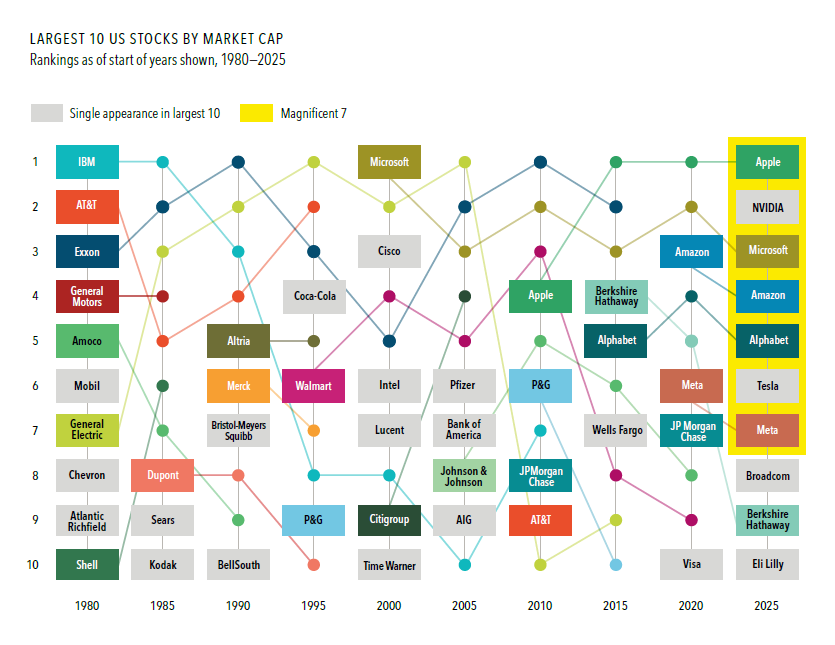
Consider this statistic from Dimensional Fund Advisers’ analysis: of the 10 largest US companies in 1980, only three made it to the top 10 by 2000.[1] Even more striking, none of those 1980 giants appears in today’s top 10. Companies like IBM, AT&T, and Exxon – once considered unassailable titans – have been replaced by an entirely new generation of market leaders.

Source: Dimensional - Click for full information

This is more than trivia; it’s a fundamental lesson about impermanent market dynamics that should inform every portfolio decision.

Research from the Centre for Research in Security Prices demonstrates that market leadership is far more transient than most investors realise: In 1980, six of the 10 largest companies were energy firms.[1] Today, technology dominates. This wasn’t gradual. It was a wholesale transformation driven by innovation and shifting economic fundamentals.

This pattern should concern anyone betting that today’s technology concentration will last for decades. Seemingly unstoppable industries may face disruption from sources we cannot yet imagine.

Technological advancement doesn’t benefit only technology companies. Throughout history, firms across all industries have leveraged new technologies to innovate and grow. The internet didn’t just create wealth for internet companies; it transformed retail, finance, healthcare, and virtually every sector.

Similarly, McKinsey research suggests AI adoption could add trillions in value across all economic sectors, not just technology.[2] A pharmaceutical company using AI for drug discovery or a manufacturer deploying advanced robotics may deliver returns that rival pure-play tech stocks – anything is possible at this stage.

The Case for Diversification

Modern Portfolio Theory, developed by Nobel laureate Harry Markowitz, demonstrates that diversification is the only “free lunch” in investing – it reduces risk without necessarily sacrificing returns.[3]

Diversification doesn’t mean avoiding the Magnificent 7 per se. These companies earn their market positions through genuine competitive advantages. It does mean resisting the temptation to overweight them simply because they’ve performed well recently. A diversified portfolio allows participation in current market leaders while maintaining exposure to companies and sectors that may emerge as tomorrow’s giants.

Remember, many of today’s Magnificent 7 were relatively small or didn’t exist 25 years ago. The next generation of market leaders is likely being built right now.

Working with a financial adviser can help you recognise and combat recency bias – this is the tendency to assume recent trends will continue indefinitely. Behavioural finance research shows this cognitive bias often leads to poor investment decisions.[4] And as any adviser worth their salt will be able to tell you, the Magnificent 7’s impressive performance creates a psychological pull to buy more of these stocks – but this often means buying high and taking concentrated risk precisely when valuations are stretched.

Instead of chasing performance, you need to stay focused on your long-term goals. Maintaining discipline around portfolio construction through regular rebalancing forces you to trim any areas that have grown over-large, so you (or rather, your financial adviser) can redeploy capital to areas that may offer better prospective returns.[5]

The Path Forward

Market history doesn’t repeat itself, but it often rhymes. While predicting which companies will lead markets in 2040 or 2050 is impossible, the leaders of the pack will certainly change. New technologies, business models, and companies will emerge, and the current leaders may become footnotes in global markets history.

A globally diversified portfolio positions you to benefit from these changes, rather than being hurt by them. They participate in today’s success stories while remaining open to tomorrow’s opportunities.

The Magnificent 7 have earned their place among America’s largest companies through innovation and execution. But despite how tempting they are, the best course of action isn’t to chase yesterday’s winners or follow the herd – it’s to build resilient portfolios that serve your unique needs.

Building a plan that can weather change (while capturing opportunity wherever it emerges) requires diversification, discipline, and a healthy respect for the lessons of market history. If that sounds daunting, try arranging a chat with your local, fiduciary financial adviser to discuss what your first steps might be – it’s a better use of your time than tracking Magnificent 7 performance, anyway.

Nick Stewart
(Ngāi Tahu, Ngāti Huirapa, Ngāti Māmoe, Ngāti Waitaha)

Financial Adviser and CEO at Stewart Group

  • Stewart Group is a Hawke's Bay and Wellington based CEFEX & BCorp certified financial planning and advisory firm providing personal fiduciary services, Wealth Management, Risk Insurance & KiwiSaver scheme solutions.

  • The information provided, or any opinions expressed in this article, are of a general nature only and should not be construed or relied on as a recommendation to invest in a financial product or class of financial products. You should seek financial advice specific to your circumstances from a Financial Adviser before making any financial decisions. A disclosure statement can be obtained free of charge by calling 0800 878 961 or visit our website, www.stewartgroup.co.nz

  • Article no. 429


References

  1. Dimensional Fund Advisers. (2024). “Will the Magnificent 7 Stay on Top?” *Dimensional Quick Take*, using data from the Centre for Research in Security Prices (CRSP) and Compustat, University of Chicago.

  2. McKinsey Global Institute. (2023). “The Economic Potential of Generative AI: The Next Productivity Frontier.” McKinsey & Company.

  3. Markowitz, H. (1952). “Portfolio Selection.” *The Journal of Finance*, 7(1), 77-91.

  4. Kahneman, D., & Tversky, A. (1979). “Prospect Theory: An Analysis of Decision under Risk.” *Econometrica*, 47(2), 263-291.

  5. Buetow, G. W., Sellers, R., Trotter, D., Hunt, E., & Whipple Jr, W. A. (2002). “The Benefits of Rebalancing.” *Journal of Portfolio Management*, 28(2), 23-32.

When Geniuses Get Burned: A Timely Lesson on Bubbles, Diversification, and the Perils of FOMO

On a crisp morning stroll through Edinburgh recently, whilst following my son’s rugby team in the UK, I found myself at the Scottish National Gallery of Modern Art, where Eduardo Paolozzi’s 1989 statue of Sir Isaac Newton caught my eye. Cast in bronze with geometric fragments, Newton is depicted as the “Master of the Universe,” his head bowed intently over mathematical instruments. It’s a mesmerising tribute to one of history’s greatest intellects, immortalised in deep contemplation of the cosmos.

But statues don’t tell the full story. What Paolozzi’s work omits is Newton’s humiliating financial debacle during the South Sea Bubble of 1720-a cautionary tale that resonates profoundly in today’s volatile markets. Historical accounts reveal that Newton initially invested a modest sum in South Sea Company stock, cashed out with a respectable profit, then watched enviously as his friends amassed fortunes while prices skyrocketed. Succumbing to the fear of missing out (FOMO), he re-entered the market near its peak with a much larger stake [1]. When the bubble inevitably burst, Newton lost approximately £ 20,000, equivalent to about £6 million today (adjusted for inflation), or roughly $14 million in New Zealand dollars [2]. His wry reflection afterwards? “I can calculate the motions of heavenly bodies, but not the madness of people” [3].

This episode isn’t just an amusing footnote in the life of a scientific giant; it’s a stark reminder that even the sharpest minds are vulnerable to market mania. If Newton, the architect of calculus and gravity, couldn’t outsmart the crowd, what hope do everyday investors have in navigating today’s hype-driven landscapes, like the AI boom?

Unpacking the Bubble Phenomenon

Financial bubbles are seductive traps, identifiable only after they’ve popped. They thrive on compelling narratives that mask underlying risks. In 1720, the South Sea Company’s promise of exclusive trade rights with South America fuelled wild speculation, driving stock prices from around £100 to over £1,000 in months before collapsing [4]. Closer to home, New Zealand’s 1987 sharemarket crash serves as a vivid parallel: fuelled by deregulation and easy credit, the NZSE index surged, only to plummet 60% in weeks, wiping out leveraged fortunes in property and equities [5, 11]. The aftermath was brutal: bankruptcies, shattered families, and a lingering distrust of markets that scarred a generation.

More recently, Auckland’s property market exhibited bubble characteristics, with median house prices tripling between 2011 and 2021 amid low interest rates and high demand [6]. These episodes highlight a pattern: euphoria driven by “this time it’s different” optimism, followed by inevitable reversion to fundamentals.

Enter today’s hottest debate: artificial intelligence. Is AI the next fire, wheel, or microchip-a paradigm shift revolutionising healthcare, agriculture, and beyond? Or is it overhyped, with valuations echoing the dotcom bubble, where slapping “.com” on a business sent stocks soaring regardless of viability [7]? Companies like Nvidia have seen shares rocket over 100% in the past year on AI enthusiasm, but sceptics warn of irrational exuberance. The truth? No one knows for sure. AI could deliver transformative value, or it might follow the path of past tech fads, leaving late entrants holding the bag.

Why Diversification is Your Best Defence

In the face of such uncertainty, diversification emerges not as a conservative cop-out, but as a strategic imperative. When predicting individual winners is near-impossible, the smart play is to spread your bets across the market. Own a broad index fund, and let capitalism’s machinery-competition, innovation, and resource allocation-work its magic over the long haul.

Strolling Edinburgh’s Royal Mile, I paused at the statue of Adam Smith, the Scottish economist whose 1776 masterpiece, The Wealth of Nations, introduced the “invisible hand” [8]. Smith argued that self-interested individuals, through free markets, inadvertently create societal benefits by directing capital to its most productive uses. No top-down planning required-just the aggregate wisdom of millions of decisions fostering efficiency and growth.

This evolutionary aspect of capitalism is key: viable companies flourish, while hype-driven ones wither. Yet spotting them in advance is a fool’s errand. Studies show that even seasoned fund managers underperform broad market indices over time, with survivorship bias and fees eroding returns [9]. For individual investors chasing the next Amazon or dodging the next Enron, the odds are stacked even higher against success.

New Zealanders have ample tools for diversification: local or global index funds covering thousands of companies, often accessible via platforms like KiwiSaver. These vehicles ensure you participate in growth sectors like AI without overexposure. Miss the ground-floor entry on Nvidia? No problem-a diversified portfolio still captures the upside while shielding you from sector-specific crashes.

The Psychology of Smart People Making Dumb Moves

Newton’s misadventure underscores a timeless truth: raw intelligence offers no immunity to behavioural biases. As Daniel Kahneman explains in Thinking, Fast and Slow, our brains are wired for quick, intuitive decisions that often lead us astray in complex environments [10]. Newton fell victim to a classic cycle: initial caution (fear of loss), sidelined envy (FOMO), and impulsive greed fuelled by social proof from his peers.

This dynamic played out vividly in New Zealand’s 1987 crash. Professionals-doctors, lawyers, accountants-piled into “can’t-lose” investments with borrowed money, convinced by the herd that prices would rise forever. When reality hit, the rapid 60% drop erased wealth overnight, triggering a cascade of personal and economic fallout [11].

Human nature hasn’t evolved since Newton’s day. Greed, fear, and herd mentality persist, amplified by social media and 24/7 news cycles. In the AI era, viral success stories can lure even savvy investors into concentrated bets, ignoring the risks.

Building Resilience Through Diversification

While diversification won’t eliminate downturns (markets are volatile by nature), it mitigates ruinous losses. Imagine holding only South Sea stock: total devastation. But a basket of British equities? Painful, but survivable, with recovery potential. The MSCI World Index’s ~8% average annual gross return over 30 years, weathering multiple crashes, exemplifies this resilience [9].

Apply this to AI: if it revolutionises society, diversified holders benefit via broad tech exposure. If it fizzles, your portfolio’s other sectors (healthcare, consumer goods, energy) provide ballast [12]. The key is discipline: resist the siren call of hot tips and maintain a balanced allocation.

Final Reflections: Wisdom from the Past

Gazing at Newton’s statue, the irony hit me: a monument to unparalleled genius, yet its subject was felled by the same primal instincts that plague us all. Bubbles will recur because human psychology is immutable. But we can arm ourselves with humility, acknowledging our limitations in outguessing markets.

Embrace diversification as your anchor, harnessing capitalism’s long-term compounding power. You don’t need Newton-level brilliance to thrive financially-often, recognising your non-genius status is the cleverest strategy.

And don’t go it alone. Newton might have avoided disaster with impartial advice. A trusted financial adviser won’t forecast the next bubble but will enforce discipline: reminding you that past performance doesn’t predict future results, crowds are often wrong, and capital preservation trumps speculative gains. They’ll tailor a diversified plan to your goals, helping you navigate emotional turbulence and emerge stronger.

In an unpredictable world, this approach turns potential pitfalls into opportunities. Review your portfolio today: is it diversified enough to withstand the next mania? If not, seek wise counsel-it could be the difference between exiting happy and exiting broke.

Nick Stewart
(Ngāi Tahu, Ngāti Huirapa, Ngāti Māmoe, Ngāti Waitaha)

Financial Adviser and CEO at Stewart Group

  • Stewart Group is a Hawke's Bay and Wellington based CEFEX & BCorp certified financial planning and advisory firm providing personal fiduciary services, Wealth Management, Risk Insurance & KiwiSaver scheme solutions.

  • The information provided, or any opinions expressed in this article, are of a general nature only and should not be construed or relied on as a recommendation to invest in a financial product or class of financial products. You should seek financial advice specific to your circumstances from a Financial Adviser before making any financial decisions. A disclosure statement can be obtained free of charge by calling 0800 878 961 or visit our website, www.stewartgroup.co.nz

  • Article no. 428


References

  1. Odlyzko, A. (2018). Notes and Records: The Royal Society Journal of the History of Science, 73(1), 29-59.

  2. UK Office for National Statistics Composite Price Index; Bank of England inflation calculator (1750-2025).

  3. Levenson, T. (2009). Newton and the Counterfeiter. Houghton Mifflin Harcourt.

  4. Dale, R., et al. (2005). The Economic History Review, 58(2), 233-271.

  5. Easton, B. (1997). In Stormy Seas. Otago University Press.

  6. Reserve Bank of New Zealand Housing Data Series (2011-2021).

  7. Shiller, R. J. (2015). Irrational Exuberance (3rd ed.). Princeton University Press.

  8. Smith, A. (1776). Wealth of Nations. W. Strahan and T. Cadell, London.

  9. Malkiel, B. G. (2019). A Random Walk Down Wall Street (12th ed.). W. W. Norton & Company.

  10. Kahneman, D. (2011). Thinking, Fast and Slow. Farrar, Straus and Giroux.

  11. Steeman, M. (2017). Stuff.co.nz, 19 October 2017.

  12. Bogle, J. C. (2017). The Little Book of Common Sense Investing (10th Anniversary ed.). John Wiley & Sons.

Why Holding Cash Feels Safe - But Isn't Always Wise

The ‘security’ of cash today often comes at the expense of tomorrow's purchasing power.

New Zealanders tend to hold cash reserves despite changing interest rate conditions. The RBNZ has cut the Official Cash Rate to 3.0% in August 2025 from its peak of 5.5% in early 2024, with term deposits following suit. While declining in line with the OCR, term deposit rates remain attractive; the highest rates on Canstar's database sit at 4.50%.

Yet, NZ’s economy contracted in the second quarter of 2025. Inflation increased to 2.70% in the same period[1] – well within the RBNZ's 1-3% target band but adding pressure to real returns.

The Money Illusion Trap

Many investors fall victim to what economists call "the money illusion": thinking about money in nominal rather than real terms[2].

A $100,000 term deposit earning 4.5% generates $4,500 annually, which feels like growth. But for someone paying 33% tax, the after-tax return is just $3,015 (3.015%). With inflation at 2.7%, this creates a real return of just 0.315%. For those in the top tax bracket (39%), this return becomes 2.745% - providing a microscopic real return of $45. That’s barely enough to buy a decent bottle of wine to drown your wealth preservation strategy sorrows.

Major bank economists forecast the OCR will fall to 2.5% by the end of 2025 or early 2026[3]. If term deposits drop to around 3%, a 33% taxpayer will earn an even measlier 2.01%.

Hidden Costs of Cash Comfort

Opportunity Cost: While current term deposits offer reasonable returns, historical equity market returns in New Zealand averaged 7-10% annually over longer periods. That 2-5% difference compounds substantially over decades.[4]

Rate Dependency Risk: With the two-year swap rate expected to drop to 2.8% as the OCR reaches 2.5%, retail deposit rates will follow. Unlike growth assets that can benefit from economic recovery, cash offers no upside participation.

Inflation Protection: Cash provides no hedge against rising costs. With administered prices driving near-term inflation pressures, purchasing power erosion remains a persistent threat.

The Economic Reality Check

New Zealand's economic recovery stalled in the second quarter. Spending is constrained by global economic policy uncertainty, falling employment, higher goods prices, and declining house prices. RBNZ notes there is scope to lower the OCR further if medium-term inflation pressures continue to ease as expected[5].

This makes holding large cash positions riskier; cash-savers face declining returns and miss potential recovery gains in other asset classes.[6]

Cash has its place – as part of a strategic, sophisticated portfolio, where professional advisers can implement a bond laddering strategy (providing income stability with superior yields to deposits), liquidity management to provide regular cash flow and reduce the need for large cash reserves and can recommend PIE funds and other tax-efficient structures that minimise the tax drag.

The Value of Professional Advice

History has shown many investors start panic selling during downturns, chasing performance at market peaks, or hoarding cash.

When cash returns are low, investors venture into adventurous territory: junk bonds, private credit, mezzanine debt arrangements, and other high-yield instruments that carry higher risks.

Working with a fee-only, fiduciary adviser is invaluable. Look for advisers who:

  • Conduct thorough discovery of your financial situation

  • Explain their investment philosophy and process clearly

  • Provide transparent fee disclosure with no hidden commissions

  • Demonstrate relevant credentials (CFP, AIF, CEFEX)

  • Show measurable progress tracking methods

 The Bottom Line

With NZ’s economic headwinds, sitting in cash isn't the safe option - it's the wealth erosion option.

"She'll be right" doesn't cut the mustard when your money's losing value faster than a leaky boat. After tax and inflation, that "safe" term deposit is barely keeping you afloat. Your future wealth depends on making this distinction now, not when it's convenient.


Nick Stewart
(Ngāi Tahu, Ngāti Huirapa, Ngāti Māmoe, Ngāti Waitaha)

Financial Adviser and CEO at Stewart Group

  • Stewart Group is a Hawke's Bay and Wellington based CEFEX & BCorp certified financial planning and advisory firm providing personal fiduciary services, Wealth Management, Risk Insurance & KiwiSaver scheme solutions.

  • The information provided, or any opinions expressed in this article, are of a general nature only and should not be construed or relied on as a recommendation to invest in a financial product or class of financial products. You should seek financial advice specific to your circumstances from a Financial Adviser before making any financial decisions. A disclosure statement can be obtained free of charge by calling 0800 878 961 or visit our website, www.stewartgroup.co.nz

  • Article no. 423


References

  1. Trading Economics. (2025). New Zealand Inflation Rate - Q2 2025. Available at: https://tradingeconomics.com/new-zealand/inflation-cpi

  2. Shafir, E., Diamond, P., & Tversky, A. (1997). Money Illusion. Quarterly Journal of Economics, 112(2), 341-374.

  3. ANZ Bank New Zealand. (2025). Weekly Data Wrap: Economic Forecasts and OCR Projections. Available at: https://www.anz.co.nz/about-us/economic-markets-research/data-wrap/

  4. NZX Limited. (2024). Historical Returns Analysis: New Zealand Equity Market Performance 1987-2024. Wellington: NZX.

  5. Reserve Bank of New Zealand. (2025). Monetary Policy Statement August 2025. Wellington: RBNZ. Available at: https://www.rbnz.govt.nz/hub/publications/monetary-policy-statement/2025/08/monetary-policy-statement-august-2025

  6. DALBAR Inc. (2024). Quantitative Analysis of Investor Behavior: New Zealand Market Study. Boston: DALBAR Research.

Modern Protection in Vehicles and Investments

The morning had been perfect for my friend Paul’s brother. The Queensland sun warmed his skin as he hitched his modern caravan to his Nissan SUV, ready for a weekend at the beach. The open road beckoned, promising relaxation and the soothing sound of waves.

The 'Great Wealth Transfer’ Myths You Should Know About

The headlines are attention-grabbing all seem to agree: The largest transfer of wealth in history is coming. But how much of this narrative holds up to scrutiny? There are several myths that need addressing.

Recognising the Social Purpose of Investing

Climate change is all over the news. Today more than ever, many of us are making small changes to our lifestyle. From recycling to going vegan or using the car less often, we are changing our ways to reduce harm to the planet. As an island country reliant on primary production and tourism for much of its economic wealth, New Zealand is particularly vulnerable to the economic and environmental impacts of climate change.

The Value Dilemma

Every investor will face a conundrum at some point: what to do when their beliefs don't work. Sometimes it's an assumption that becomes lore. A favoured company paid a dividend for 20 straight years. Of course, it's not going to ever stop paying a dividend… then it stops paying a dividend. A dagger to the heart! An outrage, there were plans for that money!