
Investment Adviser

Don't Let Your Adviser's Retirement Disrupt Yours

If you're planning your retirement with a financial adviser who's anywhere near retirement age themselves, you might be setting yourself up for a nasty surprise.

Recent industry data indicates only 10-20% of financial advisers have a documented succession plan, despite many advisers being in their mid-50s and planning to retire within the next decade. Meanwhile, 83% of people with advisers worry about what happens when their adviser retires, and more than half fear they won't receive any warning at all.

That's not just a statistic. It's a wake-up call for Kiwi investors.

You'll Likely Outlive Your Adviser's Career

If you retire at 65, you're likely to live another 25-30 years. According to Stats NZ, life expectancy for a 65-year-old New Zealander is currently 20.6 years for men and 23.2 years for women – and those figures continue to improve over time. Many Kiwis will live well into their 90s, with centenarians becoming increasingly common.

Now consider this: if your 60-year-old adviser plans to work until they're 70, that gives you just 5-10 years of their guidance during a retirement that could span three decades. You'll almost certainly outlive their working life, and quite possibly outlive them entirely.

The mismatch is stark. You need financial guidance for 25-30+ years, but your peer-age adviser might only be around for a third of that journey. Without a proper succession plan, you're facing two decades of uncertainty at precisely the time you need stability most.

The Hidden Risk in Your Financial Plan

Think about the irony for a moment. You hire a financial adviser to help you plan for decades of retirement, ensuring you'll never run out of money or face unexpected disruptions… Yet the person guiding you through this process often hasn't done the same planning for their own practice.

When an adviser retires without a proper succession plan, clients typically get assigned to someone new. Often, it’s someone they've never met.

The investment philosophy might change. The service style could be completely different. It's a bit like when your GP retires without warning and you're left scrambling to find someone new who understands your goals and history.

If you're pre-retirement (around 55 or 60) and working with an adviser who's 65 with no succession plan, you're practically guaranteeing yourself a disruptive transition right as you enter retirement. Even if that adviser works until 70 or 75, you'll still need another 15-20 years of advice after they're gone.

Why Advisers Avoid This Conversation

The reluctance to plan succession isn't malicious; it's deeply human. Creating a proper succession plan requires advisers to share their revenue with younger team members, invest significant time in training and mentoring, and confront their own career endings.

Many simply prefer to coast into semi-retirement rather than undertake this difficult work.

But their comfort shouldn't come at your expense, especially when you're planning for a retirement that could easily span three decades.

What a Proper Succession Looks Like

A well-executed succession plan doesn't happen overnight. The best transitions span multiple years, giving you time to build relationships with next-generation advisers while your current adviser gradually steps back.

You should see:

  • Early introductions to the advisers who will eventually manage your portfolio

  • Gradual transitions where new advisers take on increasing responsibility over 3-7 years

  • Consistent philosophy ensuring your investment approach doesn't change with personnel

  • Clear communication about the timeline and process

  • Demonstrated commitment such as ownership stakes for next-generation advisers

  • Age diversity on the advisory team to ensure continuity


Again, think of it like shopping for a family doctor. You don't want someone in their late 60s or 70s; you want someone who can look after you for multiple decades into the future. The same logic applies to your financial adviser, perhaps even more so given the 25-30 year timeframe you're planning for.

An adviser in their 30s or 40s can realistically serve you throughout your entire retirement. An adviser in their 60s simply cannot, no matter how skilled or dedicated they are.

This doesn’t mean you can’t get advice from an adviser in this age bracket – simply that you need to ask questions about the future.

7 Questions to Ask About Adviser Succession

Don't wait for your adviser to bring it up. Take control by asking:

  1. Do you have a documented succession plan?

  2. Who will work with my family when you retire?

  3. Have I already met this person, or are they yet to be hired?

  4. What's the age range of your advisory team?

  5. How will you ensure my investment approach, services, and fees remain consistent?

  6. What's the timeline for this transition?

  7. Given I might need advice for another 25-30 years, how does your firm plan to serve me throughout my entire retirement?


If your adviser seems uncomfortable or unprepared to answer these questions, that tells you everything you need to know.

Building Succession Into Your Planning

Smart financial planning means thinking holistically about risk. You diversify your investments through KiwiSaver and other portfolios, maintain emergency funds, and plan for healthcare costs. Adviser succession should be part of that same risk management framework.

If you're in your 40s, you might have more flexibility, but you should still favour advisers with clear succession plans. If you're approaching retirement, this becomes non-negotiable. You need an advisory team that can serve you for the next 30 years, not just the next five.

Look for firms that have already made the hard choices – those that have hired and trained next-generation advisers, documented processes and consistent philosophies, and made those younger advisers actual owners in the business. This isn't just good planning; it's a commitment to their clients' long-term wellbeing.

The Bottom Line

Your financial security is too important to leave to chance. The adviser helping you plan for decades of retirement should have spent at least as much time planning for their own succession.

The actuarial reality is clear: at 65, you're looking at potentially 25-30 years of retirement. Your peer-age adviser simply won't be working that long. The question isn't whether succession will happen – it's whether it will happen with planning and care, or chaos and disruption.

Ask the hard questions now. If the answers don't satisfy you, it might be time to find an adviser who's as committed to your future as you are.

Nick Stewart
(Ngāi Tahu, Ngāti Huirapa, Ngāti Māmoe, Ngāti Waitaha)

Financial Adviser and CEO at Stewart Group

  • Stewart Group is a Hawke's Bay and Wellington based CEFEX & BCorp certified financial planning and advisory firm providing personal fiduciary services, Wealth Management, Risk Insurance & KiwiSaver scheme solutions.

  • The information provided, or any opinions expressed in this article, are of a general nature only and should not be construed or relied on as a recommendation to invest in a financial product or class of financial products. You should seek financial advice specific to your circumstances from a Financial Adviser before making any financial decisions. A disclosure statement can be obtained free of charge by calling 0800 878 961 or visit our website, www.stewartgroup.co.nz

  • Article no. 434


Acknowledgements

Special thanks to Keith Matthews of Tulett Matthews and Associates for exploring this critical topic on the Empowered Investor Podcast and highlighting the importance of adviser succession planning for investors approaching retirement.

References

  1. Investment Planning Council (IPC) survey of 1,500+ Canadians with financial advisers, cited in Tulett Matthews & Associates, "Empowered Investor Podcast Episode 120: Don't Let Your Adviser's Retirement Disrupt Yours" (October 2024)

  2. Stats NZ, "National and subnational period life tables: 2017–2019" - Life expectancy data for 65-year-olds in New Zealand

  3. Industry research on adviser succession planning cited in Tulett Matthews & Associates podcast, showing 10-20% of advisers have documented succession plans, with average adviser age of 54 years

NZ's Economic Costume: Why Kiwis Feel Poor Despite Being "Rich"

Tonight is Halloween - a celebration of masks, illusions, and things that appear frightening but aren't real. How fitting, then, to discuss New Zealand's latest economic costume: the world's fifth-wealthiest country per capita, according to Allianz's latest Global Wealth Report.[1]

Each Kiwi is apparently worth $617,000 on average. Pop the champagne, right? Not quite.

The mask of prosperity doesn't quite match the face underneath. Most New Zealanders are too busy checking their bank balances and wincing at grocery receipts to celebrate this dubious honour.

At a recent conference abroad, colleagues from other nations questioned why New Zealanders exhibit such a "small dog complex" about our economy and stock market when we rank so highly in global wealth tables. "You must be a very wealthy nation," they observed, puzzled by our apparent lack of confidence. Their bewilderment was understandable—on paper, we look remarkably prosperous.

But the disconnect between this glowing statistic and daily financial reality reveals something troubling about how we measure prosperity - and exposes an uncomfortable truth about New Zealand's economic decline. Our "complex" isn't insecurity. It's realism.

A Nation of Landlords

Napoleon famously dismissed Britain as "a nation of shopkeepers"; a merchant class focused on trade rather than grand imperial pursuits.

If the French Emperor were observing New Zealand today, he might call us "a nation of residential landlords." We've become obsessed with buying and selling houses to one another. We treat property as our primary investment vehicle and wealth-creation strategy.

That impressive $617,000 wealth figure is overwhelmingly driven by this fixation: property values.[2] Housing represents approximately 50-58% of New Zealand household wealth.[3] Yet curiously, when the Herald reports that stripping out real estate sees us drop only to eighth place in net financial assets, something doesn't add up. If more than half our wealth is property, removing it should see us plummet far further down the rankings.

This data inconsistency itself reveals the problem: international wealth comparisons struggle to accurately capture economies where asset bubbles distort the picture. Regardless of the exact ranking, the core truth remains – housing wealth is fundamentally different from productive wealth.

If you own a $1.2 million house in Auckland, congratulations on being wealthy on paper. But alas, you can't pay for petrol with housing equity. That "wealth" is locked away, inaccessible unless you sell and move somewhere cheaper (which increasingly means moving south or to Australia[4]). Meanwhile, you're servicing a massive mortgage at interest rates that peaked above 7%.

For those who don't own property, the inflated housing market represents the opposite of wealth. It's a barrier that pushes homeownership further out of reach with each passing year.

We've become experts at shuffling residential properties between ourselves while creating little new productive value. The resulting "wealth" is a mirage. It makes the statistics look good while leaving people feeling financially squeezed.

The GDP Reality Check

Here's where the wealth ranking crumbles entirely. New Zealand's GDP per capita tells a completely different story. In the 1950s, New Zealand ranked third globally in GDP per capita. Today? We've plummeted to 37th.[5]

GDP per capita – which measures actual economic output and productivity – sits more than 20% below the OECD average. The Productivity Commission noted we should be 20% above that average given our policy settings, but we're achieving the exact opposite. As one economist bluntly put it: "We may be punching above our weight, but that's only because we are in the wrong weight division."[6]

In 2024's economic performance rankings, New Zealand placed 33rd out of 37 OECD countries.[7] We beat only Finland, Latvia, Turkey, and Estonia. Per capita output has been declining since December 2022.[5]

These are not the statistics of a wealthy, thriving nation.

When you lay bare these numbers, Kiwis' so-called "small nation complex" makes perfect sense. We're not suffering from false modesty; we're experiencing economic reality the wealth rankings fail to capture.

The Debt Burden

The wealth figures also conveniently ignore what we owe. New Zealand and Australia have seen their debt ratios surge by 15.2 percentage points to reach 113% of GDP.[1] High asset values paired with equally high debt levels mean many households are drowning in mortgage payments, leaving little for savings or discretionary spending.

The Reserve Bank was among the world's most aggressive in raising interest rates, and the economy has faltered accordingly.[5] Per capita output has contracted while unemployment climbs. Firms are downsizing. This is the lived experience behind the statistics—and it bears no resemblance to the fifth-wealthiest nation on earth.

Sixty Years of Relative Decline

The long view is sobering. New Zealand has been growing significantly slower than other OECD countries for six decades.[6] We've dropped from elite economic status to below-average performer. Our isolation, small market size, and weak productivity growth have compounded into structural disadvantages that successive governments have failed to overcome.

The wealth ranking actually highlights our problem. We've substituted asset appreciation for genuine economic growth. Rather than building productive capacity, improving wages, or fostering innovation, we've watched house prices soar and called it prosperity.

Napoleon's shopkeepers at least sold goods to customers beyond their own shores. Our landlords primarily rent to each other.

The Need for Fiduciary Advice

For individuals navigating this challenging economic landscape, the disconnect between headline wealth and financial reality makes professional guidance more critical than ever. Understanding the difference between illiquid property wealth and accessible financial assets, managing debt strategically in a high-interest environment, and building genuine financial resilience requires expertise beyond newspaper headlines.

Working with a qualified financial adviser who operates under fiduciary duty – i.e. is legally obligated to act in your best interests – can help cut through the noise. Whether you're trying to balance mortgage stress with retirement savings, questioning if your "wealth" is working effectively, or simply wondering why the statistics don't match your bank account, professional advice tailored to your specific circumstances is invaluable.

The gap between perception and reality has never been wider. Kiwis understand what the statistics obscure: you can't eat your house equity, and paper wealth means nothing when your purchasing power is eroding. What my international colleagues mistook for a national inferiority complex is actually clear-eyed recognition of our economic challenges. In uncertain times, sage financial counsel from a trusted fiduciary adviser isn't a luxury. It's essential for turning illusion into genuine security.

Nick Stewart
(Ngāi Tahu, Ngāti Huirapa, Ngāti Māmoe, Ngāti Waitaha)

Financial Adviser and CEO at Stewart Group

  • Stewart Group is a Hawke's Bay and Wellington based CEFEX & BCorp certified financial planning and advisory firm providing personal fiduciary services, Wealth Management, Risk Insurance & KiwiSaver scheme solutions.

  • The information provided, or any opinions expressed in this article, are of a general nature only and should not be construed or relied on as a recommendation to invest in a financial product or class of financial products. You should seek financial advice specific to your circumstances from a Financial Adviser before making any financial decisions. A disclosure statement can be obtained free of charge by calling 0800 878 961 or visit our website, www.stewartgroup.co.nz

  • Article no. 431


References

[1] Allianz Global Wealth Report 2025. Available at: https://www.allianz.com/en/economic_research/publications/specials_fmo/global-wealth-report.html

[2] New Zealand Herald (October 2024). "New Zealand ranks among world's top five wealthiest countries per capita in rich list report." Available at: https://www.nzherald.co.nz/business/new-zealand-ranks-among-worlds-top-five-wealthiest-countries-per-capita-in-rich-list-report/MX2QDDZWXFBBNF3NT5734XTW3E/

[3] New Zealand Treasury (2023). "Estimating the Distribution of Wealth in New Zealand." Working Paper 23/01. Available at: https://www.treasury.govt.nz/sites/default/files/2023-04/twp23-01.pdf

[4] Statistics New Zealand (July 2025). "Net migration loss to Australia in 2024." New Zealand recorded a net migration loss of 30,000 people to Australia in 2024, the largest calendar-year loss since 2012. The South Island's population grew at 1.4% annually (faster than the North Island's 1.3%), with Canterbury's Selwyn District and Queenstown-Lakes experiencing the fastest growth rates. Available at: https://www.stats.govt.nz/news/net-migration-loss-to-australia-in-2024/

[5] RNZ News (December 18, 2024). "NZ ranks low in global economic comparison for 2024." Available at: https://www.rnz.co.nz/news/business/537075/nz-ranks-low-in-global-economic-comparison-for-2024

[6] New Zealand Productivity Commission. "Economic Performance and Productivity Analysis." Referenced in Economy of New Zealand, Wikipedia. Available at: https://en.wikipedia.org/wiki/Economy_of_New_Zealand

[7] The Economist (December 2024). "OECD Economic Performance Rankings 2024."

The Price of Wisdom: What Financial Advice Is Really Worth

Russell Investments has done something rather brave: it has attempted to reduce the value of financial advice to a single number. That number, for 2025, is 4.52%.

The precision is almost comical. Not 4.5%, not "around 4 or 5%", but 4.52% – calculated to two decimal places, as if this were physics rather than the messy business of helping people not wreck their retirements. But even if the decimal places are a bit of theatre, the exercise forces an uncomfortable question into the open: what exactly are financial advisers selling, and is it worth the fee?

Investment Lessons from 1987 and 2021

New Zealanders have long memories when it comes to financial disasters. However, we seem doomed to repeat them in different asset classes.

The 1987 sharemarket crash created a generation-long aversion to equities that arguably cost Kiwi investors more than the crash itself. Those who fled shares and never returned missed decades of recovery and growth. Fast forward to the 2020s, and the only real change was the flavour of asset class in question. Property replaced shares as the "safe" investment – the thing that "always goes up." Except… it didn't.

The residential property market's dramatic decline from its 2021 peak caught out a generation of leveraged investors who'd been assured that bricks and mortar were different. Investors who'd borrowed heavily to accumulate multiple properties found themselves drowning as interest rates climbed and property values plummeted.

Russell's data shows that investors who stayed invested in the New Zealand sharemarket over the past decade outperformed those who missed just the 10 best trading days by 3.57% annually. Miss the 40 best days, and you're 60% worse off.

The expensive lesson: panic is usually more costly than the crisis that triggered it. As is the herd mentality that drives people into overvalued assets for fear of missing out.

What You're Actually Paying for with Professional Advice

The Russell report is admirably blunt about what advisers actually do.

Strip away the corporate language about "behavioural coaching" and the message is clear: advisers are worth paying primarily because they stop you from doing something catastrophic – whether that's panic-selling during downturns or panic-buying during manias.

That 4.52% breaks down like this:

  • 3.57% comes from preventing fear-based or greed-based decisions

  • 0.2% from helping choose appropriate risk levels

  • 0.75% from customising wealth plans.

The rest – the "emotional and technical expertise" of seasoned advisers – is declared "priceless."

What you're paying for isn't genius stock-picking or property market timing. You're paying someone to tell you uncomfortable truths – like that property yields in 2021 didn't justify the prices, that borrowing heavily into an overheated market was dangerous, and that diversification matters even when one asset class seems invincible.

What Russell Misses Entirely

But here's what Russell's tidy arithmetic utterly fails to capture: the value of comprehensive financial planning that extends well beyond investment returns.

1.Tax efficiency

This alone can dwarf that 4.52% in any given year. The difference between holding investments in the wrong structure versus the right one – PIE funds versus direct holdings, trusts versus personal ownership, the timing of realisations – can mean tens of thousands of dollars in a single tax year for even moderately wealthy families.

2. Asset protection

What's the percentage value of having your wealth properly structured so that a lawsuit, business failure, or relationship breakdown doesn't wipe out everything you've built? If disaster occurs, the value is effectively infinite.

3. Succession planning

This is even harder to reduce to basis points. What's it worth to ensure your estate passes efficiently to your children rather than being carved up by lawyers and the IRD? What's it worth to avoid family disputes over inheritances or ensure your business survives your death?

4. Risk management

Risk management extends beyond investment volatility. Adequate insurance coverage, appropriate policy structures, regular reviews as circumstances change – the value becomes apparent only in catastrophe but is no less real.

Support for The Goals That Matter

Perhaps most importantly, Russell's framework completely ignores what might be the highest value proposition: helping clients achieve what they really want from their wealth.

Financial plans aren't spreadsheet exercises. They're roadmaps to specific life goals – retiring early, funding children's education without debt, buying that bach, leaving a meaningful legacy, or achieving financial independence that allows career changes.

Consider these two real examples:

Example 1: Diversifying Portfolios for Property Accumulators

A professional couple in their early fifties came to us convinced they'd need to work until 65. They'd accumulated three rental properties during the boom years – two still carrying significant mortgages. They were stressed and beginning to resent the properties that were supposed to secure their future.

After comprehensive analysis, we restructured their affairs entirely. We helped them sell two properties, eliminated all personal debt, and repositioned their investments into a properly diversified portfolio with appropriate tax efficiency. The result? They retired at 58 with more financial security and significantly less stress. The value wasn't in the 4.52% – it was in getting seven extra years of freedom.

Example 2: Strategic Phased Retirement with Increased Tax Efficiency

A business owner approaching a potential sale came to us six months before signing a term sheet. Through careful structuring involving family trusts, timing of the sale, and strategic use of tax vehicles, we reduced his tax liability by over $300,000 – money that remained with his family rather than going to the IRD. More importantly, we helped him structure the proceeds to support a phased retirement that included funding his children's business ventures and establishing a charitable legacy.

These kinds of results don't show up in Russell's investment-centric quantification. But they're often what clients value most.

The Fiduciary Difference in Financial Advice

This is where the fee-only, fiduciary model becomes essential. When your adviser is paid solely by you – not by product commissions, not by mortgage brokers' referral fees, not by insurance kickbacks – all of these dimensions of advice become trustworthy.

Consider the property boom of the late 2010s and early 2020s. How many advisers benefited indirectly from encouraging clients toward leveraged property investment? A fee-only fiduciary has no such conflicts. Their only incentive is your long-term financial health.

A fiduciary investment adviser operating under frameworks like CEFEX certification isn't only preventing you from panic-selling equities; they're providing the disciplined portfolio construction and advice that can prevent over-concentration of one asset class in the first place.

The leveraged property investors of 2021 needed someone to tell them they were being greedy and foolish. Most didn't have that person. Or worse, they had advisers whose business models depended on encouraging behaviours that would later prove ruinous.

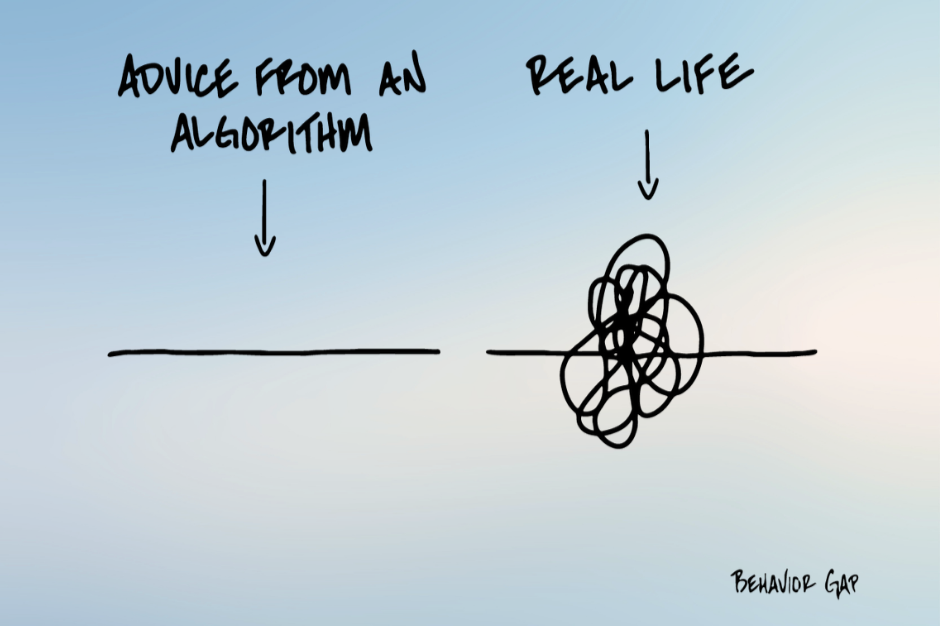
Investors need someone – a real person, with your best interest at heart – in their corner. An algorithm can rebalance a portfolio, but it can't talk someone out of borrowing a million dollars to buy their third rental property when yields don't justify prices. It certainly can't design a comprehensive wealth structure that addresses tax, protection, succession, and life goals simultaneously while adapting to changing circumstances over decades.

What Advice is Really Worth

The real value of fee-only fiduciary advice encompasses dimensions Russell doesn't even attempt to measure.

Behavioural coaching has genuine value. But reducing comprehensive financial advice to a single percentage derived from mainly investment considerations is like judging a surgeon's worth solely by their suturing speed rather than successful procedures.

The real value isn't in any spreadsheet. It's in the confidence of knowing someone is watching your back without any hidden agenda, the relief of having comprehensive planning that addresses tax, protection, and succession alongside investments, and the profound satisfaction of achieving what you set out to do with strategic wealth management.

It’s Time for a Different Conversation

If you're tired of product pitches masquerading as advice, or if you've outgrown the traditional model of financial guidance, perhaps it's time to try a different conversation – and we’re always happy to talk.

As a fee-only, CEFEX-certified fiduciary adviser, Stewart Group is legally and ethically bound to put your interests first – always. We don't receive investment commissions, referral fees, or any form of conflicted remuneration. Our only incentive is your success across all dimensions of your financial life.

Whether you're navigating a business sale, restructuring an investment portfolio that's grown unwieldy, planning for retirement that's closer than you'd like to admit, or simply wondering if there's a better way to structure your wealth – comprehensive fiduciary advice might serve you well.

The first conversation costs nothing but time. Why not contact us today, to arrange a confidential discussion about your financial circumstances and goals.

Nick Stewart
(Ngāi Tahu, Ngāti Huirapa, Ngāti Māmoe, Ngāti Waitaha)

Financial Adviser and CEO at Stewart Group

  • Stewart Group is a Hawke's Bay and Wellington based CEFEX & BCorp certified financial planning and advisory firm providing personal fiduciary services, Wealth Management, Risk Insurance & KiwiSaver scheme solutions.

  • The information provided, or any opinions expressed in this article, are of a general nature only and should not be construed or relied on as a recommendation to invest in a financial product or class of financial products. You should seek financial advice specific to your circumstances from a Financial Adviser before making any financial decisions. A disclosure statement can be obtained free of charge by calling 0800 878 961 or visit our website, www.stewartgroup.co.nz

  • Article no. 430


References

  • Russell Investments (2025). The Value of an Adviser: New Zealand Edition. Russell Investments.

  • Brokers Ireland (2025). The Value of Advice: A Whitepaper. Brokers Ireland.

  • Chaplin, D. (2025, October 14). "The value of financial advice (to two decimal points)". BusinessDesk.

The 'Great Wealth Transfer’ Myths You Should Know About

The headlines are attention-grabbing all seem to agree: The largest transfer of wealth in history is coming. But how much of this narrative holds up to scrutiny? There are several myths that need addressing.

Make sure you have a 'fire drill' for your investment plan

An adviser once said he did not so much have people with investment problems as he had investments with people problems. Your assumed rationality can vanish in a crisis. So why not build your human imperfections into your game plan?

The Siren's Songs

In Greek mythology Sirens were beautiful half-bird/half female creatures, but you couldn’t trust their appearance. They lured passing sailors with beautiful music and melody toward their island home. While not quite as dramatic, the world of investing has never been short of sirens and their songs. These mostly manifest, not in tune, but in story.

The wine lover's guide to investing

Just as winemakers don't have any say over the weather, investment managers can't control the markets. Savouring a vintage wine is one of life's great pleasures. But often overlooked in the joy of consumption is the carefully calibrated journey from grape to glass. Similar levels of care are critical to good investment outcomes.

Going green with your investments

According to a global sustainable investment group that covers Australia, New Zealand and other developed nations, assets managed under "responsible investment" strategies increased by 25 per cent between 2014-16 to US$22.89 trillion.

Which hat are you wearing?

Most of us have multiple roles — as business owners, professionals, workers, consumers, citizens, students, parents, and investors. So, our views of the world can differ according to whatever hat we're wearing at any one time.

Rainy-day Investing

Like farmers planning a harvest, investors pinning their expectations on statements about arithmetical "average" investment returns can be disappointed. As with rainfall, market returns are rarely evenly distributed either across time or place.