Investors

The DIY Investment Trap: Why New Zealanders Need to Play the Net Game

Article # 444

The democratisation of investing has transformed the financial landscape. Where once only institutional investors had access to sophisticated investment vehicles, today's retail investors can build diversified portfolios with a few clicks on their smartphones. Exchange-traded funds (ETFs) have been at the forefront of this revolution: in the United States, they now represent half of all listed funds[1], a remarkable shift that reflects their popularity and accessibility. 

The investment supermarket has expanded exponentially, offering strategies across listed and unlisted assets, domestic and international markets, and countless sectors and themes. From tech giants like Apple and Nvidia to broad market indices, bond funds to commodity trackers, the barriers to entry have never been lower.  

A generation ago, building a globally diversified portfolio required significant wealth and professional intermediaries. Today, it requires a brokerage account and an internet connection. 

But more choice doesn't automatically mean better outcomes. In New Zealand, there's a growing cohort of DIY investors who are playing the gross game when they should be playing the net game. They're watching their portfolio balances grow, celebrating double-digit returns, and comparing performance with friends… all whilst ignoring the substantial tax implications that will ultimately determine their real wealth accumulation. 

The Bracket Creep Reality 

New Zealand's tax landscape has shifted dramatically, yet many investors haven't adjusted their thinking accordingly. A significant number of Kiwis now find themselves in the 33% tax bracket (income between $70,000 and $180,000) or even the 39% bracket for those earning over $180,000, often without realising it until after 31 March when their tax returns are typically filed.[2] 

This isn't always due to massive salary increases or career progression. Bracket creep, driven by wage inflation without corresponding tax threshold adjustments, is quietly pushing more New Zealanders into higher tax brackets each year[3]. As wages rise to keep pace with the cost of living, the tax system captures an increasingly large slice of that income. What once seemed like a tax bracket reserved for high earners has become surprisingly accessible to middle-income professionals. 

But there's another factor many overlook when calculating their tax position: total earnings extend far beyond salary. Consider the full picture of your financial life. That cash sitting in the bank, even at relatively low interest rates, generates taxable income[4]. It might not seem like much on an individual transaction basis, but across multiple accounts and a full tax year, it adds up. 

Trust distributions, company dividends, rental income from investment properties, and profits from share trading; these all contribute to your taxable income.  

Many investors are genuinely surprised when they discover their effective tax rate is higher than anticipated, simply because they've been thinking about salary in isolation rather than total taxable income.  

The Hidden Consequence 

When you buy shares in Nvidia, Apple, or any other direct shareholding, or when you invest in ETFs tracking international markets, you're creating taxable events. Under New Zealand's tax rules, particularly the Foreign Investment Fund (FIF) regime, these investments generate tax obligations that must be included in your annual return[5]. 

The FIF rules are complex and often misunderstood. Many investors assume they only pay tax when they sell. In reality, they may be liable for tax on deemed income each year, regardless of whether they've sold anything. Yet a startling number of investors either don't realise this or don't adequately account for it in their investment strategy. 

They're focused on gross returns (the headline numbers showing how much their portfolio has grown) without applying a tax overlay to understand their true, net position. They celebrate when their tech stock portfolio rises 25%, but forget to calculate what that means after tax obligations are met. 

How We Got Here 

For roughly 25 years, New Zealand maintained a relatively flat tax structure with a top rate of 33%[6]. The tax environment was stable and predictable. Investors could make reasonably informed decisions knowing that their tax position would remain relatively constant. 

But the introduction of the 39% top tax rate in 2021[7], combined with the absence of inflation indexing for tax brackets, has fundamentally changed the game. Each year, more New Zealanders cross into higher tax brackets not because they're genuinely wealthier in real terms, but simply because thresholds haven't kept pace with inflation. 

The compounding effect is significant. A professional who was comfortably in the 30% bracket (or lower) a decade ago might now find themselves in the 33% or even 39% bracket, despite their real purchasing power having barely changed. The tax burden has increased substantially, yet investment strategies have often remained unchanged. 

Gross Returns vs Net Reality 

An investment delivering a 10% gross return might sound attractive, but if you're in the 39% tax bracket and a significant portion of that return is taxable under the FIF rules, your net return tells a very different story. Suddenly that 10% might be closer to 6% or 7% after tax. It’s still positive, but materially different from the headline figure. 

This distinction becomes even more critical when comparing investment options. A lower-gross-return investment with tax advantages might deliver superior after-tax returns compared to a higher-gross-return investment that's tax-inefficient for your circumstances. 

You don't want to win the battle only to lose the war. Chasing gross returns without understanding the net outcome is a pyrrhic victory – it looks impressive on portfolio statements but delivers disappointing real-world results when tax time arrives. 

The Silo Trap 

Even when investors recognise the need for professional advice, they can fall into another trap: the silo regime. Perhaps influenced by barbecue conversation about diversifying across advisers – “don't put all your eggs in one basket, mate” – some investors split their portfolio. They might allocate $750,000 here with one adviser, another substantial chunk there with a second, and perhaps a third portion elsewhere for good measure. 

The logic seems sound on the surface. After all, diversification is a fundamental investment principle, so why not diversify your advisers too? It provides a sense of security, multiple perspectives, and perhaps even keeps each adviser "honest" through implicit competition. 

You’re essentially asking each adviser to play with one hand tied behind their back. 

No single adviser in this fragmented arrangement understands your complete tax position. They can't see the full picture of your income sources, your various investment vehicles, or how different components of your portfolio interact from a tax perspective. They're optimising for their slice of your wealth without any visibility into the whole. 

One might be selecting investments that generate substantial taxable income, unaware that another adviser is doing the same thing, pushing you into a higher tax bracket than necessary. Or they might be duplicating strategies, eliminating the diversification benefits you sought by splitting your portfolio in the first place. 

Each adviser might be doing an excellent job with their portion, yet your overall outcome remains suboptimal because no one is orchestrating the tax efficiency of the complete picture[9].  

It's the financial equivalent of having multiple chefs each cooking one course of a meal without coordinating the menu. You might end up with three excellent dishes that don't work together at all. 

Why You Need a Financial Adviser 

Professional guidance matters. And not just any adviser, but one who can see your complete financial picture and implement a coordinated, tax-efficient strategy across all your assets. 

Investment success isn't measured by individual account performance. It's measured by your actual, after-tax wealth accumulation. An adviser with a holistic view can structure investments in ways that are tax-efficient for your specific circumstances, recognising that different investment vehicles have different tax treatments and that your personal tax situation is unique. 

They can help you understand whether PIE funds, direct shares, or other investment structures make the most sense for your position. They can coordinate the timing of income recognition, manage your exposure to FIF rules, and ensure your overall portfolio is working towards your net wealth goals rather than simply chasing gross returns. 

When seeking advice, look for a fee-only, unconflicted fiduciary adviser[10]. This ensures their recommendations are driven by your best interests, not commission structures or product sales targets. A fiduciary is legally obligated to put your interests first—a distinction that matters profoundly when navigating the complex intersection of investment strategy and tax planning. 

Fee-only advisers are compensated for their advice and service, not for selling particular products. This alignment of interests is crucial when you need objective guidance on tax-efficient structuring rather than a sales pitch for the highest-commission product. 

The Path Forward 

The DIY investment revolution isn't going away, nor should it. Access to investment opportunities is fundamentally democratising and positive. But as the New Zealand tax environment becomes increasingly complex, investors need to evolve their approach. 

Understanding your total tax position, applying a tax overlay to investment decisions, and focusing relentlessly on net returns rather than gross figures—these aren't optional luxuries. They're necessities for anyone serious about building wealth in today's environment. 

The supermarket aisle may be longer than ever, offering more choice than any previous generation of investors could have imagined. But choosing wisely requires understanding the true price you're paying; not just the label on the shelf, but the price after tax.  

The game has changed. Make sure you're playing it properly. 

Nick Stewart

(Ngāi Tahu, Ngāti Huirapa, Ngāti Māmoe, Ngāti Waitaha)

Financial Adviser and CEO at Stewart Group

  • Stewart Group is a Hawke's Bay and Wellington based CEFEX & BCorp certified financial planning and advisory firm providing personal fiduciary services, Wealth Management, Risk Insurance & KiwiSaver scheme solutions.

  • The information provided, or any opinions expressed in this article, are of a general nature only and should not be construed or relied on as a recommendation to invest in a financial product or class of financial products. You should seek financial advice specific to your circumstances from a Financial Adviser before making any financial decisions. A disclosure statement can be obtained free of charge by calling 0800 878 961 or visit our website, www.stewartgroup.co.nz

  • Article no. 444


References

[1] Investment Company Institute, 2024 data on US ETF market share  

[2] Inland Revenue Department, "Individual income tax rates" (current as of 2024-25 tax year)  

[3] New Zealand Treasury, "Fiscal drag and bracket creep analysis," 2024  

[4] Inland Revenue Department, "Resident withholding tax on interest"  

[5] Inland Revenue Department, "Foreign investment fund rules and portfolio investment entities"  

[6] New Zealand Tax History, "Top personal tax rates 1988-2021"  

[7] Taxation (Annual Rates for 2020–21, Feasibility Expenditure, and Remedial Matters) Act 2021  

[8] Financial Advice New Zealand, "The importance of holistic financial planning," professional standards guidance  

[9] Chartered Accountants Australia and New Zealand, "Tax-effective wealth management strategies," 2024

[10] Financial Markets Authority, "Financial adviser disclosure requirements and fiduciary standards," Financial Markets Conduct Act 2013 

28 Investment Principles That Actually Work When Markets Don't Cooperate

Article # 442

I've watched families navigate decades of volatility: crashes, recoveries, euphoria, panic. The ones who preserve wealth across generations don't have secret information or perfect timing. They follow simple rules, consistently.

February has 28 days. To ring it in, here are 28 guiding principles that have stood the test of time regardless of market activity.

1.       The market rewards patience, not prediction.

Most noise isn't information. The constant stream of commentary, analysis, and breaking news creates the illusion that staying informed means staying ahead. It doesn't. The market moves on fundamentals that reveal themselves slowly, not on headlines that change hourly.

2.       Focus on what you can control: Costs, discipline, diversification, behaviour.

You cannot control returns. You cannot control when recessions arrive or when bull markets end. But you can control how much you pay in fees, how consistently you invest, how broadly you spread your risk, and how you respond when fear or greed takes hold.

3.       You don't need to beat the market. You just need to capture it.

The obsession with outperformance drives investors towards complexity, higher costs, and ultimately, disappointment. Capturing market returns through low-cost, diversified portfolios has built more wealth over time than the pursuit of alpha ever has.

4.       The simplest portfolio is often the smartest.

Complexity rarely adds value. It adds cost, confusion, and opportunity for error. A straightforward allocation across global equities and bonds, rebalanced systematically, has outperformed the vast majority of elaborate strategies.

5.       Volatility is the price of admission.

Don't demand returns without accepting the ride. Equities deliver premium returns over time, because of fluctuations in the short term. If you cannot stomach the volatility, you don't deserve the returns.

6.       Time in the market matters more than timing the market. Always.

Missing just the 10 best days over a 20-year period can cut your returns nearly in half. Funnily enough, the best days often follow the worst ones – so it’s hard to capture them after getting cold feet on the downswing. Staying invested through the chaos is what separates wealth-builders from market-timers.

7.       Diversification is a dark horse.

Its power is revealed over decades, not days. When one asset class stumbles, another steadies the ship. The benefit isn't dramatic in any one year, but over a lifetime of investing, it's the difference between weathering storms and being swept away by them.

8.       Your plan should be built on evidence, not emotion.

Especially when emotions run high. When markets crash, fear whispers that this time is different and worse than any before. When markets soar, greed tells you that you're missing out. Evidence and decades of market history tell a different story – a much more trustworthy one.

9.       Chasing performance is a tax on impatience.

Last year's winners become this year's laggards with predictable regularity. By the time a fund or strategy appears on a "best performer" list, the opportunity has usually passed. Avoid getting swept up in the furore.

10.  The market has already priced in what everyone knows.

You don't need to outguess it. If information is public, it's already reflected in prices. Your edge as an investor isn't superior information, it's superior behaviour.

11.  A disciplined strategy beats a brilliant prediction. Every time.

Predictions fail. Discipline endures. The investor who follows a consistent plan through all market conditions will outperform the ‘strategist’ who tries to predict turning points.

12.  Your behaviour matters more than your products.

Panic is more expensive than fees: selling in a downturn locks in losses, while buying at market peaks locks in mediocre returns. Managing your behaviour by staying calm, and staying invested, matters far more than optimising your expense ratio by a few measley basis points.

13.  You don't need the perfect moment.

The moment you start is perfect enough. Markets climb over time. Waiting for a correction before investing often means waiting forever. Start now. Adjust as you go.

14.  Rebalancing is the quiet hero of long-term returns.

It forces buy-low, sell-high. When equities surge, rebalancing trims them back. When they crash, rebalancing buys more. It's counter-intuitive, uncomfortable… and extraordinarily effective over time.

15.  The best portfolios feel boring.

Boredom is not a bug, it's a feature. If your portfolio keeps you up at night with excitement, you’re probably taking on unnecessary risk. Wealth is built slowly, quietly, and without drama.

16.  Markets recover more often than they collapse.

History is your friend. Every bear market in history has eventually given way to a new bull market. Crashes feel permanent in the moment. They never are – as the adage goes, “this too shall pass.”

17.  Ignore headlines.

They're written to sell attention, not build wealth. Financial media thrives on urgency and alarm. Your portfolio should thrive on patience and perspective.

18.  Compounding works best when you don't interrupt it.

Let time do the heavy lifting. Albert Einstein allegedly called compound interest the eighth wonder of the world. But, it only works if you leave it alone – every time you exit the market, you reset the clock.

19.  Costs compound too.

Costs compound just like returns. Pay for advice that adds value, not for products that don't. The difference between value and waste always reveals itself in the fullness of time.

20.  Bad days don't destroy portfolios. Bad decisions do.

Markets fall. That's normal, and things will swing back the other way. Selling during the fall, abandoning your plan, or fleeing to cash – those are the decisions that inflict permanent damage.

21.  Not every risk deserves a reward.

Factor premiums do. Stocks are riskier than bonds, so they should deliver higher returns. Small-cap and value stocks have historically outperformed over long periods. These are risks worth taking. Concentrated bets on individual stocks or sectors? Not so much.

22.  Your portfolio should be built around you, not around the news cycle.

Your goals, your time horizon, and your risk tolerance should dictate your allocation. Not the latest economic forecast or geopolitical crisis.

23.  You don't need to predict the future.

…But you do need a strategy that survives it. Robust portfolios aren't built on forecasts. They're built on diversification, discipline, and the recognition that uncertainty is permanent.

24.  Stay invested, stay diversified, stay disciplined.

The rest is commentary. If you do these three things consistently, you will be fine. Better than fine, in fact. You'll be wealthier than the vast majority of investors who spend their lives chasing the next opportunity.

25.  Wealth isn't created in moments of excitement.

It's created in years of consistency. The investors who succeed aren't the ones who make brilliant trades or perfectly time the market. They're the ones who show up, year after year, regardless of conditions. Consistency compounds.

26.  Your worst investing day feels catastrophic. Your best investing decade feels inevitable.

Perspective matters. In the moment, a 20% drawdown feels like the end. Twenty years later, it's a footnote. Keep the long view. Stay the course.

27.  Successful investors are more patient than ‘smart’.

Intelligence helps, but temperament wins out every time. The ability to sit still, to do nothing when everyone else is panicking or euphoric, is worth more than any financial qualification.

28.  Markets don't care about your timeline. Build a plan that doesn't care about the markets.

You might need money in five years for a house deposit or in thirty years for retirement. The market will do what it does regardless. Structure your portfolio around your needs, not market predictions, and you'll sleep better through every cycle.

Remember: Markets will always be chaotic. Your response doesn't have to be.

Follow the rules (and seek professional advice)

These principles work. But they work best when you have someone in your corner who isn't conflicted by commissions, product sales, or institutional agendas.

Seek independent, impartial advice that puts you first and foremost. You are the sun, not the moon: your financial plan should orbit around you, your goals, your circumstances. Not around what someone else needs to sell.

Nick Stewart

(Ngāi Tahu, Ngāti Huirapa, Ngāti Māmoe, Ngāti Waitaha)

Financial Adviser and CEO at Stewart Group

  • Stewart Group is a Hawke's Bay and Wellington based CEFEX & BCorp certified financial planning and advisory firm providing personal fiduciary services, Wealth Management, Risk Insurance & KiwiSaver scheme solutions.

  • The information provided, or any opinions expressed in this article, are of a general nature only and should not be construed or relied on as a recommendation to invest in a financial product or class of financial products. You should seek financial advice specific to your circumstances from a Financial Adviser before making any financial decisions. A disclosure statement can be obtained free of charge by calling 0800 878 961 or visit our website, www.stewartgroup.co.nz

  • Article no. 442


Should I Invest in What I Love? Product Affection vs Investment Logic

Personal product preferences are often the worst possible guide to investment decisions.

I remember when my family first got a GoPro. Revolutionary technology, stunning footage – everyone wanted one. Naturally, I thought: "This company is going places. Maybe I should buy shares." It's a seductive logic: if I love the product, surely others will too. A decade later, I'm thankful I didn't act on that impulse.

This instinct to invest in what we know and love feels intuitive. We use the products, we understand them, we see their value. But this emotional connection – what behavioural economists call "familiarity bias" – is precisely what makes it dangerous.

Back in 2014, GoPro went public and quickly hit a market capitalization of $10 billion with virtually no competition. Today? The stock trades around $1.87 per share – down 98% from its peak, with over $9.7 billion in market value lost.

What went wrong?

Smartphones killed the action camera star. Modern phones became waterproof, gained multiple lenses, and developed image stabilisation that rivals dedicated cameras. GoPro thought they were competing against other action cameras when they were actually competing against the most successful consumer device in history.

But here's the deeper lesson: loving a product tells you nothing about the company's competitive position or long-term viability. A great product is necessary but far from sufficient for investment success. In GoPro's case, every smartphone manufacturer became their competitor, each with deeper pockets and products consumers were already buying.

The Pattern Repeats Closer to Home

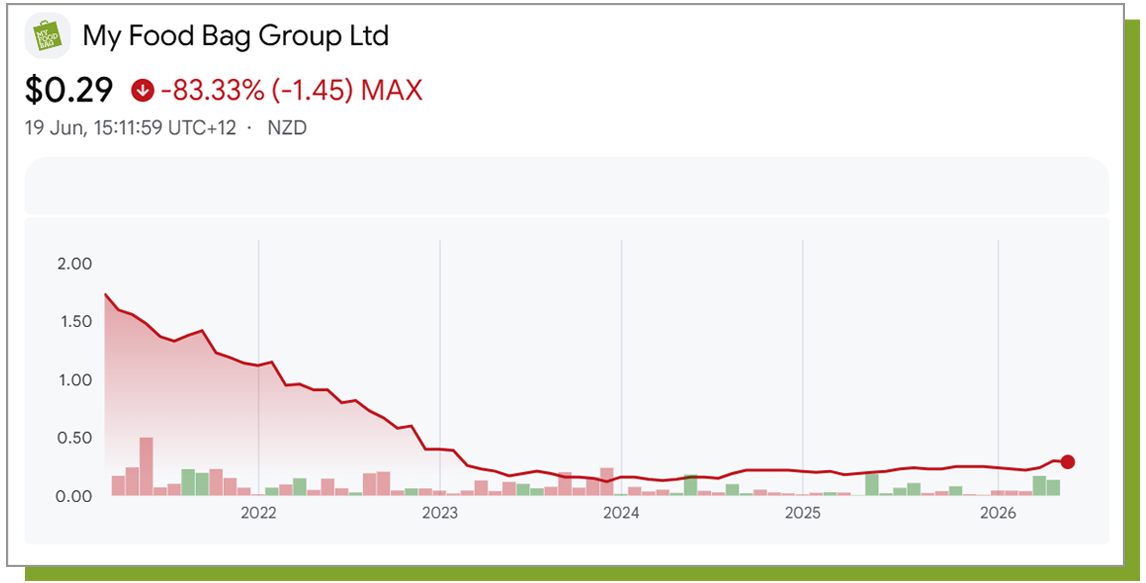
This isn't just an overseas story. Take My Food Bag – during COVID lockdowns, it seemed genius. The company went public in March 2021 at $1.85 per share, raising $342 million. Customers loved the service and bought shares. Many retail investors had enjoyed watching co-founder Nadia Lim cook on TV for years – hardly grounds for a wise investment decision. The result? Shares now trade around 25 cents – an 86% decline. As one fund manager noted, "It was a classic private equity exit, which has seen a lot of retail investors lose out."[1]

The timing seemed perfect. Lockdowns had created new habits. People were cooking at home more. The convenience model made sense. But investors failed to ask: what happens when lockdowns end? Is this a permanent behaviour shift or a temporary adaptation? How defensible is the business model? These are the uncomfortable questions that emotional attachment prevents us from asking.

As one fund manager noted, "It was a classic private equity exit, which has seen a lot of retail investors lose out."

Then there's Ryman Healthcare, beloved by many Kiwi families for good reason. My own family experienced the amazing care and kindness shown towards my late father during his time in the dementia care unit at Ryman in Havelock North. The quality of their villages is genuinely impressive. Yet despite these strengths, the stock hit $10.87 in December 2019 and now trades around $2.87 – down 74%. The investment thesis crumbled under construction delays and regulatory challenges, demonstrating that exceptional service doesn't automatically translate into strong investment returns.

This one hits close to home because the service was excellent. But gratitude and investment logic operate in different domains. A company can deliver outstanding customer experiences while simultaneously facing operational headwinds that undermine shareholder returns.

These three examples share a common thread: product or service quality created an emotional connection that clouded rational investment analysis.

The Evidence Against Emotional Investing

Behavioural finance research identifies "familiarity bias" as a major driver of poor investment decisions, where investors favour what they know rather than what performs best.[2] This bias is particularly pronounced amongst long-term investors who believe they're securing against volatility when they're actually concentrating risk.

The evidence against stock picking is overwhelming:

An Arizona State University study by Professor Hendrik Bessembinder examining over 28,000 stocks from 1926 to 2024 found that just 4% of firms created all net wealth in the U.S. stock market. The remaining 96% collectively matched Treasury bills over their lifetimes, and the majority of individual stocks actually reduced shareholder wealth compared to holding cash.[3]

Think about that. If you picked a stock at random, you'd have better than even odds of underperforming cash. The market's impressive returns come from a tiny fraction of companies – and identifying them in advance is nearly impossible.

Professional fund managers fare no better. S&P Dow Jones Indices' SPIVA Scorecard shows that after 10 years, approximately 85% of large-cap funds underperform the S&P 500, and after 15 years, around 90% trail the index.[4] Even Warren Buffett admits: "In 58 years of Berkshire management, most of my capital-allocation decisions have been no better than so-so."[5]

These aren't amateur investors. These are professionals with research teams, Bloomberg terminals, insider access, and decades of experience. If they can't beat a simple index fund, what makes individual investors think they can, especially when driven by product affection rather than analysis?

The Smart Money Questions

Instead of asking "Do I love this product?", evidence-based investors ask: How big is the addressable market? What prevents competitors from copying this? How strong are the financials? Is the company innovating fast enough? What could make this product obsolete?

These questions are deliberately uncomfortable because they force you to look beyond your emotional attachment. They require research, analysis, and a willingness to acknowledge uncertainty. Most importantly, they shift the focus from "I like this" to "can this company maintain a durable competitive advantage?"

The answers usually point to the same solution: diversification. Diversified index funds consistently outperform stock picking over the long term, providing market-matching returns while reducing the risk of catastrophic losses from individual stock failures.[6]

Diversification isn't glamorous. There's no story to tell at dinner parties about your clever stock pick. But it's precisely this lack of excitement that makes it effective. By owning the entire market, you guarantee you'll own the 4% of companies that generate all the wealth creation, without needing to predict which ones they'll be.

As a fee-only adviser working with evidence-based strategies, the real value isn't in chasing hot stocks or validating product obsessions. It's in building a robust financial plan grounded in decades of research, then maintaining discipline through market noise and emotional temptation.

This discipline is harder than it sounds. When GoPro was soaring, when My Food Bag was listing during lockdowns, when you're genuinely grateful for care received – the emotional pull to invest is powerful. It feels like you have special insight. You don't. You have an emotional connection clouding your judgment.

The most valuable thing a good adviser provides isn't stock tips or market predictions. It's the voice of reason when your emotions are screaming at you to invest in what you love. It's the person who asks the uncomfortable questions: "Have you analyzed the competitive landscape? What's your exit strategy? How does this fit your overall plan?" These questions aren't exciting, but they're essential.

Seek wise counsel, commit to a plan that aligns with your goals, and redirect that energy from stock-picking to living your life. Enjoy the products you love. Be grateful for excellent service. Just don't confuse these feelings with investment insight.

Your future self will thank you for choosing evidence over emotion.

Nick Stewart

(Ngāi Tahu, Ngāti Huirapa, Ngāti Māmoe, Ngāti Waitaha)

Financial Adviser and CEO at Stewart Group

  • Stewart Group is a Hawke's Bay and Wellington based CEFEX & BCorp certified financial planning and advisory firm providing personal fiduciary services, Wealth Management, Risk Insurance & KiwiSaver scheme solutions.

  • The information provided, or any opinions expressed in this article, are of a general nature only and should not be construed or relied on as a recommendation to invest in a financial product or class of financial products. You should seek financial advice specific to your circumstances from a Financial Adviser before making any financial decisions. A disclosure statement can be obtained free of charge by calling 0800 878 961 or visit our website, www.stewartgroup.co.nz

  • Article no. 437


References

  1. My Food Bag Group Limited. (2024-2025). Financial Results and Market Updates. NZX Announcements. Retrieved from https://investors.myfoodbag.co.nz/

    • Devon Funds Management. (2025). "My Food Bag Investment Analysis." RNZ Business Interview, May 22, 2025.

  2. Huberman, G. (2001). Familiarity breeds investment. Review of Financial Studies, 14(3), 659–680. https://doi.org/10.1093/rfs/14.3.659

    • Chew, S.H., Li, K.K., & Sagi, J. (2023). Home bias explained by familiarity, not ambiguity. Social Science Research Network. https://papers.ssrn.com/sol3/papers.cfm?abstract_id=3870716

    • De Vries, A., Erasmus, P.D., & Gerber, C. (2017). The familiar versus the unfamiliar: Familiarity bias amongst individual investors. Investment Analysts Journal, 46(1), 24-39.

  3. Bessembinder, H. (2024). Shareholder wealth enhancement, 1926 to 2022 (Updated through 2024). Arizona State University, W.P. Carey School of Business. Retrieved from https://wpcarey.asu.edu/department-finance/faculty-research/do-stocks-outperform-treasury-bills

    • Bessembinder, H. (2018). Do stocks outperform Treasury bills? Journal of Financial Economics, 129(3), 440-457.

  4. S&P Dow Jones Indices. (2024). SPIVA U.S. Scorecard Year-End 2024. Retrieved from https://www.spglobal.com/spdji/en/documents/spiva/spiva-us-year-end-2024.pdf

  5. Berkshire Hathaway Inc. (2022). Letter to Shareholders. Annual Report 2022.

  6. Malkiel, B.G. (2019). A random walk down Wall Street: The time-tested strategy for successful investing (12th ed.). W.W. Norton & Company.

    • Bogle, J.C. (2017). The little book of common sense investing: The only way to guarantee your fair share of stock market returns (10th anniversary ed.). John Wiley & Sons.

    • Fama, E.F., & French, K.R. (2010). Luck versus skill in the cross-section of mutual fund returns. The Journal of Finance, 65(5), 1915-1947.


Markets, Science, & the Chicago Legacy: Why Evidence Matters More Than Ever

Standing outside the University of Chicago Booth School of Business recently, I was struck by how this building represents something far more valuable than bricks and mortar.

The building bears the name of David Booth, founder of Dimensional Fund Advisors (DFA), whose $300 million donation in 2008 recognised the profound influence this institution has had on how we understand investing. It was the largest gift to any business school in history at the time—and for good reason. The University of Chicago has produced 97 Nobel Prize laureates, making it one of the world’s great centres of economic thought.

I’ve just returned from the United States, where I attended a conference and met with some of the most innovative wealth management firms operating today. What struck me most wasn’t the technology or the marketing—it was the unwavering commitment to letting science, not emotion, drive investment decisions.

The Chicago Revolution

The University of Chicago fundamentally changed how we understand markets. In the 1960s and 70s, Eugene Fama developed the Efficient Market Hypothesis, which challenged the prevailing wisdom that active stock pickers could consistently beat the market. His research, along with work by Harry Markowitz on portfolio theory and Merton Miller on corporate finance, created a scientific framework for understanding how markets actually work rather than how we wish they would work.

 These weren’t armchair theories. They were rigorously tested hypotheses backed by decades of data. Fama won the Nobel Prize in 2013.[1] More recently, Douglas Diamond, who serves as a director at DFA, won the Nobel Prize in 2022 for his groundbreaking research on banks and financial crises.[2] The message is clear: markets are remarkably efficient at incorporating information into prices, making it extraordinarily difficult for active managers to consistently outperform after fees.


From Theory to Practice

This is where David Booth’s story becomes fascinating. After studying under these pioneers at Chicago, he co-founded DFA in 1981 with a radical idea: academic research should drive investment strategy. Rather than trying to pick winners or time markets, DFA built portfolios that captured the dimensions of return that academic research had identified—company size, relative price, and profitability.

The firm’s commitment to its academic foundation remains extraordinary. Eugene Fama himself serves as a director and consultant to DFA, alongside Nobel laureate Douglas Diamond and numerous other distinguished academics.[3] This isn’t window dressing—these researchers actively shape the firm’s investment approach. Today, DFA manages over $850 billion globally and works exclusively with around 1,800 financial advisers and institutions worldwide who share their evidence-based philosophy.[4]

We’ve been fortunate to be part of that community since 2003. Over more than two decades, I’ve had the privilege of meeting David Booth himself, along with many of DFA’s esteemed researchers and team members. These aren’t just business relationships—they’re ongoing dialogues about how markets work and how we can best serve our clients.

But philosophy alone doesn’t pay the bills. The real work happens in translating these academic insights into portfolios that work for real New Zealanders with real goals. Our investment committee builds portfolios that harness these evidence-based principles while respecting each client’s individual circumstances. For some, that means incorporating ESG considerations—ensuring investments align with values without sacrificing returns. For others, it’s about smart tax planning, understanding how PIE funds, FIF rules, and portfolio location decisions can significantly impact after-tax wealth over time. The science tells us what works in markets; our job is to implement it in a way that works for you.


The Emotional Trap

During my US trip, I sat through presentations from wealth management firms managing billions in client assets. A common theme emerged: the biggest threat to investor success isn’t market crashes or economic recessions—it’s investor behaviour itself.

We’re hardwired for emotional responses that work against us in financial markets. We panic when markets fall and become euphoric when they rise. We chase last year’s winners and abandon sound strategies at precisely the wrong moment. We believe we can spot the next big thing, despite overwhelming evidence that even professionals cannot consistently do so.

The firms I met with have built their practices around protecting clients from themselves. They use science-based portfolio construction, maintain discipline during volatility, and focus on what investors can control: costs, diversification, tax efficiency, and most importantly, behaviour.


The New Zealand Reality

Here’s something I hear often: “But surely New Zealand is different?”

It’s not. Market principles are universal. New Zealand shares trade on the same fundamental dynamics as shares in New York, London, or Tokyo. The temptation to believe “it’s different here” often leads to home bias and concentrated portfolios that increase risk without increasing expected returns.

The evidence is unequivocal, regardless of geography. Studies consistently show that the average investor significantly underperforms the very funds they invest in, purely due to poor timing decisions. Research from Morningstar found that investors typically lag their own investments by 1-2% annually simply by buying high and selling low.[5] This behaviour penalty applies equally to investors in Auckland as it does in Austin.

Think about that: a 1-2% annual drag from poor timing decisions alone. Over a 30-year investment horizon, that’s the difference between retiring comfortably and struggling to make ends meet. And it has nothing to do with market returns or fund performance—it’s entirely self-inflicted through emotional decision-making.


What This Means for You

As your advisers, our role isn’t to predict the future or pick winning stocks. It’s to help you stay invested in sensibly constructed, evidence-based portfolios through all market conditions. The science tells us that markets reward patient investors who remain diversified and resist the urge to react to short-term noise.

This matters now more than ever. With 24/7 news cycles, social media investment “gurus,” and the constant temptation to react to market movements, maintaining discipline has never been harder—or more important.

When markets inevitably experience volatility (and they will), remember this: every market downturn in history has eventually been followed by recovery. The investors who stayed disciplined and remained invested captured those recoveries. Those who sold in panic and tried to time their re-entry typically bought back in after much of the recovery had already occurred.

Standing outside that Chicago building, I felt grateful for the legacy of rigorous thinking that continues to shape how we invest today. But the principles that emerged from those halls decades ago remain as relevant now as ever: markets work, diversification matters, costs compound, and behaviour determines outcomes.

The challenge isn’t knowing what to do—science has answered that. The challenge is doing it consistently, especially when markets test our resolve. That’s where good advice becomes invaluable.


Nick Stewart

(Ngāi Tahu, Ngāti Huirapa, Ngāti Māmoe, Ngāti Waitaha)

Financial Adviser and CEO at Stewart Group


References

 [1] The Nobel Prize, “Eugene F. Fama - Facts,” 2013, [nobelprize.org](http://nobelprize.org)

 [2] University of Chicago Booth School of Business, “Douglas W. Diamond Wins Nobel Prize in Economic Sciences,” October 2022, [chicagobooth.edu](http://chicagobooth.edu)

 [3] Dimensional Fund Advisors, “Leadership and Board of Directors,” [dimensional.com](http://dimensional.com)

 [4] Dimensional Fund Advisors SEC Form ADV, showing $835.7 billion in discretionary assets under management as of March 31, 2025

 [5] Morningstar, “Mind the Gap: The Behavior of the Average Investor,” various years, [morningstar.com](http://morningstar.com)

 [6] University of Chicago News, “Alumnus David Booth gives $300 million; University of Chicago Booth School of Business named in his honor,” November 2008, [news.uchicago.edu](http://news.uchicago.edu)​​​​​​​​​​​​​​​​

Modern Protection in Vehicles and Investments

The morning had been perfect for my friend Paul’s brother. The Queensland sun warmed his skin as he hitched his modern caravan to his Nissan SUV, ready for a weekend at the beach. The open road beckoned, promising relaxation and the soothing sound of waves.

Market Patience: The Easter Lesson for Investors

In times of market uncertainty, wealth often transfers from the impatient to the patient. This timeless truth feels particularly relevant today, as markets respond to shifting economic policies and global events with characteristic volatility.

Lessons to learn from the current bear market | Covid-19 Special Focus

Stressful events such as the current bear market are an unpleasant reality, with many investors trying to wish away negatives results in the hope they become a distant memory, but they also provide incredibly important lessons for investors and financial advisers.