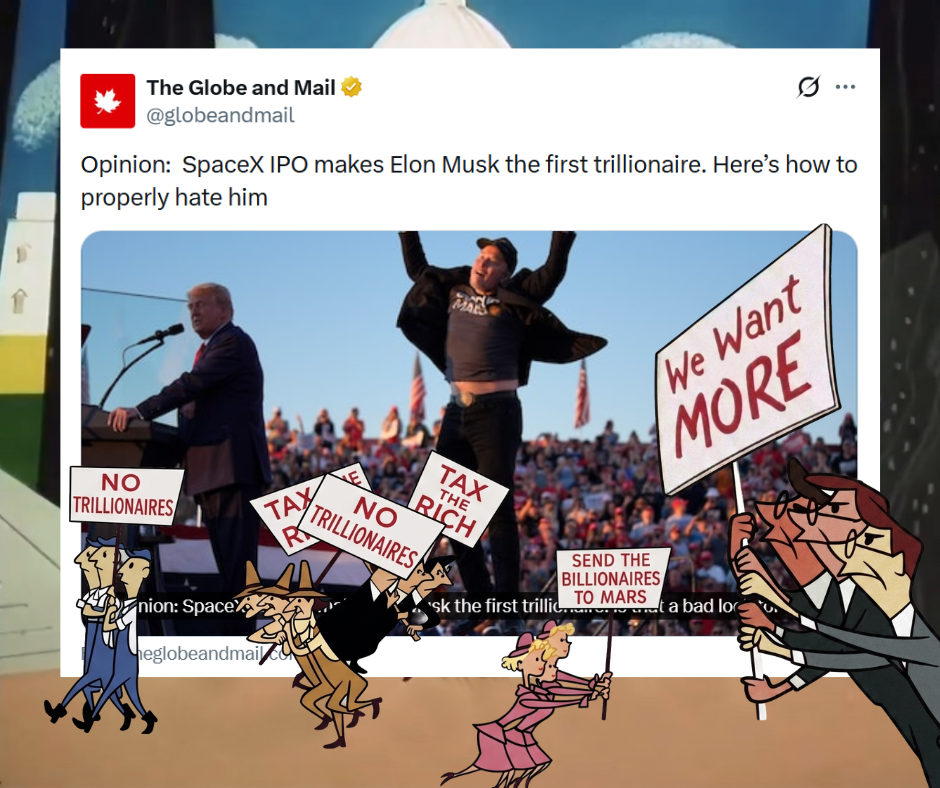
When a newspaper tells you how to hate someone, it reveals more about itself than its target.
Article #462
“Envy was once considered to be one of the seven deadly sins before it became one of the most admired virtues under its new name, ‘social justice’.”
Thomas Sowell, The Quest for Cosmic Justice (1999) [1]
Last week the New Zealand Herald reported, plainly, that Elon Musk had become the world’s first trillionaire after shares in SpaceX leapt as much as 30% on debut, the largest initial public offering in history. [2,3] That is the news. What happened next is the story.
Canada’s Globe and Mail ran an opinion piece under the headline: ‘SpaceX IPO makes Elon Musk the first trillionaire. Here’s how to properly hate him.’ After a day of ridicule, the paper swapped it for the more respectable ‘Is that a bad look for capitalism?’ and tacked on a note conceding the original ‘did not meet The Globe’s editorial standard.’ [4] The mask slipped, then was hastily refitted. But we all saw the face beneath.
Closer to home, the chorus is familiar. Oxfam Aotearoa tells us four New Zealand billionaires hold more wealth than 1.8 million of their countrymen, and calls it ‘obscene.’ [5] Academics line up on talkback to lament inequality. Polls are cited showing most New Zealanders want the ultra-rich taxed more, and we are reminded that Musk alone is worth almost as much as every New Zealander combined [6,7]. The sentiment is always the same: someone has too much, and that is a problem to be corrected rather than a phenomenon to be understood.
Musk is not, in fact, the first trillionaire. Under Robert Mugabe, Zimbabwe's central bank printed a hundred-trillion-dollar note that on its first day was worth about US$30, and within weeks nothing at all; at the peak, prices doubled every day [8]. In that sense, many Zimbabweans became trillionaires on paper yet still could not buy a loaf of bread. That is the distinction worth dwelling on.
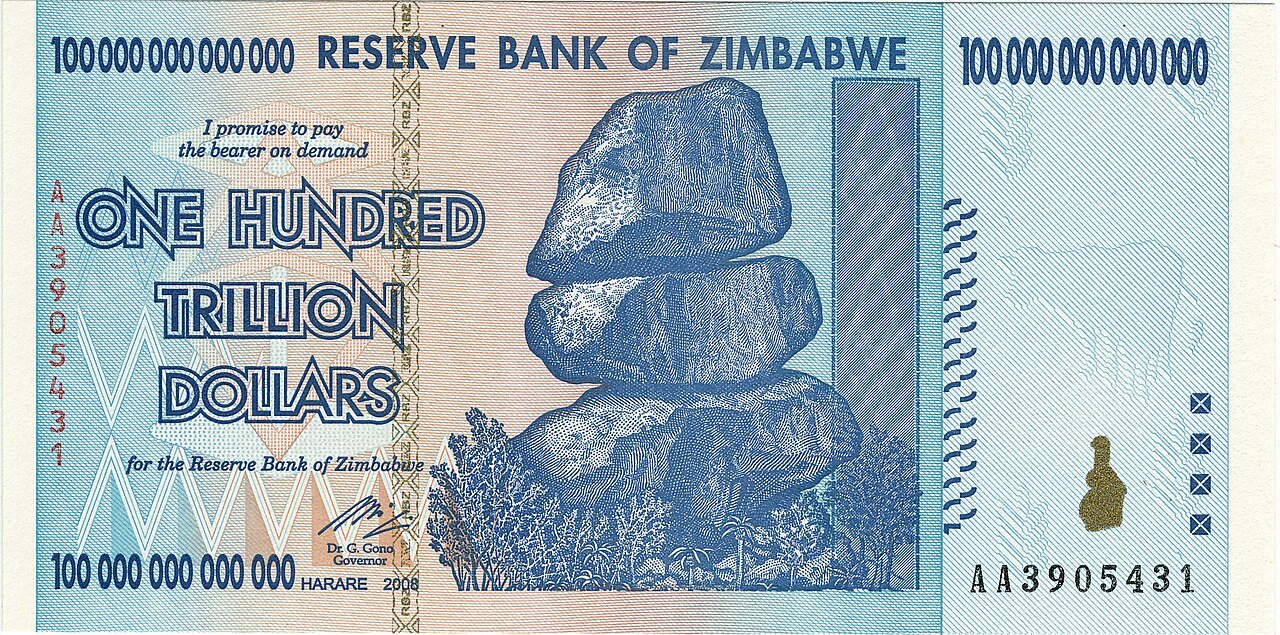
A trillion earned by building what people want is the opposite of a trillion conjured by a collapsing state: one is value created, the other value destroyed.
I want to make the unfashionable case. Not for Musk the man, he hardly needs my help, but for what the exception represents: the rare individual who turns the stuff of science fiction into things we use every day without a second thought, the smartphone in your pocket, the satellite that carries your call, the online payment that clears in seconds, the electric car at the lights, the cloud software that runs the small business down the road.
Consider the funnel. Many people have ideas. Fewer act on them. Fewer still build something that turns a profit. And a vanishingly small number, statistical outliers, take an idea and deliver it at scale. New Zealand has produced our own precious few: the Mowbray siblings, whose toy and consumer-goods firm Zuru, started in a shed in 2003, now tops the Rich List at an estimated $20 billion; Trade Me, Xero, Rocket Lab, the family-owned Gallagher Group, which grew from a Waikato farm shed and the world's first electric fence into a security firm operating in some 160 countries, and Fisher & Paykel Healthcare, built and headquartered here and exporting respiratory care to around 120 countries [9,10,11].
And the same pattern holds inside the companies we reduce too easily to a single famous name. Gwynne Shotwell joined SpaceX as its eleventh employee in 2002 and helped build it, as president, into the company that just floated; she now sits, according to Forbes, among the richest self-made women in the world, with a stake estimated at around US$2.5 billion [12]. The builders are plural, and the rewards often follow competence more than celebrity.
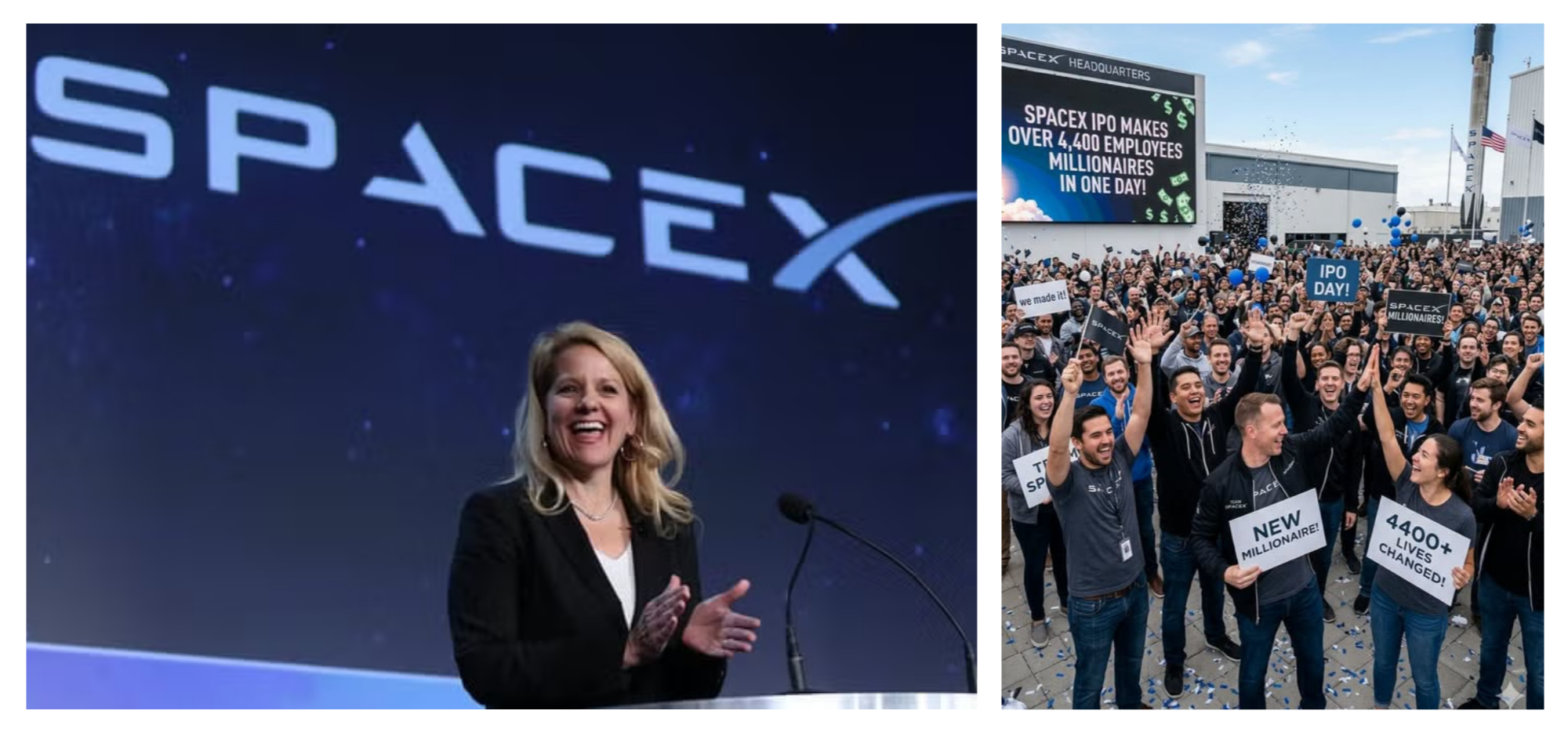
Here is the part the zero-sum brigade often misses: the same SpaceX listing that minted the world's first trillionaire also turned more than 4,400 current and former staff into millionaires, by the New York Times' reckoning – some 400 of them past the $100 million mark. The reach went a long way down the org chart. One was a welder who joined in 2015 on about US$28 an hour and took part of his pay in stock; his holding is now worth close to a million dollars [13]. The trillionaire headline and the newly wealthy welder came from the very same event. The pie did not get carved up. It got bigger.
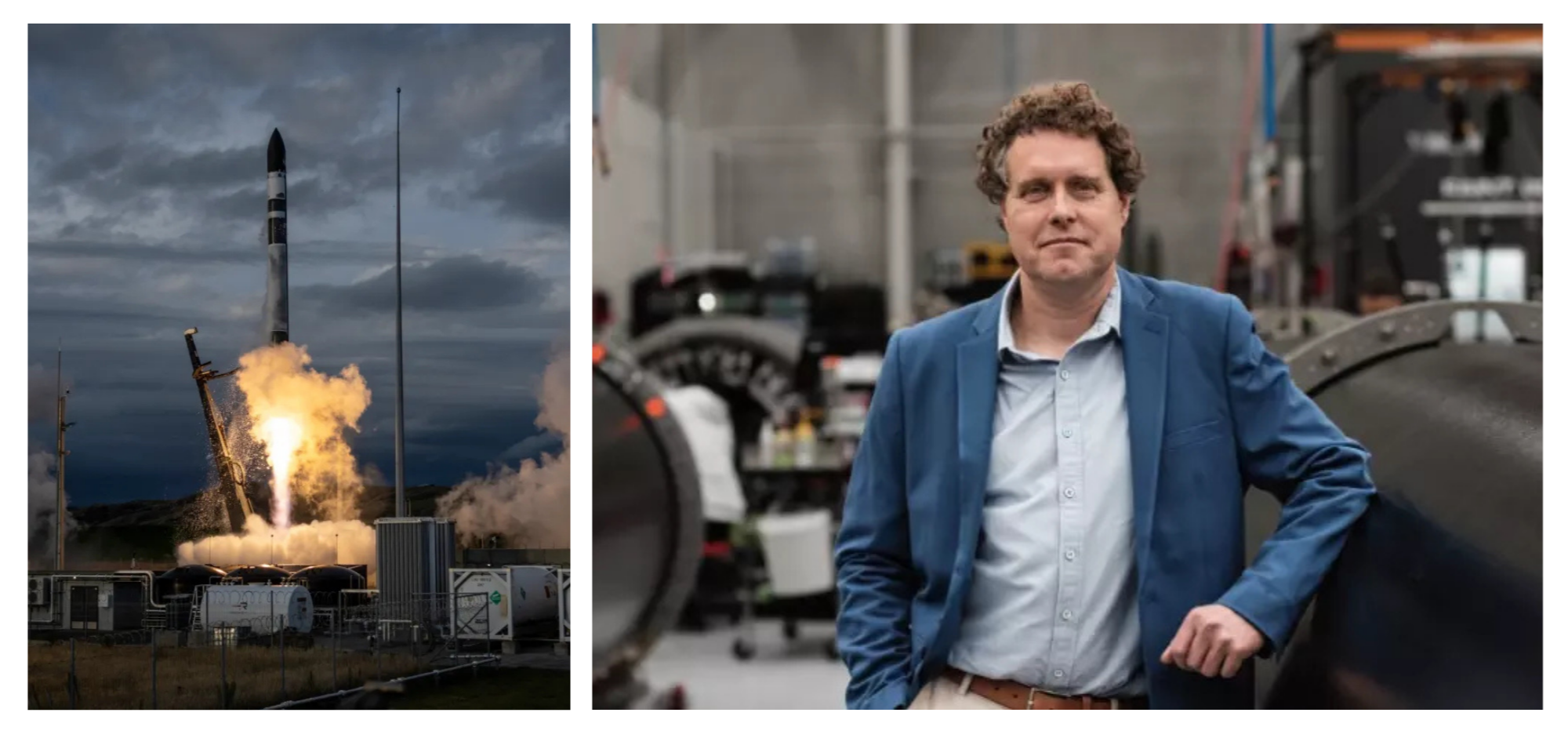
The question for New Zealand is whether we are willing to learn from that. The NBR Rich List has swelled 23-fold in forty years to a record $129 billion, with Rocket Lab's Sir Peter Beck alone leaping from about $650 million to $11 billion in a single year as his company's shares soared [14]. And yet our productivity has barely moved in thirty years. We are very good at debating how to carve the pie, and strangely uninterested in baking a larger one.
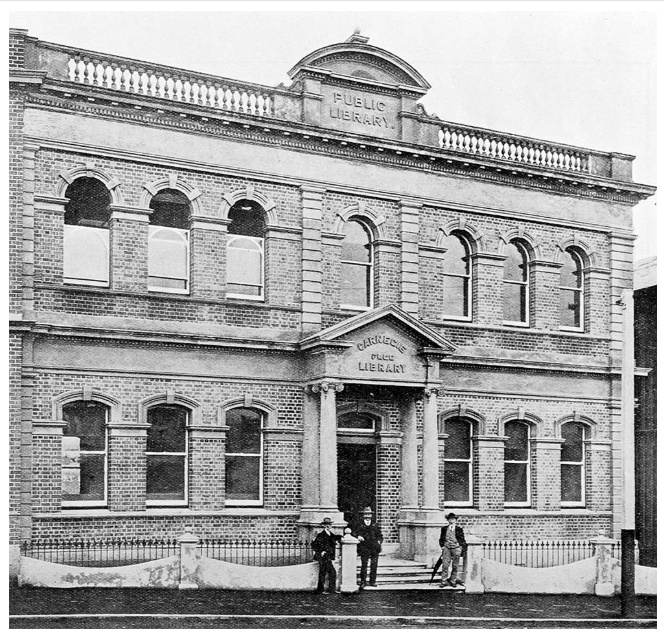
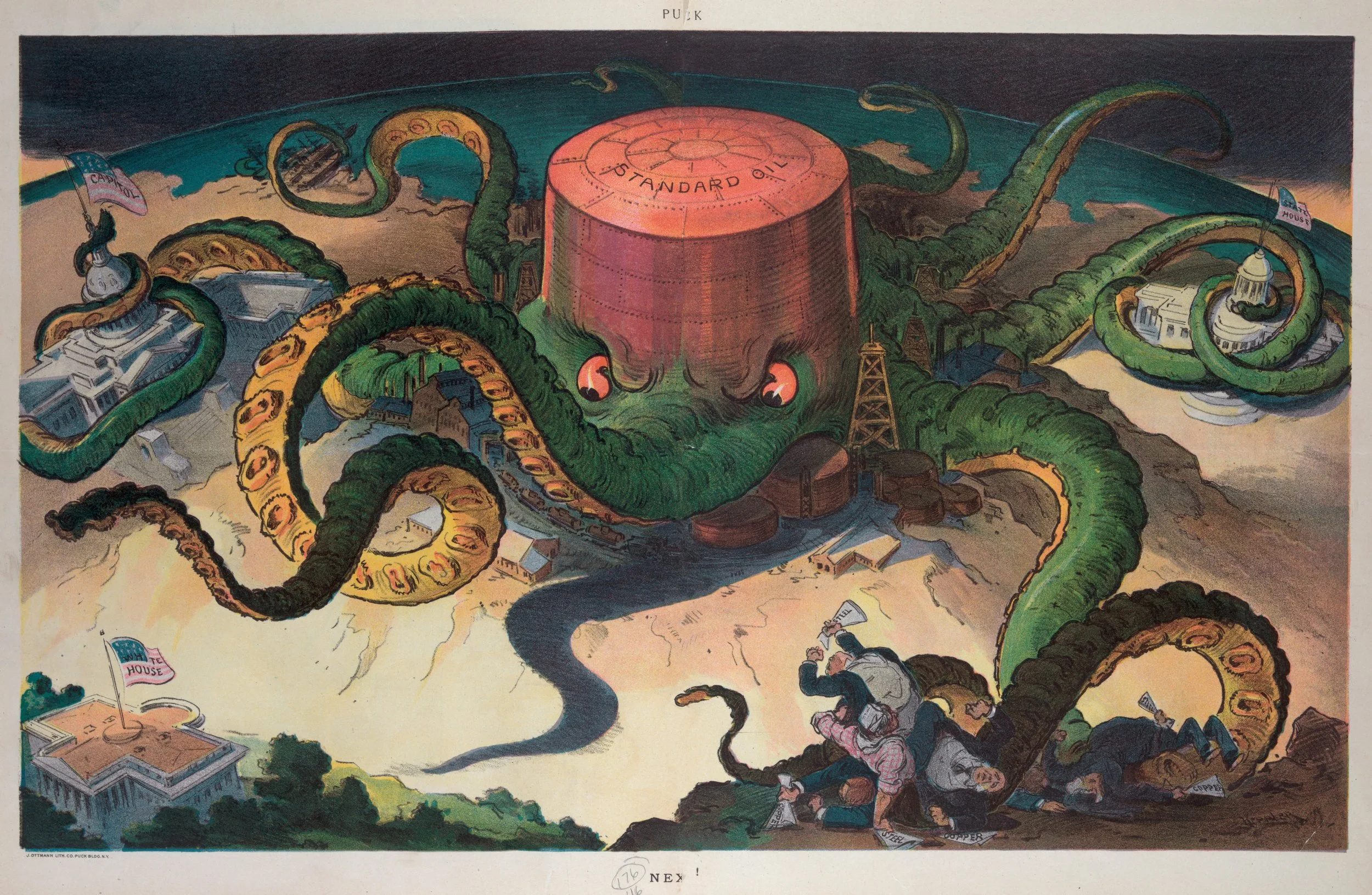
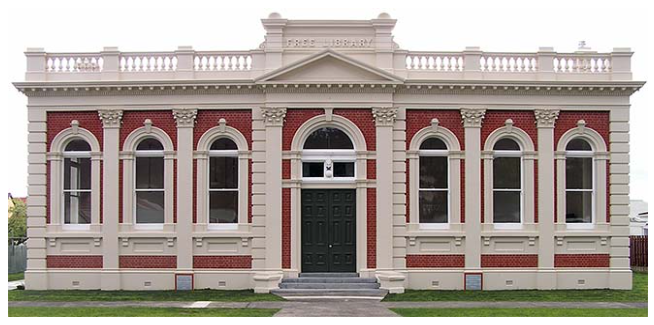
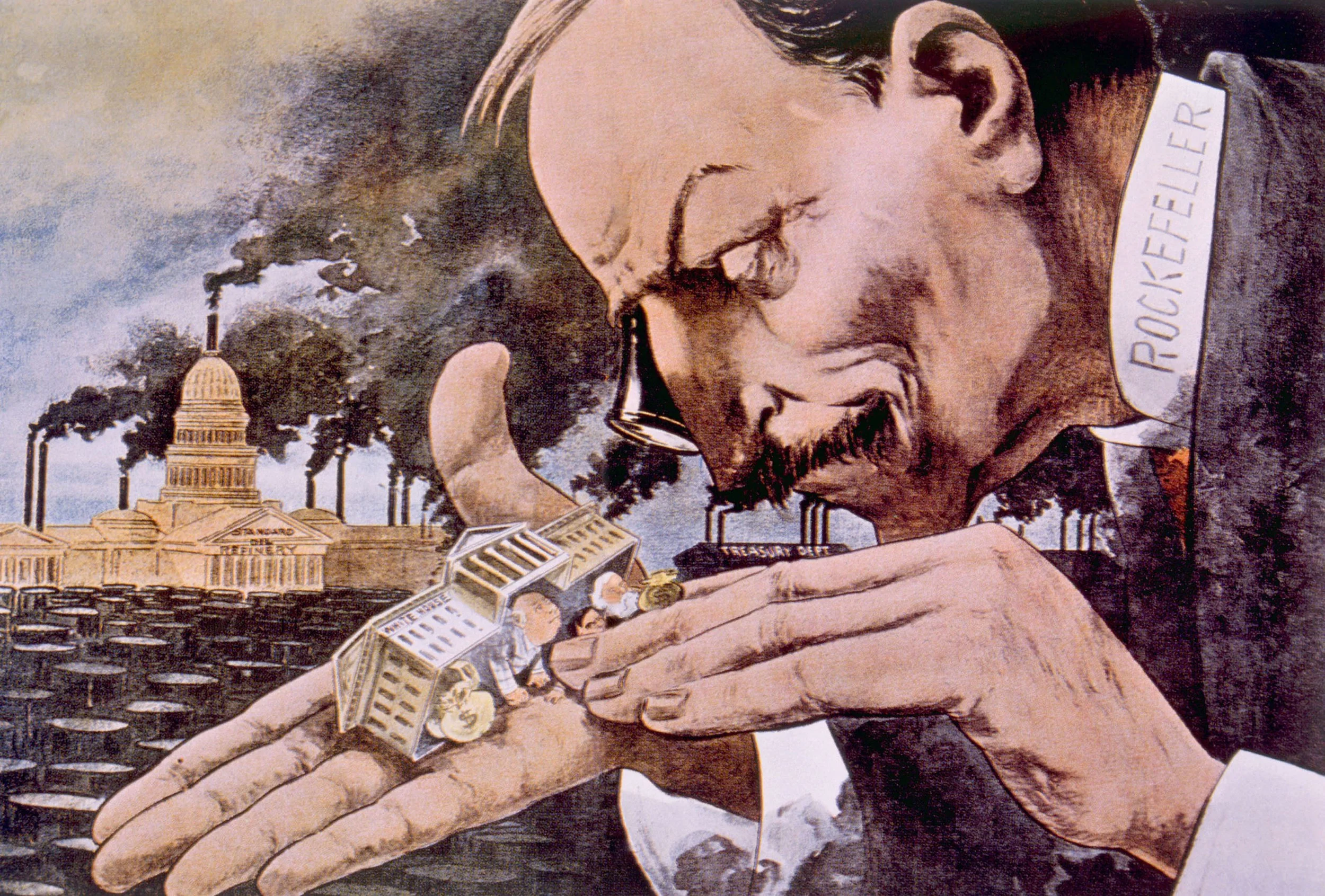
None of this is new. Andrew Carnegie and John D. Rockefeller were the titans of their age, reviled in their time as robber barons, cartoonish villains of the popular press. The cartoonists drew them as bloated octopuses with the nation in their tentacles. Carnegie ground out his fortune in steel and, in his later years, gave most of it away, seeding free public libraries across the world, more than 2,500 of them, eighteen in New Zealand alone [15]. Rockefeller's money built the University of Chicago and funded the medical research that helped tame yellow fever and hookworm [16]. The resentment faded. The libraries, the universities, the cures remain. That is the part the wreckers never see: the wealth was temporary, but the institutions it built endured, and we are still drawing on them a century later.
Great fortunes gather, they crest, and in time they disperse through families, philanthropy, taxation and the simple passage of generations. Marriages fail and children inherit and quarrel; fortunes fracture along fault lines no one planned for. Jeff Bezos parted with roughly a quarter of his Amazon stake in a single divorce [17]. Wealth scatters faster than any succession plan can contain it. No one takes it with them. They are only ever the custodian of their wealth for the span of their life, and perhaps a generation or two beyond, if they are fortunate.
I make the same point to those who fret about foreigners buying New Zealand farms and businesses. A buyer cannot pack up a farm, or a company, and carry it home in a box to their country of origin. The land stays. The business stays. The jobs, the buildings and the economic activity all remain here, in New Zealand. The buyer is a custodian, nothing more. So too with the great fortunes: the enterprises outlast the individual, and we are the beneficiaries.
And here is what the envious rarely pause to weigh: the cost of building any of it. The outlier does not arrive at scale by working office hours. Musk's own biographers record the toll: Walter Isaacson, who shadowed him for years, documents a leader hands-on in redesigning rocket components and welding design to production, while Ashlee Vance describes the hundred-hour weeks and nights spent sleeping on factory floors [18,19]. He risked ruin, repeatedly; Tesla and SpaceX both came within weeks of collapse in 2008, and he poured in his own money to keep them breathing. For every founder who makes it, a great many do not: they mortgage the house, burn the savings, lose the marriage, and end up with nothing but the lesson. Most of us, honestly, would not want that life if it were handed to us, and that is no shame. But it ought to buy a little humility before we throw stones over the fence at grass we have decided, from a distance, must be greener.
Some will say the fortune was really built on government largesse: the contracts, the green credits [20]. But the credits were no handout. Every carmaker operated under the same zero-emission rules; the money came from rival manufacturers who lagged on electric cars, not from the taxpayer; and Tesla profited simply because it built cleaner cars faster than anyone else. The same scheme runs in Europe and China. That is not a subsidy. That is winning the game everyone was playing.
As for the calls to tax such people into their place, success is already taxed, and handsomely. That is how it works. But a culture that treats achievement as a crime to be punished rather than a feat to be studied will get less of it. The numbers bear it out: resentment is not a growth strategy.
There is a fiduciary truth in all of this, the same one I return to with clients. Tearing others down builds nothing. The job, mine, yours, the nation’s, is stewardship: to grow what we are given, to think in decades rather than headlines, and to leave more behind than we found. A country that celebrates its builders is a healthier place than one that polices its winners. Glass half full beats glass half empty, every time.
So before we are told, yet again, how to properly hate someone for the sin of succeeding, it is worth asking the more useful question. Not how do we cut them down to size, but what will we leave standing when we are gone?
Winter never lasts; the snows always melt.
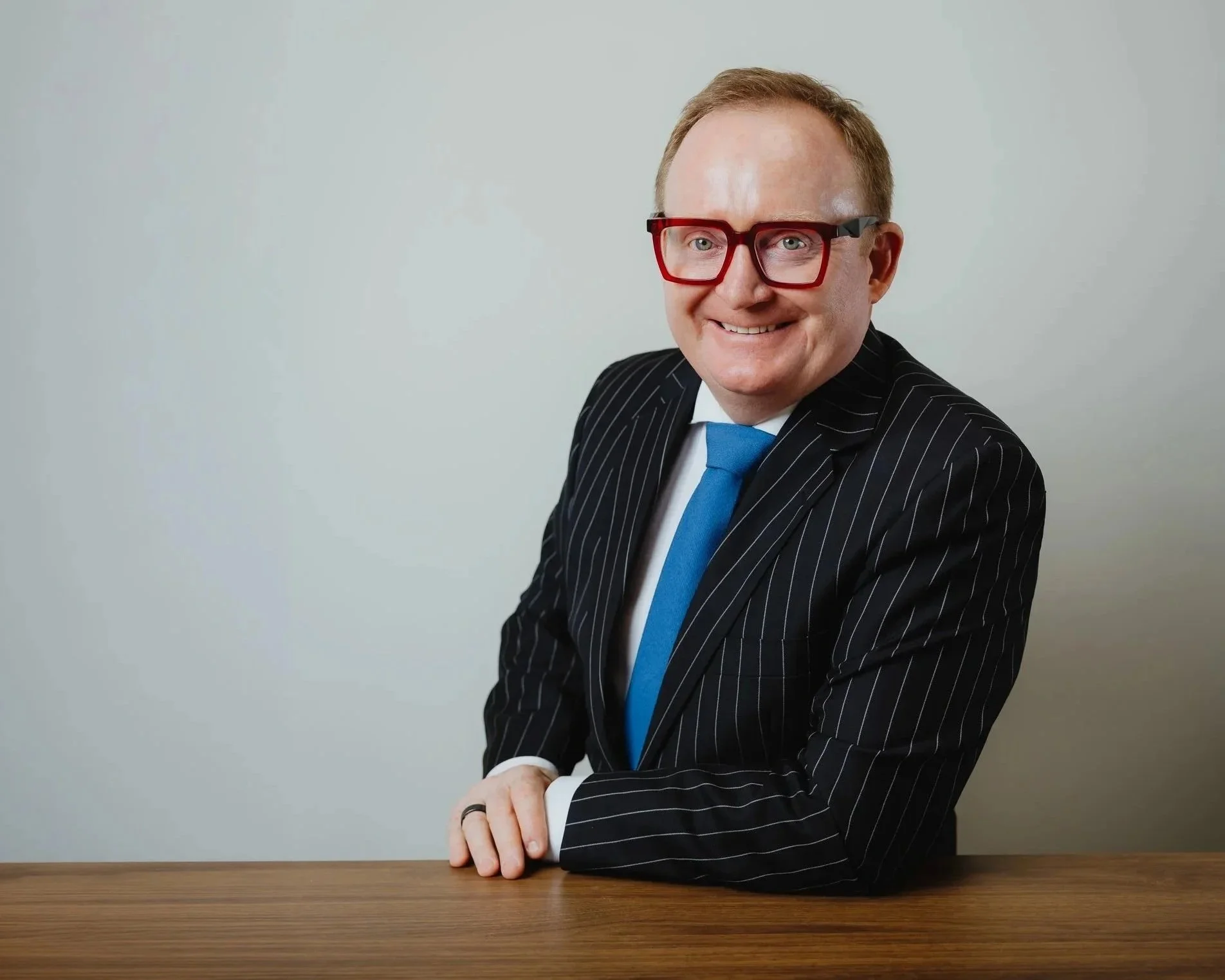
Nick Stewart
(Ngāi Tahu, Ngāti Huirapa, Ngāti Māmoe,
Ngāti Waitaha)
Financial Adviser and CEO at Stewart Group
Stewart Group is a Hawke's Bay and Wellington based CEFEX & BCorp certified financial planning and advisory firm providing personal fiduciary services, Wealth Management, Risk Insurance & KiwiSaver scheme solutions.
The information provided, or any opinions expressed in this article, are of a general nature only and should not be construed or relied on as a recommendation to invest in a financial product or class of financial products. You should seek financial advice specific to your circumstances from a Financial Adviser before making any financial decisions. A disclosure statement can be obtained free of charge by calling 0800 878 961 or visit our website, www.stewartgroup.co.nz
REFERENCES
Thomas Sowell, The Quest for Cosmic Justice (1999), source of the epigraph.
New Zealand Herald, ‘Elon Musk becomes world’s first trillionaire as SpaceX shares jump’ (June 2026).
RNZ, ‘SpaceX launches US$2 trillion market debut, the largest IPO in history’ (June 2026).
The Globe and Mail, Chris Gay, ‘SpaceX IPO makes Elon Musk the first trillionaire. Here’s how to properly hate him’ (headline since amended with editor’s note, June 2026).
Oxfam Aotearoa, statement on billionaire wealth concentration in New Zealand (2026).
RNZ / Talbot Mills poll, ‘New Zealanders support more taxes on ultra-rich, new poll shows’ (Wellbeing Economy Alliance Aotearoa; 68% backed higher taxes on the ultra-rich, 2026).
RNZ, ‘Elon Musk only marginally less wealthy than all New Zealanders combined’ (June 2026).
Reserve Bank of Zimbabwe / BBC, the Z$100 trillion note, issued 16 January 2009, worth about US$30 on its first day; one of history’s worst hyperinflations, with prices doubling daily at the November 2008 peak.
Zuru / NBR Rich List 2026, founded by Nick, Mat and Anna Mowbray in 2003; estimated at $20b, the top spot on the 2026 NBR Rich List.
Gallagher Group, Hamilton-based, family-owned; from the world’s first electric fence (1938) to integrated security solutions in around 160 countries.
Fisher & Paykel Healthcare, New Zealand-headquartered respiratory-care manufacturer; sells in around 120 countries, with roughly 1% of revenue from domestic sales (publicly listed; majority institutional ownership).
Forbes, ‘America’s Richest Self-Made Women’ (2026 list), featuring SpaceX president Gwynne Shotwell.
The New York Times, reporting via Hill.com analysis that SpaceX’s IPO would turn more than 4,400 employees into millionaires, including a welder hired in 2015 (June 2026).
NBR Rich List 2026, 40th edition; total listed wealth a record $129b (up from $102.1b), a 23-fold rise in 40 years; Rocket Lab’s Sir Peter Beck up from ~$650m to ~$11b (reported via RNZ / NZ Herald / Scoop, June 2026).
Carnegie Corporation of New York, historical record of Carnegie free public library endowments.
Rockefeller Foundation / University of Chicago, record of Rockefeller’s ~$36m founding gift to the University of Chicago and Foundation-led campaigns against hookworm and yellow fever (first yellow-fever vaccine, 1935).
Bezos / Scott divorce (2019), widely reported transfer of roughly a quarter of Jeff Bezos’ Amazon stake to MacKenzie Scott.
Walter Isaacson, Elon Musk (2023), on Musk’s hands-on engineering role across his companies.
Ashlee Vance, Elon Musk: Tesla, SpaceX, and the Quest for a Fantastic Future (2015), on the 100-hour weeks and factory-floor work ethic.
RNZ, ‘How much of Elon Musk’s wealth comes from government help? Virtually all of it’ (June 2026), cited here as the claim being answered; on ZEV regulatory credits, see the Union of Concerned Scientists and CNBC explainers (credits are traded between automakers, not paid by the taxpayer).
IMAGE CREDITS
John D. Rockefeller depicted in the political cartoon 'The Trust Giant's Point of View' by Horace Taylor in 'The Verdict, ' 1900
“Standard Oil Octopus” - Keppler, Udo J., 1872-1956, artist. Published September 1904
Carnegie Free Library, Thames - Coromandel Heritage Trust. Photograph by David Wilton.
Auckland City Libraries – Tāmaki Pātaka Kōrero, Sir George Grey Special Collections (AWNS-19080716-13-6)
