Article # 448
It’s been 181 years since Hōne Heke and Te Ruki Kawiti's warriors stormed Maiki Hill above Kororāreka, felled the British flagstaff for the fourth and final time, in what we now call the Flagstaff War.[1] If you ask most New Zealanders why Heke chopped down that pole, you'll get vague answers about sovereignty or anti-colonial protest. Some might mention it as a symbolic rejection of British authority. Others recall it as an act of defiance, full stop.
What's conveniently forgotten, or perhaps deliberately obscured, is this: Hōne Heke was protesting taxes.
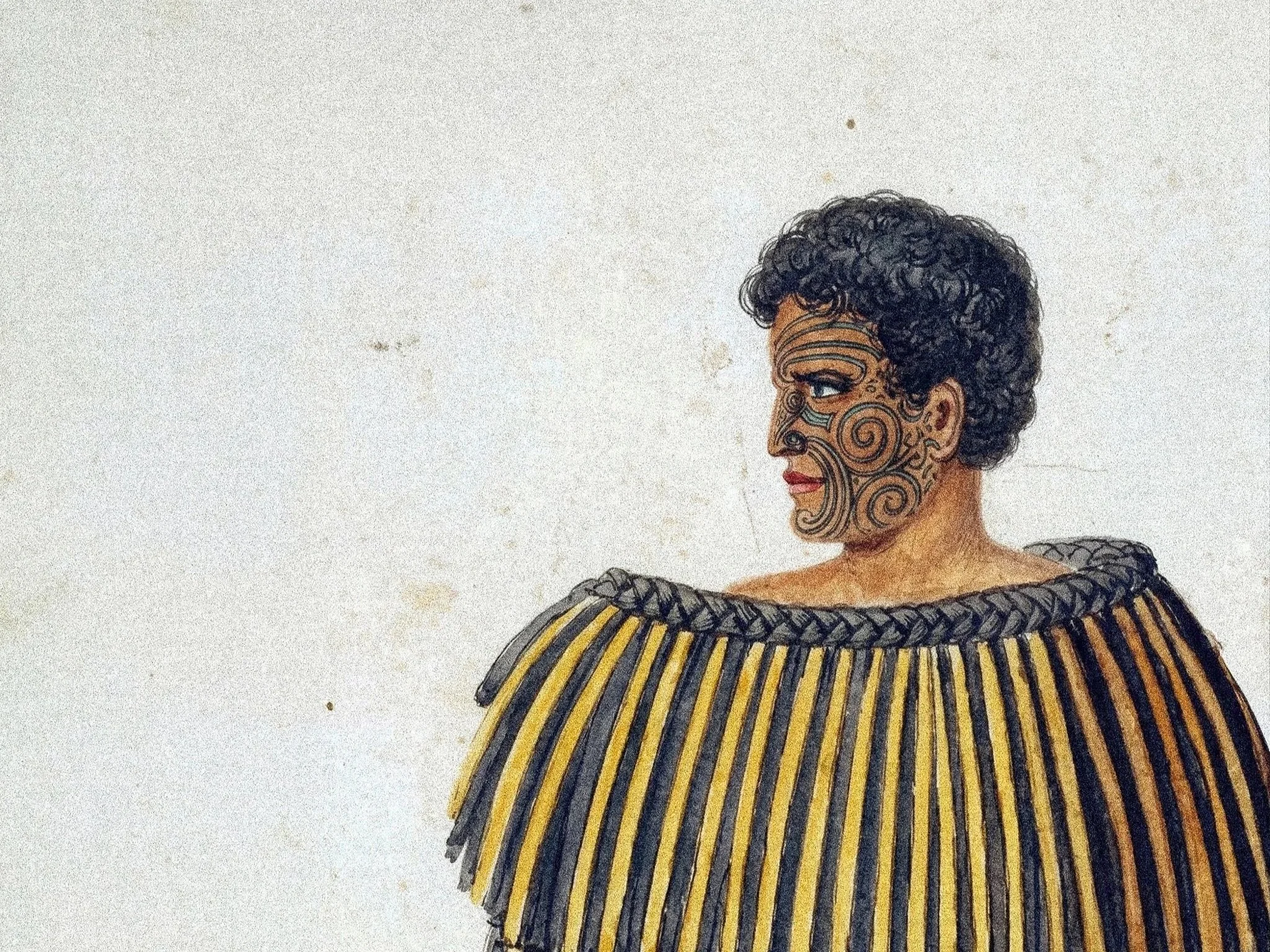
Hōne Heke, The History Collection - Alamy
In 1841, the new colonial government introduced customs duties on tea, sugar, flour, grain, spirits, tobacco, and other foreign goods.[2] These tariffs hit Māori trade in the north particularly hard, fundamentally altering the economic landscape that had made the Bay of Islands the centre of New Zealand's early colonial economy.
Kororāreka had been a thriving trading hub. While described by some as the "hellhole of the Pacific", it was undeniably prosperous. Māori merchants and rangatira like Heke had built sophisticated, profitable businesses supplying visiting ships with provisions, engaging in trade with overseas merchants, and extracting fees from vessels using the harbour. It was commercial enterprise at scale.
Then came the Crown's taxes. Suddenly, the Treaty he'd signed in good faith at Waitangi in 1840 was being followed by higher prices, reduced economic opportunity, and decisions made in Auckland without meaningful consultation (let alone consent). The government was taking a cut of every transaction, strangling the very trade that had made the Bay of Islands so prosperous.
Every ship that entered the harbour now paid customs duties to the Crown instead of port fees to local chiefs. Every bag of flour, every barrel of tobacco, every luxury good imported carried a government tax that drove up prices and reduced trade volumes. The economic sovereignty Māori chiefs believed they'd retained under the Treaty was being systematically dismantled, one tariff at a time.
Heke saw what was happening and he wasn't having it. He'd studied the American Revolution, contemporary accounts confirm this, and understood exactly what "taxation without representation" meant. He even flew the American flag during his rebellion, a detail often airbrushed out of modern retellings because it complicates the narrative. It's hard to cast Heke as simply anti-European when he's explicitly invoking American revolutionary principles and symbols.[2]
The flagstaff itself was deeply symbolic, but not in the way most people think. Yes, it represented Crown authority. But more practically, it represented the customs regime. Ships entering the harbour saw that flag and knew they'd be paying duties. It was a constant visual reminder of who now controlled the commerce of the Bay.
When Te Haratua cut it down on 8 July 1844 under Heke's orders, it was a statement: these taxes are not legitimate.[1] The Crown re-erected it. Heke personally chopped it down on 10 January 1845, wielding the axe himself. They put it up again, this time with iron cladding for protection, convinced that surely this would stop the attacks. Heke cut it down anyway on 19 January; the iron made it harder, but not impossible.
And finally, on 11 March 1845, Heke and Kawiti's forces overran the hill in a coordinated assault, killed the defenders, and felled that flagstaff one last time before sacking the town in outright economic warfare.[1]
Was it just about taxes? Of course not. Historians rightly point to the complex power dynamics within Ngāpuhi following the death of Hongi Hika in 1828, Heke's rivalry with Tāmati Wāka Nene for the paramount chieftainship, the loss of direct income from port fees, and broader questions about rangatiratanga versus sovereignty.[3] Heke was also frustrated by the capital's move from the Bay of Islands to Auckland, which had already damaged the region's economic prospects before the customs duties compounded the injury.
History is never monocausal. But the tax grievance was real, significant, and extensively documented in contemporary accounts. The Taxpayers' Union recently highlighted this often-ignored aspect of our history, noting that after Heke's rebellion, the government abolished customs duties in the Bay of Islands and declared it a free port.[2] Bad taxes were repealed because someone was willing to stand up and say "this isn't fair", and back it up with action. The policy change came too late to prevent war, but arrived nonetheless.
Some modern interpreters find this story uncomfortable as it shows a Māori rangatira fighting for economic freedom and against government overreach. It doesn't fit neatly into the box of noble savage resisting colonisation, nor does it suit the narrative of Māori as natural collectivists unconcerned with commerce, profit, and individual enterprise.
Heke was a businessman. A successful one. He understood trade, supply and demand, competitive advantage, and market dynamics. He recognised that excessive taxation kills economic activity and punishes productive enterprise. He saw government imposing costs without delivering corresponding benefits to those being taxed. And he fought back using the tools available to him in 1840s New Zealand.
Too often, Heke is reduced to a caricature; the man who chopped down the flagpole. This airbrushing of history to fit modern narratives does his character and mana a profound disservice. He was a principled, strategic thinker who would be puzzled, perhaps even insulted, by how shallow his legacy has become in popular memory. Reducing him to a one-dimensional figure of resistance obscures the sophisticated economic and political reasoning behind his actions.
The problem he identified hasn't gone away. If anything, it's getting worse. New Zealand's Tax Freedom Day, the date each year when we theoretically stop working for the government and start working for ourselves, has been creeping steadily later. In 2019, it fell on 9 May.[4] By 2021, it had slipped to 11 May.[5] The 2022-2023 period saw it jump dramatically to 20 May,[6] before settling at 16 May in 2025.[7]
That's seven days later in just six years. We're now working 136 days into the year, more than a third of it, just to pay the tax bill before we earn a single dollar for ourselves. Put another way, if you started work on 1 January, you wouldn't start earning money you could actually keep until mid-May.
The trend is troubling. Government's share of the economy keeps growing, driven by bracket creep (where inflation pushes people into higher tax brackets without any real increase in purchasing power), council rates rising over 10 percent annually for three consecutive years, and ever-expanding government spending that refuses to shrink even when politicians promise restraint.[7,8]
Despite tax cuts announced with great fanfare, despite redundancies in the public sector making headlines, and despite endless talk of fiscal discipline, New Zealanders paid nearly 5 percent more in total tax in 2025 than the year before.[8] Core Crown expenses rose from $139 billion to an estimated $144.6 billion. Welfare spending has ballooned from $26.6 billion pre-COVID to $47.8 billion in 2025; that’s nearly double in just five years.[7]
Local government deserves scrutiny too. Council rates have increased by more than 10 percent for three straight years, adding days to our collective tax burden.[7,8] While central government debates tax brackets and income tax rates, local councils have been quietly and relentlessly increasing their take.
Today, we might not resort to chopping down flagpoles (the IRD would take a dim view, and the penalties would be rather more than a military campaign in the bush). But Heke had it right: governments that tax without meaningful consent, that impose burdens without corresponding benefits, that take without giving value in return, these governments deserve to be challenged.
New Zealand has a long tradition of healthy scepticism toward authority and bureaucratic overreach. We question power. We push back against unreasonable demands. We expect government to justify what it takes from us. Perhaps we inherited some of that attitude from Heke, certainly his spirit lives on every time a New Zealander questions a rates rise or challenges a new tax.
His methods were blunt. The Flagstaff War brought death and destruction to the Bay of Islands. People died defending and attacking that pole. Towns were burned. The social fabric was torn. Violence is a terrible way to resolve policy disputes, and we've developed better mechanisms for democratic accountability since 1845.
But strip away the violence and look at his core complaint: unjust taxation forcing up prices, reducing opportunity, and transferring wealth from productive enterprise to government coffers without adequate justification or benefit. Does that sound familiar? It should. It's the same complaint we hear today, just expressed in different forums with different tools.
When you hear politicians talking about the "cost-of-living crisis," remember it was a cost-of-living crisis driven by customs duties on basic goods that sparked Heke's rebellion. When businesses complain about regulatory burden and compliance costs, remember Heke's merchants struggling with the Crown's new tariff regime.
When you question whether you're getting value for your tax dollar, especially when Tax Freedom Day keeps sliding later into the year, when rates keep rising, when spending keeps growing, you're asking the same question Heke asked in 1844.
We have elections, select committees, submissions processes, ratepayer advocacy groups. We have the Taxpayers' Union keeping score. We have media scrutiny and public debate. These are better tools than axes and muskets, and we should be grateful for them.
But fundamentally, we’re asking the same questions: when does taxation cross the line from legitimate funding of essential government services to unjust extraction? When does the government's share of the economy become so large that it hinders rather than helps our collective prosperity? At what point do we say "enough"?
This week, 181 years after that final flagstaff fell, perhaps we should remember Hōne Heke not just as the man who chopped down a pole, but as New Zealand's first tax rebel; a rangatira who understood that economic dignity, self-determination, and common sense matter more than government revenue. A businessman who recognised that prosperity comes from productive enterprise, not from government spending. A leader who knew that consent matters, that representation matters, that value for money matters.
That's a legacy worth celebrating. And it's a reminder worth heeding as Tax Freedom Day continues its unwelcome creep deeper into the year.

Nick Stewart
(Ngāi Tahu, Ngāti Huirapa, Ngāti Māmoe,
Ngāti Waitaha)
Financial Adviser and CEO at Stewart Group
Stewart Group is a Hawke's Bay and Wellington based CEFEX & BCorp certified financial planning and advisory firm providing personal fiduciary services, Wealth Management, Risk Insurance & KiwiSaver scheme solutions.
The information provided, or any opinions expressed in this article, are of a general nature only and should not be construed or relied on as a recommendation to invest in a financial product or class of financial products. You should seek financial advice specific to your circumstances from a Financial Adviser before making any financial decisions. A disclosure statement can be obtained free of charge by calling 0800 878 961 or visit our website, www.stewartgroup.co.nz
References
[1] New Zealand History, "The Flagstaff War," nzhistory.govt.nz
[2] New Zealand Taxpayers' Union, "Waitangi Day 2026," taxpayers.org.nz
[3] Academic historical analysis of the Northern War, various sources
[4] Baker Tilly Staples Rodway, "Tax Freedom Day 2019," May 2019
[5] Baker Tilly Staples Rodway, "How Tax Freedom Day, on 11 May, affects you," May 2021
[6] Baker Tilly Staples Rodway, "Tax Freedom Day 2024," May 2024
[7] Baker Tilly Staples Rodway, "Tax Freedom Day 2025," May 2025
[8] RNZ, "Taxpayers forking out almost 5% more than last year," 15 May 2025