
Article #457 - A Canny View on Capital, Productivity and the AI Moment
I was in Wellington last month, watching my son play rugby. Between the lineouts, the bagpipes, and the cheering crowds, I found myself deep in conversation with some of the opposing team's parents (as you do). One of them, it turned out, reads this column. She'd been listening to a podcast during the week and wanted to pick my brain on something that had been bothering her: the idea that technology, the internet, and now AI doesn't move the needle on GDP. Was I convinced? Did I think AI would go the same way?
I told her I'd think about it properly and write it up. So here we are.
The argument is that the internet failed to shift GDP. Productivity growth stayed stubbornly flat through the digital revolution, and AI will likely disappoint in the same way.
Tidy. Plausible. But - wrong.
Start with the measure itself. GDP is the bluntest instrument in the economist's toolkit. It counts what gets transacted, not what gets created. It captures the volume of economic activity, but not the quality of the decisions that drive it. It has no mechanism for measuring time saved, stress reduced, options expanded or freedom gained. Judging technological progress through GDP alone guarantees you miss the point entirely.
Economist Robert Solow noticed this as far back as 1987, when he observed that the computer age appeared everywhere except in the productivity statistics – a phenomenon that became known as the Solow Productivity Paradox.¹ History eventually proved him right, just on a longer lag than the critics expected. Technology hadn’t failed. GDP was simply a poor timekeeper.
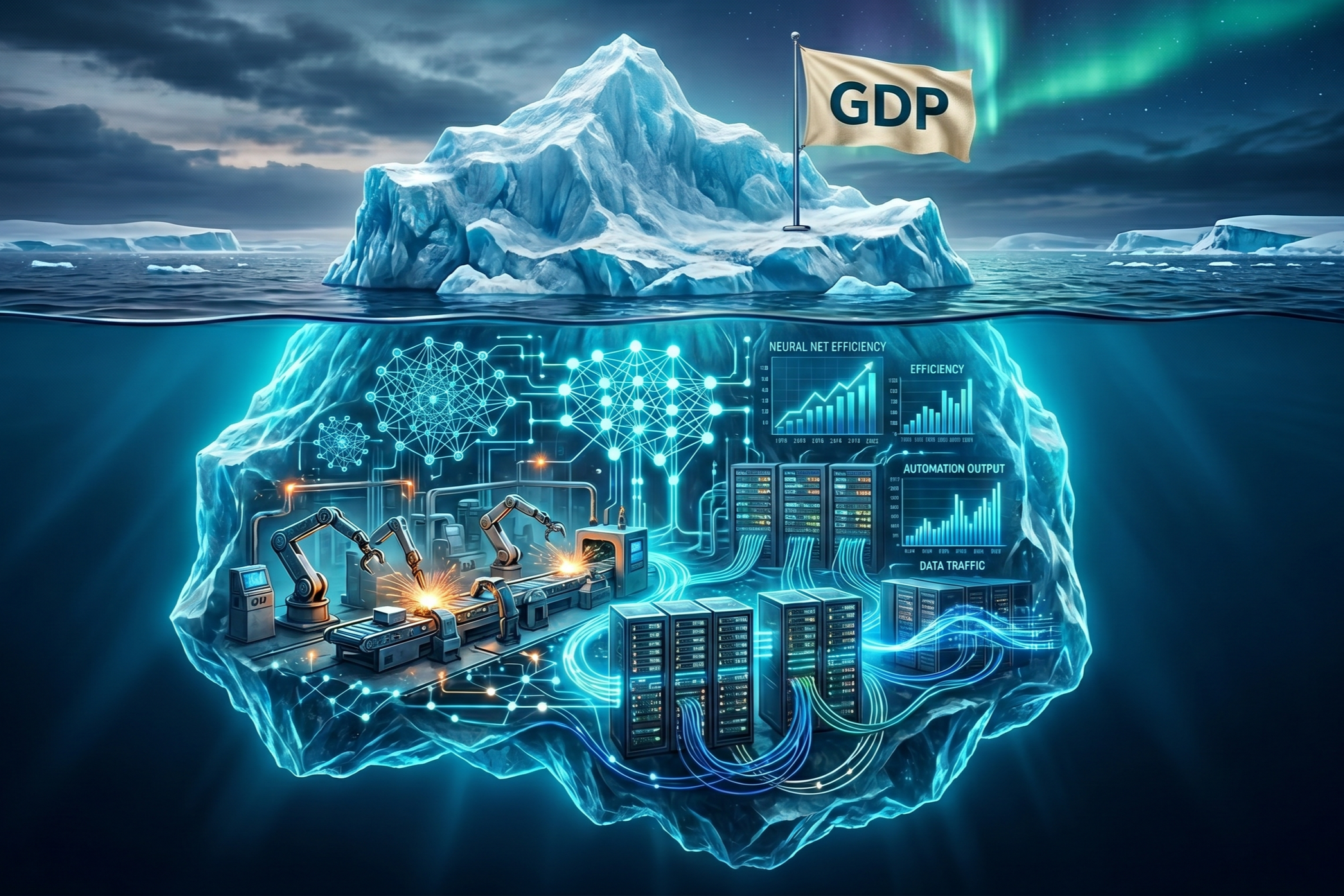
Technology is an enabler, not a product
Take the motor vehicle. The combustion engine restructured how people moved, how goods flowed, and how entire societies organised themselves. The GDP figures didn't move immediately in response to this technological feat. Infrastructure had to be built. Habits had to change. Supply chains had to be reimagined, and entirely new industries – fuel, insurance, hospitality, suburban housing – had to emerge. But once those conditions were in place, the uplift was extraordinary. We produced and shipped volumes of goods that would have been incomprehensible to the previous generation. The technology compressed time, distance and cost simultaneously, and returned something more valuable than efficiency: freedom. Freedom of movement, of choice, of attention. We enjoy freedoms our grandparents couldn't have imagined, and GDP only partially accounts for why.² The full value of what technology returns to human life has always been larger than what the national accounts can see.
The internet followed the same pattern: in its infancy, productivity statistics disappointed. Critics pointed to flat lines - exactly the lines we hear cited about AI today. Sceptics declared the revolution oversold. Then, suddenly, everything changed.
Amazon didn't just create a retail channel. It rewrote the rules of commerce, warehousing, logistics and consumer expectation. Google didn't just organise information, it fundamentally altered how knowledge was accessed and shared. The internet became the incubation platform for industries that couldn't previously exist: the gig economy, streaming, fintech, e-commerce, social media, and the vast ecosystem of software-as-a-service that now underpins nearly every business on the planet.³
GDP followed. It always does, eventually - the error is expecting it to lead.
Which brings us to AI, and the real question…
Transformation, or novelty?
The evidence points firmly to the former. AI is not an application. It is infrastructure. Just as the internet built a platform beneath entire industries, AI is now embedding itself beneath every workflow, every decision, every process across every sector simultaneously. Its speed of adoption is faster than any previous general-purpose technology, reaching 100 million users in months rather than the decades it took electricity or the telephone to achieve comparable penetration. The McKinsey Global Institute estimates AI could add between $13 and $22 trillion to the global economy annually by 2030, with generative AI alone contributing $2.6 to $4.4 trillion across industries each year.⁴
Businesses dismissing it as a "nice to have" remind me of Spencer Johnson's parable, “Who Moved My Cheese?”⁵ It describes how those who refuse to adapt are left behind not through any single dramatic moment, but through the slow, steady movement of the world around them. The cheese has moved. It is moving right now. Yet, some are still debating whether it will move at all.
For those of us who allocate capital on behalf of clients, this is not an abstract debate. It is a practical and urgent one, and it cuts to the heart of how we should think about investment discipline in a period of structural change.
History will likely repeat… eventually.
The data clearly tells us that active managers – those who believe they can outthink the market, pick winners and time the turns – have a consistently poor record of doing so. The SPIVA Scorecard, published by S&P Dow Jones Indices, shows that over a 15-year period, nearly 90% of active fund managers underperform their benchmark index.⁶
Across global markets, including Australia and New Zealand, the findings are consistent. The crystal ball is no clearer in professional hands than in the layman's. The complexity of markets, the speed of information and the weight of costs conspire to make consistent outperformance not merely difficult but statistically improbable.
A robust, evidence-based framework protects clients from the most persistent and costly mistakes in investing: reacting to noise, chasing narratives, and confusing confidence with competence.
Understanding AI and its long-term implications is not about picking technology stocks or timing a wave – that’s where you can get into trouble, à la NFTs and other failed hype stocks.
It is instead about recognising when the world is changing structurally, and ensuring that clients are positioned to participate in the full arc of that change over time – through diversified, low-cost and disciplined portfolios. The opportunity is not in predicting which companies win, but in making sure clients are in the game when the GDP finally catches up – because eventually, it will.
The woman I spoke with in Wellington already sensed this. She wasn't asking whether AI was real. She was asking whether the people managing her money understood it well enough to make sound decisions on her behalf – which is exactly the right question to be asking.
Technology enables. Capital follows. The data has never told us otherwise. The sceptics may be right on timing, but history suggests they are wrong on direction.

Nick Stewart
(Ngāi Tahu, Ngāti Huirapa, Ngāti Māmoe,
Ngāti Waitaha)
Financial Adviser and CEO at Stewart Group
Stewart Group is a Hawke's Bay and Wellington based CEFEX & BCorp certified financial planning and advisory firm providing personal fiduciary services, Wealth Management, Risk Insurance & KiwiSaver scheme solutions.
The information provided, or any opinions expressed in this article, are of a general nature only and should not be construed or relied on as a recommendation to invest in a financial product or class of financial products. You should seek financial advice specific to your circumstances from a Financial Adviser before making any financial decisions. A disclosure statement can be obtained free of charge by calling 0800 878 961 or visit our website, www.stewartgroup.co.nz
REFERENCES
Solow, R. (1987). We'd better watch out. New York Times Book Review. The observation, "you can see the computer age everywhere but in the productivity statistics", gave rise to what economists termed the Solow Productivity Paradox.
Crafts, N. (2004). Steam as a General Purpose Technology: A Growth Accounting Perspective. Economic Journal. Documents the long lag between transformative technology adoption and measurable economic uplift, a pattern repeated across industrial revolutions.
Brynjolfsson, E. & McAfee, A. (2014). The Second Machine Age. W.W. Norton & Company. Argues that digital technology's economic impact was systematically underestimated because GDP fails to capture consumer surplus and free digital goods.
McKinsey Global Institute (2023). The Economic Potential of Generative AI. McKinsey & Company. Estimates generative AI could add $2.6 to $4.4 trillion annually across industries, with broader AI contributing $13–$22 trillion by 2030.
Johnson, S. (1998). Who Moved the Cheese? G.P. Putnam's Sons. A business parable on adaptability and the cost of resisting inevitable change.
S&P Dow Jones Indices (2026). SPIVA U.S. Scorecard, Year-End 2025. Over a 15-year horizon, 90% of large-cap active managers underperformed the S&P 500. Consistent findings are reported across global markets including Australia and New Zealand.
