
Article #449
The average price of unleaded 91 jumped 14 NZD cents over a single weekend — and suddenly, commentators are reaching for the kind of language we last heard during COVID. Back then, we fought over toilet paper. Today, the panic commodity is petrol.
Let us first take a breath and assess.
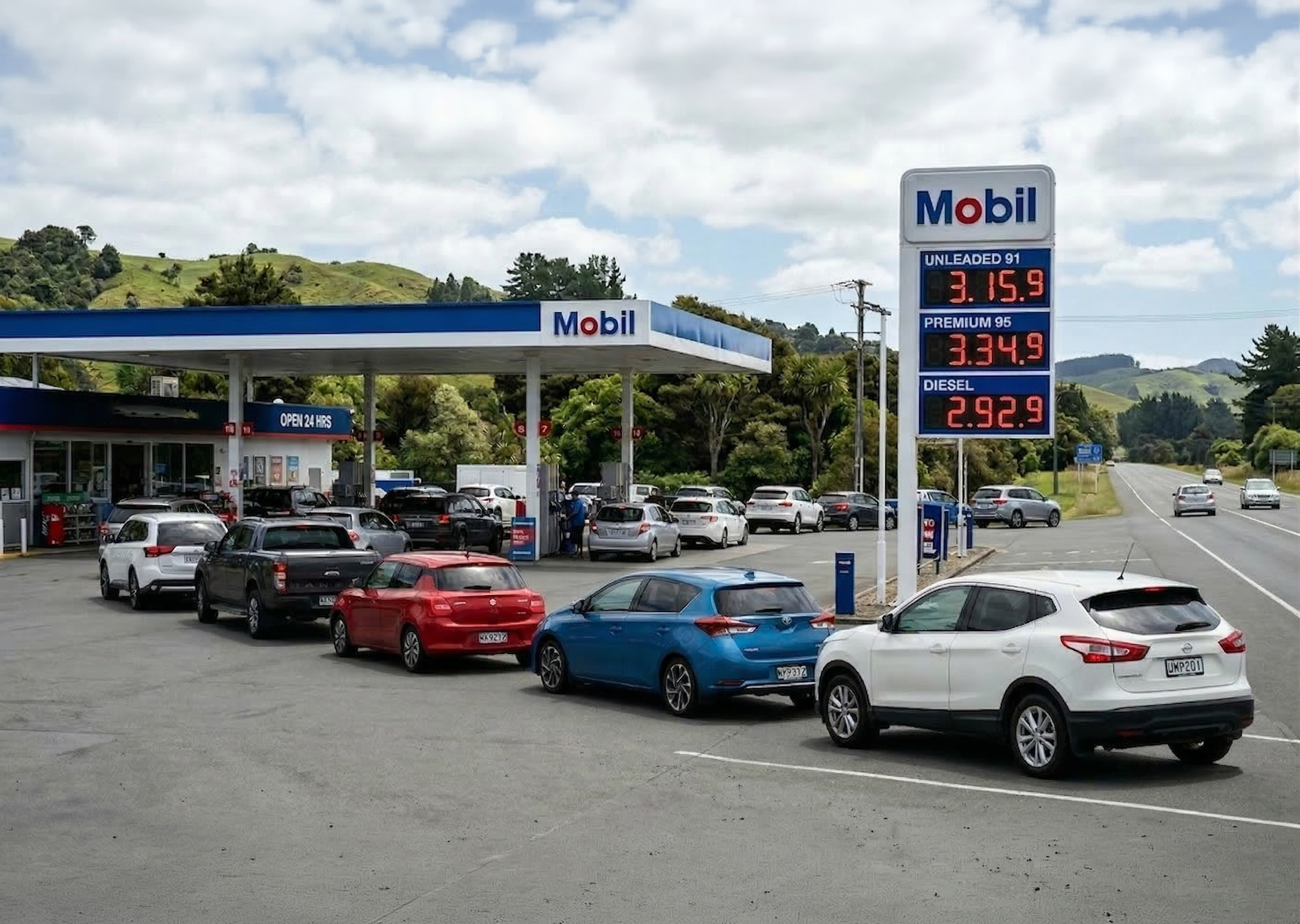
The cause: Iran’s effective closure of the Strait of Hormuz (which handles about a quarter of the world’s seaborne oil trade). This of course follows retaliatory strikes after a US and Israeli attack on Iran in late February. [1]
The effect: Global oil prices have surged past US $100 per barrel, with Brent and WTI hitting around US$110 to US$114 at the height of the crisis. That pain is not contained to the petrol forecourt. It is flowing into every corner of our economy simultaneously, because energy is embedded in the cost of producing virtually everything. [1]
The most visible casualty so far is Air New Zealand, another unfortunately familiar occurrence. Our majority state-owned carrier has cancelled approximately 1,100 flights through early May, impacting around 44,000 passengers. In USD, jet fuel spiked from around $85 per barrel before the conflict to between $150 and $200, with the refinery crack spread (the margin between crude oil and refined jet fuel) blowing out from $22 to as high as $115 per barrel. That’s a structural blow to an airline already recording losses, and it has suspended its full-year earnings guidance entirely because the numbers no longer make sense. [2–5]
Finance Minister Nicola Willis has cited New Zealand's 50 days of fuel supply as a form of reassurance, but the public must read the fine print carefully. That figure includes fuel still sitting on tankers at sea, in transit from the very region in crisis. The fuel physically on New Zealand soil is closer to 28–33 days, depending on the product. [6]
More concerning still, that onshore storage is heavily concentrated around the former Marsden Point site in the north. That means regional centres and the entire South Island operate effectively on just-in-time supply and sit at the end of an extra coastal-shipping leg that adds its own layer of vulnerability. If supply were completely cut off today, New Zealand could sustain itself for roughly a month. [6,7]
That is not 50 days — and it should reframe the conversation entirely.
Muldoon-era carless days, last deployed between July 1979 and May 1980, are being discussed as a last resort. The mere fact we’re having this conversation in 2026 should give everyone pause. [8]
This is where a Canny View requires plain speaking.
Energy is not a lifestyle choice. It is the oxygen of economic activity. Every business—whether moving freight, running a dairy farm, manufacturing product, or providing professional services—consumes energy somewhere in its cost structure. When that cost surges sharply and suddenly, the business faces exactly three options:
Pass the increase to the customer.
Absorb it through productivity gains and efficiency.
Close their doors.
There is no fourth option. This is precisely why energy price shocks are so broadly inflationary. They don’t strike one sector. They strike all sectors at once.
For shareholders and business owners, the message is clear. A viable business must pay its bills, pay its staff, and generate sufficient return to keep capital engaged. When a major uncontrollable cost input (like energy) doubles overnight, that margin compresses fast.
The businesses weathering this shock best are those that made deliberate investments in energy resilience during the quieter years. Fleet operators who transitioned to hybrid or electric vehicles, alongside conventional petrol and diesel workhorses, are finding their total fuel bill meaningfully lower today. Those with suitable rooftops or landholdings who installed solar are generating their own daytime electricity, reducing grid dependency when traditional energy costs are most volatile.
Neither investment requires ideological conviction, only the basic financial discipline of stress-testing a cost structure and acting before the stress arrives.
Resilience is built in calm weather, not in a storm.
Now to the harder conversation — one that goes well beyond oil.
New Zealand's coal reserves exceed 15 billion tonnes, spread across Waikato, Taranaki, the West Coast, Otago and Southland. Our West Coast bituminous coal is internationally prized for its exceptionally low sulphur, low ash, and low phosphorus content — a premium quality product valued by the global steel industry. Yet Genesis Energy's Huntly Power Station sources most of its coal from Indonesia, with imports surging 311% in 2024 as domestic gas supply fell faster than expected. [9–11]
We export quality. We import what we need to keep the lights on. It’s a paradox, not a viable strategy.
The same logic applies offshore. Geological surveys estimate a 90% probability that New Zealand holds undiscovered oil reserves of at least 1.9 billion barrels, with a 50% probability that the figure reaches 6.5 billion barrels. We are not a Saudi Arabia. But we are far from a barren rock. [12]
Which brings us to the captain's calls demanding accountability — plural, because there were more than one.
In 2018, then-Prime Minister Jacinda Ardern unilaterally banned all new offshore oil and gas exploration permits—no parliamentary vote, no Select Committee process, no national conversation. One announcement. Then, under the same Ardern government, New Zealand's only oil refinery at Marsden Point was closed and permanently decommissioned in 2022. The owner has since confirmed there is no prospect of restarting it; it would take billions of dollars and years of work to rebuild what took decades to establish. Associate Energy Minister Shane Jones described the closure as having fatally wounded New Zealand's fuel security. It’s difficult to argue otherwise this week. [13,14]
An uncomfortable but instructive parallel comes to mind. During Stalin's forced collectivisation in Ukraine in the early 1930s, a nation sitting atop some of the world's most productive agricultural land experienced a devastating famine while grain continued to be exported across its borders. The resources existed, and the policy choices negated them.
New Zealand is not Ukraine, and this is not the Holodomor, but the underlying dynamic—voluntarily denying access to domestic resources while importing vulnerability from abroad—is a pattern worth acknowledging.
A nation surrounded by grain, starving. A nation surrounded by hydrocarbons, panicking at the pump.
Muldoon would be baffled. His Think Big programme in the early 1980s was explicitly designed to convert New Zealand's own natural gas into synthetic fuels, fertiliser and methanol, and reduce oil import dependency following the 1973 energy shock. Think Big was expensive and its outcomes were mixed. But the underlying instinct — that a small, geographically isolated nation at the bottom of the world needs to take energy sovereignty seriously — wasn’t wrong. [15]
Domestic production does not fully insulate a small open economy from global prices. But it reduces the foreign exchange drain of pure import dependency, supports local employment, generates royalties and tax revenue for the Crown, and critically – reduces exposure to the shipping disruptions and geopolitical shocks we are living through right now. In times of crisis, a country with some domestic production and refining capacity is materially more resilient than one with neither.
The toilet paper panic of 2020 passed, and we learned almost nothing from it. Let us use this one differently: we need to have the serious, unsentimental conversation about energy sovereignty that we should have started long before Ardern's captain's call made it more urgent than it ever needed to be. We’ve missed the boat on energy resilience, and the storm has arrived; all we can do now is fortify ourselves to better weather the next one.

Nick Stewart
(Ngāi Tahu, Ngāti Huirapa, Ngāti Māmoe,
Ngāti Waitaha)
Financial Adviser and CEO at Stewart Group
Stewart Group is a Hawke's Bay and Wellington based CEFEX & BCorp certified financial planning and advisory firm providing personal fiduciary services, Wealth Management, Risk Insurance & KiwiSaver scheme solutions.
The information provided, or any opinions expressed in this article, are of a general nature only and should not be construed or relied on as a recommendation to invest in a financial product or class of financial products. You should seek financial advice specific to your circumstances from a Financial Adviser before making any financial decisions. A disclosure statement can be obtained free of charge by calling 0800 878 961 or visit our website, www.stewartgroup.co.nz
References
NZ Herald, Petrol prices expected to hit at least $3 a litre in some places, March 2026
Flight Global, Fuel price volatility prompts Air New Zealand to suspend earnings guidance, March 2026
Global Banking & Finance Review, Air New Zealand cut flights, fuel price surge wreaks havoc, March 2026
AeroTime, Air NZ to cut 1,100 flights amid soaring fuel prices, March 2026
NZX Announcement, Air New Zealand suspends FY2026 guidance, March 2026
RNZ, How much fuel does NZ have — and what happens if we run out?, March 2026
Infonews, NZ Fuel Situation — South Island Vulnerabilities, March 2026
NZ Herald, Carless days are no solution to an oil shock (Liam Dann), March 2026
Wikipedia, Coal in New Zealand, citing USGS and MBIE data
USGS Fact Sheet 2004-3089, New Zealand Coal Resources
Ministry of Business, Innovation & Employment, Energy in New Zealand 2025 — Coal
New Zealand Parliament, The Next Oil Shock?, citing Institute of Geological and Nuclear Sciences 2009
NZ Herald, First look: Inside Northland's Marsden Point oil refinery post-shutdown, November 2024
NZ Herald, Inquiry into reopening New Zealand's only oil refinery, March 2024
Wikipedia, Think Big, New Zealand Third National Government economic strategy
