Full and Final: The Value of Moving Forward

Article # 443

With Waitangi Day upon us, it’s the perfect opportunity to reflect on what makes us unique. We're one of few nations built on a founding document promising partnership: the Treaty has been imperfectly honoured, fiercely contested, never abandoned… and the journey has taught us something valuable about moving forward without forgetting the past.

There's a story from Ngāi Tahu history that captures this lesson. It involves a sacred dogskin cloak, a violation of tapu, and a cost compounded beyond anyone's imagination.

Arowhenua Marae - Photo by Nick Stewart

The Cost of Feuds

Around 1826, while Chief Te Maiharanui was away, a woman from Waikākahi wore the kurīawarua – the Chief's sacred dogskin cloak. This act sparked the kai huānga feud: years of fighting between kin across Banks Peninsula, where the final insult to the enemy after battle was to consume them (kai huānga meaning ‘to eat a relative’, as the fighting was between hapū).[1]

This internal warfare weakened Ngāi Tahu at a crucial moment in time. Te Rauparaha of Ngāti Toa then swept down from Kapiti Coast with muskets. He found an iwi divided. The feud ended when the external threat loomed, but the damage had been done: the siege of Kaiapoi and the fall of Ōnawe found Ngāi Tahu already vulnerable because of the previous fighting.

The cloak was never worth what it ultimately cost.

The Next Fight: Te Kerēme

Ngāi Tahu learned from this. When the land was taken – eight million hectares purchased by the Crown for £2,000 through Kemp's Deed in 1848 – Ngāi Tahu made its first claim against the Crown in 1849, just one year after the deed was signed.[2]

For 149 years, generation after generation carried the fight forward. This became known as Te Kerēme (The Claim).

Above the Arowhenua Marae in Temuka, where tribal gatherings have been held for over a century, hangs the name Te Hapa o Niu Tireni: "The Broken Promises of New Zealand."[3] That name captures the weight of grievance the iwi carried, which were many and justified.

  • The Crown had promised reserves for Ngai Tahu of approximately ten percent of the land sold, along with schools and hospitals. None materialised.

  • Access to mahinga kai – traditional food gathering places – was lost.

  • Sacred sites and urupā were alienated.

  • By the early 1900s, fewer than 2,000 Ngāi Tahu remained alive in their own land, deprived of virtually everything required to survive beyond subsistence level.

The fight for justice took many forms. In 1877, the prophet Hipa Te Maiharoa led over 100 followers to Te Ao Mārama in the upper Waitaki – land he maintained had never been legitimately sold under Kemp's Deed. For two years they cultivated kai and taught tikanga, a peaceful assertion of rights that had been ignored.[4] When the armed constabulary came in 1879, Te Maiharoa chose not to shed blood. They left peacefully. Though he died before any resolution, his example of principled, persistent resistance without self-destruction gave strength to the generations who continued the fight.

The struggle continued through courts, commissions, and countless petitions. When Ngāi Tahu first took Te Kerēme to court in 1868, the government passed laws to prevent the courts from hearing it. A Commission of Inquiry a decade later had its funding halted by the Crown mid-investigation. In 1887, Royal Commissioner Judge MacKay acknowledged only a "substantial endowment" of land would begin to right so many years of neglect. By 1991, at least a dozen different commissions, inquiries, courts and tribunals had repeatedly established the veracity and justice of Te Kerēme.

Fast forward to 1998. Ngāi Tahu became the first iwi to settle with the Crown under the modern Treaty settlement process. The settlement was cents on the dollar – everyone knew it. The breach had been egregious, the losses enormous. By any measure, they deserved more.

But Ngāi Tahu took the deal anyway. Full and final. As Tā Mark Solomon reflected: "The Crown reckoned full redress was worth $12 to $15 billion. Our advisers thought closer to $20 billion. We settled for $170 million — a lot less, but it allowed Ngāi Tahu to move forward, to rebuild."[5]

The Rule of 72: Investing in the future

Why settle for less than one percent of what was owed? The Rule of 72 provides part of the answer. At 7.2% returns, money doubles every 10 years. That $170 million settlement has grown to $1.66 billion in net assets today - nearly a tenfold increase in 27 years.[6] But it required stopping the fight and starting to invest.

The opportunity cost of delay is staggering. Every year spent fighting is a year money isn't compounding. Every year locked in grievance mode is a year not building for the future. The settlement allowed Ngāi Tahu to shift from survival mode to growth mode, from defending what was left to creating what could be.

This principle extends far beyond Treaty settlements:

  • Family disputes over estates burn tens of thousands in legal fees while the assets stagnate or depreciate.

  • Former business partners spend more on lawyers than the company was ever worth.

  • Divorce battles consume resources that could be rebuilding two separate lives.

 We hang in there because the principle matters, we deserve more, and because justice demands it.

And principle does matter. Justice is real – but so is your future. So is your peace of mind. So is the life you could be building instead of the grievance you're nursing.

Sometimes the juice isn't worth the squeeze.

The Value in Moving Forward

Holding grievances costs your mental health, your wellbeing, your ability to move forward – not to mention the fiscal cost. The human mind has limited bandwidth. Energy spent on past wrongs is energy unavailable for future opportunities. Anger may be righteous, but it's still corrosive.

You can be right, and still be trapped in a bad situation.

The settlement let Ngāi Tahu stop fighting the past (justified though they were) and start creating the future. That psychological shift may be worth more than any dollar figure – but the dollars did add up as well. Within a generation, the iwi went from near-extinction to becoming one of New Zealand's major economic and cultural forces. The asset base grew, yes, but so did everything else: language revitalisation programs, educational scholarships, marae restoration, cultural renaissance.

Modern New Zealand is a nation where nearly one in three people are first generation migrants, with fresh eyes unburdened by our nation’s history. These newcomers don't carry the weight of Te Hapa o Niu Tireni – the broken promises – and perhaps that lightness allows different possibilities.

That’s not to say we should forget. The name still hangs above Arowhenua Marae. The history is taught, remembered, and honoured. Moving on doesn't mean sweeping things under a rug and forgetting they existed. It means choosing where to invest your finite resources: backward into grievance, or forward into growth.

This Waitangi weekend, we celebrate a nation learning to move forward together, imperfectly but persistently. The dogskin cloak is long gone, but the lessons remain.

Sometimes "full and final" is the smartest decision you'll make. Not because you got everything you deserved, or because justice was fully served – but because opportunity cost exceeds what most people imagine.

In investment, and in life, the math is unforgiving. Every year looking backward is a year not compounding forward.

That's the real lesson Ngāi Tahu learned, twice over. Once the very hard way, fighting themselves while enemies approached, and once by choice: taking less than they deserved, and turning it into more than anyone expected.

The question isn't whether your grievance is justified. It probably is. The question must instead become: what's it costing you to hold on? And what could you build if you let it go?

Nick Stewart

(Ngāi Tahu, Ngāti Huirapa, Ngāti Māmoe, Ngāti Waitaha)

Financial Adviser and CEO at Stewart Group

  • Stewart Group is a Hawke's Bay and Wellington based CEFEX & BCorp certified financial planning and advisory firm providing personal fiduciary services, Wealth Management, Risk Insurance & KiwiSaver scheme solutions.

  • The information provided, or any opinions expressed in this article, are of a general nature only and should not be construed or relied on as a recommendation to invest in a financial product or class of financial products. You should seek financial advice specific to your circumstances from a Financial Adviser before making any financial decisions. A disclosure statement can be obtained free of charge by calling 0800 878 961 or visit our website, www.stewartgroup.co.nz

  • Article no. 443


References

[1] Mikaere, B. (1988). Te Maiharoa and the Promised Land. Auckland: Heinemann.

[2] Te Rūnanga o Ngāi Tahu. (n.d.). Claim History. Retrieved from https://ngaitahu.iwi.nz/ngai-tahu/creation-stories/the-settlement/claim-history/

[3] Arowhenua Marae. (n.d.). Te Hapa o Niu Tireni - The Broken Promises of New Zealand. Temuka, South Canterbury.

[4] Mikaere, B. (1988). Te Maiharoa and the Promised Land. Auckland: Heinemann.

[5] Solomon, M. with Revington, M. (2021). Mana Whakatipu: Ngāi Tahu Leader Mark Solomon on Leadership and Life. Massey University Press.

[6] Te Rūnanga o Ngāi Tahu. (2024). Annual Report 2024. Retrieved from https://ngaitahu.iwi.nz

28 Investment Principles That Actually Work When Markets Don't Cooperate

Article # 442

I've watched families navigate decades of volatility: crashes, recoveries, euphoria, panic. The ones who preserve wealth across generations don't have secret information or perfect timing. They follow simple rules, consistently.

February has 28 days. To ring it in, here are 28 guiding principles that have stood the test of time regardless of market activity.

1.       The market rewards patience, not prediction.

Most noise isn't information. The constant stream of commentary, analysis, and breaking news creates the illusion that staying informed means staying ahead. It doesn't. The market moves on fundamentals that reveal themselves slowly, not on headlines that change hourly.

2.       Focus on what you can control: Costs, discipline, diversification, behaviour.

You cannot control returns. You cannot control when recessions arrive or when bull markets end. But you can control how much you pay in fees, how consistently you invest, how broadly you spread your risk, and how you respond when fear or greed takes hold.

3.       You don't need to beat the market. You just need to capture it.

The obsession with outperformance drives investors towards complexity, higher costs, and ultimately, disappointment. Capturing market returns through low-cost, diversified portfolios has built more wealth over time than the pursuit of alpha ever has.

4.       The simplest portfolio is often the smartest.

Complexity rarely adds value. It adds cost, confusion, and opportunity for error. A straightforward allocation across global equities and bonds, rebalanced systematically, has outperformed the vast majority of elaborate strategies.

5.       Volatility is the price of admission.

Don't demand returns without accepting the ride. Equities deliver premium returns over time, because of fluctuations in the short term. If you cannot stomach the volatility, you don't deserve the returns.

6.       Time in the market matters more than timing the market. Always.

Missing just the 10 best days over a 20-year period can cut your returns nearly in half. Funnily enough, the best days often follow the worst ones – so it’s hard to capture them after getting cold feet on the downswing. Staying invested through the chaos is what separates wealth-builders from market-timers.

7.       Diversification is a dark horse.

Its power is revealed over decades, not days. When one asset class stumbles, another steadies the ship. The benefit isn't dramatic in any one year, but over a lifetime of investing, it's the difference between weathering storms and being swept away by them.

8.       Your plan should be built on evidence, not emotion.

Especially when emotions run high. When markets crash, fear whispers that this time is different and worse than any before. When markets soar, greed tells you that you're missing out. Evidence and decades of market history tell a different story – a much more trustworthy one.

9.       Chasing performance is a tax on impatience.

Last year's winners become this year's laggards with predictable regularity. By the time a fund or strategy appears on a "best performer" list, the opportunity has usually passed. Avoid getting swept up in the furore.

10.  The market has already priced in what everyone knows.

You don't need to outguess it. If information is public, it's already reflected in prices. Your edge as an investor isn't superior information, it's superior behaviour.

11.  A disciplined strategy beats a brilliant prediction. Every time.

Predictions fail. Discipline endures. The investor who follows a consistent plan through all market conditions will outperform the ‘strategist’ who tries to predict turning points.

12.  Your behaviour matters more than your products.

Panic is more expensive than fees: selling in a downturn locks in losses, while buying at market peaks locks in mediocre returns. Managing your behaviour by staying calm, and staying invested, matters far more than optimising your expense ratio by a few measley basis points.

13.  You don't need the perfect moment.

The moment you start is perfect enough. Markets climb over time. Waiting for a correction before investing often means waiting forever. Start now. Adjust as you go.

14.  Rebalancing is the quiet hero of long-term returns.

It forces buy-low, sell-high. When equities surge, rebalancing trims them back. When they crash, rebalancing buys more. It's counter-intuitive, uncomfortable… and extraordinarily effective over time.

15.  The best portfolios feel boring.

Boredom is not a bug, it's a feature. If your portfolio keeps you up at night with excitement, you’re probably taking on unnecessary risk. Wealth is built slowly, quietly, and without drama.

16.  Markets recover more often than they collapse.

History is your friend. Every bear market in history has eventually given way to a new bull market. Crashes feel permanent in the moment. They never are – as the adage goes, “this too shall pass.”

17.  Ignore headlines.

They're written to sell attention, not build wealth. Financial media thrives on urgency and alarm. Your portfolio should thrive on patience and perspective.

18.  Compounding works best when you don't interrupt it.

Let time do the heavy lifting. Albert Einstein allegedly called compound interest the eighth wonder of the world. But, it only works if you leave it alone – every time you exit the market, you reset the clock.

19.  Costs compound too.

Costs compound just like returns. Pay for advice that adds value, not for products that don't. The difference between value and waste always reveals itself in the fullness of time.

20.  Bad days don't destroy portfolios. Bad decisions do.

Markets fall. That's normal, and things will swing back the other way. Selling during the fall, abandoning your plan, or fleeing to cash – those are the decisions that inflict permanent damage.

21.  Not every risk deserves a reward.

Factor premiums do. Stocks are riskier than bonds, so they should deliver higher returns. Small-cap and value stocks have historically outperformed over long periods. These are risks worth taking. Concentrated bets on individual stocks or sectors? Not so much.

22.  Your portfolio should be built around you, not around the news cycle.

Your goals, your time horizon, and your risk tolerance should dictate your allocation. Not the latest economic forecast or geopolitical crisis.

23.  You don't need to predict the future.

…But you do need a strategy that survives it. Robust portfolios aren't built on forecasts. They're built on diversification, discipline, and the recognition that uncertainty is permanent.

24.  Stay invested, stay diversified, stay disciplined.

The rest is commentary. If you do these three things consistently, you will be fine. Better than fine, in fact. You'll be wealthier than the vast majority of investors who spend their lives chasing the next opportunity.

25.  Wealth isn't created in moments of excitement.

It's created in years of consistency. The investors who succeed aren't the ones who make brilliant trades or perfectly time the market. They're the ones who show up, year after year, regardless of conditions. Consistency compounds.

26.  Your worst investing day feels catastrophic. Your best investing decade feels inevitable.

Perspective matters. In the moment, a 20% drawdown feels like the end. Twenty years later, it's a footnote. Keep the long view. Stay the course.

27.  Successful investors are more patient than ‘smart’.

Intelligence helps, but temperament wins out every time. The ability to sit still, to do nothing when everyone else is panicking or euphoric, is worth more than any financial qualification.

28.  Markets don't care about your timeline. Build a plan that doesn't care about the markets.

You might need money in five years for a house deposit or in thirty years for retirement. The market will do what it does regardless. Structure your portfolio around your needs, not market predictions, and you'll sleep better through every cycle.

Remember: Markets will always be chaotic. Your response doesn't have to be.

Follow the rules (and seek professional advice)

These principles work. But they work best when you have someone in your corner who isn't conflicted by commissions, product sales, or institutional agendas.

Seek independent, impartial advice that puts you first and foremost. You are the sun, not the moon: your financial plan should orbit around you, your goals, your circumstances. Not around what someone else needs to sell.

Nick Stewart

(Ngāi Tahu, Ngāti Huirapa, Ngāti Māmoe, Ngāti Waitaha)

Financial Adviser and CEO at Stewart Group

  • Stewart Group is a Hawke's Bay and Wellington based CEFEX & BCorp certified financial planning and advisory firm providing personal fiduciary services, Wealth Management, Risk Insurance & KiwiSaver scheme solutions.

  • The information provided, or any opinions expressed in this article, are of a general nature only and should not be construed or relied on as a recommendation to invest in a financial product or class of financial products. You should seek financial advice specific to your circumstances from a Financial Adviser before making any financial decisions. A disclosure statement can be obtained free of charge by calling 0800 878 961 or visit our website, www.stewartgroup.co.nz

  • Article no. 442


The People's Poet and The People's Purse: From Burns to KiwiSaver

Article # 441

"A man's a man for a' that." - Robert Burns, 1795 [1]

Nigh on Burns Day feels like an appropriate moment to reflect on Scotland's most beloved poet. Robert Burns was no mere wordsmith; he was a revolutionary who believed wisdom and dignity belonged to everyone, not just the privileged few. Writing in Scots dialect rather than formal English, he made poetry accessible to common people in the 1700s; a radical and transformative act in its time.

Burns lived during the Age of Enlightenment, when intellectual discourse was largely confined to universities and aristocratic salons. Yet here was a ploughman-poet who insisted profound insights could come from anywhere: the farm, the tavern, ordinary folk going about their daily lives. His poetry gave voice to universal human experiences in language the people could understand.

An 18th-century Scottish poet has more to do with modern finance than you might think. Burns' commitment to democratising culture mirrors a shift that's been happening in the investment world, culminating in what might be New Zealand's most egalitarian financial innovation: KiwiSaver.

Burns' Revolutionary Accessibility

When Burns penned verses celebrating ploughmen, mice, and haggis, he was doing something deeply subversive. He was adamant that insight into the human condition – love, loss, joy, struggle – wasn't the exclusive domain of the educated elite. His genius lay in understanding that emotional intelligence and wisdom about human nature mattered more than formal education or social standing.

Consider "Auld Lang Syne," sung around the world each New Year; a meditation on friendship and memory, accessible to anyone. Or "To a Mouse," where disturbing a field mouse's nest becomes a profound reflection on planning and uncertainty. These weren't lofty academic exercises but observations from lived experience.

Burns recognised that a farmer could possess a deeper understanding than a nobleman. He celebrated the common person through genuine respect for their capacity for wisdom and feeling. This wasn't sentimentality; it was a fundamental belief in human equality that was genuinely radical for his era.

The Long Road to Investment Democratisation

For most of human history, investing was an aristocratic pursuit. You needed significant capital, insider connections, and often formal education to participate. Even in more recent history, the average person's financial planning extended to perhaps a savings account and hoping their employer's pension would suffice.

The journey toward broader access has been gradual:

  • Stock exchanges initially served merchants and wealthy traders.

  • The 20th century brought mutual funds and pension schemes, but these remained largely employer-controlled or required significant individual initiative and financial literacy.

  • The democratisation of investment accelerated with regulatory changes, technology, index funds, and online platforms.

Yet each advance still required knowledge and a confidence many New Zealanders lacked. We had democratised access… but barriers to participation remained.

KiwiSaver: The People's Purse

Enter KiwiSaver in 2007 – New Zealand's fiscal equivalent to Burns’ poetry [2]. Rather than another standard investment vehicle, it was a fundamentally egalitarian structure that would have made the Scottish bard proud.

KiwiSaver's genius lies in its true accessibility. It actively enrols people. Employers and employees both contribute. The government provides incentives. Millions of New Zealanders who might never have considered themselves "investors" were suddenly building wealth through capital markets.

The design was deliberately inclusive, as automatic enrolment meant participation became the default. Contribution rates started modestly, making it achievable for low-income workers whilst still meaningful. Importantly, the employer contribution requirement meant workers weren't building wealth alone – it was a structural recognition that wealth-building works best as a collective endeavour.

KiwiSaver has become the backbone of New Zealand's capital markets, channelling billions into productive investment [3]. As of 2024, over 3 million New Zealanders are members, with total funds exceeding $100 billion. This isn't just personal nest eggs; it's the foundation of New Zealand's investment infrastructure, funding businesses, infrastructure, and innovation.

Every working Kiwi (the cleaner, the teacher, the retail worker, the tradesperson) can build capital alongside CEOs and professionals. A person earning minimum wage with KiwiSaver has access to the same professional fund management and diversification as a high earner. The difference is scale, not opportunity.

This is investment democratisation at its finest. Not because it's simple, but because it's genuinely even-handed. Both employer and employee contribute and benefit.

Why the Human Element Still Matters

Burns understood that success in life wasn't just about opportunity; it was about how we think, feel, and respond to circumstances. Modern research tells us the same: emotional intelligence drives financial outcomes more than traditionally valued metrics like education or age [4][5].

KiwiSaver provides the vehicle. Successful wealth building still requires the human qualities Burns celebrated:

  • Patience over panic

  • Contentment over materialism

  • Long-term perspective over short-term thinking

Burns understood human nature deeply: our capacity for both wisdom and folly, our tendency toward both courage and fear.

Consider the emotional journey of investing, where markets are in a state of flux, and news cycles fan the anxious flames. The temptation to react emotionally and flee markets during downturns, or chase returns during booms, undermines long-term success.

The most successful KiwiSaver investors aren't necessarily the wealthiest or most educated. They're the ones who maintain emotional discipline. They understand that a market correction isn't a catastrophe but an opportunity. They resist the urge to constantly check balances and tinker with allocations. They stay the course through volatility, because they know what Burns knew: that the best outcomes often require patience, faith, and the wisdom to see beyond immediate circumstances.

Understanding your own emotional responses is the foundation of sound decision-making.

The Need for Wise Counsel

Burns also knew the value of good companions and sound advice. "Auld Lang Syne" isn't just about nostalgia; it's about trusted relationships that endure through time.

Having access to KiwiSaver is transformative, but maximising its benefit requires guidance. Understanding contribution rates, choosing appropriate funds, adjusting as circumstances change, planning for retirement – these decisions benefit enormously from experienced counsel.

Consider the choices KiwiSaver members face:

  1. Which fund suits your risk tolerance and timeline?

  2. Should you contribute more than the minimum?

  3. How does KiwiSaver fit with buying a home or other financial goals?

  4. When should you adjust your strategy as you age?

These aren't trivial questions, and answers vary greatly depending on individual circumstances.

Just as Burns made poetry accessible by expressing profound truths clearly, good financial advice makes wealth-building accessible by clarifying complexity without oversimplifying it.

A man's a man for a' that – every person deserves both the tools and the counsel to build lasting wealth.

Nick Stewart

(Ngāi Tahu, Ngāti Huirapa, Ngāti Māmoe, Ngāti Waitaha)

Financial Adviser and CEO at Stewart Group

  • Stewart Group is a Hawke's Bay and Wellington based CEFEX & BCorp certified financial planning and advisory firm providing personal fiduciary services, Wealth Management, Risk Insurance & KiwiSaver scheme solutions.

  • The information provided, or any opinions expressed in this article, are of a general nature only and should not be construed or relied on as a recommendation to invest in a financial product or class of financial products. You should seek financial advice specific to your circumstances from a Financial Adviser before making any financial decisions. A disclosure statement can be obtained free of charge by calling 0800 878 961 or visit our website, www.stewartgroup.co.nz

  • Article no. 441


References

[1] Burns, R. (1795). A Man's A Man For A' That. In Poems Chiefly in the Scottish Dialect.

[2] Inland Revenue. (2007). KiwiSaver Act 2006: Implementation and Overview. Wellington: New Zealand Government.

[3] Financial Markets Authority. (2024). KiwiSaver Annual Report 2024. Wellington: New Zealand Government.

[4] Brown, K. W., & Ryan, R. M. (2003). The benefits of being present: Mindfulness and its role in psychological well-being. Journal of Personality and Social Psychology, 84(4), 822-848.

[5] Klontz, B., Britt, S. L., Mentzer, J., & Klontz, T. (2011). Money beliefs and financial behaviors: Development of the Klontz Money Script Inventory. Journal of Financial Therapy, 2(1), 1-22.

Taking Advice from Algorithms: Why the Messy Line Matters

Article # 440

You know what real life looks like? Messy. But you wouldn't know it from most financial plans – not algorithmic ones, anyway.

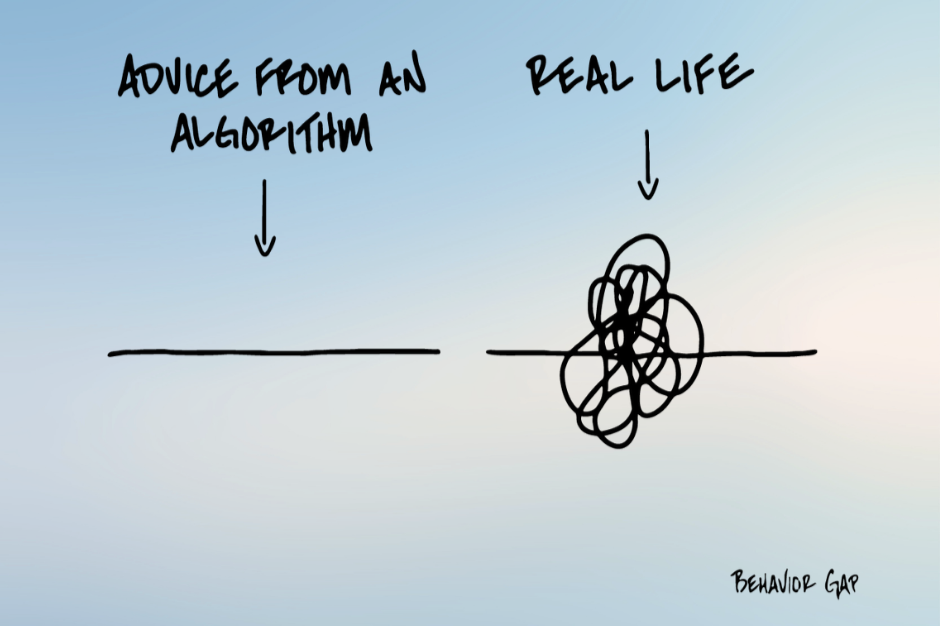
Most advice out there comes as a straight line. A tidy formula. Clean inputs, clean outputs. Do X, get Y! Save this percentage, retire at that age. Follow these steps, achieve this outcome.

But real life is messier. It's a chaotic tangle of loops and knots and unexpected detours.

And here's the thing about that mess—it's not a bug. It's not a sign you're doing it wrong. It's not evidence that you're bad with money or that you lack discipline. The mess is the point. The mess is what makes us human.

The Seduction of the Straight Line

There's something deeply appealing about algorithmic advice. It’s so clean. Plug in your numbers, and out comes a plan: no ambiguity, no second-guessing. Just follow the formula.

When you're overwhelmed by financial decisions, a straight line feels like relief. Someone—or something—finally has the answer. “Just tell me what to do, and I'll do it!”

Everything’s mapped out. It’s paint by numbers, just like when you were a kid.

But here's what the algorithm doesn't know: it doesn't know that your mother just got diagnosed with cancer and you're trying to figure out if you can afford to take unpaid leave. It doesn't know that your child is struggling in school and needs a tutor you hadn't budgeted for. It doesn't know that you just got an unexpected bonus and you're torn between paying down debt, investing, or finally taking that trip you've been postponing for five years.

The algorithm doesn't know that you're human, and life changes.

Why Math Isn't Enough

Don’t be mistaken - the maths matters. Of course it does! Compound interest is real. Time value of money is real. The difference between a 6% return and an 8% return over thirty years is very real.

But when we reduce money to maths alone, we forget what it feels like to make decisions when you're scared. Or uncertain. Or grieving. Or excited. Or exhausted. Or newly in love. Or watching your industry collapse. Or getting a second chance you never expected.

Financial decisions aren't made in a vacuum. They're made in the tangled middle of actual lives.

That's why human financial advice still matters. Not because humans are better at maths than machines—we're definitely not. But because good advisors know that the maths is just the beginning. The real work is helping people navigate the gap between what the spreadsheet says they should do and what feels possible in their actual circumstances.

Algorithms Optimise, Humans Navigate

Here's what I've learned after years of working with people and their money: algorithms optimise for efficiency. Humans navigate complexity.

An algorithm can tell you the mathematically optimal move. But it can't tell you whether that move is worth the fight it'll cause with your spouse. It can't weigh the emotional cost of saying no to your child’s sports travel team against the financial benefit of staying on track. It can't factor in the value of sleeping soundly at night, even if that means choosing a less "optimal" investment.

There's a reason Japanese retirement homes started removing robots and bringing back human caregivers.1 The robots were more efficient. They didn't get tired. They didn't call in sick. They could lift residents without risking back injuries. But the residents wanted the human touch. They wanted someone who could sense when they needed comfort, not just assistance. Someone who could respond to mood, not just medication schedules.

The same principle applies to money. The algorithm gives you the straight line. The human advisor helps you draw your actual path through the tangled mess.

And sometimes the best financial decision isn't the one that maximizes your net worth. Sometimes it's the one that lets you live with yourself. Sometimes it's the one that honours your values, even when it costs you. Sometimes it's the one that acknowledges you're not just a rational economic agent making optimal choices—you're a person trying to build a life that matters.

You Don't Know Where You Sit on the Curve

Late last year, I wrote about how no one actually knows where they sit on the curve of life's probabilities.2 The algorithm assumes average. But you're not living an average life—you're living your specific life, with your specific luck (good and bad) in any given year. My claims year proved that perfectly.

Some years, you sail through with nothing but routine expenses. The algorithm would call that "optimal."

Other years, everything hits at once. Three family emergencies, a job loss, a health scare, and a busted gearbox. The algorithm would call that "suboptimal" or "poor planning."

Yet, both years are just… life. You didn't do anything wrong in the hard year. You didn't do anything especially right in the easy year. You just lived as normal, where probability meets reality and the straight line becomes a scribble.

The Question Worth Asking

So here's what I want you to ask someone you care about today: What did your budget not account for this past year?

Budgets are great. I believe in them. But they're not magic. Real life always sneaks something in. The car repair. The friend's wedding at the other end of the country. The opportunity you couldn't pass up. The emergency that wasn't really an emergency but felt like one at the time.

Those deviations from the plan? They're not failures. They're data. They're information about what your life actually requires, not what the algorithm thinks it should require.

The straight line is beautiful. But the tangled mess is real. And real is where we have to learn to make good decisions.

Why We Still Seek Human Advice

Here's the deeper truth about why people still seek human financial advice in an age of robo-advisors and AI-powered planning tools: life is dynamic, and our responses need to be too.

A good financial plan isn't static. It breathes. It adapts. It changes when your circumstances change, when your values shift, when unexpected opportunities arise or unwanted challenges appear.

The algorithm updates when you feed it new numbers. The human advisor updates when they see the worry in your eyes, hear the excitement in your voice, sense the hesitation you can't quite articulate. They adjust not just to what has changed, but to how you've changed.

Because here's what the tangled mess really represents: not chaos, but adaptation. Not failure, but responsiveness. Not a deviation from the plan, but evidence that you're paying attention to your actual life and adjusting accordingly.

The straight line assumes the future will be like the past. The tangled line knows better. It knows that life zigs when you expect it to zag. It knows that the best plan is one that can bend without breaking, that can accommodate both disaster and delight, that can hold space for the full complexity of being human.

That's not a bug in the system. That's the whole point of having a life worth planning for.

Nick Stewart

(Ngāi Tahu, Ngāti Huirapa, Ngāti Māmoe, Ngāti Waitaha)

Financial Adviser and CEO at Stewart Group

  • Stewart Group is a Hawke's Bay and Wellington based CEFEX & BCorp certified financial planning and advisory firm providing personal fiduciary services, Wealth Management, Risk Insurance & KiwiSaver scheme solutions.

  • The information provided, or any opinions expressed in this article, are of a general nature only and should not be construed or relied on as a recommendation to invest in a financial product or class of financial products. You should seek financial advice specific to your circumstances from a Financial Adviser before making any financial decisions. A disclosure statement can be obtained free of charge by calling 0800 878 961 or visit our website, www.stewartgroup.co.nz

  • Article no. 440


References

  1. James Wright's research on Japanese eldercare facilities found that care workers often rejected robots like the "Hug" lifting device, preferring to care with their own hands and finding it more respectful to residents. See: Wright, James. Robots Won't Save Japan: An Ethnography of Eldercare Automation (Cornell University Press, 2023); and MIT Technology Review's coverage of robot implementation challenges in Japanese care homes (January 2023). ↩

  2. "Why Self-Insurance Rarely Works," Stewart Group, December 5, 2024 ↩


When Good Intentions Meet Poor Planning

A successful professional – let's call him "Mr H" – had built an impressive career and accumulated substantial wealth. He owned property, had invested in overseas estates, and maintained generous pension arrangements.

He also had a complex personal life: an estranged wife he still supported financially, a long-term partner who had borne his only child, and extended family who depended on him.

Before embarking on what would prove to be his final business venture, Mr H added a hasty codicil (an addition) to his existing will. In it, he praised his partner's invaluable contributions to his career and pleaded that she be given "an ample provision to maintain her rank in life."¹ He entrusted her and their young daughter as "a legacy to my company and extended family," confidently expecting that his colleagues and family would honour his wishes.

He was catastrophically wrong.

The Background: A Man at the Height of Success

Mr H had reached the pinnacle of his profession. He was celebrated, wealthy, and influential. He purchased a substantial country estate – a property with elegant gardens, spacious grounds, and all the trappings of success. He paid approximately $2.25 million for the initial property and would eventually expand his holdings to over 160 acres, spending another $2 million on additional land purchases, creating what he called his "paradise."

His partner, Miss E, was instrumental in transforming the property, which featured five spacious bedrooms, two large drawing rooms, a dining room, library, extensive grounds with ornamental gardens, and even an icehouse. Mr H was so delighted with the estate that he repeatedly expanded it, despite his own written advice to Miss E not to acquire anything "too large, for the establishment of a large household would be ruinous."

And oh, the irony of those prophetic words…

The Will: A Masterclass in What Not to Do

Despite his professional acumen and access to the best legal minds of his era, Mr H's estate plan was fundamentally flawed. His original will left his entire estate, including lucrative overseas investments generating substantial annual income, to his brother Mr W (a clergyman). To his partner Miss E, he left only the substantial home and gardens, as well as a modest $125,000 annual income from his overseas estate. His daughter Miss H received $1m for education and a $50,000 allowance annually.²

On paper, these seemed like reasonable provisions. In reality, they were a recipe for disaster.

The problems were immediate and devastating:

Failure #1: No Trust Structure

Despite trusts being well-established legal instruments at the time, Mr H left everything to Mr W outright, apparently assuming his brother would "do the right thing" and support Miss E and Miss H. Family loyalty, after all, should count for something. He didn't even put his wishes in writing within the will itself. He just relied on an understanding between brothers.

He was wrong. Mr W and his wife immediately distanced themselves from Miss E—conveniently forgetting that she had cared for their own children for years while they pursued their own interests, and kept every penny.³ Given Mr H's dangerous profession and rather unique home life situation, a trust would have worked particularly well to protect his vulnerable dependents. A trust would have ensured regular payments to Miss E, protected Miss H's inheritance until she came of age, and prevented Mr W from simply pocketing everything.

But Mr H chose personal trust over legal structure. This was a mistake.

Failure #2: Gifting Encumbered Assets

The substantial home and gardens had been Mr H's pride and joy, his "paradise" where he could finally relax between his demanding work commitments. The property required constant maintenance, employed numerous servants, and demanded significant annual upkeep costs that far exceeded the modest $125,000 annual income Miss E received.²

The estate became an albatross around her neck. She couldn't afford to maintain it properly, yet she couldn't bear to sell her only tangible connection to the man she loved. She was asset-rich but cash-poor, a predicament that would lead to her financial ruin. Had Mr H consulted with estate planning professionals, they would have immediately identified this mismatch between the asset's carrying costs and the income provided to support it.

The property needed either sufficient income to maintain it, or it should have been sold with the proceeds placed in trust for Miss E's benefit. Instead, he gave her an expensive liability disguised as an asset.

Failure #3: Relying on Third Parties

The codicil added just before his final business venture was emotional rather than legally binding. Mr H "hoped" and "trusted" that his business associates would provide for Miss E, citing her work and contributions to the company's success.¹ He wrote movingly about her service and sacrifice, expecting that gratitude and honour would compel them to act.

But hope isn't a legally enforceable instrument. When his business chose to ignore his dying wishes, there was no mechanism to compel them. They threw a lavish $3.5 million funeral celebrating his achievements but didn't spend a penny on his partner or child.² Miss E approached them repeatedly, armed with Mr H's codicil and the testimony of colleagues who had witnessed his wishes. They refused every time.

Had these provisions been written into a binding legal agreement or trust structure, Miss E would have had recourse. Instead, she had only Mr H's heartfelt words… which proved worthless in court.

Failure #4: No Contingency Planning

What if his business refused to honour his wishes? What if Mr W proved ungenerous? What if Miss E fell into debt due to the property's crushing costs? What if she died while Miss H was still a minor; who would protect the child then?

None of these scenarios were addressed. Mr H had made his fortune through strategic planning in his professional life, carefully considering risks and preparing for multiple contingencies. Yet he left his personal affairs almost entirely to chance, apparently believing that good intentions and family loyalty would be sufficient.

The Devastating Aftermath

Miss E tried desperately to maintain the substantial home and gardens as a memorial, entertaining influential contacts in hopes of securing the support Mr H had promised would come. She invested what little money she had into keeping up appearances, hoping that someone – Mr W, the business associates, influential friends – would finally help.

Instead, she fell deeply into debt. With no legal protection and no reliable income, creditors closed in.⁴ The very property that was supposed to provide her with security became her prison. Within just eight years of Mr H's death, she was arrested for debt. She and young Miss H fled the country, living in poverty overseas – a shocking fall for a woman who had once been celebrated in the highest circles of society.

Miss E died in squalor around Miss H's fourteenth birthday, denying to the end that she was the girl's mother – perhaps hoping to spare her daughter the stigma of illegitimacy that would have made her life even harder.⁵ Miss H had to be smuggled back home disguised as a boy to avoid arrest for her mother's debts.⁶ The daughter returned home penniless, her childhood shattered, to be passed between reluctant relatives who viewed her as an unwanted burden.

Meanwhile, Mr W received a $25 million grant to purchase an estate, along with prestigious titles for himself and his son; the very honours Mr H had aspired to but never achieved in life. Other family members received $2.5 million each.² Even Mr H's estranged wife, from whom he had been separated for years, received generous provision.⁷

Everyone was taken care of, except the woman and child he loved most.

From the Northern Club Art Collection
Title: Portrait of Lord Nelson
Artist: Benjamin West

The Reveal

The saga above isn't hypothetical, nor is it contemporary. This catastrophic failure of estate planning happened over 200 years ago. "Mr H" is Vice-Admiral Horatio Nelson, 1st Viscount Nelson: the most celebrated naval commander in British history, victor of Trafalgar, the man whose column still dominates London's Trafalgar Square. "Miss E" is Emma, Lady Hamilton, "Miss H" is their daughter Horatia, and "Mr W" is his brother, the Reverend William Nelson.

Merton Place, the estate Nelson loved so dearly, was eventually sold off in pieces. Today, the site where Britain's greatest naval hero found his "paradise" is occupied by modern housing estates and a pub called The Nelson Arms. Not a single brick remains of the house where he spent his happiest days.

If someone of Nelson's intelligence, status, and access to legal counsel could make such devastating mistakes, what hope do the rest of us have without proper planning?

6 Lessons for Today’s Investors

The lessons from this 200-year-old tragedy remain relevant today:

1.       Use trusts for complex situations. Don't rely on family members to "do the right thing." Create legally binding structures that ensure your wishes are carried out regardless of personal relationships or good intentions.

2.       Match assets to beneficiaries' actual needs. Don't gift property or assets that require more income than you're providing to maintain them. Consider the total cost of ownership, not just the asset's value.

3.       Make provisions legally enforceable. Emotional appeals and dying wishes carry no legal weight. If you want something done, make it a binding legal obligation, not a heartfelt request.

4.       Plan for contingencies. What if your primary plan fails? What if beneficiaries predecease you? What if relationships change? Good estate planning anticipates multiple scenarios.

5.       Don't let complex personal situations discourage proper planning. If anything, unusual family arrangements demand MORE sophisticated planning, not less. Nelson's situation (an estranged wife, a partner, an illegitimate child, and complex family dynamics) required expert legal structures, not informal arrangements.

6.       Review and update regularly. Nelson's codicil was added hastily before battle. Professional estate planning requires time, thought, and regular review as circumstances change.


200 years later, Nelson's strategic brilliance at Trafalgar is remembered and celebrated. But so is the tragedy of Emma Hamilton and Horatia Nelson, abandoned to poverty and disgrace despite his dying wishes:

“Take care of my dear Lady Hamilton, Hardy. Take care of poor Lady Hamilton.”⁸

He tried. But without proper legal structure and financial planning, good intentions meant nothing.

Nick Stewart

(Ngāi Tahu, Ngāti Huirapa, Ngāti Māmoe, Ngāti Waitaha)

Financial Adviser and CEO at Stewart Group

  • Stewart Group is a Hawke's Bay and Wellington based CEFEX & BCorp certified financial planning and advisory firm providing personal fiduciary services, Wealth Management, Risk Insurance & KiwiSaver scheme solutions.

  • The information provided, or any opinions expressed in this article, are of a general nature only and should not be construed or relied on as a recommendation to invest in a financial product or class of financial products. You should seek financial advice specific to your circumstances from a Financial Adviser before making any financial decisions. A disclosure statement can be obtained free of charge by calling 0800 878 961 or visit our website, www.stewartgroup.co.nz

  • Article no. 439


References

  1. Encyclopedia.com. "Hamilton, Emma (1765–1815)." Women in World History: A Biographical Encyclopedia. Available at: https://www.encyclopedia.com/women/encyclopedias-almanacs-transcripts-and-maps/hamilton-emma-1765-1815

  2. Wikipedia. "Emma, Lady Hamilton." Accessed November 2025. Available at: https://en.wikipedia.org/wiki/Emma,_Lady_Hamilton

  3. Lady Hamilton & Horatio Nelson. "Nelson's Inheritance (part 50)." Words Music and Stories, January 7, 2023. Available at: https://wordsmusicandstories.wordpress.com/2023/01/07/lady-hamilton-horatio-nelson-nelsons-inheritance-part-50/

  4. Wikipedia. "Horatia Nelson." Accessed November 2025. Available at: https://en.wikipedia.org/wiki/Horatia_Nelson

  5. National Museum of the Royal Navy. "The extraordinary life of Horatia Nelson." Available at: https://www.nmrn.org.uk/news/extraordinary-life-horatia-nelson

  6. Find a Grave. "Horatia Nelson Ward (1801-1881)." Available at: https://www.findagrave.com/memorial/6884289/horatia-ward

  7. Lilystyle. "Nelson's Descendants in Brent." Available at: https://lilystyle.co.uk/nelson-s-descendants-in-brent.html

  8. Goode, Tom and Dominic Sandbrook. "RIHC | Nelson EXTRA: The Fate of Lady Hamilton." The Rest Is History podcast, November 5, 2025. Available at: https://podcasts.apple.com/nz/podcast/the-rest-is-history/id1537788786

  9. Merton Historical Society. "A History of Lord Nelson's Merton Place." Available at: https://mertonhistoricalsociety.org.uk/a-history-of-lord-nelsons-merton-place/

  10. Warwick, Peter. "Here was paradise - A description of Merton Place." Available at: https://wandle.org/aboutus/nelson2005/paradise.htm

Note: Historical currency amounts (pounds sterling, circa 1805) have been converted to approximate modern dollar equivalents, accounting for inflation and purchasing power.