
Article #485
The last fortnight on Wall Street
Wall Street and global markets have had a rough fortnight. The S&P 500 and the Dow, two big US share indexes, closed in correction territory on Friday 20 November, meaning a fall of 10% or more from the high [1]. The same day the Nasdaq dropped 5.3%, about 10% for the week and its worst since 2020 [2]. While shares fell, government bonds rose. The swings continued this week: on Wednesday the Nasdaq fell as much as 4.6% before closing slightly lower [3].
Commentators offered plenty of reasons: worries about the price of artificial intelligence companies, interest rate expectations, and year-end profit taking. The explanations always arrive after the fall, and none of them tells us what happens next. Rough, yes. Also normal, as 1910 shows.
That year a firestorm tore through the forests of Montana, Idaho and Washington. Driven by 70 mile an hour winds, it burned more than three million acres in two days. It killed 87 people, 78 of them firefighters, and flattened towns such as Wallace in Idaho [4].

The young US Forest Service took away the wrong lesson. Fire was the enemy. Congress doubled the service’s budget, light burning was dismissed as dangerous, and in 1935 the rule became that every fire should be out by 10 o’clock the next morning [5].
For a while it looked like it worked. By the 1970s the approach was containing 98% of wildfires. Later research showed that fire plays a positive role in many western forests, and the Forest Service changed course [5]. Small fires clear the undergrowth. Stop them all and the fuel builds until the one that escapes is far worse than any small one would have been.
A long calm feels like safety. It is the opposite.
Markets have small fires too
Markets work the same way. A correction is a small fire. Dimensional Fund Advisors, a global investment research firm, studied the US sharemarket, the world’s largest, from 1979 to 2023. The average fall within a calendar year was about 14%. Yet 37 of the 45 years still finished positive [6]. History is no promise, but small fires are normal and healthy.

Source: Dimensional Fund Advisors
Long runs of growth change behaviour. When prices have risen for years, rising prices start to feel normal. Caution slips. Risk gets taken on because nothing has gone wrong, and the absence of a problem gets mistaken for the absence of risk. A pullback is the check.
Houses and private equity: volatility with the lights off
Same idea, different market. New Zealand houses feel calm because there is no price on a screen every second. Private equity and venture capital are not marked to market daily either. No daily price is not the same as no volatility. It is volatility with the lights off.
Property has had its own long run, and our forebears said that housing always goes up. For many it did, and timing was a big part of that. Timing is another word for luck. House prices rose 43% in the 18 months to November 2021 [7]. Cotality now has national values 19.1% below that peak and Hastings values more than 20% below it, with Havelock North homes above $2 million down about 25% from their peak [8]. Once inflation is counted, we estimate the national fall at about 30%.
Governments from both sides have also changed the rules after people bought. For years the clever move was the loss-attributing qualifying company, which let losses on a leveraged rental cut the owners’ tax on their salaries, until National ended loss attribution from April 2011[9]. Labour denied interest deductions on rental borrowing from 2021[10], and National restored full deductibility by April 2025 [11]. Whatever you think of each rule, the lesson is the same. A return you had planned on moved after you had signed.
What debt does to a pullback
Now add debt. Say a $1 million house is bought with a $200,000 deposit and an $800,000 loan. A 20% fall, about what Hastings has seen, takes $200,000 off the gross value. The loan stays at $800,000, so the $200,000 of equity is gone. That is a net loss of 100%. The same fall on $200,000 of shares bought without borrowing costs $40,000. These figures ignore interest, fees and tax.
An offset account saves interest on the savings sitting against the loan. It does not shrink the debt, and it does not stop a valuation falling.
A pullback you can sit through is a nuisance. A pullback that forces you to sell is a loss. The more you borrow, the less choice you have about which one you get.
So the useful question is not what the house might be worth. It is how big a fall your household could survive before you borrow. Could you sit through two years of falling values without being forced to sell? A bank will lend you the most it is allowed to. A fiduciary asks whether you should.
The instinct is to step aside
At times like this the instinct is to step aside. Finances and emotion don’t make good bedfellows.
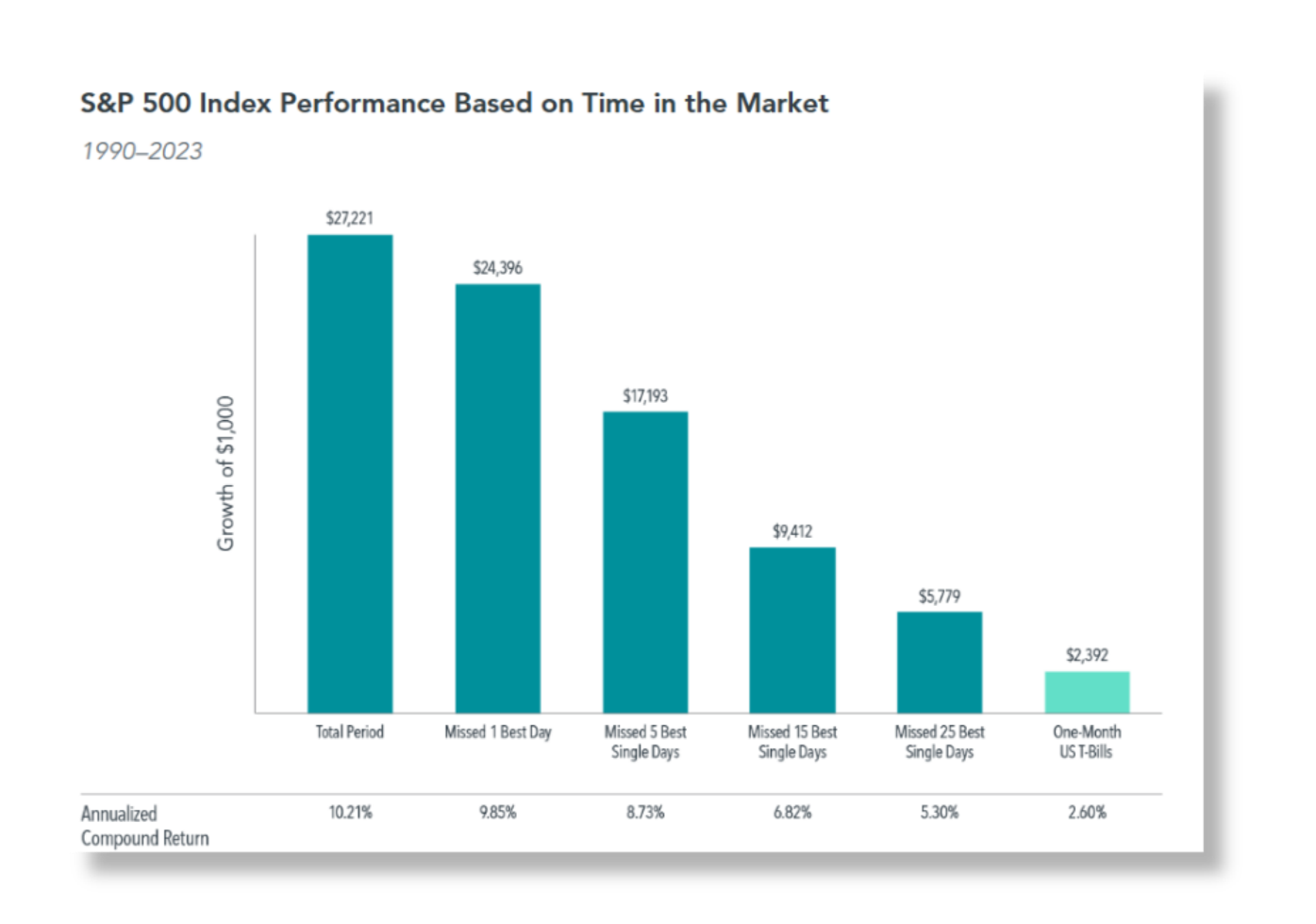
Stepping aside has a price. Dimensional’s figures for the S&P 500, the main US sharemarket index, show $1,000 invested in 1990 grew to $27,221 by the end of 2023, in US dollars [6]. Miss only the five best days and you would have over $10,000 less. Selling after a fall means being right twice: when to get out and when to get back in.
Source: Dimensional Fund Advisors
Warren Buffett put it simply in his 1997 shareholder letter. Someone who plans to keep eating hamburgers for life should hope beef gets cheaper, not dearer. The same goes for anyone who will keep buying shares: in his words, prospective purchasers “should much prefer sinking prices” [12]. Cheaper prices help when you are still buying, and hurt when you are about to sell. That is why your stage of life belongs in the plan.
For many KiwiSaver members the horizon is long. A fit and healthy 65-year-old can expect around two decades, and KiwiSaver money does not have to come out at 65. A long horizon is what lets a pullback do its work.
Rebalancing is the controlled burn
Foresters eventually learned. Today they light small, controlled fires on purpose. Rebalancing is the controlled burn. We rebalanced our client portfolios on 28 October, as we do periodically. It was routine, set by the calendar and not by a view on the market, and it landed about three weeks before this fall. That was timely, and sometimes luck is helpful, but it does not make a portfolio immune to a fall like this.
Rebalancing means returning a portfolio to the mix of shares, bonds and cash agreed in your plan. When shares run, you sell a little. When they fall, you top up.
That is holding course. A plan agreed in calm weather is there for the stormy days. The rebalance is the plan working, on schedule, not a reaction to the headlines.
Who is giving you the advice?
So who is giving you the advice? A fiduciary puts your interests first and is paid by you, not by the product.
Advice earns its keep at times like this. Anyone looks like a good manager when markets only rise. A fiduciary keeps you to the plan built on your goals, not the headlines. It cannot stop a market falling. It can help stop a temporary fall becoming a permanent loss.
Find a fiduciary before you need one, because when the market noise gets loudest, you’ll need sound advice and wise counsel.

Nick Stewart
(Ngāi Tahu, Ngāti Huirapa, Ngāti Māmoe,
Ngāti Waitaha)
Financial Adviser and CEO at Stewart Group
Stewart Group is a Hawke's Bay and Wellington based CEFEX & BCorp certified financial planning and advisory firm providing personal fiduciary services, Wealth Management, Risk Insurance & KiwiSaver scheme solutions.
The information provided, or any opinions expressed in this article, are of a general nature only and should not be construed or relied on as a recommendation to invest in a financial product or class of financial products. You should seek financial advice specific to your circumstances from a Financial Adviser before making any financial decisions. A disclosure statement can be obtained free of charge by calling 0800 878 961 or visit our website, www.stewartgroup.co.nz
References
1. CNBC (19 November 2026). S&P 500 and Dow close in correction; Nasdaq erases 2026 gain as AI rout picks up steam (headline only). https://www.cnbc.com/2026/11/19/stock-market-today-live-updates.html
2. Reuters via Investing.com (20 November 2026). Nasdaq plunges 5% a day after Anthropic debut: Nasdaq Composite down 5.3% on the day and 10% for the week, S&P 500 down 3.7%. https://www.investing.com/news/stock-market-news/nasdaq-plunges-5-a-day-after-anthropic-debut-but-investors-still-believe-in-ai-5042641
3. Reuters via Business Recorder (25 November 2026). Nasdaq slides 4% as AI selloff, tariff proposals rattle Wall St. IBTimes (25 November 2026) reports the Nasdaq fell as much as 4.6% on the day before a partial recovery. https://www.brecorder.com/news/40450713/nasdaq-slides-4-as-ai-selloff-tariff-proposals-rattle-wall-st
4. Roos, D. The Great Fire of 1910 and the rise of wildfire suppression. History.com. https://www.history.com/articles/great-fire-1910-wildfire-suppression
5. Forest History Society. U.S. Forest Service fire suppression (1935 10 a.m. policy; later let-burn policy). https://foresthistory.org/research-explore/us-forest-service-history/policy-and-law/fire-u-s-forest-service/u-s-forest-service-fire-suppression/
6. Dimensional Fund Advisors (4 March 2025). Investing Can Be a Roller Coaster: Three Tips for Riding Out the Ups and Downs. US stock market 1979 to 2023: average largest intra-year decline about 14%, 37 of 45 calendar years positive; S&P 500 1990 to 2023: $1,000 grew to $27,221, missing the five best days cost more than $10,000. US dollars. https://www.dimensional.com/lu-en/insights/investing-can-be-a-roller-coaster-three-tips-for-riding-out-the-ups-and-downs
7. BNZ Eco-Pulse (June 2026), as reported by Mortgage Professional Australia NZ. REINZ House Price Index: 43% rise May 2020 to November 2021. https://www.mpamag.com/nz/specialty/residential/nz-had-one-of-the-worlds-deepest-house-price-falls-so-why-arent-prices-cheap/580570
8. Cotality NZ Home Value Index, October 2026 (published 5 November 2026): national values 19.1% below the January 2022 peak. Hastings is from the August 2026 index (20.8% below peak) and has not been updated for October. https://www.cotality.com/nz/insights/articles/housing-market-down-again-as-election-looms
9. Inland Revenue Policy (11 October 2010). Qualifying company reforms announced: LAQCs to lose loss attribution from 1 April 2011. https://taxpolicy.ird.govt.nz/news/2010/2010-10-11-qualifying-company-reforms-announced
10. Simpson Grierson. Full interest deductibility for residential rental properties returns but no change to loss ring-fencing (interest limitation rules from 2021). https://www.simpsongrierson.com/insights-news/legal-updates/full-interest-deductibility-for-residential-rental-properties-returns-but-no-change-to-loss-ring-fencing
11. Deloitte NZ (May 2024). May 2024 changes to residential property taxation explained: interest deductibility 100% from 1 April 2025; two-year bright-line from 1 July 2024. https://www.deloitte.com/nz/en/services/tax/perspectives/may-2024-changes-to-residential-property-taxation-explained.html
12. Buffett, W. Berkshire Hathaway shareholder letter for 1997 (hamburger and beef prices analogy). https://www.berkshirehathaway.com/letters/1997.html