
Article #483
A note from Nick: This is the longer edition of the weekend’s column, and a companion to my recent piece on the global bond auction - Cheap Money has a Maturity Date. That article looked at why the price of money is set by the market and not by announcement. This week’s looks at what that does to council borrowing in Hawke’s Bay, and at who had done the sums. [1]
The $34.7 million question
Splash Planet needs around $34.7 million over the next 15 years to replace ageing rides, pools, buildings and facilities, according to Mayor Wendy Schollum. That is largely to maintain what is already there, not to add new attractions. [2]
Keeping it much as it is would lift the contribution on an average Hastings rates bill from about $50 a year to an estimated $125 over that period. Ratepayers now contribute about $1.6 million a year. By my arithmetic, $1.6 million at $50 a bill implies about 32,000 rateable properties, so $125 a bill is about $4 million a year. It cross-checks: $34.7 million over 15 years is about $2.3 million a year in capital, plus $1.6 million to run the park. [2]
In fairness, people love it. About 81,000 visited last financial year, and independent analysis tied $11.4 million of spending across Hawke’s Bay to visitors from outside the region between October 2023 and March 2025. Council has explored higher prices, longer opening and a private operator, and says none of them solves a short, weather-dependent season or the cost of replacing the rides. No decision has been made, and Council’s survey is open until 29 November. [2] [3]
I raise it because of what it sits on. The council asking residents to fund $34.7 million of rides and pools has half a billion dollars of debt on an average term of 2.32 years. The two questions belong together, and only one of them is in the survey. [4] [3]

Nobody wants to get caught shaking the (Robert Muldoon) piggy bank when you should have done the sums.
A kingdom counted in a year
At Christmas 1085, William the Conqueror asked what England held, who owed what, and what it was worth. [5]
Commissioners were sent to every shire. The survey was finished in 1086. A king with horses and quills counted a kingdom in about a year. [5] [6]
The framework for Domesday Book was the tax assessment lists. Rulers who plan to collect taxes tend to count first. Ratepayers are entitled to ask whether the people who collect from them have counted too. [6]
Three councils, one question
Three Hawke’s Bay councils were asked about their debt: what they owe, when it falls due, and what a rise in rates would cost. Hastings and Central Hawke’s Bay answered mine. Napier answered a ratepayer’s version of the same question.
Napier’s position needs care. It answered a ratepayer’s request, after its email security filter intercepted the original and it apologised for the delay. [7] But my own request, sent on 7 October, remains unanswered, with no update since 5 November, when Napier said it would miss the 20 working day limit and expected to respond “tomorrow or early next week”. [8] I have not lodged a complaint with the Ombudsman.
Hastings answered on the nineteenth of the twenty working days. Central Hawke’s Bay answered in eleven days. [9]
The most revealing question was the simplest. Does Council hold any modelling of a 1% rise in refinancing rates? Central Hawke’s Bay: yes, $480,000 a year. Napier: no, the document does not exist. Hastings: it will be done as part of the 2027-37 Long Term Plan, adopted in June 2027. [9] [7] [4]
Hastings: half a billion dollars on a two year fix
Gross external debt at 30 June 2026 was $493.7 million, draft pending audit. Cash was $7.6 million. Net debt excluding internal borrowings was $486.1 million. [4]
Neither of the headline figures is what matters. This is. The weighted average duration of that borrowing is 2.32 years. That is the average time left before the loans must be repaid or refinanced, not the interest-rate fix.
Half a billion dollars, on something close to a two year fix.
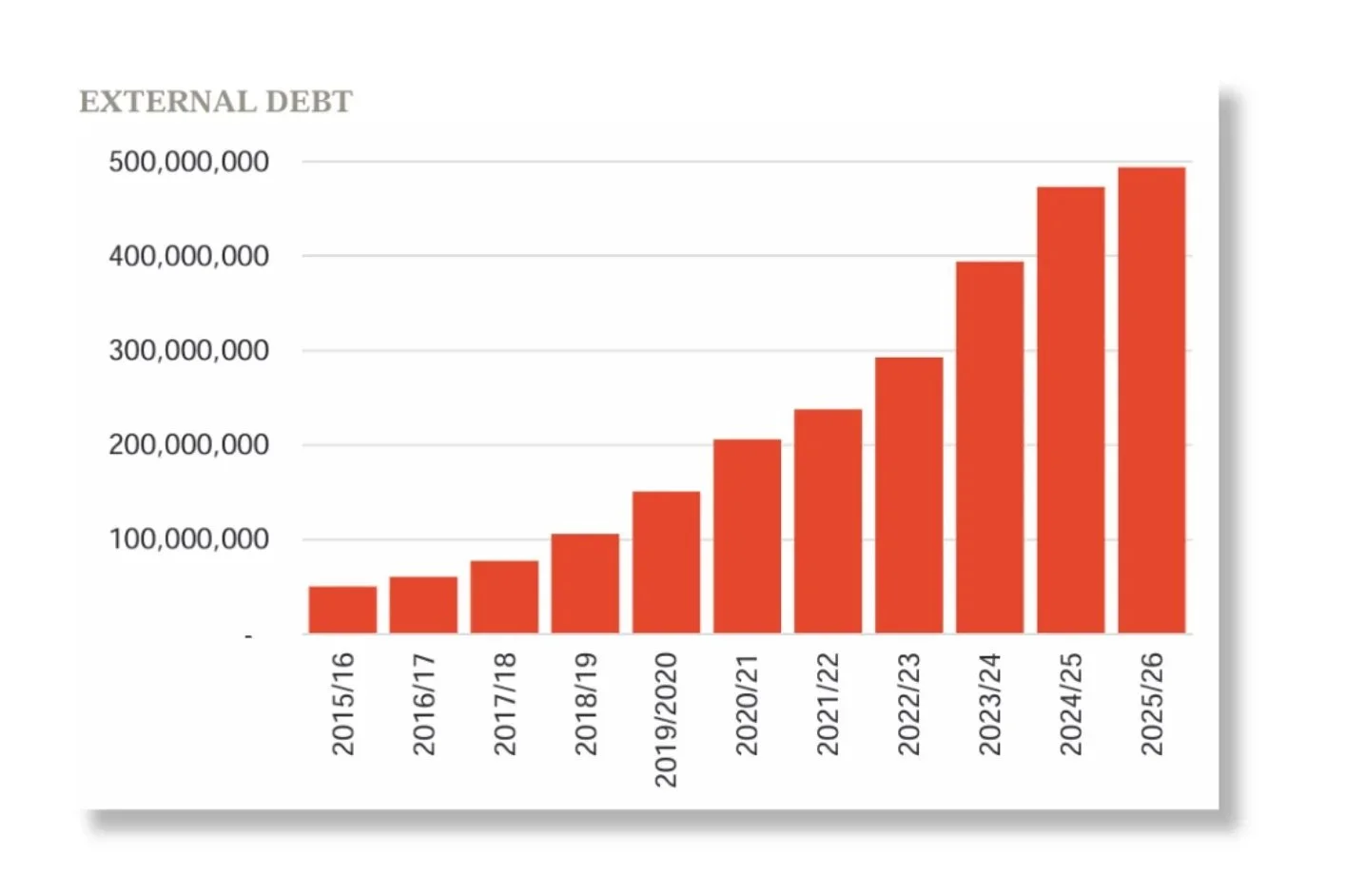
Source: Hastings District Council 2025-2026 Annual Report
Hastings: the reason, and the limit
There is a reason, and it is fair to give it. Of the $493.7 million, $287.7 million, close to 58%, is water, against water revenue of $60.3 million. That debt is due to move to Water Hawke’s Bay on 1 July 2027. A note on Council’s maturity sheet says the high share maturing within a year is “due to a specific strategy facilitating the transfer of water debt”. [4] Council’s July report to its Risk and Assurance Committee says the same, and that the shift had been signalled in earlier treasury updates. [10]
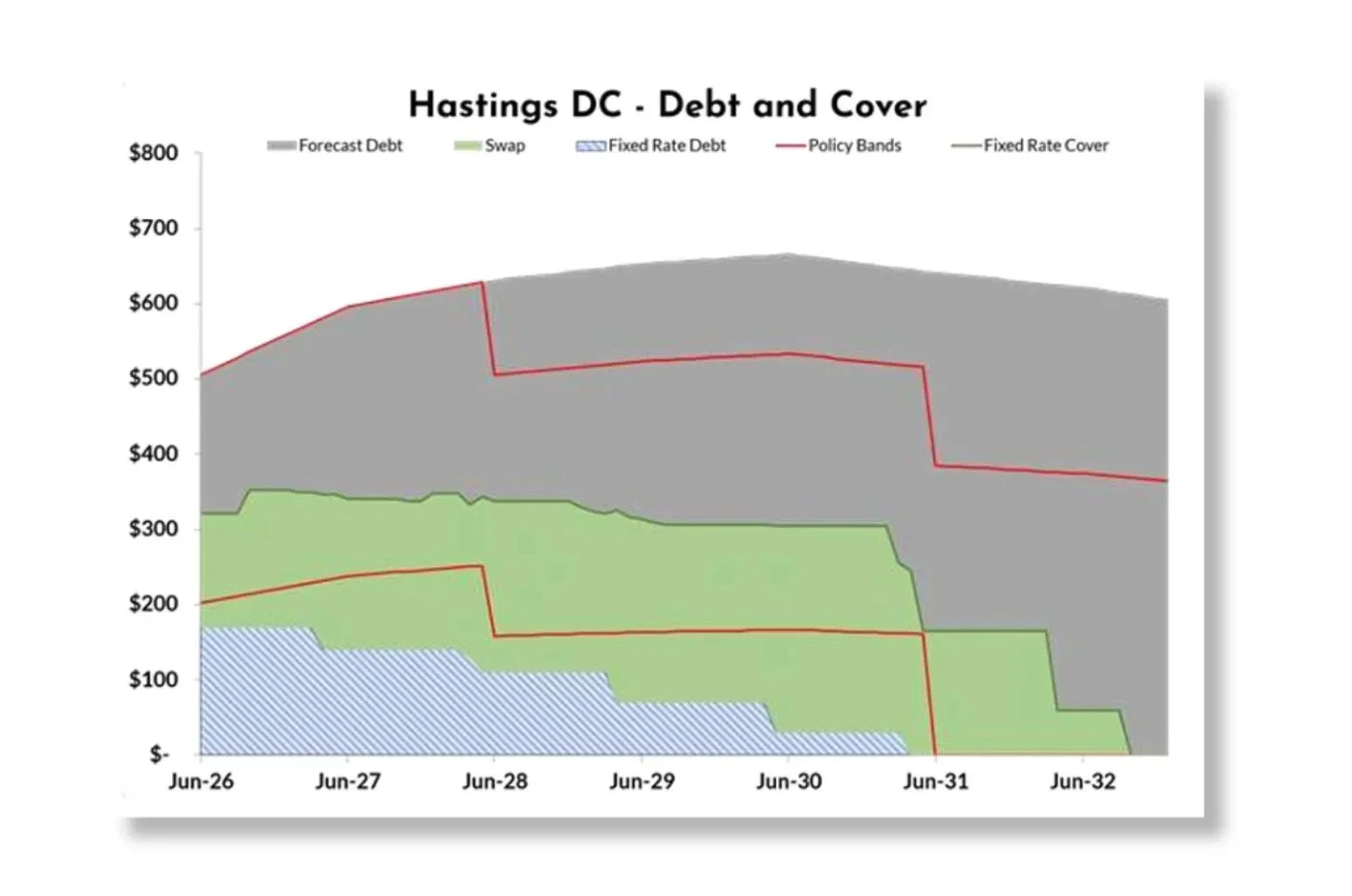
Debt cover as at 30 June 2026
Source: Hastings District Council - Risk and Assurance Committee Meeting Agenda | 22 July 2026
Central Hawke’s Bay says the same thing. Its June treasury report says maturities are likely to be rolled over for a short duration to align with the new entity, and all of its debt is due inside three years. [9] The regional water plan says debt repayment stays ringfenced to each council’s area, so that legacy debt is serviced from customers in that area. It also projects the new entity’s borrowings rising from $391 million in 2024/25 to $863 million in 2033/34. [11] Council is right that its own debt falls after the transfer. But the debt does not go away. The household simply pays it through a water bill instead of a rates bill, and the projected borrowing is rising.
But there is a debt maturity limit Council set itself. Its funding policy says no more than 33% of its debt should mature in any one year, so that it is never forced to refinance too much at once. The maturity sheet and the July committee report both show 37% for the first year, and the committee was asked to note it. [4] [10] That cap would also let the entire book roll inside three years. Council has been open about it, but a breach with a good reason is still a breach, and ratepayers should know about it.
Hastings: a choice, not a limit
Ratepayers have been told for a decade that all this borrowing is intergenerational investment. Long lived assets, long term thinking, a gift to the grandchildren. The assets may well be. The funding is not.
Council’s own answer says all its debt is planned to mature by 2031, and adds that maturing debt will successively roll over. A pipe laid this year will still be in the ground in 2080. The money that paid for it will be found again, more than once, at whatever the market is charging on the day. [4]
It did not have to be this way. The Local Government Funding Agency, which lends to most councils, will go out to April 2037, about ten and a half years. In the year to 30 June 2026 it lent $3.873 billion across 233 loans to 69 councils and CCOs at an average term of five years. [12] Across the sector the average term of loans outstanding to councils was 3.24 years at 30 June 2026, itself short by historical standards, and Hastings sits below even that. [4] [12]
As a financial adviser, if a client sat in front of me, they could not fix a loan beyond five years, and even then they would be told to stagger the terms. A council’s assets last decades, so it can match its loans to them better than most. It can go out to ten and a half years, and Hastings averages 2.32.
The water plan itself says the tenor of the new entity’s borrowings might align with the economic life of the infrastructure, and that sound debt management means staggering maturities to avoid concentrated rollover. [11] That is the right principle. It should apply to the council’s own debt too.
Hastings: the ladder
On 15 April 2027, $136 million matures, roughly 28% of the debt. By April 2029, close to three quarters of the external debt will have matured or rolled. [4]
The cliff is smaller than it looks. About 65% of the debt is fixed through swaps, inside a policy band of 40% to 99%, and most of the April 2027 tranche already floats and resets every quarter. [4]
The slower squeeze is in the swaps. Forty million dollars borrowed around 2% in 2021 rolls off between 2027 and 2029: $10 million at 1.93%, $10 million at 2.04% and $20 million at 2.20%. The forward start swaps Council has put in place for the later years are priced between 3.6% and 4.4%, out to 2032. [4]
But it cuts both ways. About $110 million of fixes struck above 5% also fall away between 2027 and 2031. [4] The net effect on the interest bill is not in the schedule. That is exactly why the modelling matters.
Hastings: what it does to a rates bill
In 2015 Mayor Lawrence Yule said Hastings was in a good financial position despite $55 million of external debt. [13] Last year’s interest bill alone was $19.9 million, more than a third of that, up from $5.9 million in 2021/22. The weighted average cost of Council’s borrowing was 3.58% in 2021/22. It was 4.33% last year. The 2024-34 plan forecasts $49.4 million by 2033/34, about two and a half times today’s bill. [4]
The ratio that matters most to a household is finance costs as a share of the rates take. It was 6.2% in 2021/22, peaked at 16.2% in 2023/24, and was 13.0% last year. [4]
The 2024-34 Long Term Plan forecast 18.1% for last year and up to 19.0% in the years after. Those forecasts were written before the water transfer, and last year came in well under them: $19.9 million against $28.1 million. Council says it does not expect to reach the plan’s $700 million debt peak. [4] Part of the reason is that projects were delayed: Council says it borrowed $55 million less than forecast last year, and the delayed projects are still required. [3] Nobody has published what the ratio looks like once the water debt has gone. That is the number ratepayers need, and it is not yet to hand.
Hastings: the exam
Hastings’ answer to the stress test question, in full: sensitivity modelling is to be completed as part of the 2027-37 Long Term Plan, which goes to Council for adoption in June 2027. [4]
That is a student revising in June for a paper sat in April. The stress test is booked for after the flood.
What staggers me is how ordinary this risk is. Anyone with a mortgage knows the cheap fixed rates are gone. Longer rates have gone up faster than shorter ones, and New Zealand’s 10 year government bond yield was 4.63% on 11 November, after topping 5% three weeks ago, against a Reserve Bank cash rate under 3%. [14] Last month France’s 10 year borrowing cost topped 5% for the first time since 2002, with riots in the streets and a budget it could not pass. [15] It is front page news.
Council’s plan assumes borrowing at 5.25% to 5.5%, which looks sensible against today’s market. [4] What nobody has said is what a point more costs. On the whole $493.7 million, one percentage point is nearly $5 million a year once it has all repriced. On the $206 million that stays if the water debt moves in full, it is about $2 million.
Napier: the council across the Bay
Napier was candid about what it has and has not done. At 30 June 2026 it had $145 million of external debt, up from $65 million a year earlier, on plan. [16] Its Three-Year Plan projected $343 million by 2034. [17] Its borrowing costs were $14,000 in 2022/23, $5.2 million last year, and $9.6 million in this year’s annual plan. [7] This year’s proposed rates increase was 8.8%, and 5.7 percentage points of it was borrowing costs. [18]
Napier historically fixed all its borrowing. About 24% is now floating, the blended cost of funds is 4.18%, and it holds no swaps. [16] [7] Its new policy caps maturities at 33% in any year and terms at 10 years, and Napier says it has been outside policy since adopting it because of an old $5 million loan maturing in 2037 at 5.61%, which it is trying to close out. [7] [16] It is also getting a credit rating, with Fitch contracted. [16]
Napier has withheld forecasts until its Long Term Plan is finalised, and it has not modelled a 1% rise. [7] That is the same gap as Hastings, from a council with far less debt.
Central Hawke’s Bay: the council next door
Central Hawke’s Bay received the same sort of request on 4 September and answered it on 15 September. Eleven days. It supplied the full loan schedule, the swap book, five years of cost of funds, the covenant position and the sensitivity number.
It holds $48 million of external debt, all with the LGFA, against $42 million net. Its average interest cost was 2.28% in 2021/22, 5.40% in 2023/24 and 4.50% last year. Debt to income sits at 64% against a 175% limit. A 1% rise in refinancing costs would cost it an extra $480,000 a year. [9]
It is short too. Its debt matures in three tranches between 2027 and 2029, which I make an average of about two years, and its latest report shows them at 34%, 34% and 31% against a 35% cap. [9] It has the same water reason. The difference is that it has done the sums and told ratepayers, and it flagged ahead a policy breach it expects in 2030 if its water debt does not transfer. That is what good disclosure looks like.
The grain of truth
In fairness to Hastings, this is a question of cost, not solvency, and the distinction matters. Net debt sits at 147% of operating revenue against an LGFA covenant of 280%. Standard and Poor’s has affirmed the Council at A plus, stable. About 65% of the debt is fixed, with swaps out to 2032. The rates increase for 2026/27 was held to 5.9% against the 10% the plan had signalled. [4] [19]
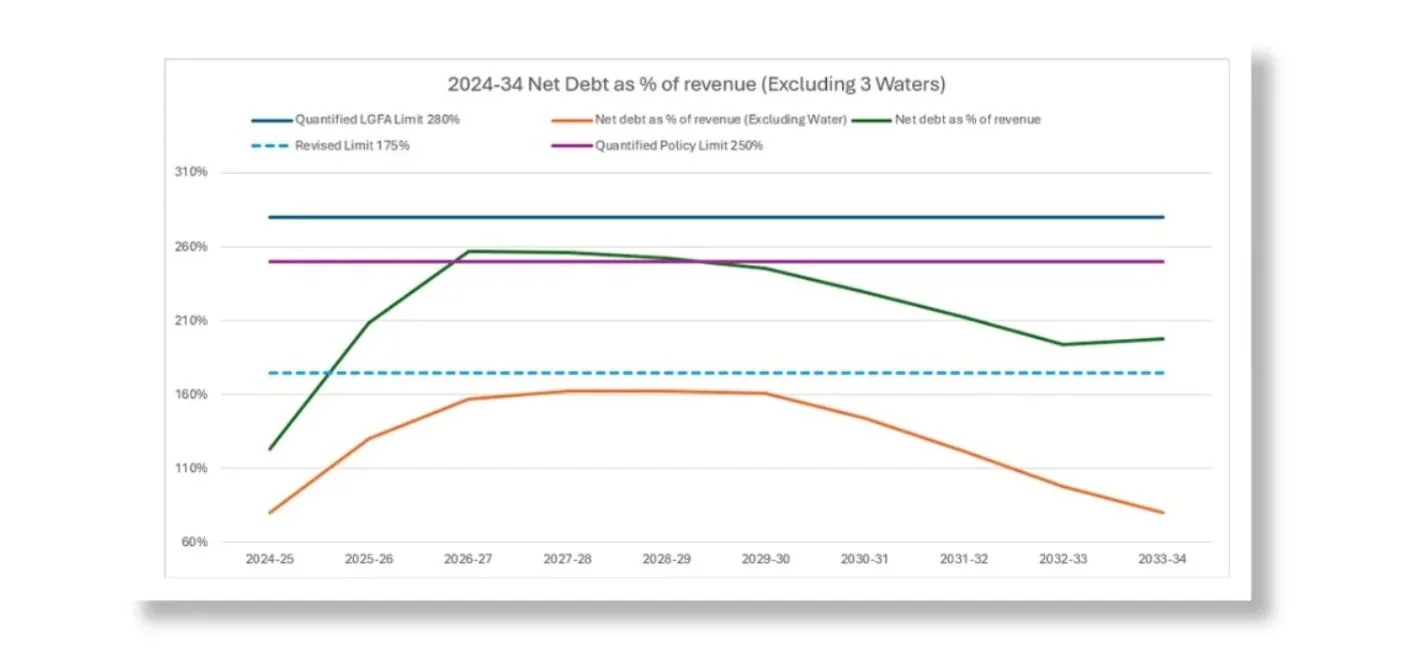
Source: Hastings District Council - Risk and Assurance Committee Meeting Agenda | 22 July 2026
A council that hedges forward, stays inside its covenants and holds its rating is not a council in trouble. But hedging buys time rather than immunity, and a policy cap breached for a good reason is still a cap breached. Popularity is a feeling. The ledger is a receipt.
When the pain arrives
All of this sits on the yield curve I wrote about two months ago, and the curve has only steepened since. [1] The Reserve Bank’s cash rate is under 3%, but councils borrow for three, five and ten years, and the market sets those prices, not an announcement.
Council is already asking. Its consultation, open until 29 November, puts the theme park, the Hastings Art Gallery, senior housing, parks and playgrounds, roads and footpaths, visitor information and community grants in front of residents, and the draft Long Term Plan follows in early 2027. [20] Splash Planet costs ratepayers about $1.6 million a year, about $50 a rates bill, and the art gallery about $1.9 million, about $58 a bill. [20] Splash Planet’s recent seasons have been mixed. It closed 14 days early in 2024/25, but by mid-January 2026 visitors were up 5,000 and revenue was up about $150,000 despite 13 fewer days. [20]
Waiaroha cost about $370,000 a year in 2025. [21] The 2018 master plan costed redevelopment options for Splash Planet at $25 million to $32 million, so today’s $34.7 million to maintain what is there is the same order of magnitude. [22] Keeping Splash Planet as it is would average about $4 million a year, nearly two points on the $206 million that stays if the water debt moves in full, and the gallery costs a further $1.9 million. The 2021 money is being replaced at about two points more. Council has been finding small change down the back of the couch. These numbers are not small change, and not a tuck here and a trim there.
Whose interest
The fiduciary question in local government is not whether anyone has behaved badly. It is a question of sequence. The analysis that would tell ratepayers what refinancing costs them is scheduled for after the refinancing. Whatever else that is, it is not information in the hands of the people who pay.
Hastings has answered the questions put to it, and that deserves saying. Central Hawke’s Bay answered fastest and went furthest. Napier, after a slow start, was frank about what it has not done. The gap between those three responses is about what each council thought was worth knowing in advance.
There could be some sacred cows killed, and not just one or two. Better that elected members choose which, in daylight and in front of the people paying, than that the market chooses for them. Know the cost before the market sets it.
Nick Stewart
(Ngāi Tahu, Ngāti Huirapa, Ngāti Māmoe,
Ngāti Waitaha)
Financial Adviser and CEO at Stewart Group
Stewart Group is a Hawke's Bay and Wellington based CEFEX & BCorp certified financial planning and advisory firm providing personal fiduciary services, Wealth Management, Risk Insurance & KiwiSaver scheme solutions.
The information provided, or any opinions expressed in this article, are of a general nature only and should not be construed or relied on as a recommendation to invest in a financial product or class of financial products. You should seek financial advice specific to your circumstances from a Financial Adviser before making any financial decisions. A disclosure statement can be obtained free of charge by calling 0800 878 961 or visit our website, www.stewartgroup.co.nz
References
1. Nick Stewart (12 September 2026). Cheap money has a maturity date. Canny View, NZ Herald Business / Hawke’s Bay Today. https://www.nzherald.co.nz/hawkes-bay-today/news/cheap-money-has-a-maturity-date-nick-stewart/premium/Q6RXF2YVWVCIDLEFT7LGWS4FWE/
2. Mayor Wendy Schollum, Hastings District Council (10 November 2026). Statement on Splash Planet and the Long Term Plan survey ($34.7 million over 15 years to replace ageing rides, pools, buildings and facilities; average rates-bill contribution from about $50 to an estimated $125 a year; about 81,000 visitors last financial year; ratepayers contribute about $1.6 million a year), as supplied by Nick Stewart.
3. Hastings District Council, Long Term Plan 2027-2037: Pre-engagement (survey open 2 to 29 November 2026; Council spent $9.2 million less than budgeted on operating costs and borrowed $55 million less than forecast in 2025/26, with delayed projects still to be funded). https://www.myvoicemychoice.co.nz/hdc/long-term-plan-2027-2037-pre-engagement/
4. Hastings District Council (2026). Response to request under the Local Government Official Information and Meetings Act 1987 regarding Council’s debt position, 30 September 2026, with attached loan schedule, swap schedule, funding maturity and KPI sheets, cost of debt worksheet and LGFA compliance workpaper. Figures as at 30 June 2026, marked draft pending audit review of the Annual Report.
5. Domesday Book. Wikipedia, citing the Anglo-Saxon Chronicle for 1085 and the book’s colophon for 1086. https://en.wikipedia.org/wiki/Domesday_Book
6. Domesday Book, Open Domesday background notes (dot-domesday.me.uk/book.htm), covering the Christmas 1085 council and the completion of the survey by August 1086.
7. Napier City Council (2026). Response to request under the Local Government Official Information and Meetings Act 1987 regarding Council’s debt position, request dated 3 September 2026, acknowledged 8 October 2026.
8. Napier City Council, Governance Team, email to the author, 5 November 2026, advising it would not meet the maximum time limit for the author’s request of 7 October 2026 and expected to respond ‘tomorrow or early next week’.
9. Central Hawke’s Bay District Council (2026). Information request 2026-82 re Council’s Debt Position, 15 September 2026, and Treasury Management Report to the Risk and Assurance Committee, 25 June 2026. Figures from the unaudited Annual Report 2025/26.
10. Hastings District Council, Risk and Assurance Committee agenda, 22 July 2026, Item 6: Treasury Activity and Funding Update, with Attachment 1, Treasury Dashboard June 2026. https://hastings.infocouncil.biz/Open/2026/07/RAACC_22072026_AGN_6315_AT.PDF
11. Hawke’s Bay Regional Water Services Delivery Plan (executed), joint Water Services Council-Controlled Organisation of Napier City, Hastings District and Central Hawke’s Bay District Councils, pages 73 to 76 (projected borrowings, tenor and refinance risk, ringfenced debt repayment, attributed three waters debt).
12. New Zealand Local Government Funding Agency. Longest bond on issue LGF130, maturing 15 April 2037 (2.00% coupon), offered at tender in August 2026 (as supplied by the author); quarterly reports to shareholders (average term of loans outstanding to councils 3.24 years at 30 June 2026); and LGFA lending in the year to 30 June 2026 of $3.873 billion across 233 loans to 69 councils and CCOs at an average term of 5.0 years. https://www.lgfa.co.nz/
13. Hawke’s Bay Today / NZ Herald (28 September 2015). Mayor Lawrence Yule explains Hastings debt (Hastings in a good financial position despite carrying $55 million debt). https://www.nzherald.co.nz/hawkes-bay-today/news/mayor-lawrence-yule-explains-hastings-debt/Z2TXRR5SJMFYUDYD3DQ4JOQF2Y/
14. New Zealand 10 year government bond yield: 4.63% on 11 November 2026 (as supplied by the author); 5.06% on 21 October 2026 (Investing.com historical data); Trading Economics (23 October 2026), New Zealand 10Y Yield Climbs to Nearly 3-Year High. Check against Reserve Bank of New Zealand wholesale interest rates (B2) at filing. https://www.rbnz.govt.nz/statistics/series/exchange-and-interest-rates/wholesale-interest-rates
15. The Guardian (21 October 2026). French borrowing costs hit 24-year high as civil unrest and budget fears spook markets. https://www.theguardian.com/business/2026/oct/21/french-borrowing-costs-failure-to-pass-budget-govenment-bonds-violent-street-protests
16. Napier City Council, Corporate and Performance Committee agenda, 13 August 2026, Treasury Activity and Funding Report (external debt $145 million at 30 June 2026, $65 million at 30 June 2025).
17. Hawke’s Bay Today (3 January 2025). Hawke’s Bay: How much debt does each council have? https://www.nzherald.co.nz/hawkes-bay-today/news/hawkes-bay-how-much-debt-does-each-council-have/WOPXIWUR25AKVPJVBYXDKL6N5A
18. Hawke’s Bay Today (3 March 2026). Napier City Council proposes 8.8% average rates rise for the year. https://www.nzherald.co.nz/hawkes-bay-today/news/napier-city-council-proposes-88-average-rates-rise-for-the-year/A5AXA5YK3VHA5GAHUZWSCFXPUA/
19. Hastings District Council (2026). Annual Plan 2026/2027, adopted. https://www.hastingsdc.govt.nz/assets/Document-Library/Plans/Annual-Plan/Annual-Plan-202627-Council-Adopted.pdf
20. Linda Hall, Local Democracy Reporting, Hawke’s Bay Today (2 November 2026). Splash Planet’s future up for feedback as Hastings council looks to limit rates rises (ratepayer cost about $1.6 million a year for Splash Planet and about $1.9 million for the Hastings Art Gallery; consultation open until 29 November via myvoicemychoice.co.nz). https://www.nzherald.co.nz/hawkes-bay-today/news/splash-planets-future-up-for-feedback-as-hastings-council-looks-to-limit-rates-rises/PY3C3WMR65AHBI2RE5FKDHRBZY/
21. Nick Stewart, Hawke’s Bay Today (15 February 2025). Hastings District Council: Time for fiscal prudence (Splash Planet 2023/24: revenue $3.37 million, operating expenses $4.47 million, $1.4 million ratepayer funding, $5.54 million capital in the 2024-34 plan; Waiaroha Discovery Centre $370,000 annual operating cost). https://www.nzherald.co.nz/hawkes-bay-today/news/hastings-district-council-time-for-fiscal-prudence-nick-stewart/TRLZQBIULNA3XHYNRFMJGVXBZ4
22. Visitor Solutions Ltd (August 2018). Splash Planet Master Plan Report, prepared for Hastings District Council (four preliminary master plan options costed between $25 million and $32 million; Option D $31 million). Supplied by Marcus Buddo.