
Article #481
A week out from an election that will be fought partly on the cost of living, the S&P/NZX 50 carries an awkward statistic of its own. Over the five years to 30 September, the index returned about 1.2% a year including dividends and imputation credits, roughly 6% in total [1]. Over the same five years, consumer prices rose about 24% [2]. Do the sums and an investor who stayed in the local index has lost about 14% of their purchasing power, before tax and fees. That is not a “wait it out” market. It is a structural problem. And it is the moment to stop pretending that “investing locally” is, on its own, a strategy.

Now consider the opportunity cost. Over those same five years, the S&P 500 has returned about 13% a year in US dollars, up roughly 83% in total [6]. The MSCI Emerging Markets Index returned 33.6% in 2025 and a further 23.4% in the nine months to 30 September [7]. Past returns are not a reliable guide to future ones, and that cuts both ways. But the signal is hard to ignore: global shares and emerging markets have both outpaced the home team.
The fair counter is that the index now sits close to its highs. But that is the point. It took nearly five years for the market to climb back above its January 2021 peak [3]. Five years to get back to even.
Cast your mind back. In 2014, HSBC’s Paul Bloxham crowned New Zealand the “rock star economy” [4]. For most of the decade that followed, the NZX was one of the best-performing developed-market indices in the world. The cracks showed long before the index did: under the Ardern government, ANZ business confidence sank to a ten-year low by mid-2018 and on to near-pandemic depths in 2022 [5]. A decade on, the band has clearly stopped touring.
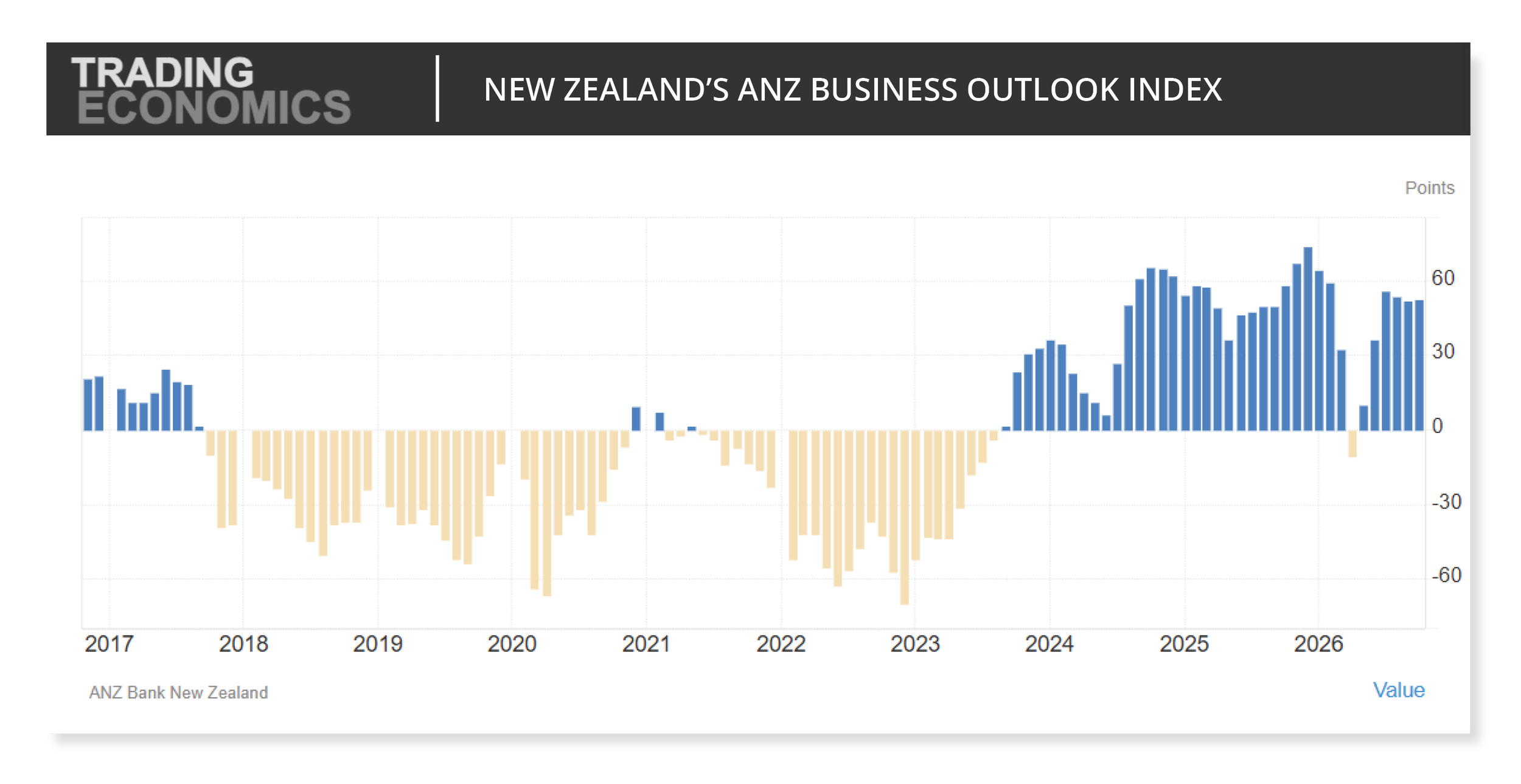
Source: Trading Economics - clink image for more detail
Confidence has since bounced. The NZIER’s latest quarterly survey shows net confidence jumping from +14 to +40 [11]. Yet the sharemarket has largely treaded water. Good news that does not move the price is information too.
The home-bias problem
There is no shortage of reasonable explanations for why Kiwi investors hold mostly Kiwi assets - currency familiarity, dividend imputation credits, the comfort of knowing the brands you pass on the street. None of them is good enough on its own.
Look at the scoreboard. Those emerging-market returns were driven by names like TSMC, Samsung, Tencent and Alibaba - companies you cannot meaningfully access through a corner-office broker at the bottom of the world. Asking a local broker to run a thoughtful Taiwanese, South Korean, Brazilian or Chilean equity strategy is a bit like asking your local real estate agent for guidance on buying a Manhattan apartment. They may be a perfectly capable person. They are still the wrong person for the job.
And here is the twist. In the nine months to 30 September, the S&P/NZX 50 returned 2.1%. The version that caps each stock at 5% lost 2.0%, and the SmallCap Index lost 3.0% [8]. The top of our market is heavy on rate-sensitive utilities, infrastructure and a single dominant healthcare stock.
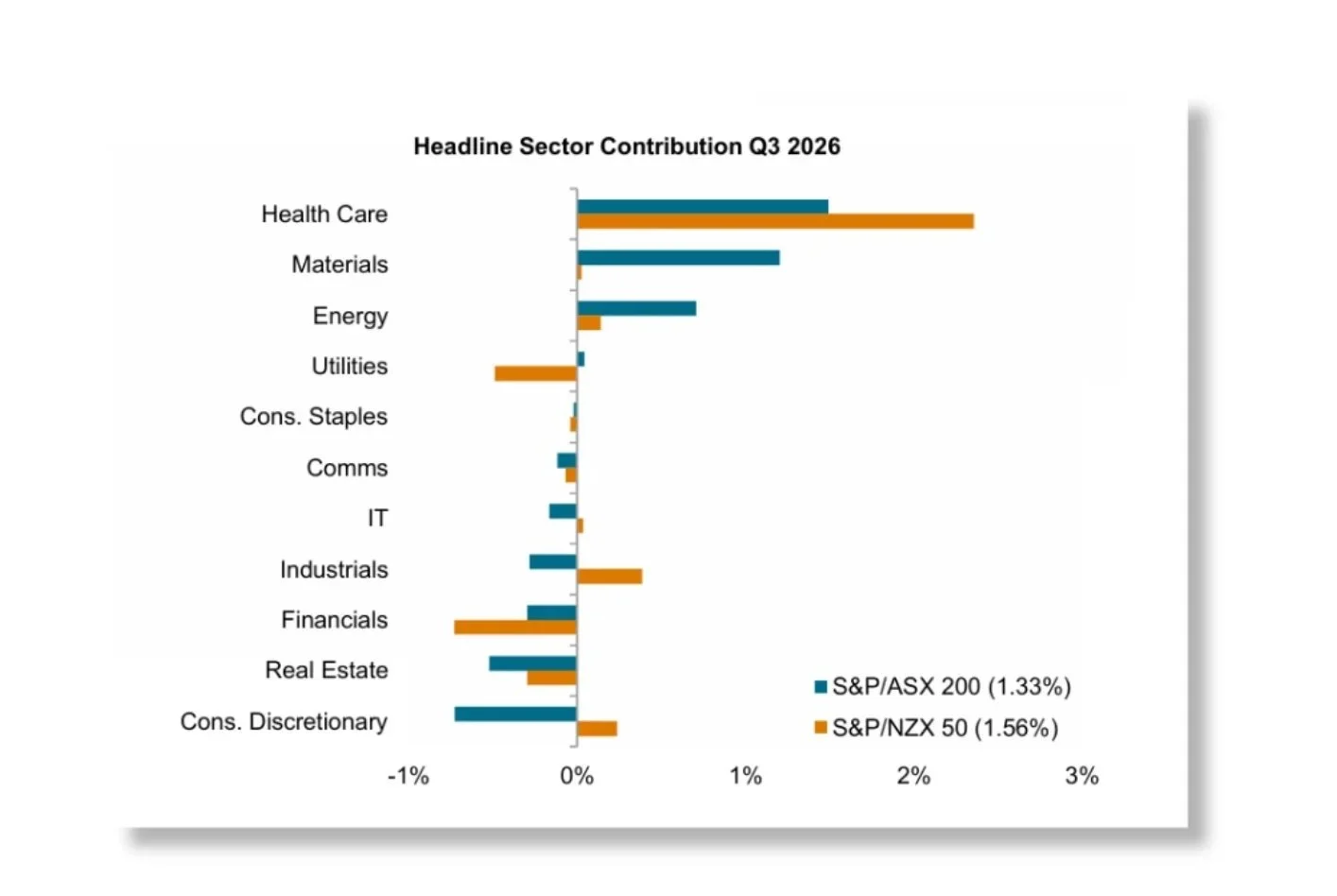
Source: S&P Dow Jones Indices | A concentrated contribution
The Reserve Bank has lifted the OCR to 2.75% in two hikes since July [12], and the property and power names have felt it. Every dog has its day, and the broad market has not had its turn. That alone is the case for diversification - even within New Zealand, let alone offshore.
Spending in NZD does not mean investing only in NZD
A common defence of staying local goes: “But I spend my money here.” True. You also retire here, raise your kids here, and pay your power bill here. None of that requires 100% of your investment portfolio to be in New Zealand dollars. Currency-matching some of your retirement spending makes sense. Currency-matching all of it, in a country whose stock market has just gone backwards in real terms for half a decade, does not.
Yes, there are tax wrinkles. New Zealand investors lose the benefit of Australia’s franking credits when buying across the Tasman. Fair point. But the difference between a tax-friendly local strategy that returns less than inflation and a globally diversified one that captures the world’s growth is not a debate worth having on tax grounds alone. Just because you do not know a brand or use the service does not mean you should be afraid to own it.
This is not a theoretical problem. Most KiwiSaver funds hold a slice of their shares in New Zealand. It is worth knowing how big that slice is, and what you pay for it.
The election adds another reason to look offshore
The general election is on 7 November. The Greens, on 15% in the latest 1News-Verian poll [9], are campaigning on a 2.5% tax on net assets above $10 million, with the family home exempt. They also want a 33% tax on inheritances and gifts above $1 million, paid by the recipient, a 45% top income tax rate above $160,000, and a 33% company tax rate for firms with turnover above $30 million [10]. Labour says it will not adopt that package and is sticking with its own 28% capital gains tax [10].
The detail matters. Wealth held in trusts would be apportioned back to the person behind the trust. The family home is exempt from the wealth tax, and family homes and farms are exempt from the inheritance tax. Māori land and the assets of post-settlement governance entities are exempt from both [10]. The Greens say the inheritance tax would touch about 1,100 people a year.
New Zealand has been here before. Estate duty applied to deaths up to December 1992, and gift duty was abolished in 2011 [13].
The polls show a close race, with National and Labour level on 28% [9]. Labour’s leader has said he disagrees with most of the Greens’ tax package, and has warned that people may simply move their money to avoid a wealth tax. Whatever your politics, this is a difficult backdrop for anyone with an aspirational, entrepreneurial outlook, and the shape of any coalition deal may take weeks to emerge. Pair that with five years of going backwards in real terms on the local index and the case for holding some of your wealth beyond one country’s tax and political cycle gets stronger.
What good looks like
Careful diversification. Genuine fiduciary management. A financial plan built around your goals and your currency liabilities, not around the logos you happen to recognise at the supermarket. Unfamiliarity is not a risk in itself - concentration is. In practice, that usually means meaningful exposure to global developed equities, a deliberate allocation to emerging markets, a sensible - not symbolic - weighting to New Zealand and Australia, and a portfolio built around your time horizon rather than your news feed.
The NZX 50 will have its day again. These things move in cycles. But the lesson of the past five years is the one markets have always taught: do not put all your eggs in one basket, no matter how comforting the basket feels.
A fiduciary adviser is bound to put your interests ahead of their own, and ahead of the logos you recognise. Advice is not free, but the alternative costs more. If you think professional advice is expensive, try using an amateur. Position for your goals, not for a ballot box. When the noise gets loud, seek advice and wise counsel.

Nick Stewart
(Ngāi Tahu, Ngāti Huirapa, Ngāti Māmoe,
Ngāti Waitaha)
Financial Adviser and CEO at Stewart Group
Stewart Group is a Hawke's Bay and Wellington based CEFEX & BCorp certified financial planning and advisory firm providing personal fiduciary services, Wealth Management, Risk Insurance & KiwiSaver scheme solutions.
The information provided, or any opinions expressed in this article, are of a general nature only and should not be construed or relied on as a recommendation to invest in a financial product or class of financial products. You should seek financial advice specific to your circumstances from a Financial Adviser before making any financial decisions. A disclosure statement can be obtained free of charge by calling 0800 878 961 or visit our website, www.stewartgroup.co.nz
References
1. SuperLife, S&P/NZX 50 Fund fact page - S&P/NZX 50 Gross with Imputation Index return, c.1.2% a year over five years to 30 September 2026 (market index return 1.24%).
2. Stats NZ, Consumers Price Index: annual change 3.0% (September 2025 quarter), 4.1% (June 2026 quarter, released 21 July 2026); Westpac NZ CPI preview, September quarter 2026 (3.7% forecast). Cumulative c.24% is a compounding of annual rates. September 2026 quarter release due 22 October 2026 - update before print.
3. BusinessDesk via Good Returns, “NZ stocks ride wave of 2026 optimism”, 3 November 2025 - the 8 January 2021 peak stood until 9 October 2025.
4. Paul Bloxham, HSBC Chief Economist (Australia & New Zealand), CNBC interview, 6 January 2014.
5. ANZ Business Outlook Survey - net confidence -45 (July 2018, ten-year low); -62.6 (mid-2022, near the April 2020 low of -66.6).
6. S&P 500 total return, SPY proxy, c.12.9% a year over five years to 16 October 2026 (+83% cumulative); US dollars. chartrow.com, totalrealreturns.com.
7. MSCI Emerging Markets Index, net return in US dollars: 2025 +33.57%, 2026 year to 30 September +23.38% (index figures from a fund-provider fact sheet dated 30 September 2026); MSCI index factsheet (2025 gross +34.36%).
8. S&P Dow Jones Indices, Dashboard: Australia & New Zealand, 30 September 2026 - year-to-date total returns: S&P/NZX 50 +2.11%, S&P/NZX 50 Portfolio -2.00%, S&P/NZX SmallCap -3.03%.
9. 1News-Verian poll, 13 October 2026 - National 28%, Labour 28%, Greens 15%.
10. 1News, “What are the Greens’ tax plans - and who would have to pay?”, 4 October 2026; Labour’s 28% capital gains tax position as reported in the same piece.
11. NZIER Quarterly Survey of Business Opinion, September quarter 2026, released 6 October 2026 - general business situation +40, seasonally adjusted (previous quarter +14). Via Westpac IQ and ANZ research notes.
12. Westpac NZ, RBNZ September 2026 Monetary Policy Statement - OCR raised 25 basis points to 2.75% on 2 September 2026, the second hike since July. Next review 28 October 2026 - check before print.
13. Estate and Gift Duties Act 1968 and Estate Duty Repeal Act 1999 (estate duty applied to deaths before 17 December 1992); gift duty abolished 1 October 2011.