
Article # 447
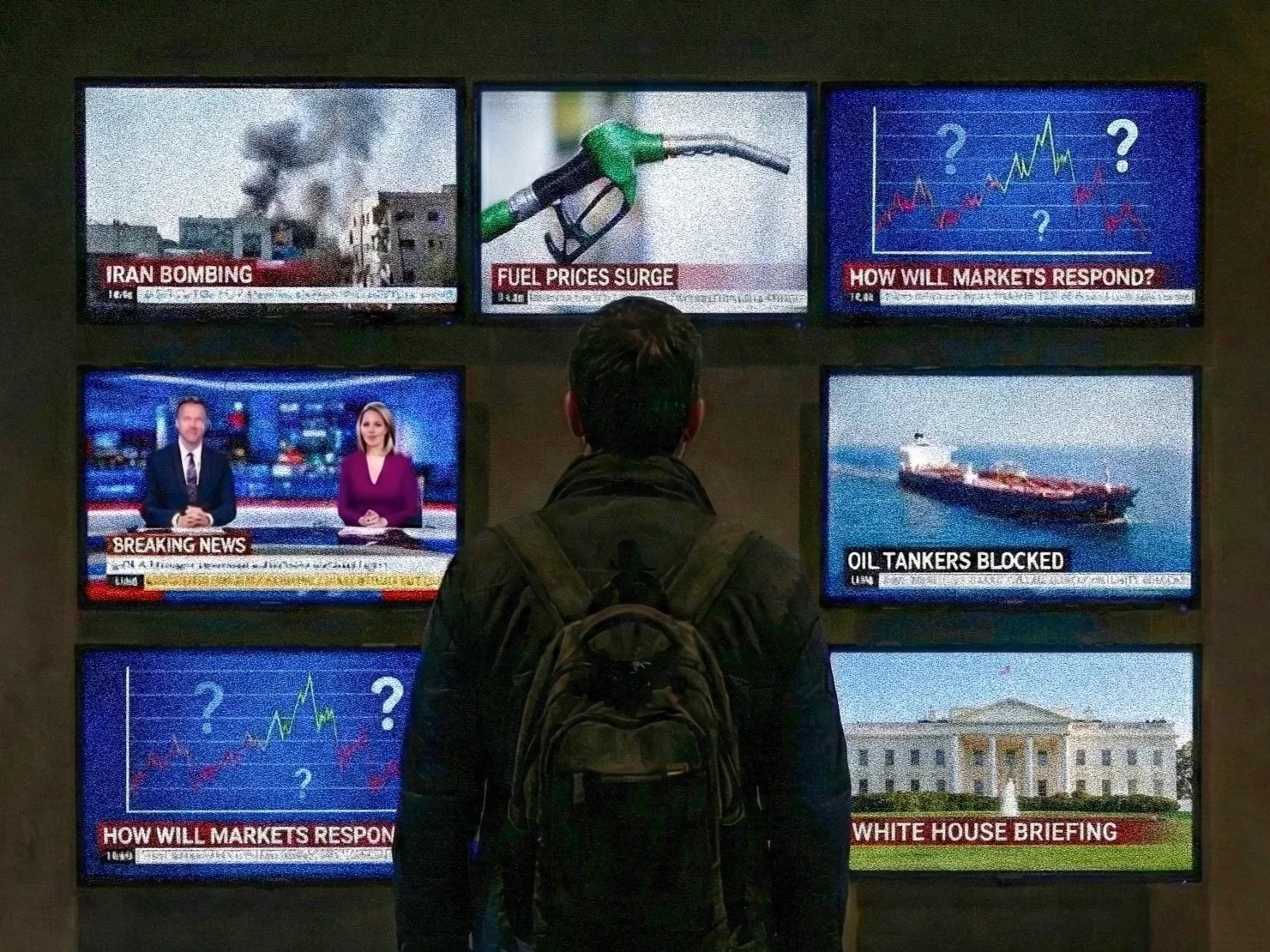
The New Zealand media has had a busy week connecting the US and Israeli strikes on Iran to your wallet. Some of it is legitimate. Some of it is noise dressed up as financial guidance. Knowing which is which - now that’s useful.
Let's start with what’s real.
The Strait of Hormuz: A known pressure point
The Strait of Hormuz is a roughly 33km-wide chokepoint between the Persian Gulf and the Gulf of Oman. Around 20% of the world's daily oil supply and a similar share of global liquefied natural gas trade passes through it every single day, mostly bound for China, India, Japan, and South Korea.¹
This waterway has been a pressure point for decades. Iran mined it during the Iran-Iraq War in the 1980s, prompting direct US military intervention in what became known as the Tanker War (during which more than 500 vessels were damaged or destroyed).² In December 2011, Iran threatened closure in response to Western sanctions, triggering the deployment of a US-British-French naval flotilla. In 2019, tanker seizures and attacks on shipping spiked tensions again. In June 2025, Israel's strikes on Iranian nuclear facilities prompted Iran's parliament to pass a motion recommending closure, though that did not materialise into a full blockade.³
The point is this: the Strait of Hormuz has been a geopolitical instrument for Iran for more than 40 years. Successive US administrations, allies, and global energy markets have navigated those threats repeatedly. Every episode generated alarming coverage. Yet every episode passed. That does not make the current situation trivial, but it does provide context that breathless headlines rarely bother to include.
New Zealand's real exposure
Importantly, New Zealand has direct and specific economic exposure to this conflict.
According to the Meat Industry Association (MIA), nearly all of New Zealand's red meat exports to the Gulf Cooperation Council (Bahrain, Kuwait, Oman, Qatar, Saudi Arabia, and the UAE) travel through the Strait of Hormuz. In 2025, that trade was valued at $298 million, including $166 million in chilled exports, which are the most time-sensitive.⁴
Supply chain firm Kotahi, which handles freight on behalf of Fonterra and Silver Fern Farms, has confirmed that all major shipping lines have suspended services through the strait, with some 4,000 containers of New Zealand export cargo currently in transit.⁴
Fuel prices are also a legitimate concern. New Zealand no longer imports crude directly from the Middle East, but petrol is priced in a global market. Brent crude spiked more than 8% when trading opened after the weekend strikes.⁵ Analysts at JPMorgan and Citigroup have warned that sustained disruption could embed a significant geopolitical premium for weeks.
The New Zealand Ministry of Foreign Affairs and Trade has noted that rising fuel costs do not just show up at the pump. They pervade the economy through transport, logistics, and consumer prices – and may force the Reserve Bank to respond with always-dreaded interest rate adjustments.⁶
One lesser-discussed exposure: approximately one-third of the world's fertiliser trade also passes through the Strait of Hormuz, meaning prolonged disruption could eventually flow through to agricultural input costs. This is directly relevant to a primary-export economy like New Zealand's. ⁷
So yes, there are real and specific things worth monitoring here. Beyond fearmongering, we must consider geography and economic forces decades in the making.
Now for the noise...
Here’s where some of the coverage starts to serve the headline more than the reader.
At 7:56 am on Monday, 2 March, before Wall Street had even opened for the day, 1News published a piece headlined "Iran attack sparks warning for KiwiSaver, fuel, inflation."
Readers were told to brace for volatility, expect red ink in their KiwiSaver, and anticipate a flight to safer assets.⁸ By the time New Zealand investors had read that article over their morning coffee, absorbed the alarm, and perhaps reached for their phones to switch funds... Wall Street had opened, dipped 1.2%, and was already recovering. The S&P 500 closed that Monday virtually unchanged, finishing the session up just 0.04%.⁹
The warning had outrun the facts by an entire trading day.
Alarming coverage is produced in real time, often ahead of the facts. By the time reality arrives, in this case, a market that largely shrugged off the initial shock and bought the dip, most people have already absorbed the panic as truth and may have acted on it.
Advising the average investor to urgently check their KiwiSaver balance and consider switching funds is, for most people, bad advice dressed up as financial concern. This applies equally to any well-constructed investment portfolio underpinned by a comprehensive financial plan.
The latest data from the Retirement Commission puts the average KiwiSaver balance at $37,079 and the average member age at approximately 44.¹⁰ That means the typical New Zealand investor has roughly 20 to 25 years of accumulation ahead before they reach 65. Long-term KiwiSaver growth funds have historically returned between 7% and 9% annually.¹¹ Across that kind of horizon, even a meaningful short-term market dip is a rounding error in the final outcome.
The pattern markets have seen repeatedly, last June's brief Israel-Iran exchange being a useful recent reference point, is as follows:
Equity markets sell off sharply on geopolitical shock.
They recover once it becomes clear the worst-case scenario has not materialised.
Investors who switched to conservative funds during that episode locked in losses they then missed recovering as markets rebounded.
The same logic applies whether you hold KiwiSaver, managed funds, or a direct share portfolio.
A comprehensive financial plan is engineered to withstand volatility. Abandoning it because of a week of alarming headlines is not a financial decision; it is an emotional one.
Four genuine reasons to review your investments
The right time to review your asset allocation or contribution settings is when your circumstances change — not when the news cycle does.
Has your income shifted significantly?
Are you approaching 65 and still in an aggressive growth fund that no longer reflects your timeline?
Has your risk tolerance genuinely changed — not because of a week of coverage, but because of a considered, honest look at your financial position and goals?
Are there changes to your broader financial plan that warrant a portfolio rebalance? These are all valid triggers for a conversation with your financial adviser.
But if your goals, your timeline, your income, and your broader financial picture are the same today as they were a fortnight ago, and for most people they are, the rational position is to stay the course.
A well-built investment portfolio is designed to absorb decades of global volatility. Many such portfolios have weathered the Global Financial Crisis, the COVID-19 crash, the 2022 rate shock, and last June's regional conflict. Each of those episodes generated similar headlines. Each time, disciplined investors who stayed the course came out ahead of those who did not.
When others are running from the fire
Warren Buffett has made a career of running towards financial fires, not away from them. Writing in the depths of the Global Financial Crisis, his philosophy spoke to financial discipline over the furore of the day: "Whether we're talking about socks or stocks, I like buying quality merchandise when it is marked down."¹²
The irony of a market downturn? Precisely when assets go on sale is when most investors want nothing to do with them; it’s when they are expensive and rising that everyone wants in. Buffett's instruction has always been the opposite: be fearful when others are greedy, and greedy when others are fearful. That’s not a comfortable stance when headlines are blaring an alarm. But discomfort and bad decision-making are not the same thing.
This is where a structured, disciplined rebalancing strategy earns its keep.
When equities fall, and fixed income or defensive assets hold their ground, a rebalancing framework triggers a deliberate, rules-based response: trim what has held up, add to what has fallen. Not because of a hunch. Not because of a headline. Because the plan said so before any of this happened.
That’s the discipline Buffett is describing. Not panic, not paralysis — but a pre-committed process that removes emotion from the equation and replaces it with structure. The investors who do best through periods like this are not the ones who predicted the conflict or called the bottom. They’re the ones who had a plan, stuck to it, and let systematic rebalancing do what it was designed to do.
Discipline pays off
The media's job is to make you read the next paragraph. Your financial plan's job is to compound quietly over decades. These two objectives are not aligned – and it’s worth remembering that when the very same article explaining why oil prices are rising pivots abruptly to urging you to check your KiwiSaver.
There is genuine news here worth following closely: shipping disruptions, petrol prices, fertiliser costs, red meat export disruptions, and what unfolds in the Strait of Hormuz over the coming weeks are all legitimately important to New Zealand households and businesses. Read those stories. Understand the exposure.
But when the coverage drifts into urging reactive investment decisions based on today's headlines, that is where you put the phone down, flick on the kettle, and make yourself a brew instead of making rash investment decisions.
Your future self will thank you.

Nick Stewart
(Ngāi Tahu, Ngāti Huirapa, Ngāti Māmoe,
Ngāti Waitaha)
Financial Adviser and CEO at Stewart Group
Stewart Group is a Hawke's Bay and Wellington based CEFEX & BCorp certified financial planning and advisory firm providing personal fiduciary services, Wealth Management, Risk Insurance & KiwiSaver scheme solutions.
The information provided, or any opinions expressed in this article, are of a general nature only and should not be construed or relied on as a recommendation to invest in a financial product or class of financial products. You should seek financial advice specific to your circumstances from a Financial Adviser before making any financial decisions. A disclosure statement can be obtained free of charge by calling 0800 878 961 or visit our website, www.stewartgroup.co.nz
Article no. 447
References
[1] US Energy Information Administration. (2024). Strait of Hormuz — World's Most Important Oil Chokepoint. https://www.eia.gov/international/analysis/special-topics/World_Oil_Transit_Chokepoints
[2] Ratner, M., Lawson, A., & Brock, J. (2025). Iran Conflict and the Strait of Hormuz: Oil and Gas Market Impacts. Congressional Research Service. https://www.congress.gov/crs-product/R45281
[3] Times of Israel. (2026, March 1). Strait of Hormuz: Key Oil Route in Middle of Iran Crisis. https://www.timesofisrael.com/strait-of-hormuz-key-oil-route-in-middle-of-iran-crisis/
[4] Meat Industry Association NZ / Kotahi NZ. (2026, March 1). Statements on Strait of Hormuz shipping disruption. Reported in NZ Herald. https://www.nzherald.co.nz/business/us-iran-conflict-threatens-nz-red-meat-exports-via-strait-of-hormuz
[5] Franck, T., & Imbert, F. (2026, February 28). Markets Brace for Impact After US Strikes Iran. CNBC. https://www.cnbc.com/2026/02/28/markets-brace-for-impact-following-us-military-strikes-against-iran.html
[6] New Zealand Ministry of Foreign Affairs and Trade. (2025, July). NZ Economy Not Immune to Conflict in the Middle East. https://www.mfat.govt.nz/en/trade/mfat-market-reports/nz-economy-not-immune-to-conflict-in-the-middle-east-july-2025
[7] Stojanovic, U., & Bradshaw, T. (2026, March 1). Strait of Hormuz: If the Iran Conflict Shuts the World's Most Important Oil Chokepoint, Global Economic Chaos Could Follow. The Conversation. https://theconversation.com/strait-of-hormuz-if-the-iran-conflict-shuts-worlds-most-important-oil-chokepoint-global-economic-chaos-could-follow-277199
[8] Edmunds, S. (2026, March 2). Iran Attack Sparks Warning for KiwiSaver, Fuel, Inflation. RNZ / 1News. Published 7:56am. https://www.1news.co.nz/2026/03/02/iran-attack-sparks-warning-for-kiwisaver-fuel-inflation/
[9] CNBC Markets Desk. (2026, March 2). Stock Market Today: S&P 500 Ends Monday Just Above the Flatline, Rebounding from Sharp Declines. CNBC. https://www.cnbc.com/2026/03/01/stock-market-today-live-update.html
[10] Reyers, M. (2025, March). KiwiSaver Member Data — December 2024. Te Ara Ahunga Ora Retirement Commission / Melville Jessup Weaver. Reported in: Edmunds, S. What Average KiwiSavers' Balances Are at Your Age. RNZ News. https://www.rnz.co.nz/news/business/545015/what-average-kiwisavers-balances-are-at-your-age
[11] MoneyHub NZ. (2024). Average KiwiSaver Balance by Age. https://www.moneyhub.co.nz/average-kiwisaver-balance-by-age.html
[12] Buffett, W. (2008). Berkshire Hathaway Inc. Chairman's Letter to Shareholders. Berkshire Hathaway. https://www.berkshirehathaway.com/letters/2008ltr.pdf